

Japan PC Service Co.,Ltd. Fiscal Year Ended August 2026 Earnings Analysis: Record-High Revenue and Corporate DX Shift, Profitability Improvement Measures for FY2027

Sentiment Analysis
Based on the earnings presentation materials for the fiscal year ended August 2026 for Japan PC Service Co.,Ltd. (Securities Code: 6025), we provide a detailed breakdown and analysis of the current period's performance trends, factor analysis, business-specific progress, and future growth strategies.
1. Consolidated Financial Highlights for the Fiscal Year Ended August 2026
For the fiscal year ended August 2026, consolidated results were as follows: net sales of 8.086 billion yen (up 1.258 billion yen year-on-year, +18.4%) , operating profit of 72 million yen (down 26 million yen year-on-year) , ordinary profit of 60 million yen (down 63 million yen year-on-year) , and net loss attributable to owners of the parent of -6 million yen (down 28 million yen year-on-year) .
Net sales exceeded the initial forecast of 8 billion yen by 86 million yen, marking a record high for the second consecutive year. Conversely, in terms of profit, the results fell below the initial forecasts (operating profit of 90 million yen, ordinary profit of 79 million yen, and net profit attributable to owners of the parent of 10 million yen), resulting in a year-on-year decline in profit and a final net loss.
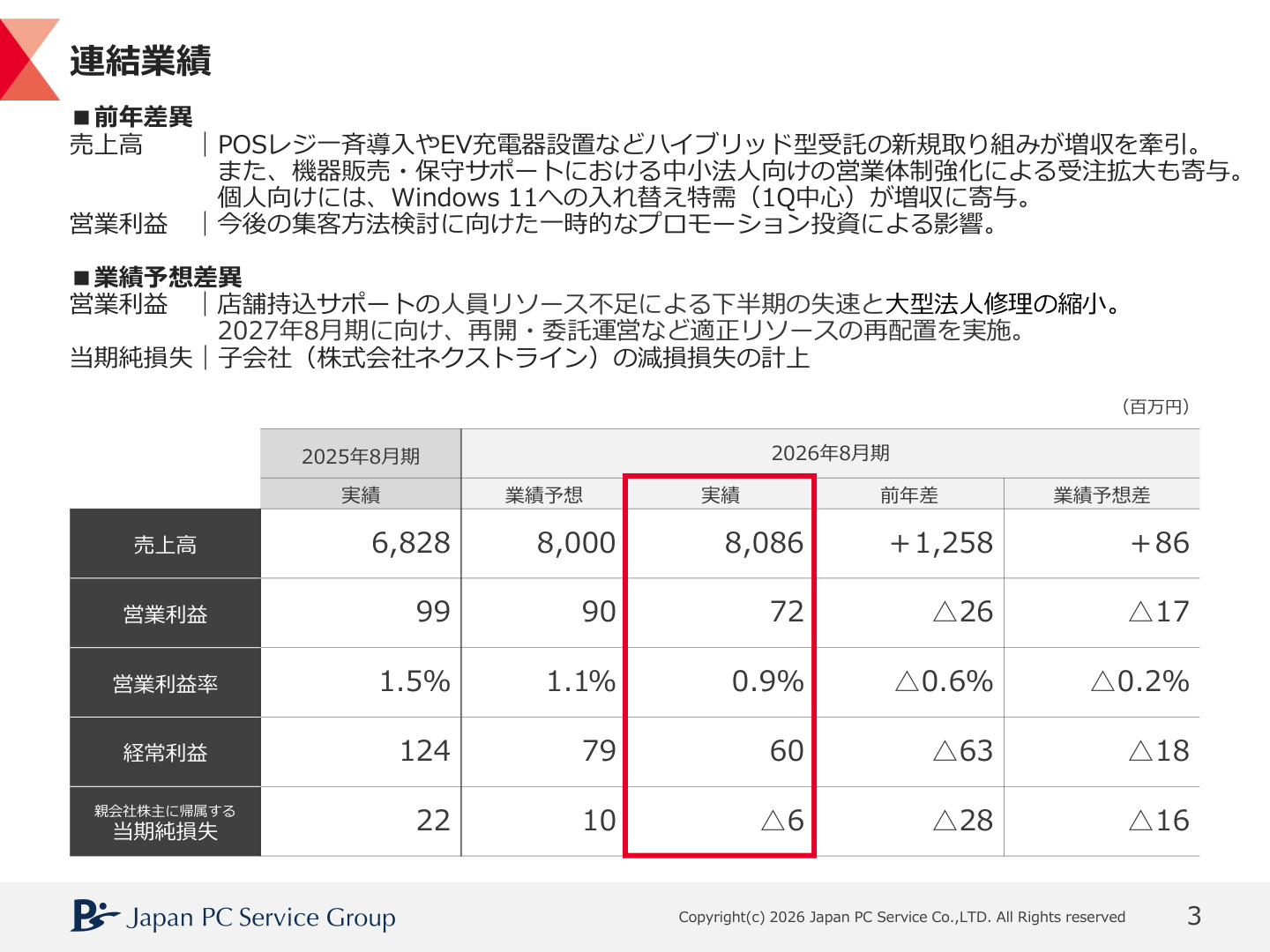
This slide provides an overview of the variances between the results for the fiscal year ended August 2026 and both the previous year's results and the initial forecasts. The background to the decline in profit at each level, despite the expansion in net sales, involves multiple factors, including temporary investment costs, changes in cost structure, and the recording of extraordinary losses.
2. Factor Analysis of Revenue and Profit Changes
(1) Background to Revenue Growth
The growth in net sales was driven by the expansion of Corporate DX Support . Specifically, the new "Hybrid Outsourcing" initiative, which provides end-to-end services from equipment procurement, kitting, and installation to call center outsourcing and maintenance—such as for the simultaneous introduction of POS registers and EV charger installation—has yielded results. In addition, the expansion of orders through the strengthening of the sales structure for equipment sales and maintenance support for small and medium-sized enterprises, as well as demand for Windows 11 upgrades for individuals, particularly in the first quarter, contributed to the revenue increase.
(2) Trends in Gross Profit and Cost of Sales
Gross profit was 2.801 billion yen, an increase of 343 million yen year-on-year (+14.0%). However, the gross profit margin was 34.6%, a decline of 1.4 percentage points from 36.0% in the previous fiscal year . The materials cite the following two factors for this:
- Increase in outsourcing costs linked to the growth in Corporate DX Support (outsourcing costs increased by 440 million yen from 938 million yen in the previous year to 1.378 billion yen, +47.0%)
- Increase in purchases of merchandise and raw materials for the simultaneous introduction of POS registers involving equipment procurement (merchandise and raw materials increased by 251 million yen from 1.317 billion yen in the previous year to 1.568 billion yen)
(3) Factors for Shortfall in Operating Profit and Final Profit/Loss
In selling, general and administrative expenses, temporary promotional investments (approximately 130 million yen) aimed at considering future customer acquisition methods acted as a factor in pushing down operating profit. The materials explain that excluding this promotional investment, operating profit would have exceeded the level of the previous fiscal year. Factors for the shortfall against earnings forecasts included a slowdown in the second half due to a shortage of personnel resources for in-store support, and a contraction in large-scale corporate repairs. Furthermore, the fact that the reversal of allowance for doubtful accounts recorded in the previous year was down 33 million yen year-on-year, and the recording of an impairment loss for a subsidiary (Next Line Co., Ltd.) as an extraordinary loss, were the factors that led to a final net loss of -6 million yen.
3. Performance Trends by Business Segment
The composition of net sales by business segment is as follows:
(1) Field Support Business: 6.477 billion yen (up 1.05 billion yen year-on-year)
- On-site Support : 2.929 billion yen (up 138 million yen year-on-year, +4.9%) The strengthening of the sales structure for small and medium-sized enterprises contributed to this. While the decline in PC sales and the completion of the Windows 11 migration demand suppressed growth in the individual segment, the corporate segment secured revenue growth by expanding into areas such as security equipment like UTM and server support.
- Agency Setup Support (including installation work) : 799 million yen (up 370 million yen year-on-year, +86.2%)
- Kitting : 1.017 billion yen (up 499 million yen year-on-year, +96.3%) Driven by large-scale corporate contracts such as POS register introductions, this segment saw significant growth.
- In-store Support : 1.052 billion yen (up 23 million yen year-on-year) Growth stalled in the second half due to a shortage of resources at directly managed stores caused by personnel reallocation for the operation of smartphone repair counters, and a contraction in large-scale corporate repairs.
- Other (Corporate DX, Communications, After-sales) : 677 million yen (up 19 million yen year-on-year)
(2) Membership Support Center Business: 1.609 billion yen (up 207 million yen year-on-year)
- Call Center Outsourcing : 788 million yen (up 292 million yen year-on-year, +58.9%) The outsourcing of operation, maintenance, and help desk services for Corporate DX Support projects contributed to this.
- Membership Support : 821 million yen (down 84 million yen year-on-year) Revenue declined due to the suspension of new acquisitions for certain partner services.
4. Verification of Promotional Investment and Shift in Customer Acquisition Strategy
During the current period, the company appointed Machiko Ono as an image character and conducted large-scale TV commercials for the "Digiho" brand and cross-media test marketing in the Kansai region (February and June 2026). Approximately 70% of the additional promotional expenses were allocated to advertising and production costs, with costs also distributed to contract-related expenses and surveys/analysis for effectiveness verification. As a result of the verification, the brand awareness rate in the Kansai region improved as planned , and the number of website visits also increased. On the other hand, the materials note that while changes in the number of inquiries were seen in some categories, challenges remain in immediate conversion to sales. Based on these results, for the fiscal year ending August 2027, the company plans to shift from investment aimed at maximizing awareness to investment that emphasizes improving sales conversion , narrowing down to highly effective media and broadcast time slots, and re-examining the timing of expansion into the Kanto region based on business conditions.
5. Full-Year Earnings Forecast and Profitability Improvement Measures for the Fiscal Year Ending August 2027
The consolidated earnings forecast for the fiscal year ending August 2027 anticipates revenue and profit growth and a return to profitability .
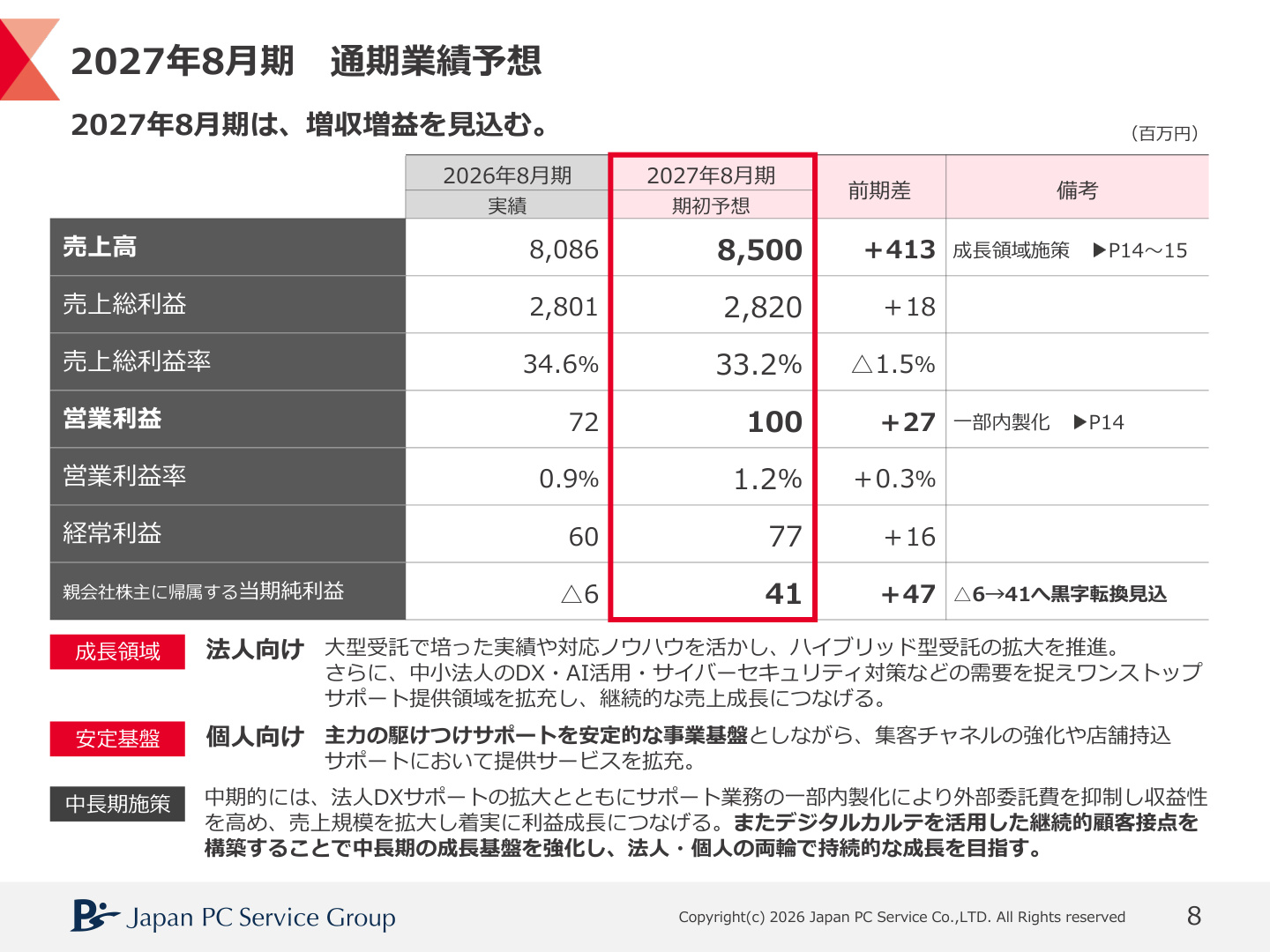
As shown in the slide above, the full-year plan for the fiscal year ending August 2027 sets forth net sales of 8.5 billion yen (up 413 million yen year-on-year) , operating profit of 100 million yen (up 27 million yen year-on-year) , ordinary profit of 77 million yen (up 16 million yen year-on-year) , and net profit attributable to owners of the parent of 41 million yen (up 47 million yen year-on-year) . Although the gross profit margin is expected to decline to 33.2% (down 1.5 percentage points year-on-year), the company plans to increase the operating profit margin from 0.9% to 1.2% by promoting the in-house production of some support operations and streamlining selling, general and administrative expenses.
Key policies include the following:
- Growth Areas (Corporate) : Expansion of hybrid outsourcing leveraging the track record of large-scale contracts, and capturing demand for DX, AI utilization, and cybersecurity measures for small and medium-sized enterprises.
- Stable Foundation (Individual) : While maintaining on-site support as a stable foundation, strengthening customer acquisition channels and expanding services provided for in-store support.
- Medium- to Long-term Measures : Reducing external outsourcing costs through the in-house production of some support operations and building continuous customer touchpoints utilizing "Digital Medical Records."
6. Deep Dive into Future Growth Strategies and Medium- to Long-term Measures
(1) Deepening Corporate DX Support and Promoting In-house Production
In Corporate DX Support, the company is promoting hybrid outsourcing that balances "temporary revenue at the time of introduction" with "continuous operation and maintenance revenue after introduction."
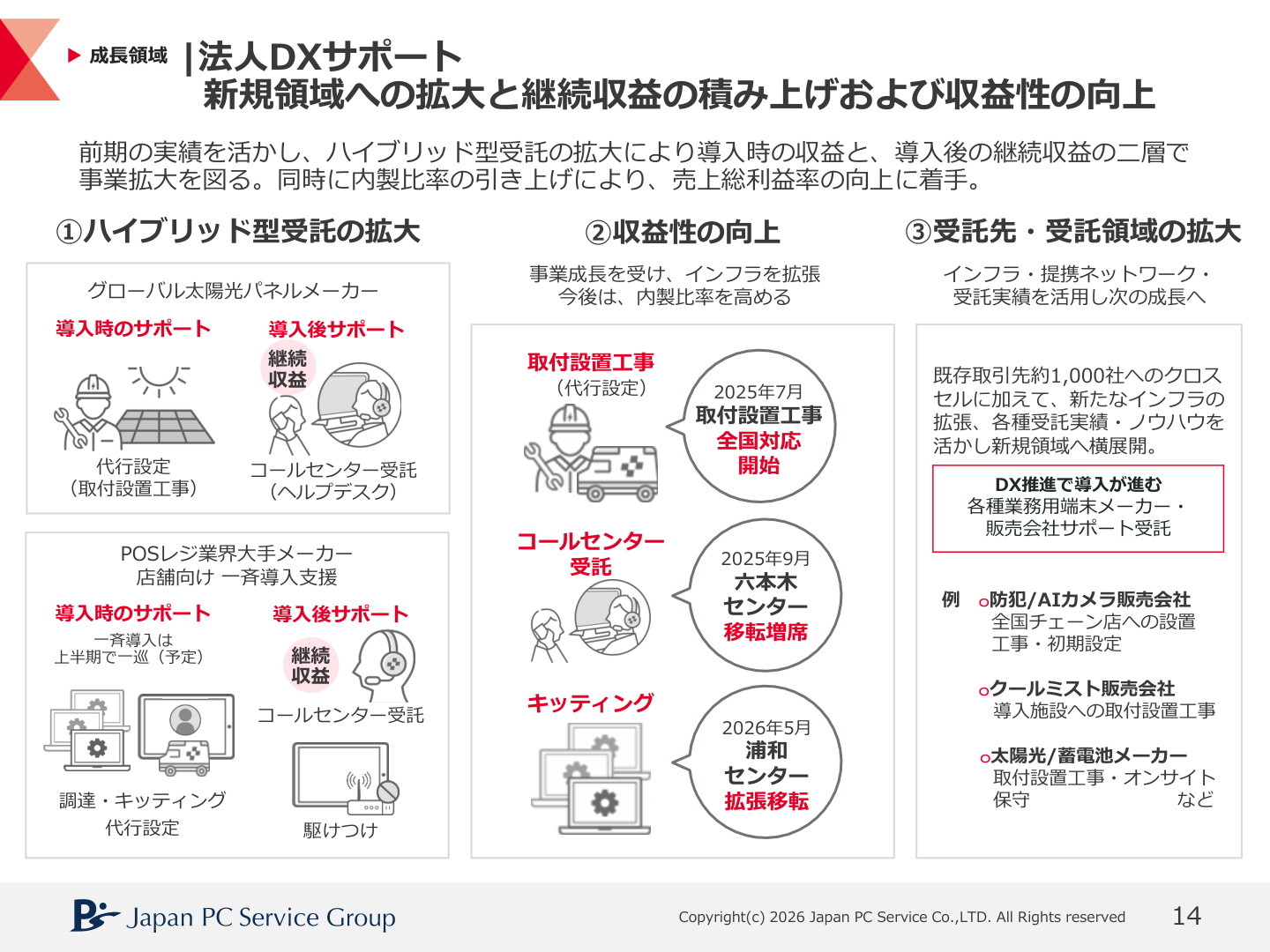
This slide shows an end-to-end provision system from introduction support such as equipment procurement, kitting, and installation work, to subsequent call center outsourcing (help desk) and on-site maintenance. To reduce outsourcing costs that had been increasing with the expansion of contracts, the following infrastructure expansions are underway:
- Installation work : Nationwide coverage started in July 2025
- Call center outsourcing : Relocated and expanded the Roppongi Center in September 2025
- Kitting : Relocated and expanded the Urawa Center in May 2026 The company plans to use these bases to increase the ratio of in-house support operations and improve the gross profit margin. In addition to cross-selling to approximately 1,000 existing clients, the company is promoting horizontal expansion to security/AI camera sales companies, cool mist sales companies, and solar/storage battery manufacturers.
(2) One-stop IT Environment Support for Small and Medium-sized Enterprises
Net sales of on-site support for small and medium-sized enterprises expanded 2.7 times in three years , from 138 million yen in the fiscal year ended August 2023 to 372 million yen in the fiscal year ended August 2026. In response to the start of the operation of the Supply Chain Security Evaluation System (SCS Evaluation System) expected around March 2027, the company plans to increase the number of IDs for "Digiho BIZ," which provides terminal/IT asset management and security diagnostics, and is planning the deployment of support tools for SCS Evaluation System applications.
(3) Transformation to a Stock-based Business through the Digital Medical Record Concept
Aiming to transform from the conventional "flow-type" business of repairs and support to a "continuous revenue-type" business, the company is working on renewing the system infrastructure for "Digital Medical Records." "Digiho Free Membership" was released in February 2026, and the completion of the Digital Medical Records is scheduled for December 2026. The plan is to build a mechanism to visualize and diagnose the customer's digital environment (Digiho Health Check) through the records, and encourage conversion to paid membership and repeat usage. Note that a new medium-term management plan including these items is scheduled to be announced soon.
This content is not intended as investment advice or a recommendation. Any opinions expressed are solely the personal views of each article.