

Daiwa House REIT Investment Corporation Fiscal Period Ended August 2026 Earnings Analysis: A New Growth Scenario Targeting '30 Billion Yen in Returns' Driven by Accelerated Asset Recycling and Robust Internal Growth

Sentiment Analysis
1. Fiscal Period Ended August 2026 (41st Fiscal Period) Earnings Highlights and Overview
Daiwa House REIT Investment Corporation delivered solid results for the fiscal period ended August 2026 (41st fiscal period), exceeding initial forecasts. This performance was driven by the distribution of gains from property sales, alongside strong internal growth centered on residential and logistics facilities.
Distribution per unit (DPU) for the period was 3,113 yen . While this represents a decrease of 345 yen compared to the previous period, it represents an upside of +193 yen (+6.6%) against the initial forecast of 2,920 yen announced in April 2026. Operating revenue was 31.249 billion yen (down 813 million yen from the previous period, up 872 million yen from the initial forecast), operating income was 14.312 billion yen (up 106 million yen from the previous period, up 912 million yen from the initial forecast), and net income was 12.137 billion yen (down 75 million yen from the previous period, up 862 million yen from the initial forecast). The year-on-year decline in revenue is attributable to the absence of gains from the sale of real estate (which decreased from 2.234 billion yen in the previous period to 764 million yen in the current period). However, rental business revenue grew steadily to 30.485 billion yen, an increase of 656 million yen from the previous period, confirming the strengthening of the earnings power of the assets under management.
Regarding the portfolio's overall operational status, the period-end occupancy rate remained high at 99.1% (flat compared to the previous period), while the NOI yield improved to 5.1% (+0.3 percentage points from the previous period) and the NOI yield after depreciation improved to 3.9% (+0.3 percentage points from the previous period). The total asset scale (total acquisition price) reached 913.9 billion yen , and total unrealized gains reached 290.6 billion yen (an unrealized gain ratio of 34.4%), an increase of 9.1 billion yen from the previous period, supported by rent increases. NAV per unit (excluding goodwill) also continued to expand to 160,882 yen (up 1,677 yen from the previous period).
2. Roadmap for Accelerated Asset Recycling and Rapid DPU Expansion
To enhance the portfolio's inflation resilience and maximize unitholder value, Daiwa House REIT Investment Corporation is aggressively promoting an "Asset Recycling Strategy" that combines property sales with the acquisition of high-yield, high-growth properties. From the fiscal period ended August 2025 through the fiscal period ended August 2026, the REIT realized 19.4 billion yen in sales and 7.3 billion yen in gains. From the fiscal period ending February 2027 onwards, it intends to further accelerate the pace of sales, targeting "approximately 20 billion yen" in property sales annually .
By distributing the gains generated through these continuous asset sales to unitholders over multiple periods, the level of distributions is expected to rise significantly from the next period onwards.
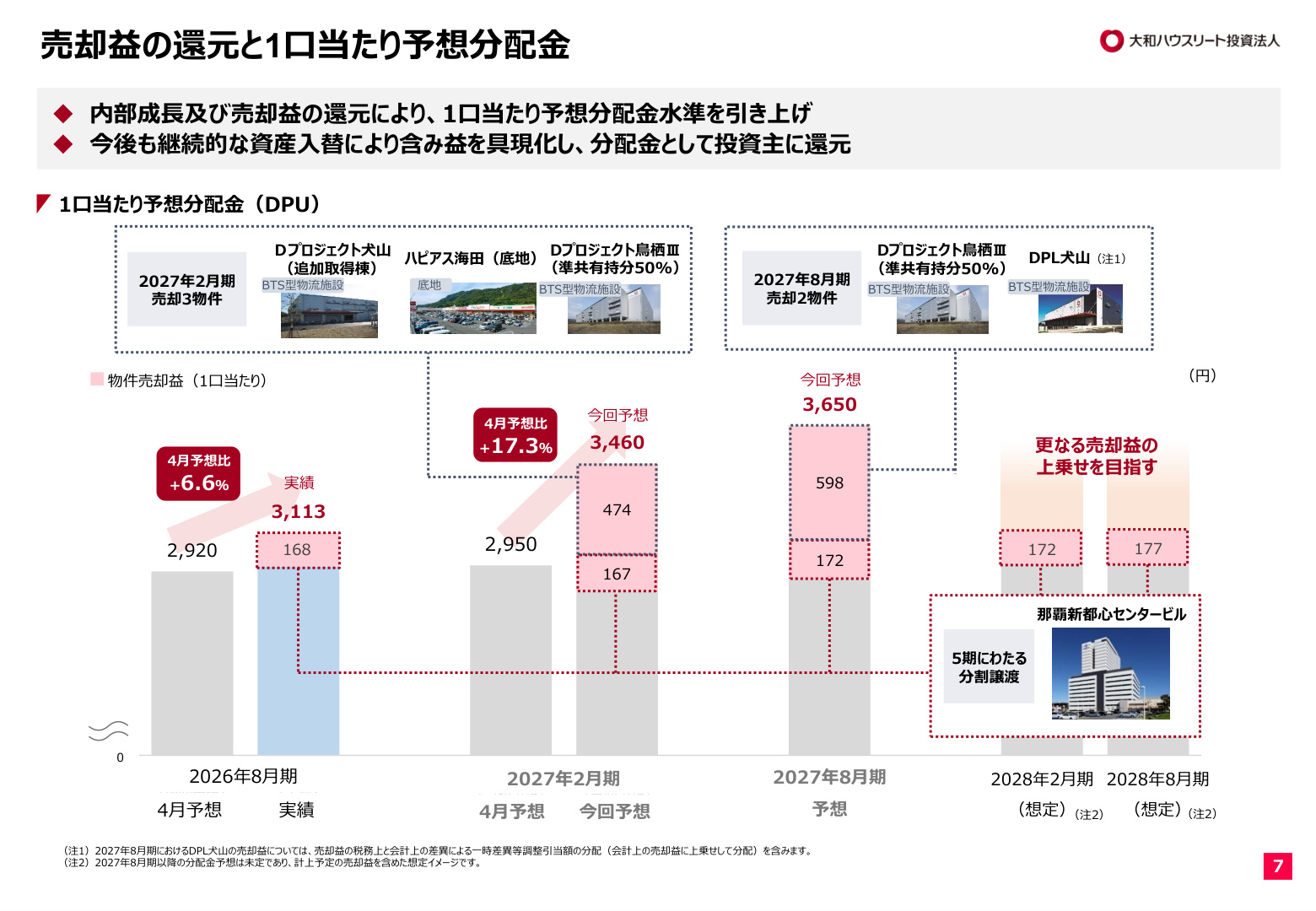
As shown above, the distribution forecasts for the fiscal periods ending February 2027 and August 2027 clearly reflect the progress of this strategy.
- Fiscal period ending February 2027 (forecast) : The forecasted DPU is 3,460 yen (a significant upward revision of +17.3% from the April forecast of 2,950 yen). Of this, gains from property sales account for 474 yen . This includes gains from the sale of three properties: the BTS-type logistics facilities "D Project Inuyama (additional building)" and "D Project Tosu III (50% quasi-co-ownership interest)," and the land site "Hapias Kaita," as well as the partial sale of the Naha Shintoshin Center Building (equivalent to 167 yen).
- Fiscal period ending August 2027 (forecast) : The forecasted DPU is planned to further increase to 3,650 yen . This includes an additional 598 yen in gains from the sale of two logistics facilities (the remaining 50% interest in D Project Tosu III and DPL Inuyama) and gains from the sale of the Naha Shintoshin Center Building (equivalent to 172 yen).
- Fiscal periods ending February 2028 and August 2028 (conceptual image) : With the five-period phased sale of the large-scale office building "Naha Shintoshin Center Building" (selling 10% interest each period), gains of 172 yen to 177 yen per period are definitively incorporated as a baseline, with a policy to seek further gains on top of this.
A virtuous cycle has been established: selling properties with low inflation resistance or limited growth potential, and using the proceeds to acquire properties with high occupancy and rent-increase potential, such as urban hotels and commercial facilities near train stations, as described below.
3. Adapting to the Era of Rising Interest Rates and "Further Growth Targets"
In response to expectations of interest rate hikes in the financial markets and the accelerating pace of rate increases, Daiwa House REIT Investment Corporation has updated its environmental assessment and set "Further Growth Targets" by restructuring its balance sheet (BS) and reviewing its capital allocation priorities.
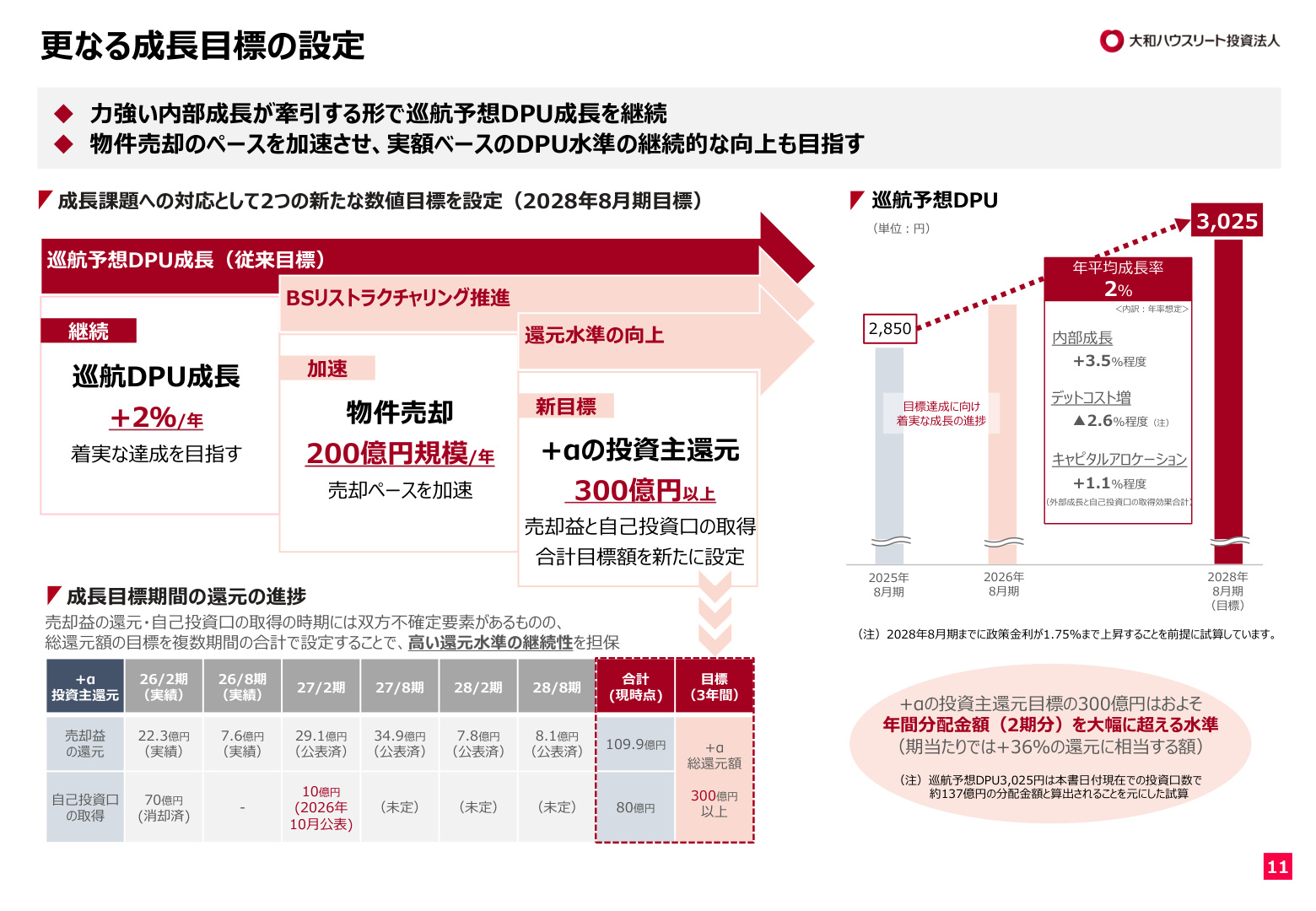
Key points shown in this new strategy slide include a clear growth breakdown aiming for a cruising DPU forecast of 3,025 yen in the fiscal period ending August 2028 , overcoming increased interest costs through internal growth and capital policy, and setting a massive additional return framework.
- Roadmap to Achieve Average Annual +2% Growth in Cruising DPU : The calculation assumes that the policy interest rate will rise to 1.75% by the fiscal period ending August 2028, incorporating factors for increased debt costs (approximately -2.6% per year). Against this, the logic is to fully absorb the impact of rising interest rates and maintain a cruising annual growth of +2% (from 2,850 yen in the fiscal period ended August 2025 to 3,025 yen in the fiscal period ending August 2028) by combining internal growth (+3.5% per year) through strong rent increases, primarily in residential and logistics properties, and capital allocation effects (+1.1% per year) through asset recycling and the acquisition of treasury investment units.
- Formulation of New Target: "Additional Unitholder Returns of 30 Billion Yen or More" (3-year total) : An ambitious target has been set to aim for a total of 30 billion yen or more in unitholder returns over the three years from the fiscal period ending February 2026 to the fiscal period ending August 2028, combining the distribution of property sales gains and the acquisition of treasury investment units. This 30 billion yen level is significantly larger than the total annual distribution (for two periods) (equivalent to +36% return per period) . It indicates that there is room for an additional 11 billion yen or more in returns over the remaining period, on top of the approximately 19 billion yen total of already announced and implemented sales gain distributions (approximately 11 billion yen) and treasury investment unit acquisitions (8 billion yen: 7 billion yen cancelled in the previous period + 1 billion yen resolved in the current period).
4. Segment Operational Status: Residential Facilities Driving Record Rent Increases
The primary driver of internal growth is residential facilities (rental housing) , which account for 26.8% of the portfolio (based on acquisition price). Although the average occupancy rate during the period was 97.0% (-0.5 percentage points vs. forecast) due to continued aggressive leasing, the momentum for rent increases has reached an all-time high.
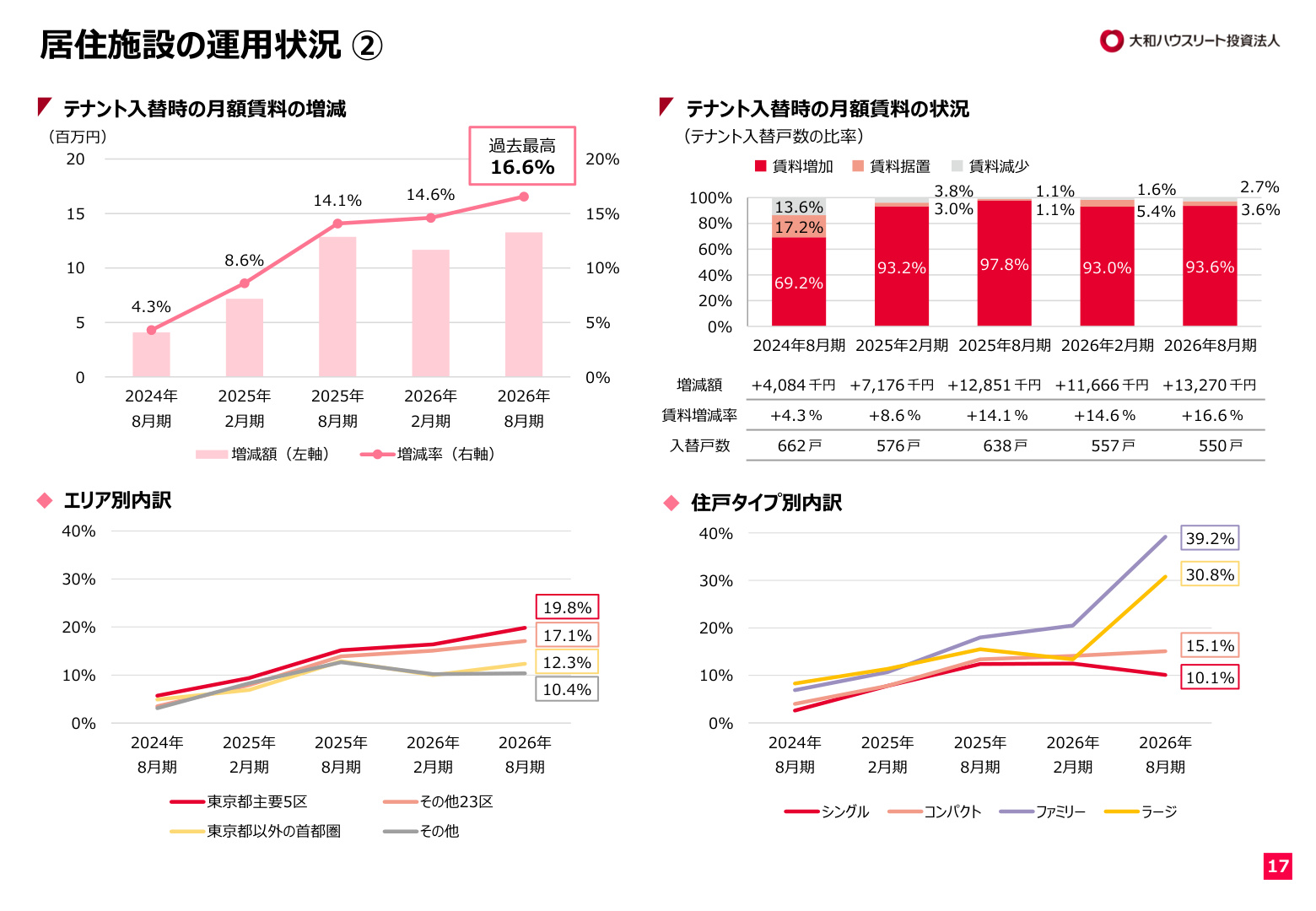
As the data in the slide above illustrates, rent revisions for residential facilities have recorded historical growth rates.
- Rent Change Rate upon Tenant Turnover : This reached a record high of +16.6% in the current period (compared to +14.6% in the previous period). Of the 550 units turned over, the percentage of units with increased rent reached 93.6% , while only 2.7% saw a decrease. The monthly rent increase amounted to 13.27 million yen/month.
- Explosive Growth by Type and Area : In particular, the rent increase rate upon turnover for family-type ( +39.2% ) and large-type ( +30.8% ) units stood out, clearly reflecting strong actual demand and supply constraints for spacious and large-sized units. By area, double-digit increases have taken root across Tokyo, with +19.8% in the five major wards of Tokyo and +17.1% in the other 23 wards.
- Progress in Renewal Rents : Even at the time of renewal, the acceptance rate was maintained against a 98.7% proposal rate, and the change rate recorded a record high of +2.1% . In the five major wards of Tokyo, it reached +2.9%.
- High-ROI Renovations : In high-quality renovations targeting wealthy individuals (4 to 6 units implemented per period, assumed ROI of 10% or more), new rents increased by +33.1% to +49.3% for properties in Shibuya and Minato wards, achieving extremely high investment efficiency with an ROI of 17.5% to 23.5%.
5. Operational Trends in Logistics, Hotels, and Commercial Facilities, and External Growth Pipeline
In asset classes other than residential facilities, profit maximization measures tailored to the inflationary environment are also underway.
- Logistics Facilities (Portfolio ratio 51.8%) : The period-end occupancy rate remained at 99.4% . The rent change rate for tenants whose contracts expired during the period was +3.6% , and monthly rent increased by 3.443 million yen/month. The REIT aims for rent increases of 5% or more for future contract expirations (fiscal periods ending February 2027 and August 2027). Notable are the changes in contract structures and the introduction of inflation-linked clauses, rapidly increasing inflation resilience by switching from ordinary lease contracts , where rent increases are difficult, to fixed-term lease contracts (Fukuoka +7.3%, Hachioji +3.7%) and introducing CPI (Consumer Price Index) linked clauses in long-term contracts (two cases already agreed upon).
- Commercial Facilities (Portfolio ratio 13.0%) : The occupancy rate was 99.4% (+0.2 percentage points from the previous period). Rent increase renewals (+6.3% to +26.2%) were concluded for multiple properties, including "Unicus Takasaki," achieving a monthly rent increase of 7.909 million yen/month ( +13.4% ).
- Hotel Facilities (Portfolio ratio 4.1%) : The occupancy rate remained at 100.0% . Against the backdrop of inbound demand and rising accommodation prices, ADR (Average Daily Rate) and RevPAR (Revenue Per Available Room) performed well, and variable rent from hotel tenants grew significantly by +12.9% year-on-year . In September 2026, the REIT acquired " MIMARU Tokyo Ikebukuro " (acquisition price 11.5 billion yen, appraisal value 17.2 billion yen, assumed NOI yield 6.0%), a property in a prime location with strong inbound demand from the group pipeline, strengthening revenue capture through a fixed + variable rent structure.
- External Growth Pipeline : Also in September 2026, the REIT acquired " Urawa Calue (Bic Camera Urawa West Exit Store) " (acquired 50% interest in two phases, acquisition price 9.5 billion yen, appraisal value 11.2 billion yen, assumed NOI yield 5.3%), a newly built large-scale complex commercial facility a 1-minute walk from Urawa Station. Furthermore, in December 2026, the acquisition of the development property " Amanek Kumamoto " (planned acquisition price 4.75 billion yen, assumed NOI yield 5.6%) is scheduled, continuing the steady acquisition of high-quality pipelines utilizing sponsor support.
6. Financial Soundness and Capital Allocation
Regarding financial management, which is most closely watched during periods of rising interest rates, both stability and cost control are being achieved.
- LTV Control : The period-end LTV (excluding goodwill) was 45.6% (+0.1 percentage points from the previous period), cruising stably around the target range of 45%. The appraisal LTV (excluding goodwill) reflecting unrealized gains is at an extremely sound level of 34.4% .
- Debt Composition and Ratings : Total interest-bearing debt is 406.9 billion yen, the average procurement interest rate is 1.03% , the fixed interest rate ratio is 89.0% , and the average remaining duration is 3.6 years . The REIT maintains high credit ratings of "AA (Stable)" from JCR and "AA- (Stable)" from R&I.
- Flexible Refinancing : In the fiscal period ended August 2026, while assessing interest rate trends, the REIT strategically utilized variable interest rates (1.63% to 1.66%) in some areas and promoted the leveling of repayment deadlines. In September 2026, it repaid 1 billion yen in borrowings using proceeds from property sales.
- Acquisition of Treasury Investment Units : To improve capital efficiency and return value to unitholders, the REIT resolved in October 2026 to acquire treasury investment units with a total acquisition amount of 1 billion yen (upper limit) (acquisition period: October 20, 2026 to November 30, 2026). The acquired investment units are scheduled to be cancelled, which will directly contribute to the improvement of NAV per unit and DPU.
7. Summary and Future Focus Points
Daiwa House REIT Investment Corporation's 41st fiscal period earnings were highly significant, not only for its solid operational performance but also for demonstrating to the market "proof of internal growth power exceeding interest rate hikes" and "a path to rapid DPU expansion accompanying annual asset recycling of 20 billion yen scale."
Future focus points include the following items:
- Progress of the distribution plans for the fiscal periods ending February 2027 (3,460 yen forecast) and August 2027 (3,650 yen forecast) , and the smooth completion of scheduled property sales (D Project Tosu III, DPL Inuyama, etc.).
- Sustainability of the double-digit rent increase momentum in residential facilities , and the progress of switching to fixed-term leases and introducing CPI clauses in logistics facilities.
- Execution status of the unitholder return framework of 30 billion yen or more over 3 years (timing and scale of additional treasury investment unit acquisitions).
- The pace of continuous acquisition of high-quality assets with inflation resistance and high yields, utilizing the abundant pipeline of the Daiwa House Group.
Attention is focused on the REIT's strategic initiatives to simultaneously advance BS restructuring and improve portfolio quality in response to major changes in the business environment, namely inflation and rising interest rates.
This content is not intended as investment advice or a recommendation. Any opinions expressed are solely the personal views of each article.