

Fukuoka REIT Corporation 44th Fiscal Period Earnings Analysis: A Sustainable Growth Story Driven by Robust Internal Growth and Strategic Asset Recycling

Sentiment Analysis
Fukuoka REIT Corporation (Securities Code: 8968), a pioneer in region-specific REITs focusing on the Fukuoka and Kyushu areas, has announced its financial results for the fiscal period ended August 2026 (44th fiscal period). The company is steadily raising its fundamental earning power (EPU) through the recovery of inbound demand centered on commercial facilities, progress in upward rent revisions for offices, and agile asset recycling that combines the divestment of aging office properties with investments in logistics facilities and commercial SPCs.
This report provides a multi-faceted analysis based on the 44th fiscal period earnings presentation materials, covering recent performance highlights, operational trends by asset class, external growth and financial strategies, and mid-to-long-term targets leading up to the fiscal period ending August 2029.
1. 44th Fiscal Period Results and DPU Trends: Strong Expansion of Fundamental Earning Power (EPU)
Operating results for the 44th fiscal period were as follows: operating revenue of 10.898 billion yen (+75 million yen compared to the previous period), operating profit of 4.463 billion yen (-23 million yen), ordinary profit of 3.932 billion yen (-73 million yen), and net income of 3.931 billion yen (-73 million yen). Although profit decreased compared to the previous period due to factors such as increased repair expenses and interest payments, NOI reached 6.384 billion yen , exceeding the previous period (6.367 billion yen) and marking a record high for the second consecutive period . The period-end occupancy rate also remained at a high level of 99.4% .
Distributions per unit (DPU) reached 4,075 yen , exceeding the initial forecast (4,000 yen) by 75 yen . This upside was primarily driven by active commercial facilities, centered on Canal City Hakata, where percentage rents linked to tenant sales significantly outperformed expectations (a positive impact equivalent to +240 yen).
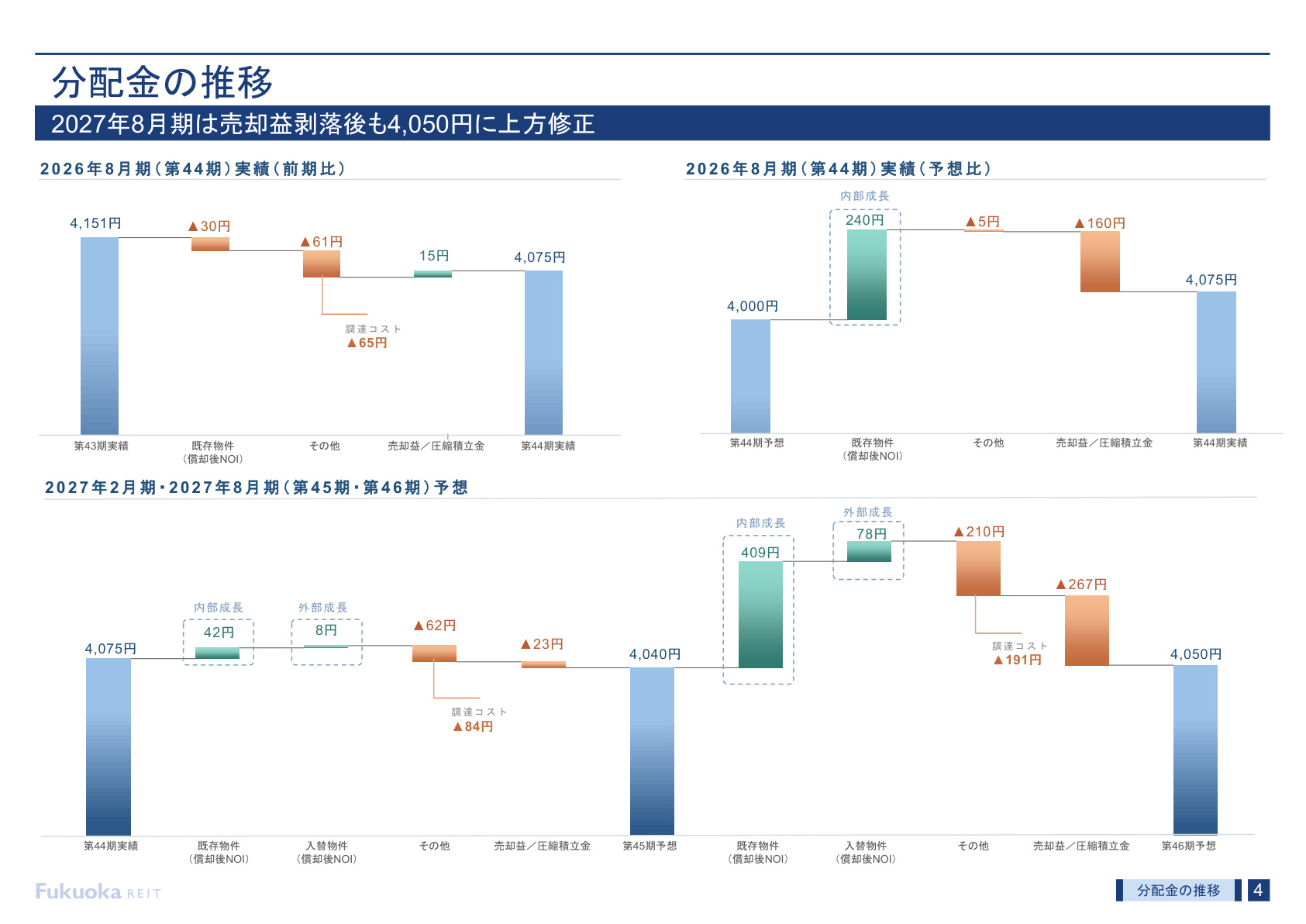
The waterfall chart above (Slide 4) is of critical importance in understanding future DPU trends. The REIT has supported distributions over the past several periods by recording gains on property sales (643 million yen in the 44th period, with 621 million yen forecast for the 45th period); however, gains on property sales will be completely absent in the 46th fiscal period (ending August 2027) forecast (-267 yen) . Additionally, an increase in procurement costs due to rising interest rates (-191 yen) is anticipated.
Nevertheless, as shown in the slide, the strong internal growth of existing properties (+409 yen) and the effects of asset recycling (+78 yen), which will be discussed later, fully cover these one-time profit losses and cost increases. Consequently, the DPU forecast for the 46th fiscal period has been upwardly revised to 4,050 yen, an increase of 50 yen from the previous target . This clearly demonstrates a trajectory where cruising-base EPU (net income per unit) grows by +7.0% compared to the 44th fiscal period forecast , independent of property sale gains.
2. Mid-to-Long-Term Roadmap: The Path to a "DPU of 4,240 yen" by August 2029
Fukuoka REIT Corporation is not only aiming to achieve an EPU/DPU of 4,050 yen (forecast) for the fiscal period ending August 2027, but has also set a mid-to-long-term growth target of a DPU of 4,240 yen by the fiscal period ending August 2029 (50th fiscal period) . This corresponds to a compound annual growth rate (CAGR) of approximately 3%, and the company plans to achieve this early through the following four pillars:
- Internal Growth : Increase in percentage rents and steady execution of rent increase negotiations, primarily for offices.
- External Growth : Acquisition of new properties (including the use of SPCs) and asset recycling that leads to qualitative improvement of the portfolio.
- Fund Procurement : Utilization of LTV control (50% cap) and minimization of procurement cost increases through adjustments to borrowing periods and interest rate types.
- Equity Strategy : Optimal capital policy considering the cost of capital and P/NAV levels (including consideration of share buybacks).
3. Explosive Growth and Future Development of Core Asset "Canal City Hakata"
Canal City Hakata, the flagship property of the portfolio, is maximizing the benefits of the strong recovery in inbound tourism and active domestic consumption.
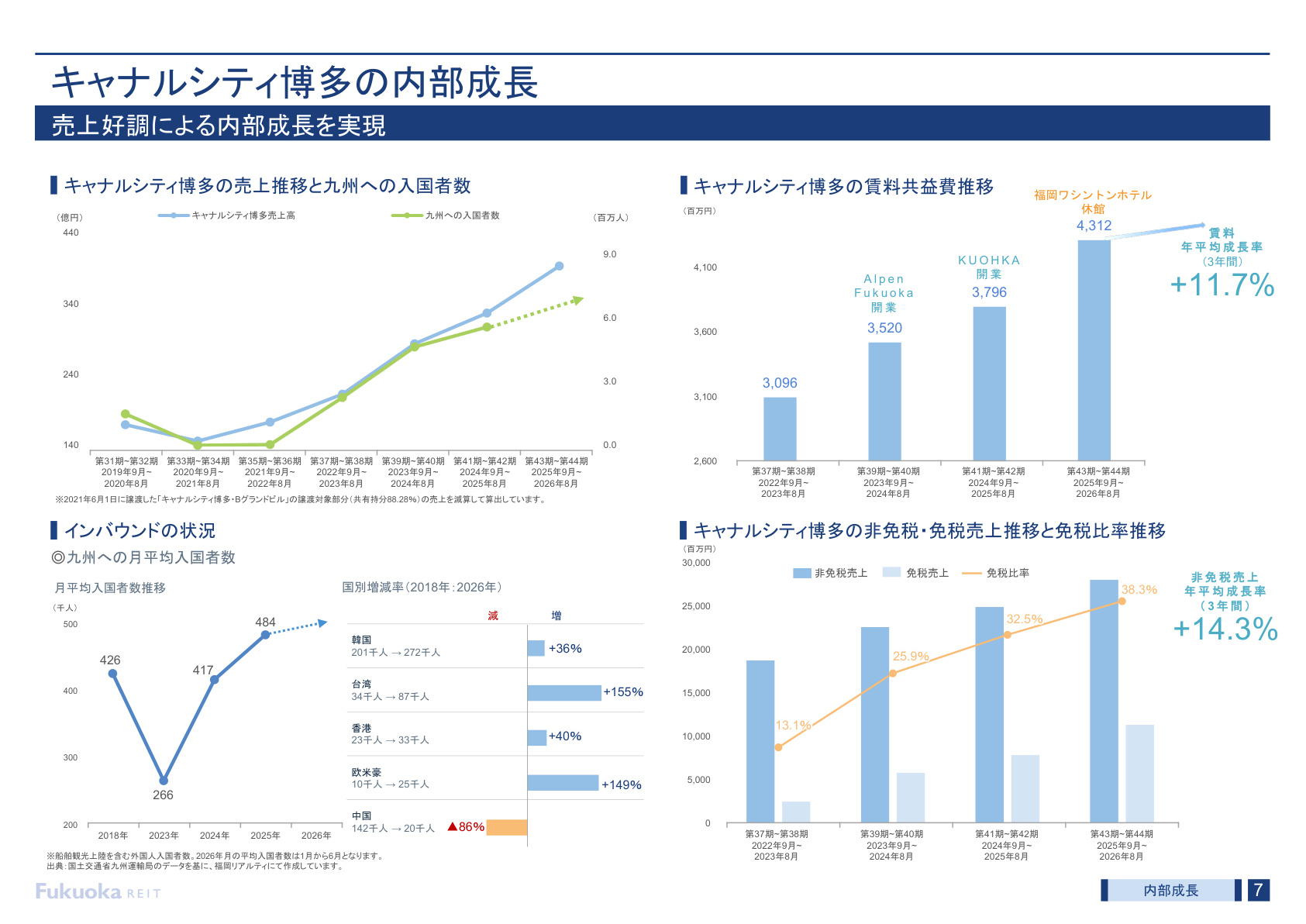
As shown in Slide 7, the average monthly number of inbound visitors to Kyushu in 2026 was 484,000, significantly exceeding the 2018 level (426,000). Notably, there has been a shift in the composition by country: while visitors from mainland China have decreased (-86%), there has been a surge in visitors from Taiwan (+155%), Europe/America/Australia (+149%), Hong Kong (+40%), and South Korea (+36%) , expanding the base of inbound demand in both quality and quantity.
Capturing this robust inbound demand, the tax-free sales ratio at Canal City Hakata has surged to 38.3% . Non-tax-free sales have also grown steadily at a 3-year CAGR of +14.3% , and in conjunction with this, rental and common area charge revenue has grown at a high pace of +11.7% per year over the past three years , reaching 4.312 billion yen in total for the 43rd and 44th periods combined.
Furthermore, the following value-up initiatives are underway as future growth measures:
- Fukuoka Washington Hotel Renewal : Total investment of 1.399 billion yen, with an expected NOI yield of 11.0% . The project includes a complete renovation of guest rooms and the addition of family rooms, with a phased opening starting in September 2026.
- Ramen Stadium Renewal : Total investment of 604 million yen, with an expected NOI yield of 7.0% .
- East Building Relaunch & Seiryu Park Opening : Expected to increase annual visitors by +5.0% and +4.0% respectively through enhanced connectivity with adjacent areas.
4. Operational Trends by Segment: Office, Commercial, Residential, and Logistics
(1) Office Buildings: Emergence of Positive Rent Gaps
The office vacancy rate in the Fukuoka business district is 5.02% (4.51% for existing buildings, 24.50% for new buildings). Strong expansion demand is absorbing new supply such as the Tenjin Big Bang, and average rents continue to trend upward (+4.4% year-on-year). Fukuoka REIT Corporation's office holdings are extremely robust with an occupancy rate of 98.1% . The positive rent gap , which indicates the divergence between market rent and current rent, has reached 11.8% (82.8% of the leased area has room for revision), and the company achieved 53 million yen in annual rent increases (43 cases) during the 43rd and 44th periods. With contract renewals for over 4,000 to 8,000 tsubo coming up annually, steady rent increases are expected.
(2) Other Commercial Facilities
- Park Place Oita : Achieved more than 5 times the rent compared to the previous tenant following the introduction of MUJI.
- Konoha Mall Hashimoto : Transitioned to a "base rent + percentage rent" system through the introduction of Sports Depo and others.
- Marinoa City Fukuoka (Land) : Currently being rebuilt into "(Tentative Name) Mitsui Outlet Park Fukuoka," scheduled to open in the spring of 2027. Rent is scheduled to be revised from 32 million yen per month during the construction period to 97 million yen per month after opening.
(3) Residential, Logistics, and Hotels
- Residential : Occupancy rate of 96.4%, rent increase rate upon revision/tenant replacement is +15.4% , and the positive gap has expanded to +17.2% .
- Logistics : Achieved a +7.6% rent increase at the Tosu Logistics Center upon contract renewal.
- Hotels : Tissage Hotel Naha maintains strong ADR and RevPAR.
5. External Growth and Capital Allocation: The Full Picture of Strategic Asset Recycling
Regarding external growth, the company announced an "asset recycling strategy" to reallocate funds from the sale of aging offices to the acquisition of logistics facilities with growth potential and investments in commercial facility SPCs.
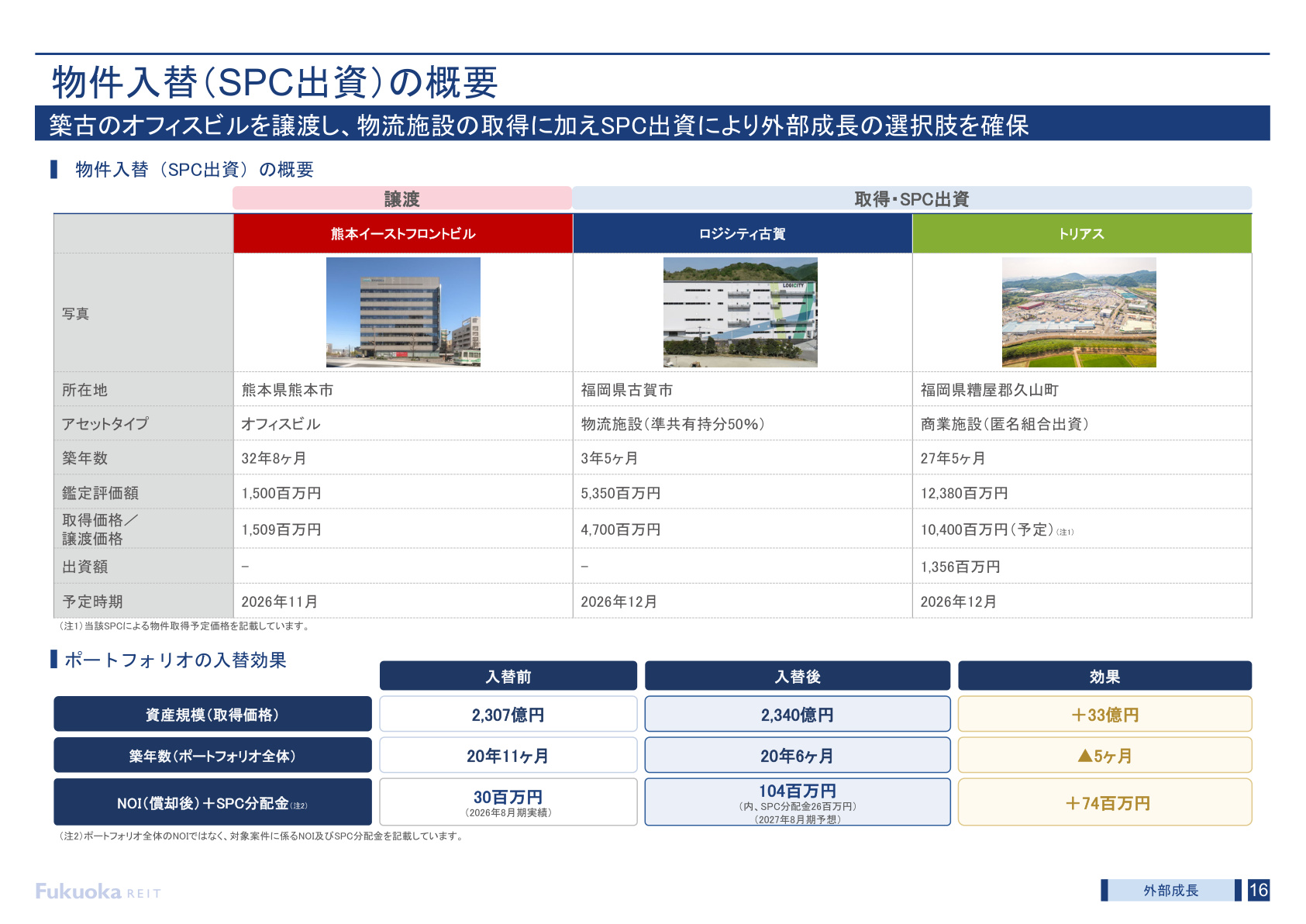
As shown in Slide 16, the content of this recycling is highly strategic:
- Divestment : Kumamoto East Front Building (32-year-8-month-old office, sale price 1.509 billion yen)
- Acquisition/Investment : Logi City Koga (50% quasi-co-ownership interest, 3-year-5-month-old logistics facility, acquisition price 4.7 billion yen) and anonymous association investment in an SPC holding the large-scale commercial facility Torius (investment amount 1.356 billion yen).
The portfolio improvement effects brought about by this transaction are clear:
- Expansion of Asset Scale : From 230.7 billion yen to 234 billion yen based on acquisition price ( +3.3 billion yen ).
- Rejuvenation of Portfolio : Average building age from 20 years and 11 months to 20 years and 6 months ( -5 months younger ).
- Improvement in Profitability : Compared to the post-depreciation NOI of the divested property (30 million yen), the revenue from the acquired/invested properties is 104 million yen (post-depreciation NOI of 78 million yen + SPC distribution of 26 million yen), creating a cash flow generation effect of +74 million yen per year .
6. Financial Management: Resilience to Interest Rate Hikes and Unrealized Gain Buffers
In response to concerns about interest rate hikes accompanying the Bank of Japan's normalization of monetary policy, the REIT is promoting proactive financial control.
- Procurement Structure : Total interest-bearing debt at the end of the period was 96.35 billion yen, with a fixed-rate ratio of 83.1% , average remaining debt duration of 3.7 years , and average interest rate during the period maintained at 0.90% . The company has obtained ratings of "AA- (Stable)" from JCR and "A+ (Stable)" from R&I.
- Flexibility in Procurement Policy : Mitigating the pace of cost increases under rising interest rates through adjustments to procurement periods (shortening/variable) and spread compression negotiations. While the scenario of two additional interest rate hikes (totaling 0.50%) is incorporated as the assumed interest rate for new borrowings in the 45th and 46th periods, the company has built a structure where the NOI increase (+388 million yen) from the 44th period results to the 46th period forecast significantly exceeds the increase in procurement costs (+239 million yen) .
- Leverage and Unrealized Gains : Period-end LTV is 42.4% (based on appraisal value, 33.0% ). The company has 34.7 billion yen in borrowing capacity up to the LTV cap of 50%. Furthermore, the total appraisal value of held properties has reached 279.3 billion yen, with unrealized gains amounting to 64.7 billion yen . These unrealized gains serve as a thick safety buffer for the portfolio and, at the same time, as a powerful source of funds for future asset recycling and capital allocation.
Summary
Fukuoka REIT Corporation's 44th fiscal period results confirmed the earnings growth of Canal City Hakata due to the surge in inbound tourism, as well as strong rent increase revisions for offices and residential properties against the backdrop of a robust Fukuoka economy. The company has fully compensated for the loss of one-time property sale gains through internal growth of existing properties and earnings expansion from agile asset recycling, and is on a solid growth trajectory toward the upward revision to a cruising DPU of 4,050 yen for the fiscal period ending August 2027, and further toward the 4,240 yen target for the fiscal period ending August 2029 .
This content is not intended as investment advice or a recommendation. Any opinions expressed are solely the personal views of each article.