

ALINCO INCORPORATED Q2 FY2027 Financial Results: 12% Increase in Operating Profit Driven by Core 'Albatross' and Rental Businesses; Steady Progress Toward Full-Year Targets Despite FX Losses

Sentiment Analysis
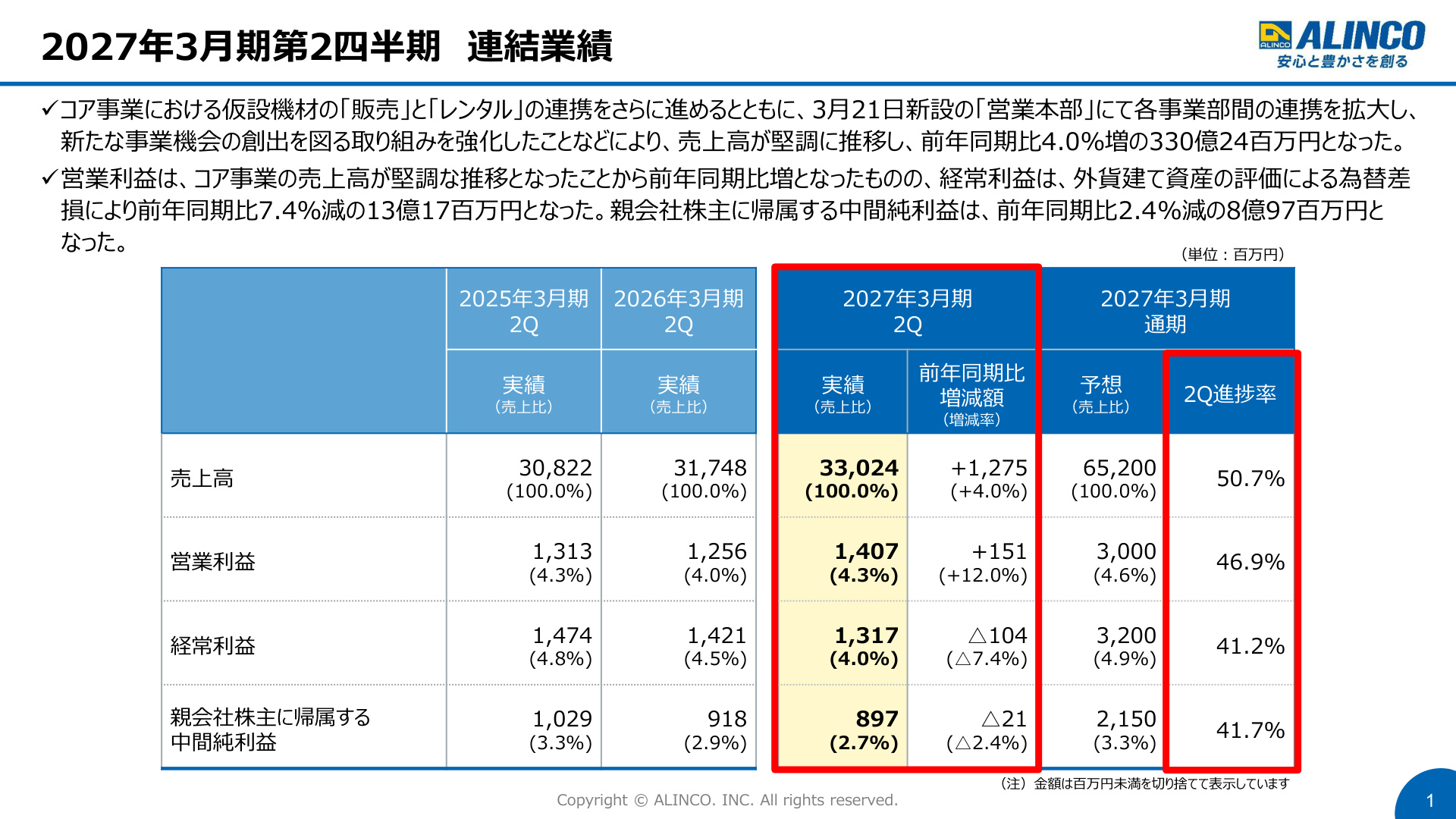
ALINCO INCORPORATED reported its consolidated financial results for the second quarter (interim period) of the fiscal year ending March 31, 2027 , achieving both revenue growth and double-digit operating profit growth. Net sales rose 4.0% year-on-year to 33.024 billion yen , and operating profit increased 12.0% year-on-year to 1.407 billion yen . Conversely, due to valuation losses on foreign currency-denominated assets resulting from exchange rate fluctuations, ordinary profit decreased 7.4% year-on-year to 1.317 billion yen , and profit attributable to owners of parent for the interim period fell 2.4% year-on-year to 897 million yen .
This report provides an in-depth analysis of the financial results from multiple perspectives, including the drivers behind the strong performance of the core construction equipment business, the profit structure of each segment, an examination of foreign exchange impacts, and capital policies, including share buybacks.
1. Summary of Consolidated Financial Results for Q2 FY2027
Performance for the interim period showed solid expansion in both net sales and operating profit, driven by the promotion of collaboration between "sales" and "rental" in the core construction equipment field, as well as the creation of synergies between business divisions through the "Sales Headquarters" established on March 21, 2026.
【Significance and Background of the Slide Above】
This slide presents the key data summarizing the company's overall performance for the interim period and the progress rate (KPI) against full-year forecasts. The progress rate for net sales is 50.7% , and for operating profit is 46.9% , maintaining a pace generally in line with the full-year plan (net sales of 65.2 billion yen, operating profit of 3 billion yen). In particular, the double-digit growth in operating profit from 1.256 billion yen in the same period last year to 1.407 billion yen (+151 million yen) confirms that the strengthening of core earnings power is progressing steadily. On the other hand, the progress rate for ordinary profit remained at 41.2% , which can be attributed to a temporary downward impact from foreign exchange losses (non-operating expenses) rather than weakness in the core business.
2. Segment Trends: Contrasting Performance Between Core and General Businesses
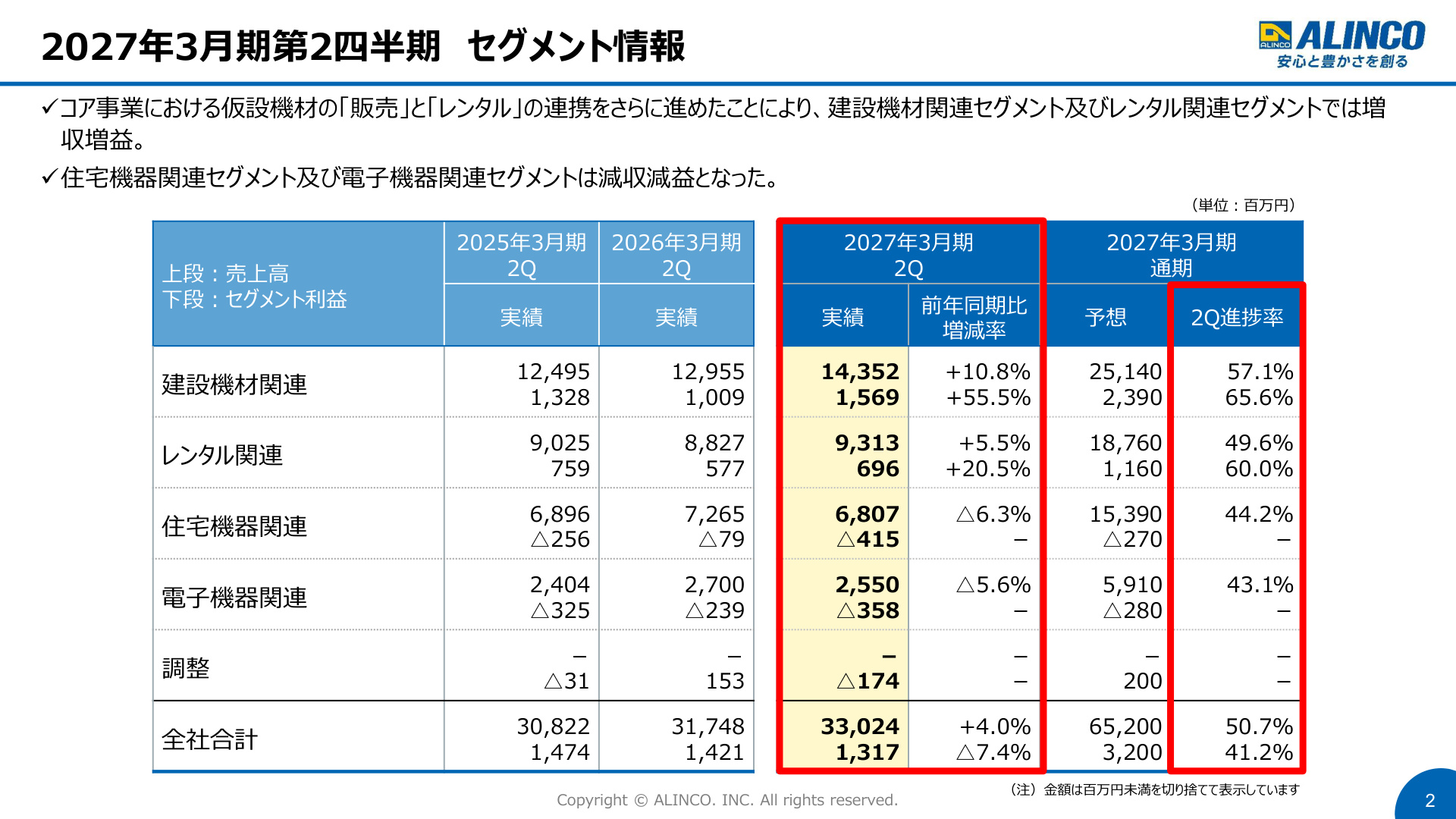
The company's overall performance was driven by its core businesses: the Construction Equipment segment and the Rental segment . Meanwhile, the Housing Equipment and Electronic Equipment segments continue to report operating losses due to market environment impacts.
【Significance and Background of the Slide Above】
This slide highlights the company's reliance on its profit structure. The combined operating profit of the two core businesses, Construction Equipment and Rental, reached 2.265 billion yen , significantly boosting overall company operating profit. The status of each segment is as follows:
-
Construction Equipment Segment (Net sales: 14.352 billion yen / +10.8% YoY, Segment profit: 1.569 billion yen / +55.5% YoY) Sales volume increased significantly as the user base for the flagship next-generation scaffolding "Albatross" steadily expanded. Combined with improved production efficiency and the effects of sales expansion, segment profit recorded extremely high growth of 55.5% compared to 1.009 billion yen in the same period last year. The progress rate against the full-year profit forecast of 2.39 billion yen has reached 65.6% .
-
Rental Segment (Net sales: 9.313 billion yen / +5.5% YoY, Segment profit: 696 million yen / +20.5% YoY) Despite some construction delays due to the situation in the Middle East, high utilization rates were maintained overall. In particular, for event rentals, the shift of concert schedules to avoid extreme heat and favorable weather worked in the company's favor. Furthermore, in addition to continued investment in rental assets to meet the customer shift from "ownership to rental," the penetration of rental price revisions (increases) absorbed the rise in depreciation expenses, achieving a 20.5% increase in segment profit .
-
Housing Equipment Segment (Net sales: 6.807 billion yen / -6.3% YoY, Segment loss: 415 million yen / 79 million yen loss in the same period last year) While sales of brown rice refrigerators and high-place work platforms from the subsidiary SHIP Co., Ltd. remained steady, sales of home fitness products declined due to cooling consumer sentiment caused by rising prices. The company is currently undergoing a structural transformation to expand sales channels from the traditional home-use sector to the commercial-use sector .
-
Electronic Equipment Segment (Net sales: 2.55 billion yen / -5.6% YoY, Segment loss: 358 million yen / 239 million yen loss in the same period last year) Although sales of wireless communication equipment increased by capturing replacement demand for commercial radios and digital fire-defense radios, the segment experienced a temporary decline in revenue due to the impact of price revisions for orders in the printed circuit board business at a subsidiary, leading to an expansion of the segment loss.
3. Examination of Profit Fluctuation Factors: Contrast Between Core Business Growth and FX Factors
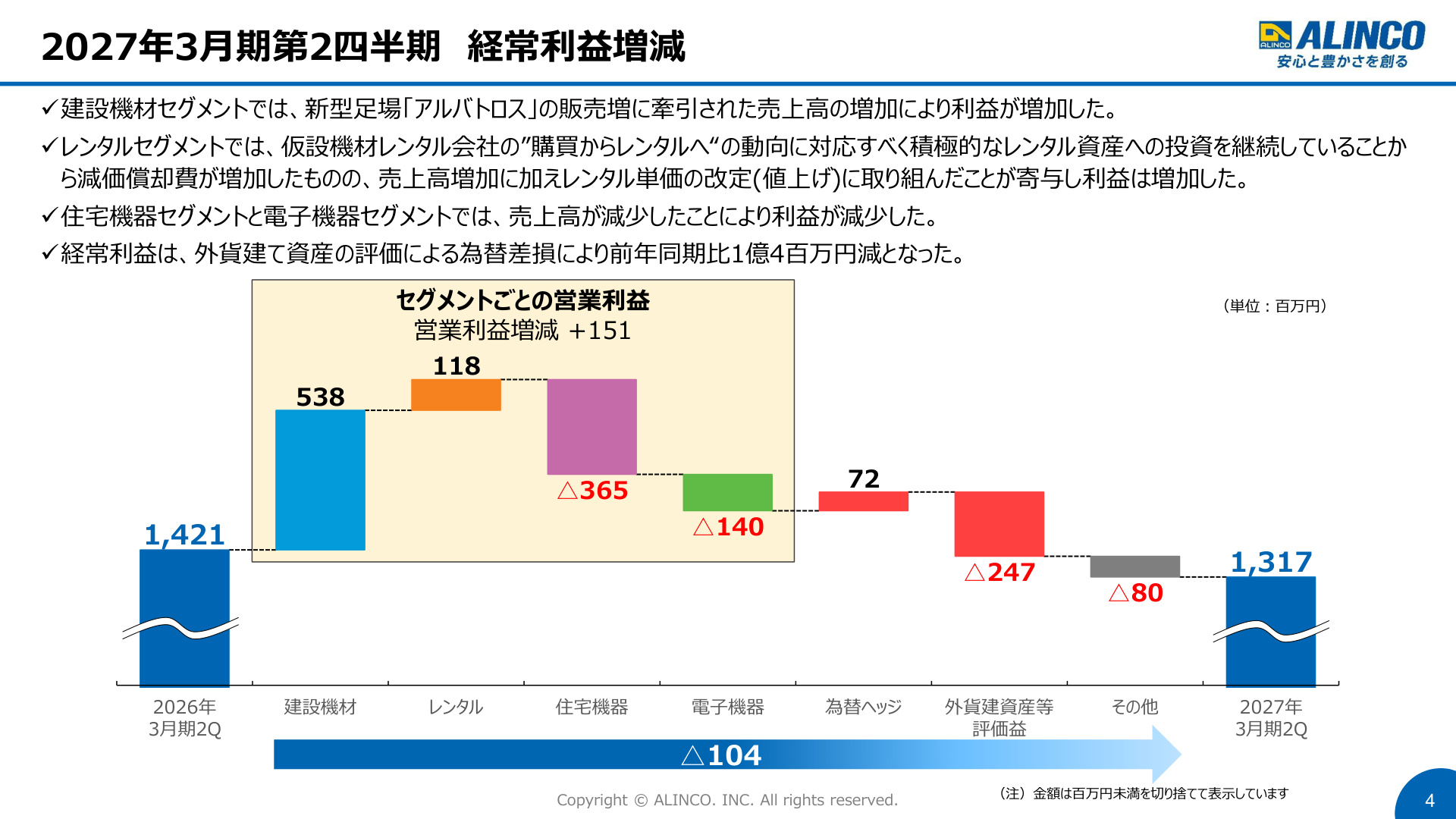
The reason for the decrease in ordinary profit despite achieving growth in operating profit lies in the impact of foreign exchange-related items in non-operating income and expenses. The breakdown is organized in the analysis slide below.
【Significance and Background of the Slide Above】
This slide clearly breaks down the 104 million yen decrease in profit from 1.421 billion yen in ordinary profit in the same period last year to 1.317 billion yen this term. On an operating profit basis, which indicates core business earnings, the growth in core businesses—Construction Equipment (+538 million yen) and Rental (+118 million yen)—outpaced the declines in Housing Equipment (-365 million yen) and Electronic Equipment (-140 million yen), resulting in an overall positive contribution of +151 million yen. However, in non-operating items, although there was a gain from foreign exchange hedging (+72 million yen), valuation losses on foreign currency-denominated assets of -247 million yen occurred due to sharp fluctuations in exchange rates. The company's assumed USD/JPY rate is set at 150 yen, and the slide clearly shows that the volatility of exchange rates during the period impacted valuation losses, leading to a year-on-year decrease in ordinary profit.
4. Financial Position and Cash Allocation
Total assets at the end of the second quarter of the fiscal year ending March 31, 2027, increased by 3.356 billion yen from the end of the previous fiscal year to 76.639 billion yen .
- Current Assets : Increased to 46.085 billion yen (+3.119 billion yen from the end of the previous fiscal year) due to factors such as an increase of 1.754 billion yen in notes and accounts receivable-trade and an increase of 664 million yen in electronically recorded monetary claims.
- Non-current Assets : While 1.047 billion yen was invested in rental assets to meet strong demand, 577 million yen in depreciation was recorded, resulting in 30.554 billion yen (+237 million yen from the end of the previous fiscal year).
- Liabilities and Net Assets : Total liabilities reached 43.048 billion yen (+3.323 billion yen from the end of the previous fiscal year) due to an increase in interest-bearing debt. Net assets remained almost flat at 33.591 billion yen (+33 million yen from the end of the previous fiscal year) as a result of recording 897 million yen in interim profit attributable to owners of parent, offset by dividend payments (439 million yen) and the acquisition of treasury shares (601 million yen).
- Key Financial Indicators : The equity ratio is 43.8% (down 2.0 points from the end of the previous fiscal year), and the D/E ratio is 0.92x (0.81x at the end of the previous fiscal year).
5. Shareholder Return Policy: Progress of Treasury Share Acquisition
The company is conducting treasury share acquisitions based on a resolution of the Board of Directors held on May 1, 2026, for the purpose of improving capital efficiency and enhancing shareholder returns.
- Details of Acquisition Framework : Total number of shares to be acquired: 1.1 million shares (maximum, 5.5% of total issued shares) ; Total acquisition cost: 1 billion yen (maximum) ; Acquisition period: May 7, 2026, to April 27, 2027.
- Progress (as of September 30, 2026) : Total number of shares acquired: 586,400 shares ; Total acquisition cost: 629 million yen .
Progress is at 53.3% of the maximum number of shares and 63.0% of the maximum acquisition cost, confirming that flexible and planned share buybacks are progressing steadily during the period.
6. Future Business Outlook and Key Points
Key points to watch in future business development are as follows:
- Sustainability of Core Business Growth : Continued generation of solid cash flow is expected in the second half due to the expansion of the customer base for the next-generation scaffolding "Albatross" and the establishment of price revision effects in the rental business.
- Profit Improvement Measures for Housing and Electronic Equipment : The focus will be on whether the shift of fitness products in the Housing Equipment segment to commercial sales channels and the order trends following price revisions for printed circuit boards in the Electronic Equipment segment will lead to improved profitability in the second half.
- FX Sensitivity and Management of Foreign Currency Assets : It is necessary to monitor the execution status of foreign exchange forward contracts and hedging strategies based on the assumed rate (150 yen), as well as the impact of exchange rate levels toward the end of the fiscal year on ordinary profit and net profit for the period.
With the two pillars of construction equipment and rental demonstrating strong earning power, the extent to which measures for recovering profitability in non-core fields progress will be the key to achieving the full-year plan.
This content is not intended as investment advice or a recommendation. Any opinions expressed are solely the personal views of each article.