

Mitsui Fudosan Accommodations Fund Inc. 41st Fiscal Period Earnings Deep Dive: Strong Rental Momentum in the Tokyo Metropolitan Area and Building Interest Rate Resilience via 'Management Policy 2.0'

Sentiment Analysis
Mitsui Fudosan Accommodations Fund Inc. (Securities Code: 3226) reported strong results for its 41st fiscal period (March 1, 2026, to August 31, 2026), driven by robust internal growth and strategic asset replacement. Distribution per unit (DPU) reached 2,445 yen , exceeding the publicly announced forecast of 2,397 yen by 48 yen and marking a 40 yen increase compared to the previous period's results.
Against the backdrop of strong residential demand centered in central Tokyo, the rent change rate upon tenant replacement accelerated to +15.2% , while the rent change rate upon lease renewal reached a record high of +2.9% . Furthermore, the fund unveiled a new growth strategy, "Management Policy 2.0," in anticipation of rising interest rates. By combining aggressive internal growth, asset replacement involving the distribution of unrealized gains, and the strategic use of internal reserves, the fund has clearly demonstrated its policy to aim for sustained DPU growth of over 3% per annum . This report provides a multifaceted analysis, from the details of the 41st fiscal period results to the mechanisms for future growth.
1. 41st Fiscal Period Earnings Highlights: The Structure of Increased Revenue, Profit, and DPU Outperformance
In the 41st fiscal period, the fund achieved significant growth in both revenue and profit, with operating revenue increasing by 865 million yen from the previous period to 14.592 billion yen , operating profit increasing by 631 million yen to 7.524 billion yen , and net income increasing by 482 million yen to 6.835 billion yen .
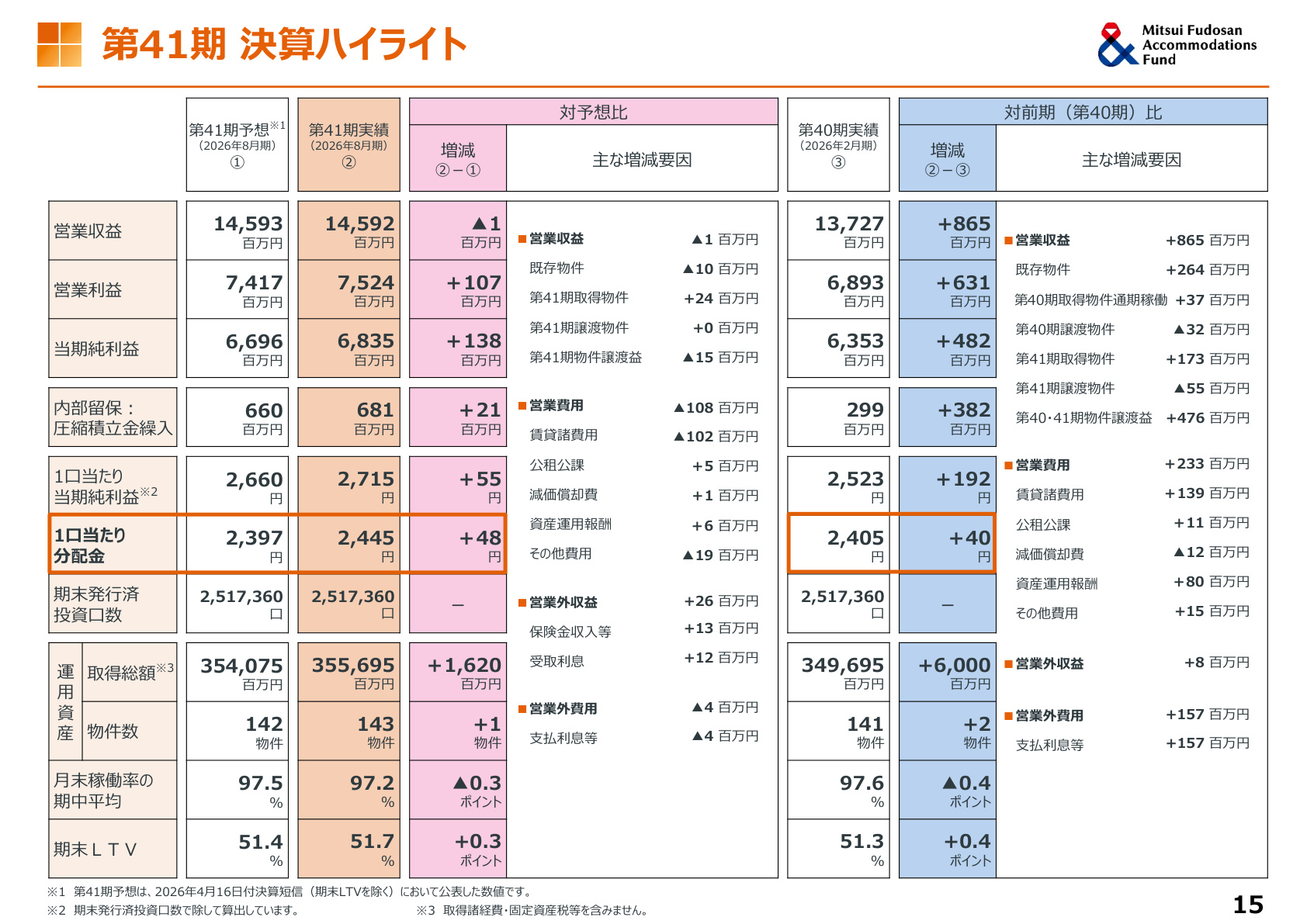
As shown in the slide above, the primary drivers of earnings expansion were increased rental revenue from existing properties (+264 million yen compared to the previous period) , the full-period and new contributions from properties acquired in the 40th and 41st periods (+210 million yen), and gains on the sale of properties in the 40th and 41st periods (+476 million yen) resulting from asset replacement. These revenue-increasing factors significantly outweighed the rise in rental expenses and interest payments (non-operating expenses increased by 157 million yen compared to the previous period).
Furthermore, the fact that the fund achieved a DPU of 2,445 yen—48 yen above the initial forecast—even after retaining 681 million yen as a reserve for reduction of entry from gains on property sales (+21 million yen vs. forecast, +382 million yen vs. previous period), confirms that the fund is simultaneously enhancing its fundamental earning power and expanding its financial buffers.
2. Acceleration of Internal Growth: Record-High Rent Increases in Both Replacements and Renewals
Based on acquisition price, 88.6% of the fund's portfolio is located in the 23 wards of Tokyo , and by number of units, 83.1% consists of single and compact types . Driven by a net population inflow into Tokyo's 23 wards, primarily among the younger generation, and wage growth trends for those in their 20s and 30s, supply and demand in the residential rental market remain extremely tight.
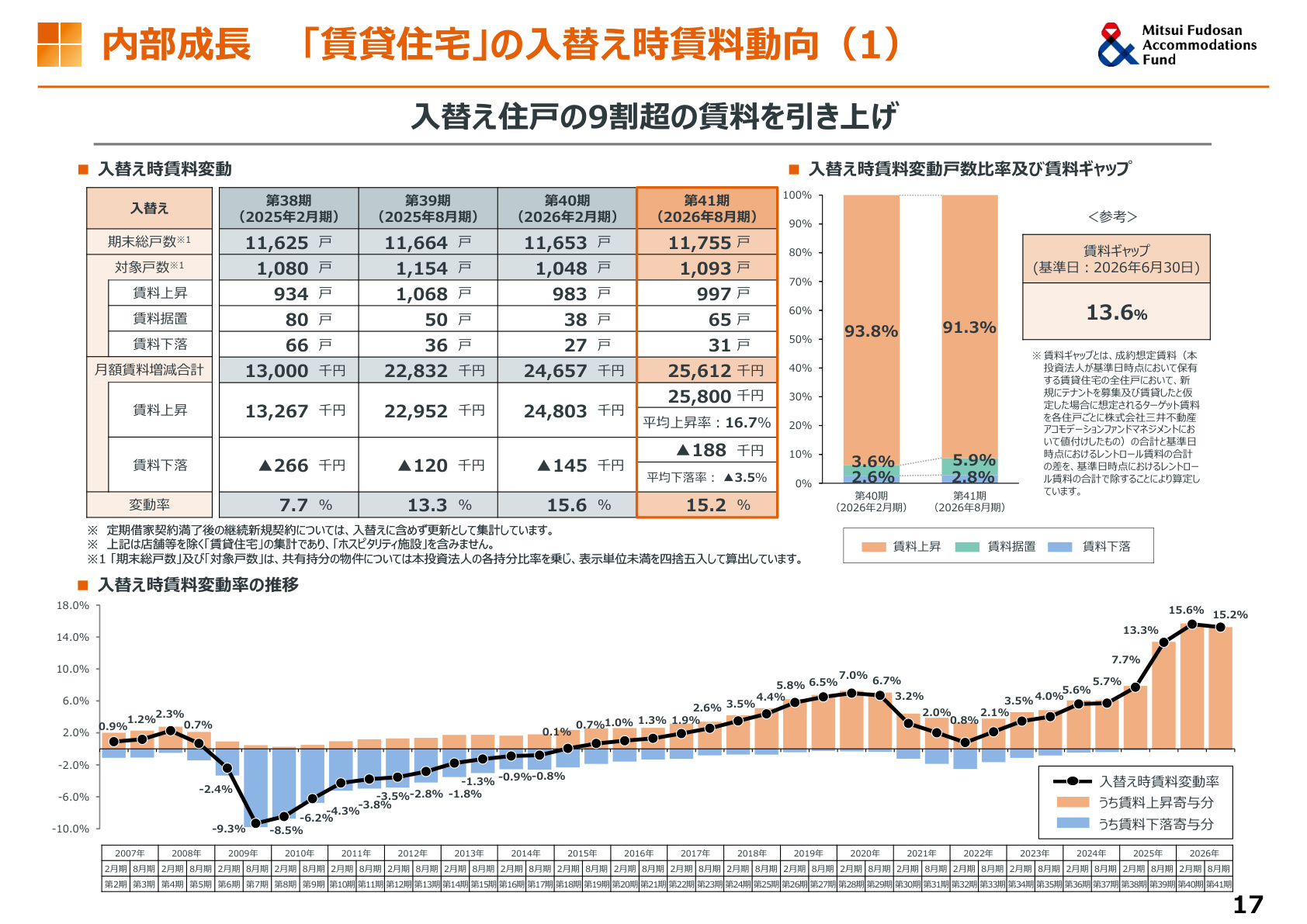
The momentum of internal growth is best symbolized by the rent trends upon tenant replacement shown above. The rent change rate upon replacement in the 41st period was +15.2% , maintaining a very high level of growth following the 39th period (+13.3%) and 40th period (+15.6%). Notable achievements include:
- Rent increases were successfully implemented in 91.3% of replacement units (decreases were only 2.8%). The average increase for units with higher rents reached 16.7% .
- The rent gap , which indicates the discrepancy between market rent and contract rent, stands at 13.6% (as of the end of June 2026), leaving ample room for rent increases upon tenant turnover.
- By area, the change rate upon replacement was driven by the three central wards at +20.2% and other 23 wards at +15.5% . By type, all categories achieved double-digit increases: large types (+25.6%), family types (+18.1%), singles (+15.0%), and compact types (+13.5%).
Furthermore, strengthening negotiations during lease renewals is yielding significant results. The rent change rate upon renewal in the 41st period expanded to a record high of +2.9% (averaging +3.5% from May to August 2026). With the renewal request rate rising significantly from 34.5% in the previous period to 50.3% , and the acceptance rate remaining high at 78.6% , rent revisions for existing tenants are becoming firmly established. As a result, while maintaining a high occupancy rate of 97.2% at the end of the period, the rent per tsubo of the residential portfolio has steadily risen to 13,298 yen (a semi-annual change rate of +1.72%, a pace of over 3% per annum).
In addition, multifaceted revenue maximization measures are underway, including incidental revenue initiatives (expected to increase revenue by about 86 million yen/year after cruising, through reviews of bicycle parking and internet-related services), renewal fee initiatives (expected at about 41 million yen/year), and the trial introduction of fixed-term lease contracts for some units (e.g., Park Cube Meguro Tower).
3. External Growth and Qualitative Improvement through "Strategic Asset Replacement"
Since the 38th period, Mitsui Fudosan Accommodations Fund Inc. has strengthened its external growth by utilizing the sponsor pipeline as well as the asset management company's proprietary routes . From the 41st to the 42nd period, the fund acquired 4 new properties for about 8 billion yen and sold 2 properties for about 2.8 billion yen.
- 41st Period Acquisitions : Sponsor-developed "Park Axis Oshiage Residence" (1.77 billion yen, NOI yield 4.0%), "Park Axis Nishimagome" (1.44 billion yen, 4.2%), and proprietary route properties including the newly built student apartment "Campus Terrace Kyudai Gakkentoshi" (3.2 billion yen, 4.2%) and "Park Cube Hachioji" (1.62 billion yen, 4.3%).
- 41st Period Dispositions : Sold "Park Axis Tsukishima" and "Dormy Nishi-Ogikubo" for a total of 2.8 billion yen (recording a gain on sale of about 888 million yen).
- 42nd Period Acquisitions : Proprietary route properties with high rent upside, "Park Cube Omori Sanno" (3.13 billion yen, NOI yield 3.7%) and "Park Cube Nakano North" (1.61 billion yen, 3.3%).
Through this series of asset replacements, the average age of acquired properties is 6.7 years, while disposed properties averaged 25.3 years , achieving a rejuvenation of the portfolio's average age and suppressing future repair burdens. Backed by the pipeline held by the Mitsui Fudosan Group (47 properties and 6,030 units completed or under leasing, mainly in Tokyo's 23 wards), the fund maintains a structure capable of agile property acquisitions by leveraging its borrowing capacity (about 20 billion yen until LTV reaches 55%).
4. "Management Policy 2.0" and the Mid-to-Long-Term DPU Roadmap
With interest rate hikes following the Bank of Japan's normalization of monetary policy in mind, the fund has announced "Management Policy 2.0," which evolves its conventional management policy.
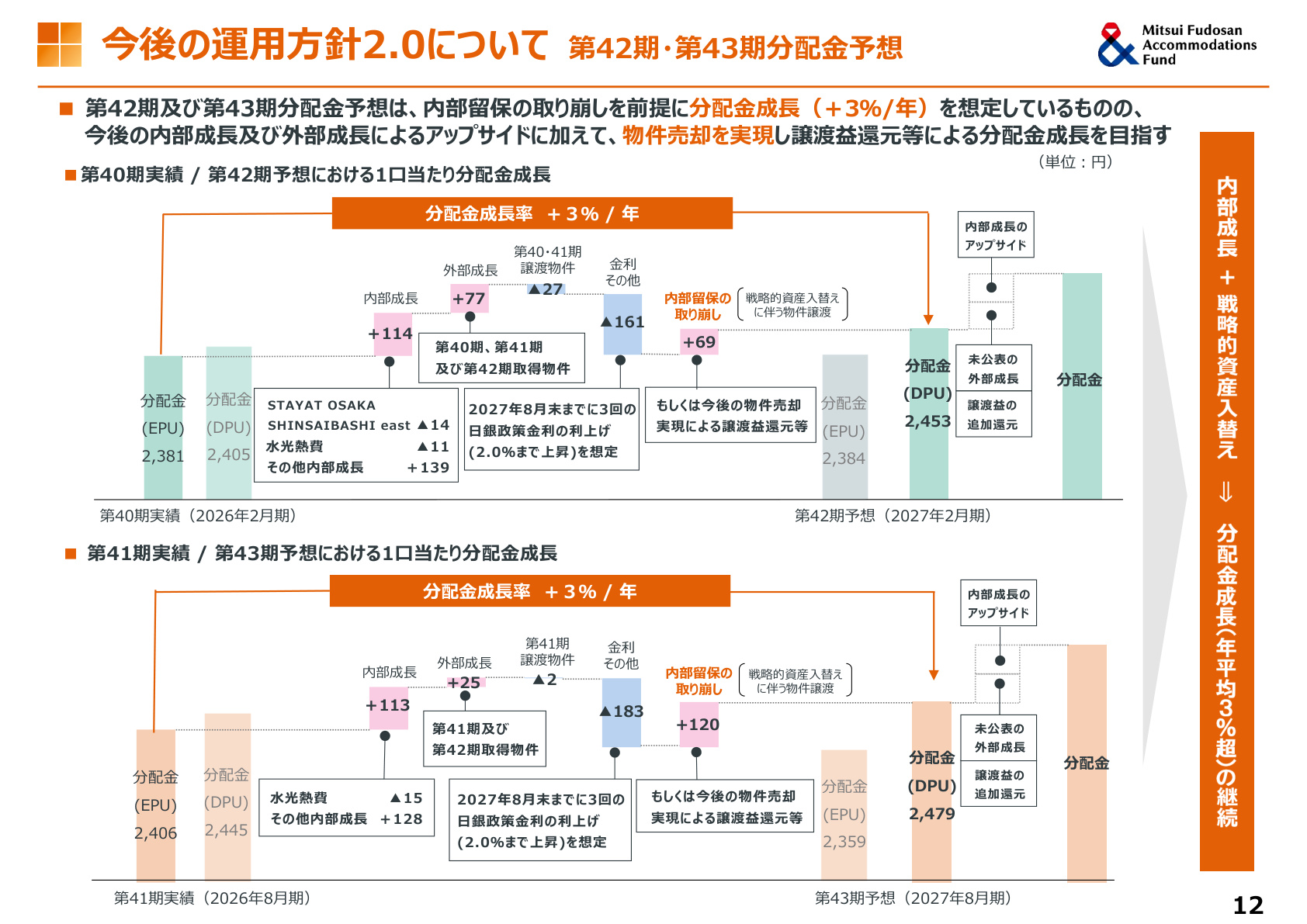
The slide above is key data breaking down the DPU simulation and growth factors for the 42nd and 43rd periods in a rising interest rate environment. As a prerequisite, it incorporates a conservative interest rate hike scenario in which the policy rate is raised in three stages to 2.0% by the end of August 2027.
Based on this scenario, while interest and other cost increases are expected to push down DPU by 161 yen in the 42nd period and 183 yen in the 43rd period, the fund has designed a structure to fully absorb this through the following measures:
- Strong Internal Growth : Creating positive factors of +114 yen in the 42nd period and +113 yen in the 43rd period through robust rent revisions.
- Contribution from External Growth : Boosting DPU by +77 yen in the 42nd period and +25 yen in the 43rd period through the full contribution of acquired properties.
- Reversal of Internal Reserves and Distribution of Gains on Sale : Utilizing the reversal of internal reserves, etc., of +69 yen in the 42nd period and +120 yen in the 43rd period.
As a result, the announced DPU forecasts are 2,453 yen for the 42nd period and 2,479 yen for the 43rd period , indicating sustained DPU growth at a pace of +3% per annum . Furthermore, additional upside from further internal growth and the potential recording of gains on sale from unannounced property transactions are positioned as upside factors.
5. Financial Management and ESG Initiatives
Regarding finances, as of the end of the 41st period, the total asset LTV was 51.7% (appraisal LTV based on appraisal value was 32.5% ), the long-term debt ratio was 98.8% , the fixed-interest ratio was 81.1% , the average remaining duration was 4.2 years , and the weighted average interest rate was 0.87% . Through a high fixed-interest ratio and long-term debt, the fund controls the risk of sudden interest rate spikes while maintaining an AA- (R&I) rating, the highest level among residential J-REITs.
In terms of sustainability, the ratio of green building certifications is 33.5% based on gross floor area (2030 target: 40%), and the conversion to LED lighting in common areas has been completed for all 123 properties. Additionally, the fund is steadily making progress in both reducing environmental impact and enhancing social value, such as by expanding the installation of energy consumption measuring devices in private areas and holding coexistence events with local communities.
Summary
Mitsui Fudosan Accommodations Fund Inc. in the 41st fiscal period accurately captured the strong residential market conditions in Tokyo's 23 wards, achieving both double-digit rent increases upon replacement and record-high increases upon renewal, thereby significantly enhancing its fundamental earning power. Moving forward, under "Management Policy 2.0," the fund has established a management structure to overcome the anticipated interest rate hike phase through the three pillars of "aggressive internal growth," "asset replacement leveraging unrealized gains," and "agile use of internal reserves," aiming for sustainable improvement in unitholder value.
This content is not intended as investment advice or a recommendation. Any opinions expressed are solely the personal views of each article.