

FORCIA,Inc. Q2 FY2027 Earnings Deep Dive: Significant Growth Driven by Major Project Deliveries and Platform Expansion

Sentiment Analysis

1. Executive Summary: Achieving Significant Revenue and Profit Growth with High Progress
FORCIA,Inc. delivered strong financial results for the second quarter (interim period) of the fiscal year ending February 2027, with both net sales and profits at all levels significantly exceeding those of the same period last year. Net sales increased by 64.5% year-on-year to 1.806 billion yen , and operating profit surged by 933.1% year-on-year to 345 million yen . As of the interim period, the company has reached an 83.9% progress rate against its full-year operating profit forecast.
The strong performance is attributed to the smooth progress of core system renewals and new service development projects for key clients, as well as the completion of delivery and acceptance of a major project (worth approximately 400 million yen) during the second quarter, for which revenue recognition timing had been revised in the previous fiscal year. Even excluding this one-time acceptance factor, development revenue trended higher than the same period last year, demonstrating robust customer demand for the company's core search technology platform "Spook" and its travel DX platforms "webコネクト" and "valueコネクト."
2. Interim Financial Highlights and Revenue Structure Breakdown
The details of the interim P/L (Profit and Loss Statement) and sales composition are as follows.
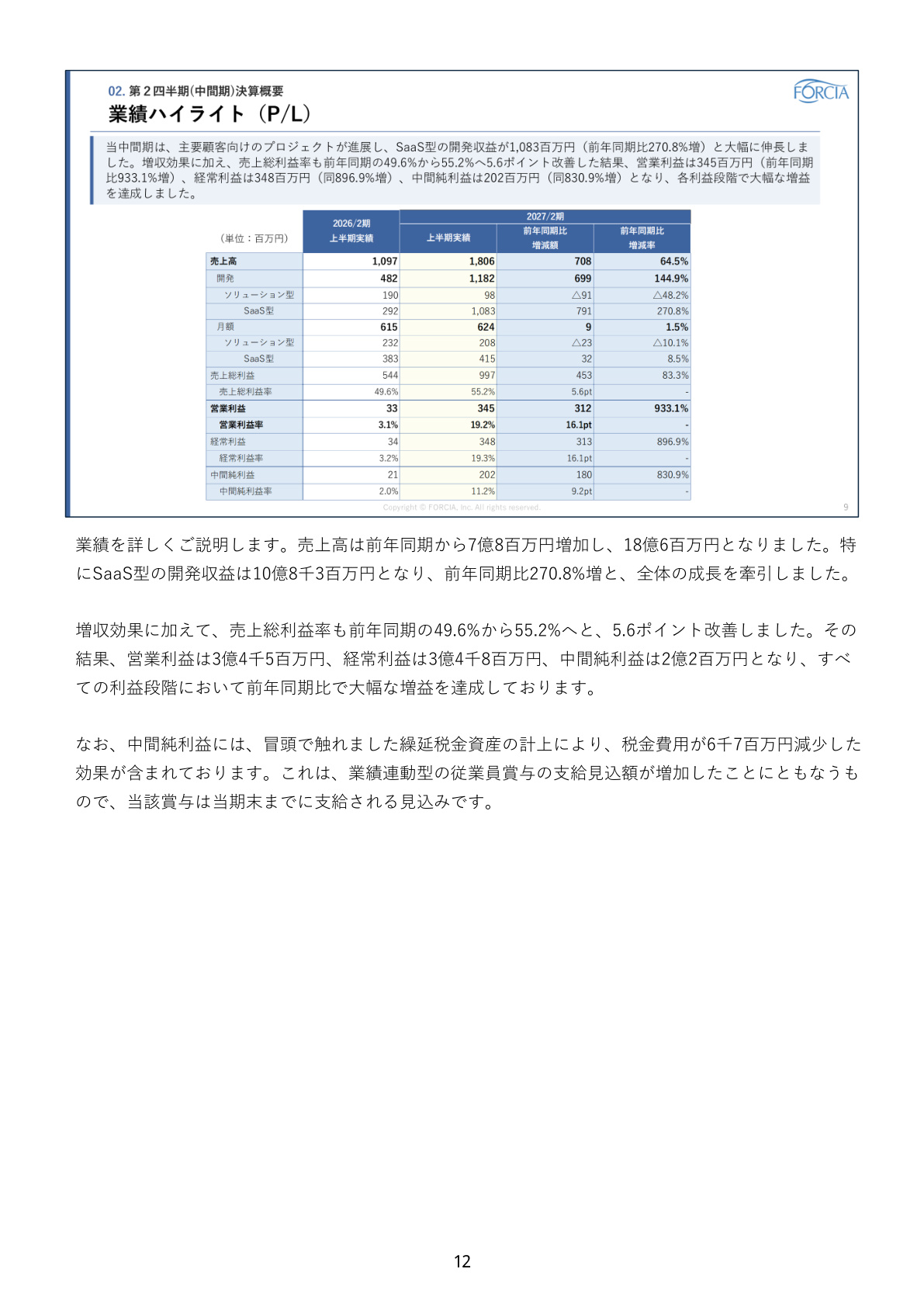
The earnings highlight slide above is a critical page that succinctly illustrates the dramatic growth in performance during this interim period and its underlying factors. Of particular note are the dramatic improvement in profit margins accompanying the expansion of net sales and the growth of SaaS-based products.
Trends in Key Financial Indicators
- Net Sales : 1.806 billion yen (+64.5% YoY)
- Development Revenue : 1.182 billion yen (+144.9% YoY)
- Of which SaaS-based: 1.083 billion yen ( +270.8% YoY)
- Of which Solution-based: 98 million yen (-48.2% YoY)
- Monthly Recurring Revenue : 624 million yen (+1.5% YoY)
- Of which SaaS-based: 415 million yen (+8.5% YoY)
- Of which Solution-based: 208 million yen (-10.1% YoY)
- Development Revenue : 1.182 billion yen (+144.9% YoY)
- Gross Profit : 997 million yen (+83.3% YoY)
- Gross Profit Margin : 55.2% (+5.6 percentage points improvement from 49.6% in the same period last year)
- Operating Profit : 345 million yen ( +933.1% YoY)
- Operating Profit Margin : 19.2% (+16.1 percentage points improvement from 3.1% in the same period last year)
- Ordinary Profit : 348 million yen (+896.9% YoY)
- Interim Net Profit : 202 million yen (+830.9% YoY)
Regarding the revenue structure, the shift from "Solution-based" services, which previously had strong characteristics of contract development, to " SaaS-based " services that provide standard functions as modules, has become clear. With SaaS-based development revenue surging to 1.083 billion yen, the gross profit margin rose to 55.2%, allowing the company to significantly absorb the increase in SG&A expenses (up 140 million yen) associated with sales growth and achieve a high operating profit margin of 19.2%.
Note that the interim net profit includes the effect of recording deferred tax assets (a reduction in tax expenses of approximately 67 million yen) associated with performance-linked employee bonus provisions.
3. Progress by Revenue Category and Customer Segment
Trends in Development Revenue and Monthly Recurring Revenue (Stock Revenue)
As a business model, the company has two pillars: " Development Revenue " from initial setup, customization, and core system construction, and " Monthly Recurring Revenue " from maintenance and licenses that accumulate stably after system launch. While the ratio of development revenue temporarily spiked in the second quarter due to the concentration of major project acceptances, monthly recurring revenue is also accumulating steadily. Monthly recurring revenue recorded 307 million yen on a quarterly basis, maintaining solid growth on an actual basis, excluding the impact of one-time cancellation fees from the same period last year. The design is such that long-term monthly stock revenue is expected to transition as major development projects for key clients go live sequentially.
Performance by Customer Segment
- Enterprise Segment : 1.276 billion yen ( +103.5% YoY)
- Multiple core system renewals and new service construction projects for major travel agencies progressed, serving as the primary driver of overall sales.
- Standard Segment : 500 million yen (+16.1% YoY)
- This segment addresses individual requirements of mid-sized companies while utilizing standard functions, steadily expanding the number of client implementations and sales.
- Basic Segment : 29 million yen (-25.5% YoY)
- A shared service for small-scale operators. While sales scale is currently limited, it is positioned as a base for expanding future customer touchpoints.
4. Financial Soundness (Balance Sheet)
The financial position as of the end of the second quarter of the fiscal year ending February 2027 remains extremely sound.
- Total Assets : 2.806 billion yen (+651 million yen from the end of the previous fiscal year)
- Following the acceptance of some major projects, a transfer from contract assets to accounts receivable occurred (accounts receivable 809 million yen, contract assets 534 million yen). Cash and deposits were 873 million yen (-414 million yen).
- Total Liabilities : 615 million yen (+449 million yen from the end of the previous fiscal year)
- Primarily due to increases in accrued corporate taxes and bonus provisions.
- Total Net Assets : 2.19 billion yen (+202 million yen from the end of the previous fiscal year)
- Net assets increased due to the recording of 202 million yen in interim net profit.
- Equity Ratio : 78.1%
The company maintains a solid equity ratio, ensuring the financial capacity to support growth investments and the parallel promotion of large-scale development projects.
5. Full-Year Earnings Forecast and Outlook for the Second Half
The progress status against the full-year earnings forecast is as shown in the slide below.
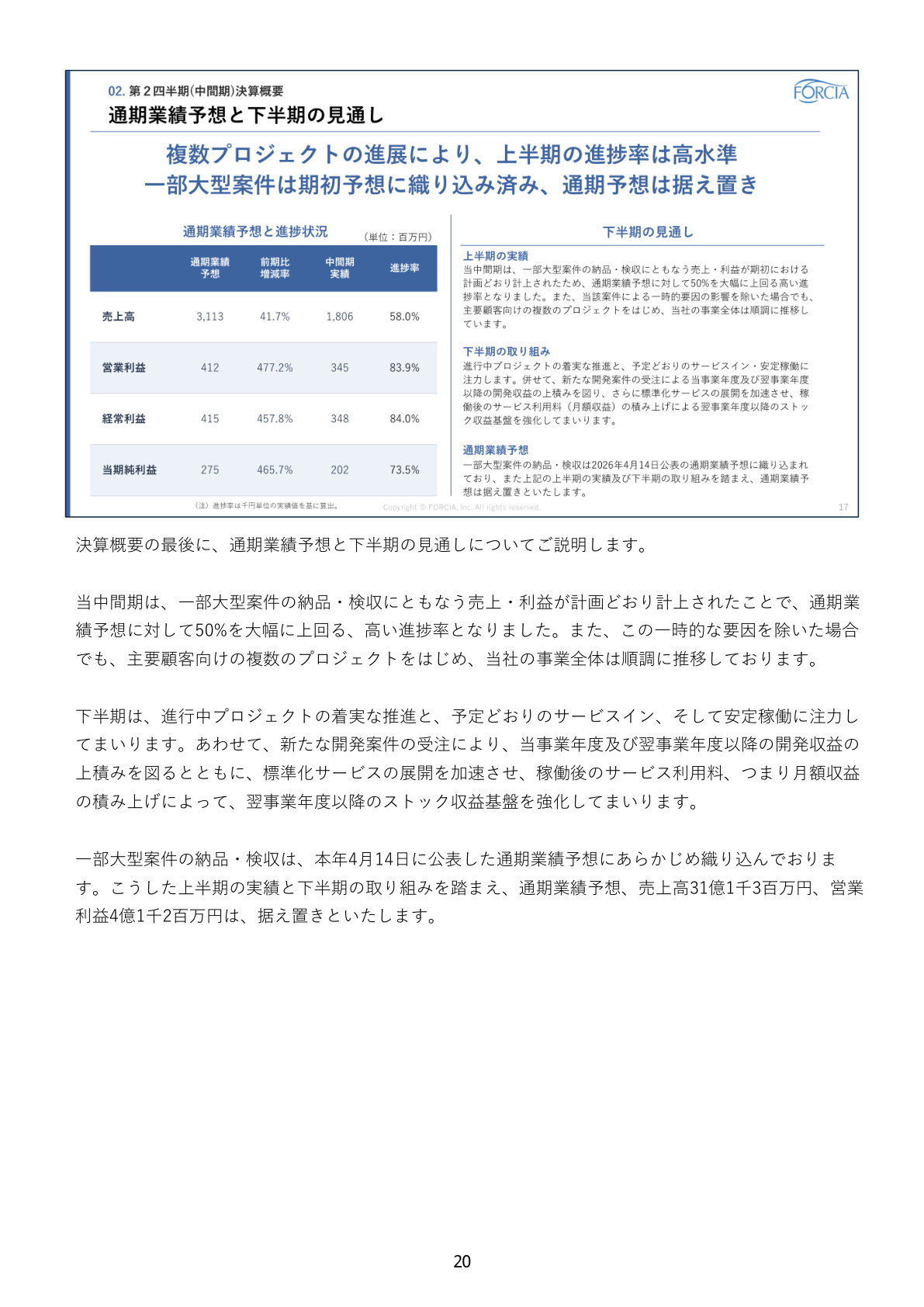
The reason this slide is important is that it clarifies the background and second-half initiatives regarding the market's biggest concern: "Why was the full-year forecast maintained despite reaching an 83.9% progress rate in operating profit by the interim period?"
Full-Year Earnings Forecast and Progress Rate
- Net Sales : 3.113 billion yen (+41.7% YoY) / Interim Results: 1.806 billion yen (Progress Rate 58.0% )
- Operating Profit : 412 million yen (+477.2% YoY) / Interim Results: 345 million yen (Progress Rate 83.9% )
- Ordinary Profit : 415 million yen (+457.8% YoY) / Interim Results: 348 million yen (Progress Rate 84.0% )
- Net Profit (Full-Year Forecast) : 275 million yen (+465.7% YoY) / Interim Results: 202 million yen (Progress Rate 73.5% )
Background for Maintaining Forecasts and Second-Half Policy
The major projects for which delivery and acceptance were completed in the second quarter were already factored into the full-year earnings forecast announced at the beginning of the fiscal year (April 14, 2026). Therefore, the performance is in line with the company's plan, and the full-year earnings forecast remains unchanged.
In the second half, the company plans to focus on the reliable service launch and stable operation of ongoing projects, while also working to secure new development orders for growth in the next fiscal year and beyond. Furthermore, the company plans to accelerate the deployment of standardized services and strengthen monthly recurring revenue (stock revenue base) after service launch.
6. Mid-to-Long-Term Growth Strategy: Three Steps and Progress
The company has presented a clear roadmap to evolve from a mere contract development company into a "data distribution platform for the travel and tourism industry."
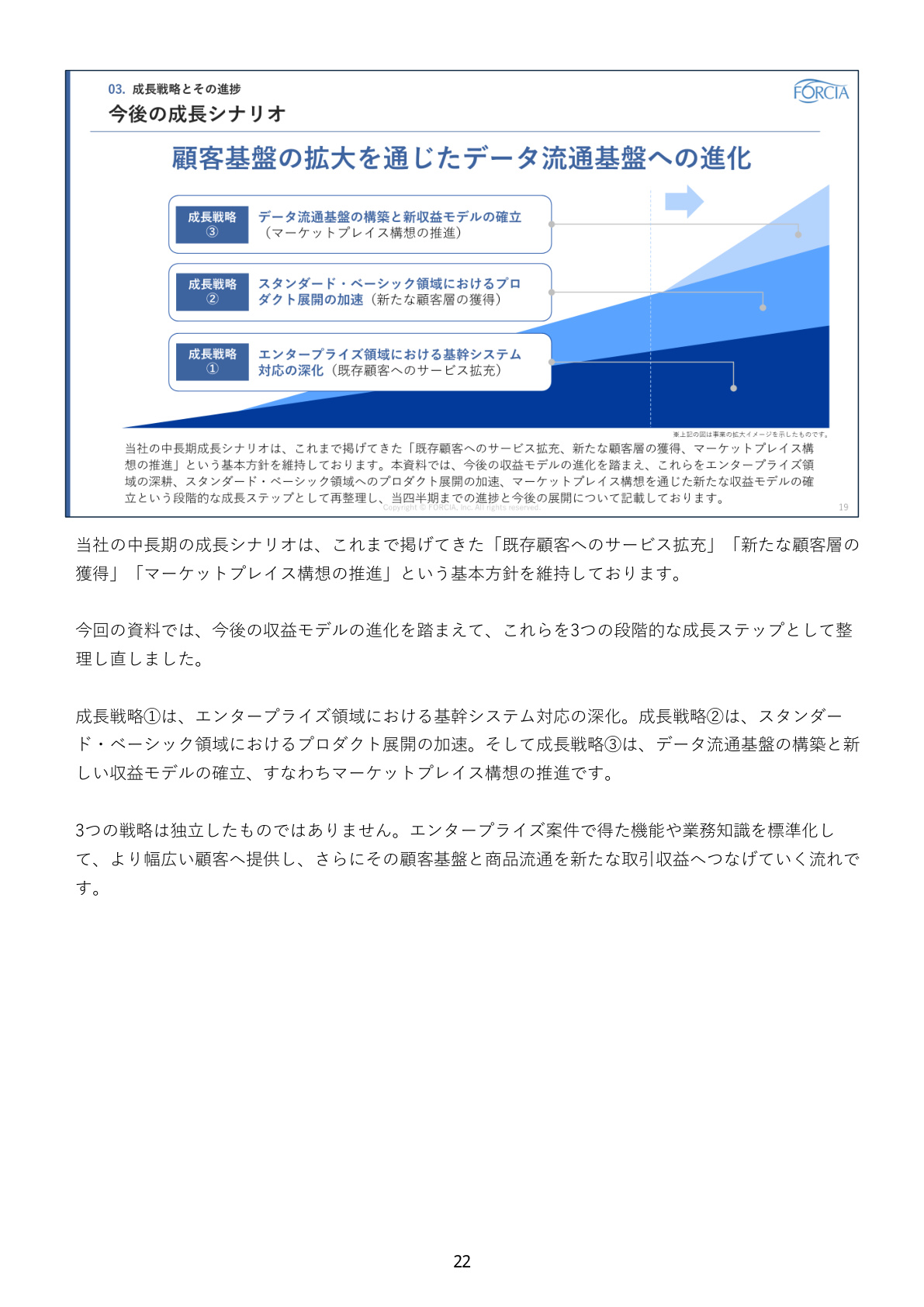
This slide is the core framework that systematizes the evolution process of FORCIA,Inc.'s mid-to-long-term value proposition and revenue model. The three growth strategies are not isolated but are designed to scale in conjunction with one another.
Growth Strategy ①: Deepening Core System Support in the Enterprise Segment
Through core system renewals and new service construction for major travel agencies, the company establishes deep operational know-how and a foundation of trust. During this interim period, the design and development phases for major clients were completed, and renewal projects for accommodation reservation systems and group travel systems progressed. Additionally, the company has introduced AI-driven development and review methods at development sites, initiating verification and practical application aimed at reducing development man-hours and improving quality.
Growth Strategy ②: Accelerating Product Deployment in Standard and Basic Segments
The company standardizes functions cultivated in enterprise projects and aims for horizontal deployment as " webコネクト (Light Plan) " for mid-sized operators and non-travel companies (MaaS operators, transportation companies, companies with membership services, etc.). This strategy captures the needs of non-travel companies to incorporate travel and tourism products into their own services.
Growth Strategy ③: Building a Data Distribution Foundation and Establishing New Revenue Models (Marketplace Concept)
Centering on " valueコネクト ," which connects tourism material suppliers (suppliers) and sellers (sellers), the company is building a product distribution platform. In addition to the traditional revenue structure of "development revenue + monthly maintenance fees," the company aims to establish a new revenue model that expands take-rate (transaction fee) revenue based on distribution transaction volume.
7. Major Business Developments and Future Topics of Interest
During this period and recently, concrete achievements symbolizing cross-industry collaboration and platformization have occurred in succession.
- **Tourism MaaS (Collaboration with Toyota Financial Services)
- Participated in a project led by Toyota Financial Services under the Ministry of Land, Infrastructure, Transport and Tourism's FY2026 "Tourism MaaS Promotion Project."
- Providing "valueコネクト" and "webコネクト" as a common reservation infrastructure for the MaaS app "** my route **," building a system that allows users to search, book, and pay for transportation tickets and content such as sightseeing, experiences, and dining all within the app (final stage toward service launch).
- ** Implementation at Mitsui-Isetan Nikko Travel
- In September 2026, began providing "webコネクト" and "valueコネクト" to Mitsui-Isetan Nikko Travel.
- Expanded new functions necessary for escorted tours, such as customer/member management, tour operation management, and revenue management. Plans to launch an OTA-style travel sales service for identified Mitsui-Isetan Group customers starting in March 2027.
- **Promotion of Tourism Distribution DX and Industry Standardization
- Strengthened external communication to lead the digitalization of the entire supply chain, such as participating in the Tourism Industry Cashless Promotion Council and holding seminars at Tourism EXPO Japan 2026.
8. Conclusion
FORCIA,Inc.'s Q2 FY2027 earnings results not only showed a sharp increase in profit due to the completion of major project acceptances but also proved that the ** shift to a high-profit SaaS-based model ** and the ** deepening of the enterprise foundation** are progressing steadily. For the second half and the next fiscal year, the company has clearly outlined a growth story: standardizing these development assets to expand into other industries such as MaaS and membership services, and adding take-rate revenue through "valueコネクト."
This content is not intended as investment advice or a recommendation. Any opinions expressed are solely the personal views of each article.