

Kitanotatsujin Corporation (2930) Business Overview and Model Analysis: The D2C In-House System Driving High Profitability and the 'Minimizing Revenue, Maximizing Profit' Philosophy

Sentiment Analysis
Kitanotatsujin Corporation (Securities Code: 2930) held its financial results briefing for the second quarter of the fiscal year ending February 2027, providing a detailed explanation of its business overview and the unique business model that supports its growth.
The company is a D2C (Direct to Consumer) enterprise engaged in the planning and sale of cosmetics and health foods. It has established a unique market position over many years through rigorous management of return on investment and a thorough in-house operational structure. This report provides a comprehensive overview of the company's business foundation, product development philosophy, unit economics of subscription services, and its proprietary management theory: the "Law of Minimizing Revenue and Maximizing Profit."
1. Company Overview and Full-Year Earnings Forecast
Founded in May 2000 and incorporated in May 2002, the company is listed on the Tokyo Stock Exchange Prime Market and the Sapporo Securities Exchange Main Board. The group includes SALONMOON Co., Ltd. , which offers hair irons, and Karacon Direct Co., Ltd.
The earnings trends and forecasts disclosed are as follows:
- FY2026 Results : Revenue of 11.21 billion yen , Operating Profit of 1 billion yen
- FY2027 Full-Year Forecast : Revenue of 15.96 billion yen , Operating Profit of 1.05 billion yen
The company operates with a dual-headquarters structure in Tokyo (Kabukiza Tower) and Sapporo (Sapporo Sosei Square), with 250 directors and employees (as of May 31, 2026).
2. Source of Competitiveness: A D2C Business Model Specialized in In-House Operations
While typical e-commerce and mail-order companies tend to rely on external partners for many processes such as advertising operations, customer support, and system development, Kitanotatsujin Corporation operates almost all business functions in-house , with the exception of product manufacturing (OEM outsourcing) and logistics/shipping services.
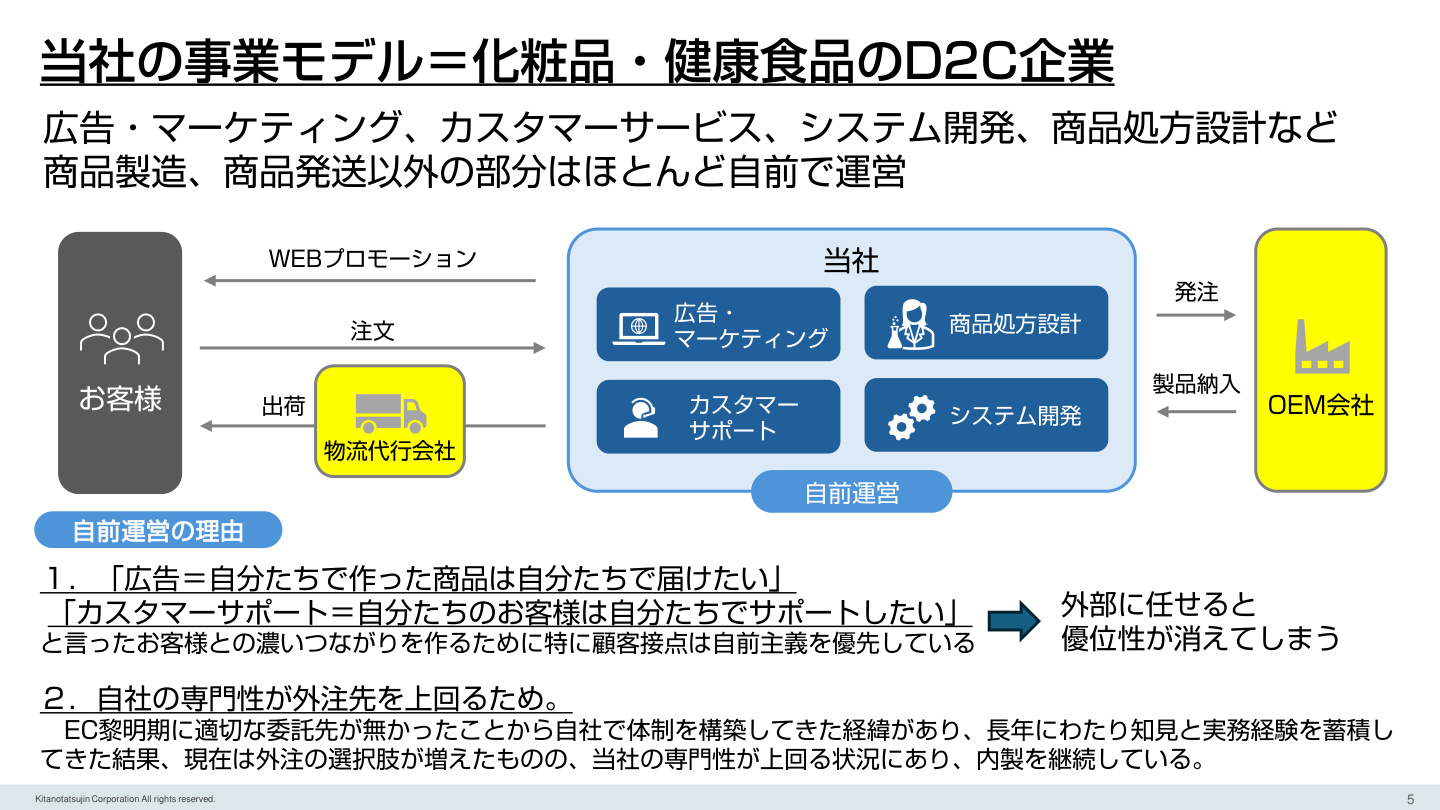
[Slide Commentary: The Competitive Advantage of the Business Model Shown in Slide 5]
Slide 5 clearly illustrates which functions the company handles within the supply chain and which are outsourced. The reasons for the company's commitment to in-house operations are summarized in the following two points:
- In-House Customer Touchpoints : Based on the philosophy of "wanting to deliver and support the products we create ourselves," the company builds deep connections with customers by directly controlling advertising, marketing, and customer support. Outsourcing these functions would dilute the company's differentiation and competitive advantage.
- Accumulation of Expertise Surpassing External Providers : Having started in-house operations because appropriate outsourcing partners did not exist during the early days of e-commerce, the company has accumulated know-how and practical experience that now exceed the expertise of external vendors.
This vertical integration-like in-house model serves as a platform that enables rapid improvement cycles and high profitability.
3. Rigorous Product Development Rules and Quality Control System
The company's flagship brand, "Kitano Kaiteki Kobo," does not aim for mass appeal but instead focuses on products that address "pinpoint and deep-seated concerns."
- Development Policy : The company sets an extremely strict standard known as "Satisfaction Quality," with a rule to "only launch products when we have created something surprisingly good."
- Quality Evaluation : The company has established 1,527 original evaluation items as quality standards for both pre-use and usage stages.
- Living Environment Testing : All directors and employees use the products for one month in the same living environment as customers, while reading the actual materials (manuals, booklets, etc.) sent to them. They thoroughly verify from a user's perspective whether, for example, "the quality remains stable even if left in the bathroom for a long period" or "there are any deficiencies in the manual."
Flagship Product Achievements
- 'Kaiteki Oligo' : A household oligosaccharide food product that improves bowel movements for those prone to constipation. It is a long-selling product that has received notification as a Food with Function Claims, holds a formulation patent (No. 6328422), and has won the Monde Selection award 13 times.
- 'Deep Patch Series' : Cosmetics that apply medical microneedle technology to deliver beauty ingredients solidified into needles directly into the stratum corneum. With cumulative sales exceeding 66 million patches , it has been recognized by Guinness World Records™ for 7 consecutive years as the largest brand in the beauty microneedle skin patch category.
4. The "Enka Strategy" and Subscription Model for Revenue Stability
One of the company's management philosophies is the "Enka Strategy," which is not swayed by temporary booms. Avoiding models that explode in popularity like pop music only to fade rapidly, the company focuses on developing and nurturing products that are loved for a long time, like Enka music, generating stable revenue over the long term.
This strategy is supported by a subscription business model . Currently, the company has nearly 300,000 subscription customers . While a single-purchase business requires generating new sales from scratch every month, the subscription model allows new customers to accumulate as recurring revenue for subsequent months, dramatically increasing the predictability and stability of revenue as the business scales.
5. Profit Structure and Unit Economics of Subscriptions
To grow a subscription model appropriately, precise balance management between Customer Acquisition Cost (CPO) and Customer Lifetime Value (LTV) is essential.
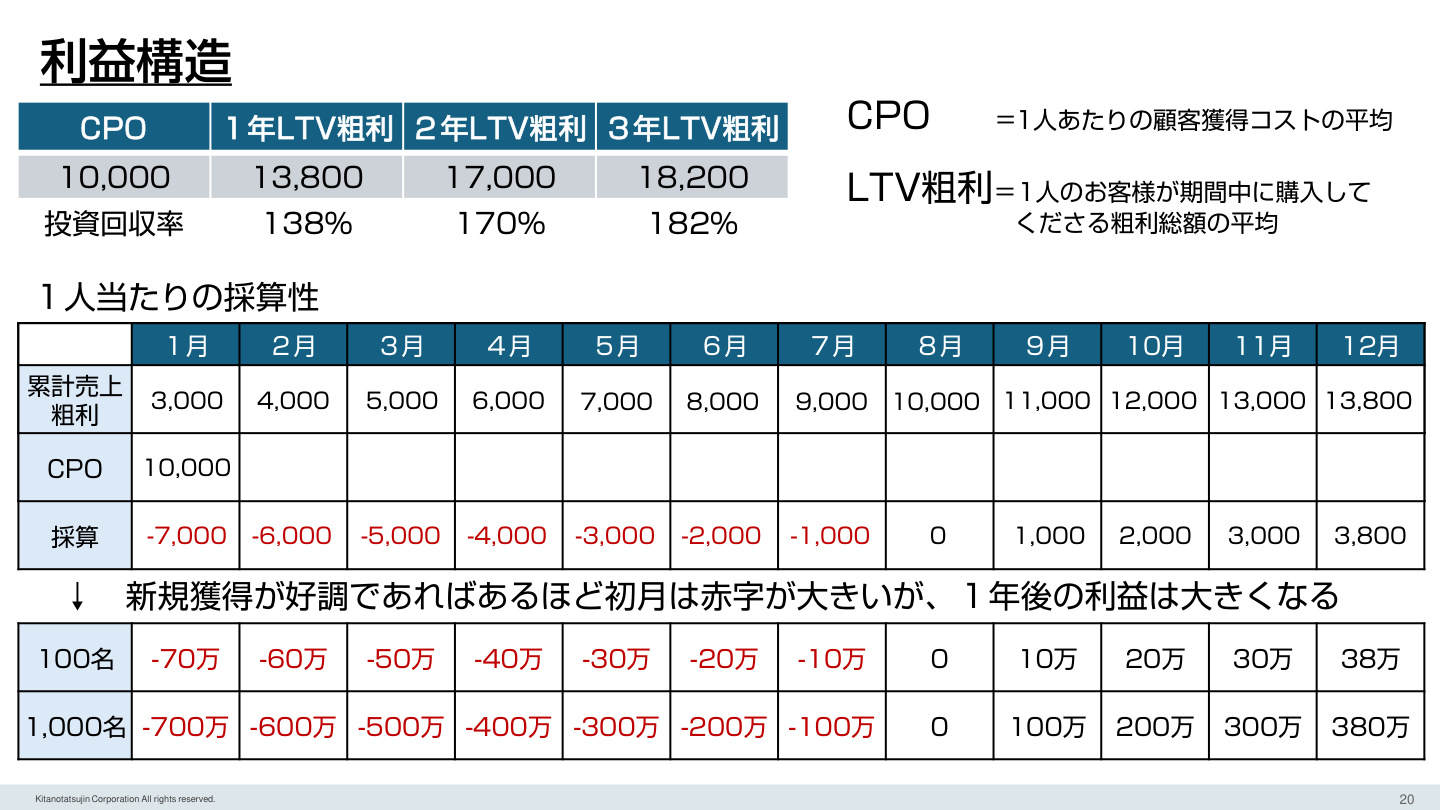
[Slide Commentary: The Mechanism of the Profit Structure Shown in Slide 20]
Slide 20 shows a simulation of investment recovery when acquiring new customers.
- CPO (Customer Acquisition Cost) : 10,000 yen per person
- LTV Gross Profit Trends :
- 1-Year LTV Gross Profit: 13,800 yen (Investment Recovery Rate: 138% )
- 2-Year LTV Gross Profit: 17,000 yen (Investment Recovery Rate: 170% )
- 3-Year LTV Gross Profit: 18,200 yen (Investment Recovery Rate: 182% )
Under this structure, since a CPO of 10,000 yen is incurred against a gross profit of 3,000 yen per customer in the first month, there is a 7,000 yen loss (negative profitability) in the first month alone. The more successful the new customer acquisition, the larger the accounting loss in the first month.
However, as acquired customers continue to use the product, the cumulative gross profit balances out with the CPO in the 7th month (recovery complete), and from the 8th month onward, it shifts to a period of pure profit contribution. The design generates a profit of 3,800 yen per person after one year, establishing a unit economics model where "losses as upfront investments are accepted, and are reliably recovered over the long term through LTV gross profit."
6. Implementation of the Unique Theory: "The Law of Minimizing Revenue and Maximizing Profit"
At the root of the company's management philosophy is the "Law of Minimizing Revenue and Maximizing Profit," built from the personal experiences of President Katsuhisa Kinoshita.
At the time of founding, the company had very limited capital and operated in an environment where "a loss meant immediate death." This led to the formation of a philosophy that prioritizes "the profit that definitely remains on hand against the advertising expenses invested" rather than "increasing revenue." Furthermore, as the company scaled, it faced the challenge that "fixed costs in the back-office department expand in tandem with the increase in product orders and shipments," leading to the conclusion that "for the same amount of profit, lower revenue is superior in management as it keeps fixed cost risks lower."
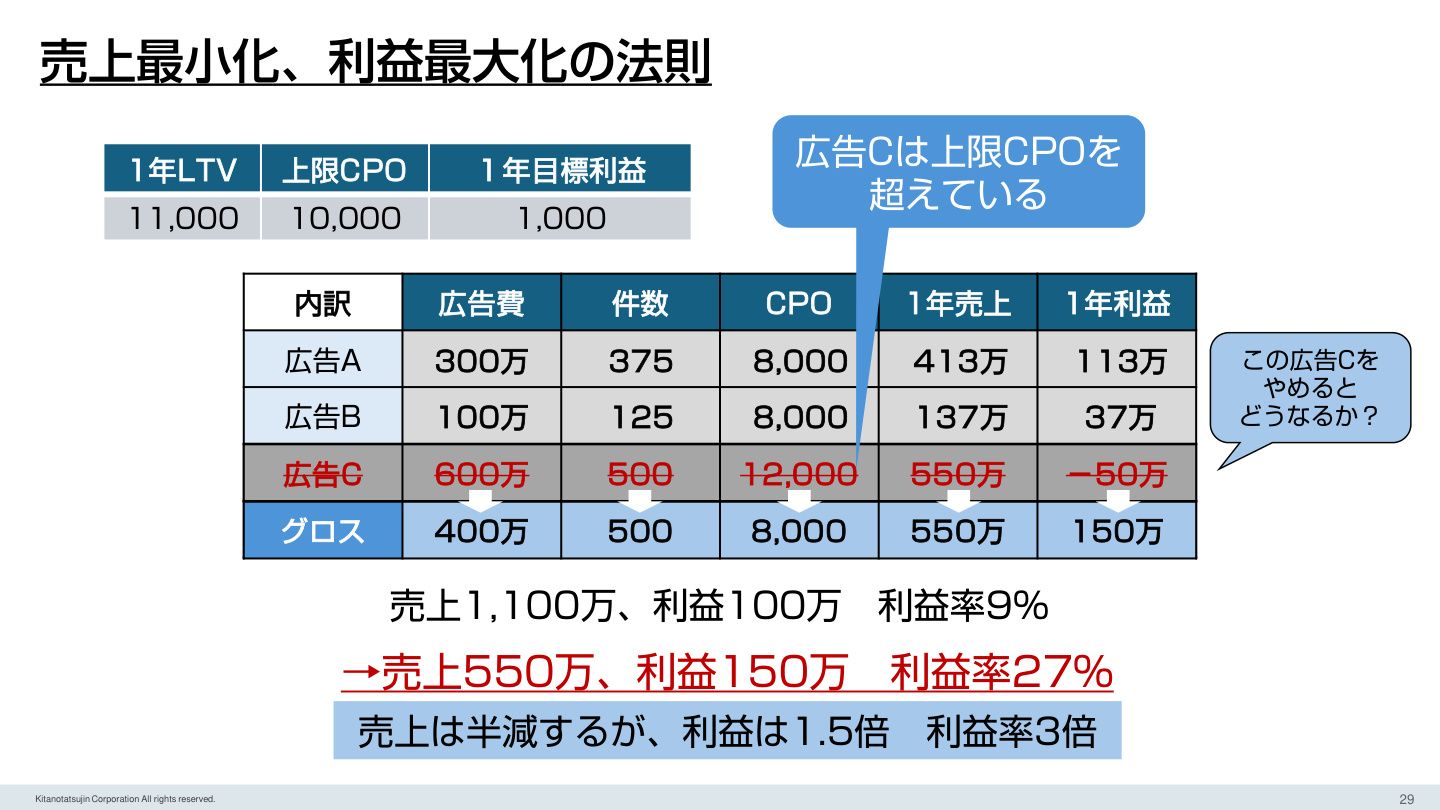
[Slide Commentary: The Logic of Profit Improvement Shown in Slide 29]
Slide 29 analyzes the marginal profitability of each advertisement and specifically shows how the profit structure is dramatically improved by eliminating unprofitable measures.
- Before Improvement (Total Aggregate) :
- Advertising Expenses: 10 million yen, Number of Acquisitions: 1,000, CPO: 10,000 yen (within the CPO limit)
- 1-Year Revenue: 11 million yen, 1-Year Profit: 1 million yen , Profit Margin: 9%
- Analysis of Breakdown :
- Ad A: Ad Expenses 3 million yen, CPO 8,000 yen, 1-Year Profit 1.13 million yen
- Ad B: Ad Expenses 1 million yen, CPO 8,000 yen, 1-Year Profit 0.37 million yen
- Ad C: Ad Expenses 6 million yen, CPO 12,000 yen (exceeding limit), 1-Year Profit -0.5 million yen (loss)
- After Improvement (Stopping unprofitable Ad C) :
- Advertising Expenses: 4 million yen, Number of Acquisitions: 500, CPO: 8,000 yen
- 1-Year Revenue: 5.5 million yen ( Revenue halved )
- 1-Year Profit: 1.5 million yen ( Profit increased 1.5 times )
- Profit Margin: 27% ( Profit margin improved 3 times )
Even if a measure appears profitable in the aggregate, by strictly managing the marginal CPO by medium and creative, and cutting off loss-making factors, it becomes possible to "increase total profit and profit margin simultaneously while reducing the scale of revenue." By consistently executing this mathematical approach, the company has achieved 10 billion yen in revenue and 2.9 billion yen in profit while maintaining a debt-free management status.
7. Corporate Philosophy and Future Outlook
The company upholds the following philosophy as its medium- to long-term policy:
- Mission : To improve the world's QOL by 1% with surprisingly good products
- Vision : To become a next-generation global D2C manufacturer representing Japan
- Value : A group of experts who turn "interesting" into reality to create "thank yous"
Kitanotatsujin Corporation combines its in-house development capabilities, thorough quality control, in-house operations, and precise unit economics to maintain a sustainable high-profit structure while promoting business activities with an eye toward global expansion beyond Japan.
This content is not intended as investment advice or a recommendation. Any opinions expressed are solely the personal views of each article.