

OXIDE Corporation Q2 FY2027 Financial Results: Significant Revenue and Profit Growth Driven by Semiconductor Business, Upward Revision of Full-Year Forecast and Early Achievement of Mid-Term Targets

Sentiment Analysis
Overview and Executive Summary
OXIDE Corporation (Securities Code: 6521) announced its financial results for the second quarter of the fiscal year ending February 2027, delivering strong performance characterized by significant revenue growth and a turnaround to operating profit, led by its core semiconductor business.
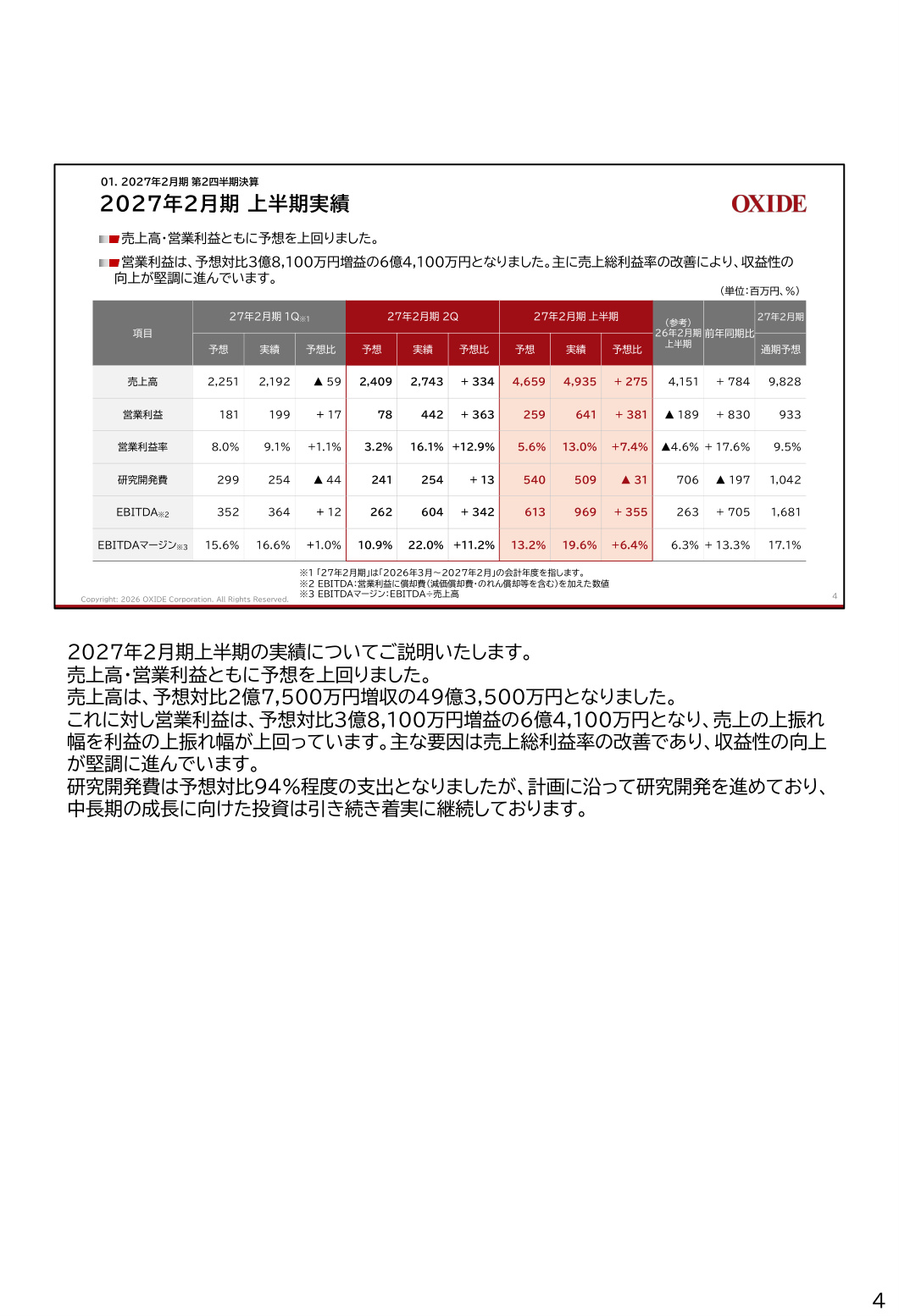
For the first half of the fiscal year, total company revenue reached 4.935 billion yen (an increase of 784 million yen year-on-year), with an operating profit of 641 million yen (compared to an operating loss of 189 million yen in the same period last year). Profitability metrics improved dramatically, with an operating margin of 13.0% (up 17.6 percentage points year-on-year) and an EBITDA margin of 19.6% (up 13.3 percentage points year-on-year). All four key performance indicators exceeded internal forecasts, with the operating margin for the second quarter (standalone) reaching 16.1%.
In light of these results, the company has upwardly revised its full-year consolidated earnings forecast for the fiscal year ending February 2027. Revenue has been raised from the previous forecast of 9.828 billion yen to 10.323 billion yen, and operating profit from 933 million yen to 1.367 billion yen. Furthermore, in response to the rapid expansion of the generative AI and data center markets—expected to be long-term growth drivers—the company has decided to make large-scale capital investments in "Faraday rotators" for optical communications, balancing an aggressive growth strategy with improvements in financial health (a reduction in Net Debt/EBITDA).
Analysis of H1 Consolidated Results for the Fiscal Year Ending February 2027
The following slide summarizes the performance for Q1, Q2, and the cumulative first half of the fiscal year ending February 2027, compared against initial forecasts and the same period of the previous year.
Slide Commentary and Background of Performance
As shown in the slide above, revenue for the first half of the fiscal year ending February 2027 was 4.935 billion yen, an increase of 275 million yen against the initial forecast. Particularly noteworthy is the growth in operating profit, which reached 641 million yen, exceeding the forecast by 381 million yen. The structure of this performance shows that the profit upside (up 381 million yen) exceeded the revenue upside (up 275 million yen), primarily due to a significant improvement in the gross profit margin.
Looking at the quarterly progression, operating profit expanded rapidly from 199 million yen in Q1 (operating margin of 9.1%) to 2.743 billion yen in revenue and 442 million yen in operating profit in Q2 (operating margin of 16.1%). While maintaining investment in future technology foundations with R&D expenses totaling 509 million yen for the first half (94% of the forecast), the company secured a high EBITDA of 969 million yen (19.6% margin). The results clearly demonstrate a complete departure from the operating loss (189 million yen) recorded in the same period last year, marking a transition into a phase of robust profitability.
Detailed Trends by Business Segment
1. Semiconductor Business: Expansion Outpacing Market Growth and Record-High Orders
The semiconductor business was the primary driver of the company's strong performance. Revenue for the first half reached 3.259 billion yen (up 70% year-on-year, up 338 million yen against forecast). This growth significantly outpaces the expansion of the wafer fabrication equipment (WFE) market (projected by SEMI to grow by 23.2% in 2026), driven by strong shipments of single crystals and laser products, in which the company holds a high market share.
Regarding order trends, the company recorded record-high orders of 3.456 billion yen for the first half (compared to 1.951 billion yen in the same period last year). The order backlog at the end of the second quarter remained at a high level of 3.39 billion yen, and the company has continued to see extremely solid order momentum, including the acquisition of large-scale orders in September, the start of the third quarter.
Furthermore, the following key measures are progressing in technology and business development:
- Development of Deep-UV Femtosecond Lasers for Advanced Semiconductor Back-end Processes: By integrating wavelength conversion technology with the femtosecond laser technology of Poland-based Fluence, the company has developed a high-output, short-pulse laser with a wavelength of 258nm. This accelerates expansion into the micro-fabrication market for advanced packaging such as CoWoS and CoPoS, as well as Co-Packaged Optics (CPO).
- Appointment of Management Strategy Advisor: The company has appointed Mr. Shin Kayama, former head of Toshiba's semiconductor business and recipient of the IEEE Robert N. Noyce Medal, as a Management Strategy Advisor to strengthen the business portfolio and global expansion.
2. Healthcare Business: Addressing Rising Raw Material Costs and Reviewing Transaction Terms
Revenue for the healthcare business in the first half was 874 million yen (up 36 million yen against forecast, down 285 million yen year-on-year). Although the first-half plan was achieved because shipments delayed from the first quarter contributed to the second quarter, revenue decreased compared to the same period last year. Currently, the company is facing deteriorating procurement environments and soaring prices for key raw materials, and is continuing discussions with major customers to review transaction terms. The company is prioritizing profitability and focusing on negotiations to secure appropriate margins.
3. New Business Fields: Demand for Data Centers and Impact of Timing Differences
Revenue for the new business fields in the first half was 800 million yen (down 99 million yen against forecast, down 271 million yen year-on-year). While shipments of Faraday rotators for data centers, driven by the spread of generative AI, generally proceeded according to plan, the downward variance was caused by the delay of certain projects in other areas to the second half. However, inquiries for optical communications and data centers, which are focus areas, remain extremely strong.
Upward Revision of Full-Year Consolidated Earnings Forecast for the Fiscal Year Ending February 2027
Reflecting the strong progress in the first half and the outlook for the second half, the full-year consolidated earnings forecast has been upwardly revised. The details are shown in the slide below.
Slide Commentary and Revision Points
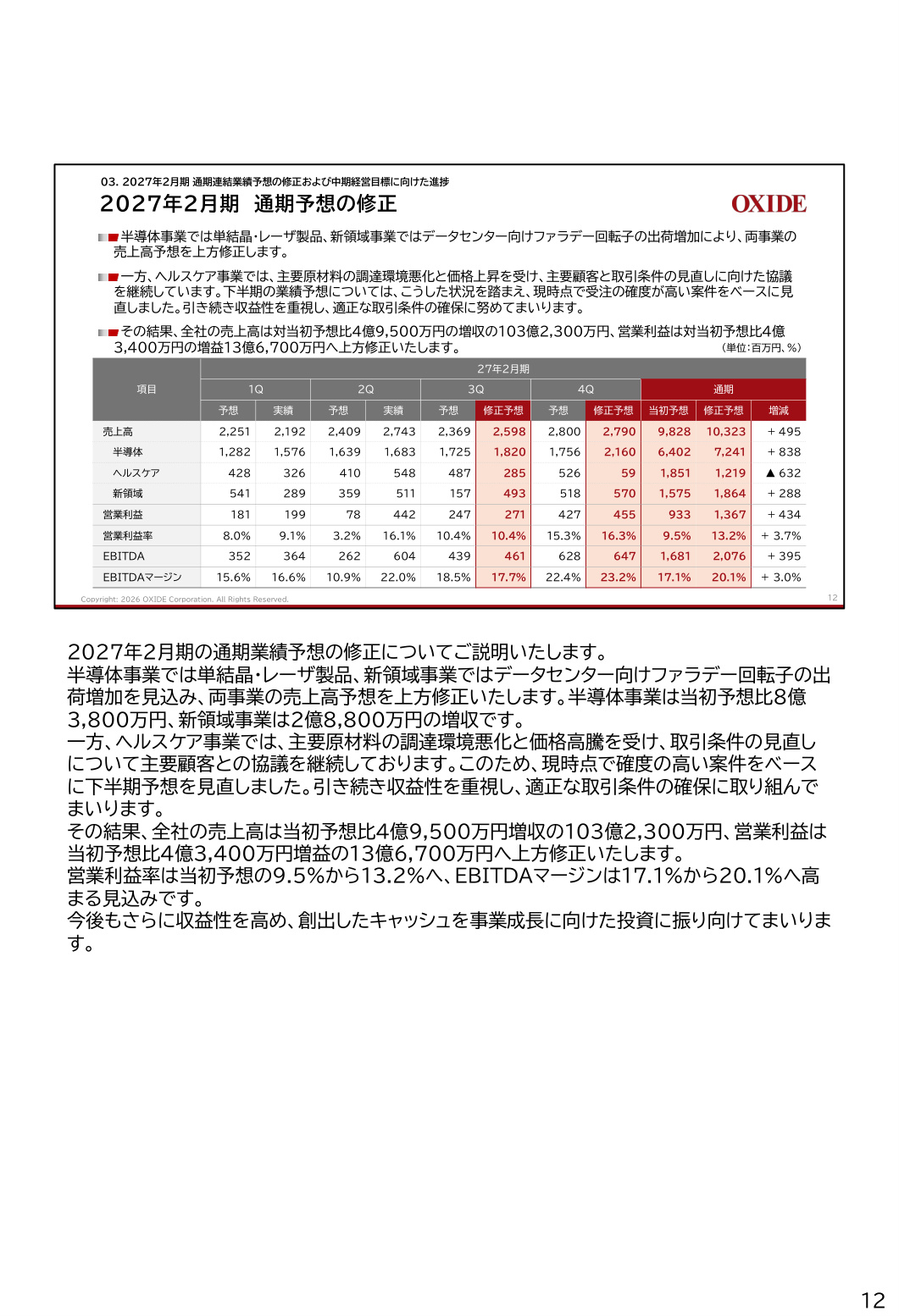
The most notable aspects of the full-year forecast revision are that revenue is expected to exceed the 10 billion yen milestone to reach 10.323 billion yen (up 495 million yen from the initial forecast) and operating profit has been raised to 1.367 billion yen (up 434 million yen from the initial forecast, a significant upward revision of 46.5%).
The revisions by segment are as follows:
- Semiconductor Business: Significantly increased from the initial forecast of 6.402 billion yen to 7.241 billion yen (up 838 million yen). High shipment levels are expected to continue in the second half.
- New Business Fields: Upwardly revised from the initial forecast of 1.575 billion yen to 1.864 billion yen (up 288 million yen), anticipating increased shipments of Faraday rotators for data centers.
- Healthcare Business: Based on the status of discussions regarding rising raw material costs and the review of transaction terms, the forecast has been reduced from the initial 1.851 billion yen to 1.219 billion yen (down 632 million yen), reflecting a focus on projects with higher certainty.
Due to this portfolio shift, the full-year operating margin is expected to improve significantly from the initial 9.5% to 13.2% (up 3.7 percentage points), and the EBITDA margin from 17.1% to 20.1% (up 3.0 percentage points).
Progress Toward Mid-Term Management Targets: Achieving Operating Margin Target One Year Early
In the mid-term management targets disclosed in April 2026, the company set goals of an "operating margin of 12% and EBITDA margin of 22%" for the fiscal year ending February 2028, and "revenue of 13 billion yen, operating margin of 14%, and EBITDA margin of 23%" for the fiscal year ending February 2029.
With this upward revision of the full-year forecast (operating margin of 13.2%), the company is expected to achieve the 12% operating margin target set for the fiscal year ending February 2028 one year ahead of schedule. Additionally, the EBITDA margin of 20.1% is within range of the fiscal year ending February 2028 target (22%). The company has indicated its intention to consider revising its mid-term management targets after assessing progress in the second half.
Balancing Growth Investment and Financial Health
Against the backdrop of a rapid recovery in profitability, the company is boldly proceeding with capital investments to capture the explosive growth of the generative AI market.
Slide Commentary and Capital Investment Plan
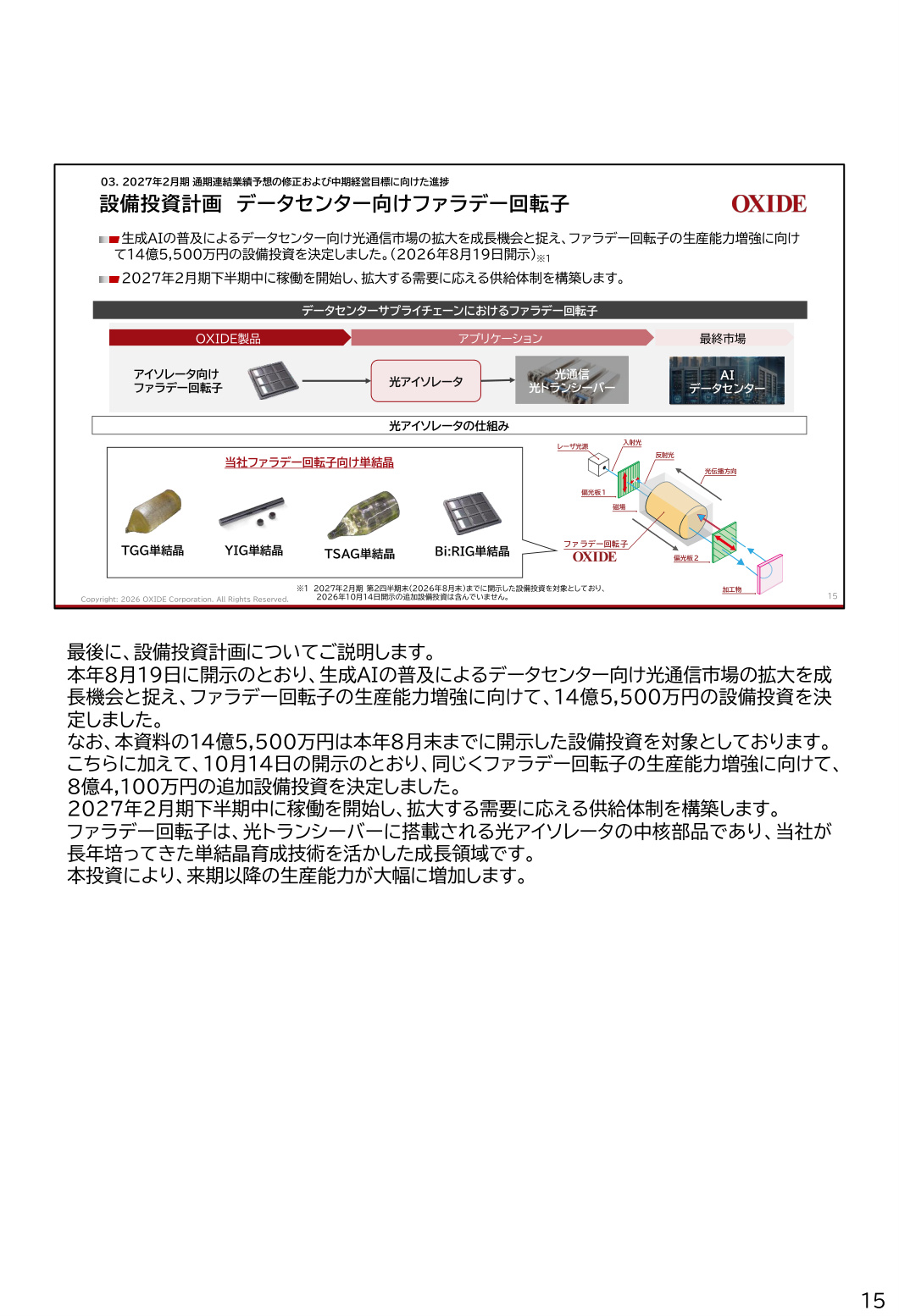
As shown in the slide above, the company has decided to make large-scale investments to increase production capacity for Faraday rotators for optical isolators, which are key components of optical transceivers for data centers. In addition to the 1.455 billion yen capital investment disclosed on August 19, 2026, an additional investment of 841 million yen was decided on October 14. The company plans to begin operations sequentially during the second half of the fiscal year ending February 2027 to establish a supply system capable of meeting the rapidly increasing demand from the next fiscal year onward.
As a result, the total capital investment for the fiscal year ending February 2027 is expected to nearly double to just under 3 billion yen from the initial plan of 1.555 billion yen (excluding the additional amount disclosed on October 14).
Steady Improvement in Financial Health
While promoting large-scale capital investments, the company's financial position is rapidly improving due to increased cash-generating ability from profit growth.
- Net Debt/EBITDA: Significantly decreased from 7.1x at the end of the fiscal year ended February 2025 to 3.7x at the end of the fiscal year ended February 2026, and further to 2.6x at the end of the second quarter of the fiscal year ending February 2027.
- Equity Ratio: Stood at 34.7% at the end of the second quarter of the fiscal year ending February 2027, an increase of 2.9 percentage points from the end of the previous fiscal year.
In this way, a cycle is being established where the company steadily executes upfront investments in high-growth markets while appropriately maintaining financial discipline.
Summary and Future Outlook
OXIDE Corporation's financial results for the second quarter of the fiscal year ending February 2027 mark a milestone that clearly demonstrates the overwhelming recovery of its core business, driven by the expansion of demand for lasers and single crystals for semiconductor wafer defect inspection equipment, and the cultivation of its second pillar: Faraday rotators for AI and data centers.
Key points to watch in the future include:
- The digestion of the semiconductor business order backlog and the progress in commercializing new products for advanced back-end processes (Deep-UV femtosecond lasers).
- The ramp-up status of investments to increase production of Faraday rotators and the pace of shipment expansion for data centers.
- The timing of reaching agreements on price and transaction terms with customers in the healthcare business and the recovery of profitability.
- The content of the rolling (upward revision) of mid-term management targets, which are expected to be achieved one year early.
These financial results confirm that the company is steadily advancing the restructuring of its business portfolio toward high-profitability, centered on high-value-added optical technology.
This content is not intended as investment advice or a recommendation. Any opinions expressed are solely the personal views of each article.