

CENTRAL REIT Investment Corporation Fiscal Period Ended August 2026 (17th Period) Earnings Deep Dive: Growth Strategy Under the Dual-Sponsor Structure and Underlying Earning Power Overcoming Temporary Headwinds
Sentiment Analysis
CENTRAL REIT Investment Corporation (Securities Code: 3488) reported its financial results for the 17th fiscal period (ended August 2026), with distributions per unit reaching 3,411 yen (up 173 yen from the previous period and 68 yen above the initial forecast), marking a dividend increase that exceeded expectations. Since the transition to a "dual-sponsor structure" involving Meitetsu Urban Development and Xymax Group, the REIT has been concentrating its investments in the Chubu region, centered on Nagoya, and strengthening its portfolio's earnings base.
This report provides a multifaceted analysis of 10 key topics, including the details of the 17th period results, temporary factors affecting the 18th and 19th period earnings forecasts (a major tenant departure at Sapporo Odori), the strong internal growth of the office segment, financial management in preparation for rising interest rates, and the medium- to long-term roadmap for scale expansion.
1. Highlights of the 17th Fiscal Period (Ended August 2026) Results
Operating revenue for the 17th period was 1,967 million yen (up 6 million yen from the initial forecast), operating profit was 1,075 million yen (up 7 million yen), ordinary profit was 897 million yen (up 17 million yen), and net income was 896 million yen (up 17 million yen). Distributions per unit were 3,411 yen , an increase of 68 yen from the publicly announced forecast of 3,343 yen.
Compared to the previous period (16th period: 3,238 yen), despite the dilutive effect of the third-party allotment (▲161 yen), increased non-operating expenses such as higher borrowing costs (▲210 yen), and higher SG&A expenses (▲50 yen), the full-period contribution from newly acquired properties "Enishio Meieki" and "Kamimaezu KD Building" (+491 yen) and rent increases and cost optimization at existing properties (+89 yen) significantly outweighed these factors, achieving a dividend increase of 173 yen compared to the previous period .
2. Portfolio Overview and Key Indicators
The status of the portfolio as of the end of the 17th period (August 31, 2026) is as follows:
- Number of properties : 20 properties
- Asset size (based on acquisition price) : 50.5 billion yen
- Appraisal value : 65.3 billion yen ( unrealized gain of 14.1 billion yen, unrealized gain ratio +27.5% )
- Portfolio-wide occupancy rate : 99.6%
- NOI yield (based on acquisition price) : 5.8% (NOI yield after depreciation 4.9%)
- Composition by use (based on acquisition price) : Office 62.0%, Commercial facilities 25.4%, Hotels 10.8%, Others 1.8%
- NAV per unit : 156,999 yen (net assets per unit 103,335 yen)
The unrealized gain based on appraisal value has expanded to 14.1 billion yen, and the portfolio-wide occupancy rate remains at an extremely high level of 99.6%.
3. Dual-Sponsor Structure and Chubu Region Focus Strategy
The Investment Corporation maintains a robust collaborative structure between Meitetsu Urban Development (Meitetsu Group) , which possesses a solid foundation and development track record in the Chubu region, and the Xymax Group , which boasts outstanding property management and facility operation capabilities. In the Nagoya area, which has a solid economic and industrial base and high disposable income, the REIT adopts a strategy that fuses the sourcing and development capabilities of both sponsors with their operational know-how, supported by future growth momentum such as the opening of the Linear Chuo Shinkansen and the expansion of the Chubu Centrair International Airport runway.
4. Growth Strategy: Medium- to Long-Term Roadmap (From 100 Billion Yen to 200 Billion Yen)
The growth vision aimed for by the Investment Corporation is clearly mapped out.
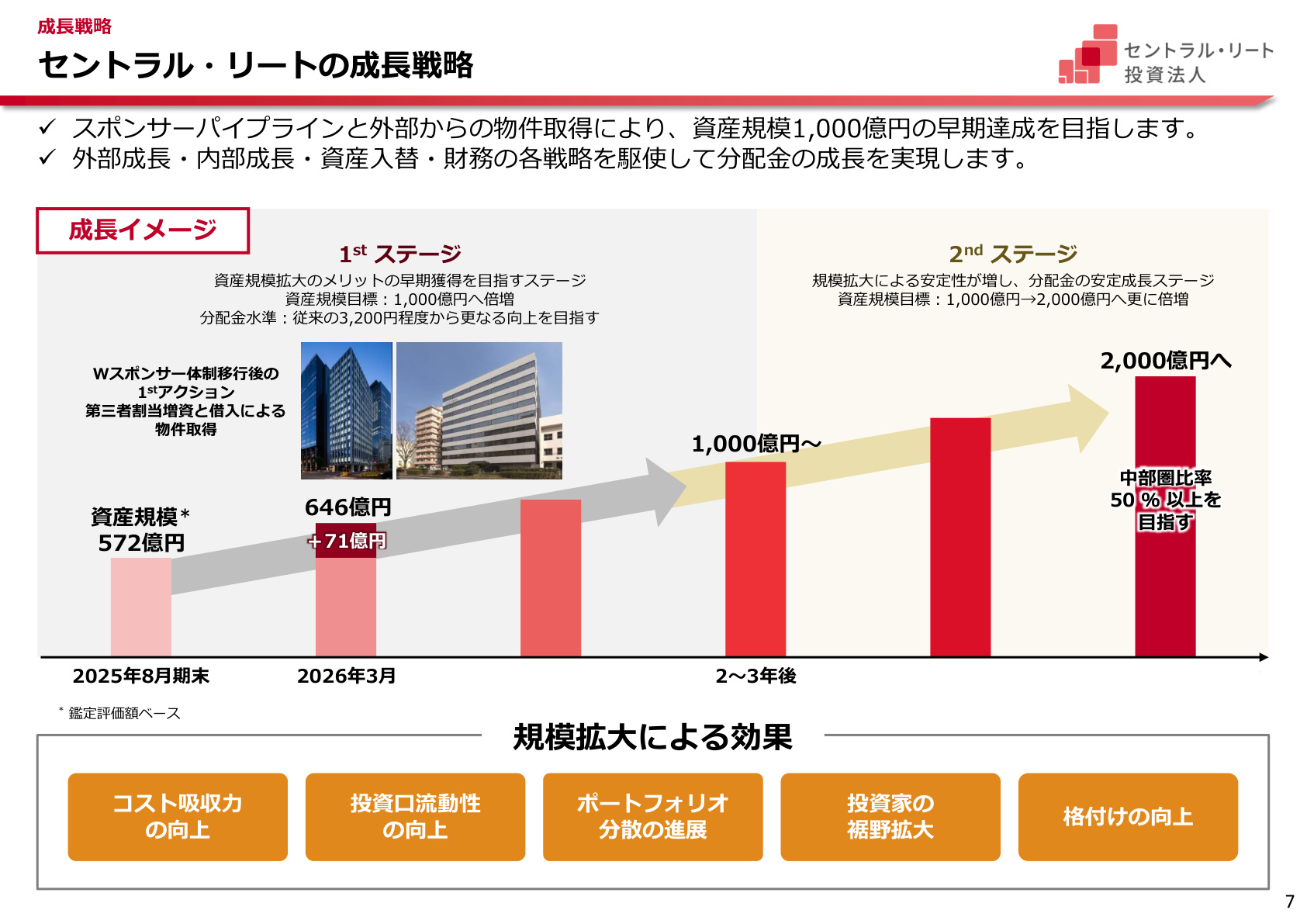
The slide above illustrates the two-stage growth steps formulated by the Investment Corporation.
- 1st Stage (2–3 years later) : A phase aiming for an early doubling of asset size to 100 billion yen through sponsor pipelines and external acquisitions. The REIT aims to improve the distribution level from the conventional level of around 3,200 yen.
- 2nd Stage : Aiming for a further doubling of asset size from 100 billion yen to 200 billion yen , increasing the Chubu region ratio in the portfolio to 50% or more .
The design is intended to maximize unitholder value by creating a virtuous cycle of five elements: "improved absorption of fixed costs," "improved liquidity of investment units," "progress in property and tenant diversification," "expansion of the institutional investor base," and "improvement in credit ratings."
5. 18th and 19th Period Earnings Forecasts and the Impact of the Major "Sapporo Odori" Departure
As for future earnings forecasts, for the 18th period (ending February 2027), operating revenue of 1,944 million yen, net income of 829 million yen, and forecasted distributions per unit of 3,155 yen are expected. For the 19th period (ending August 2027), operating revenue of 1,959 million yen, net income of 750 million yen, and forecasted distributions per unit of 2,857 yen are expected.
Regarding the factors behind the temporary decline in distributions and their details, it is essential to check the following slide on factors for increase/decrease.
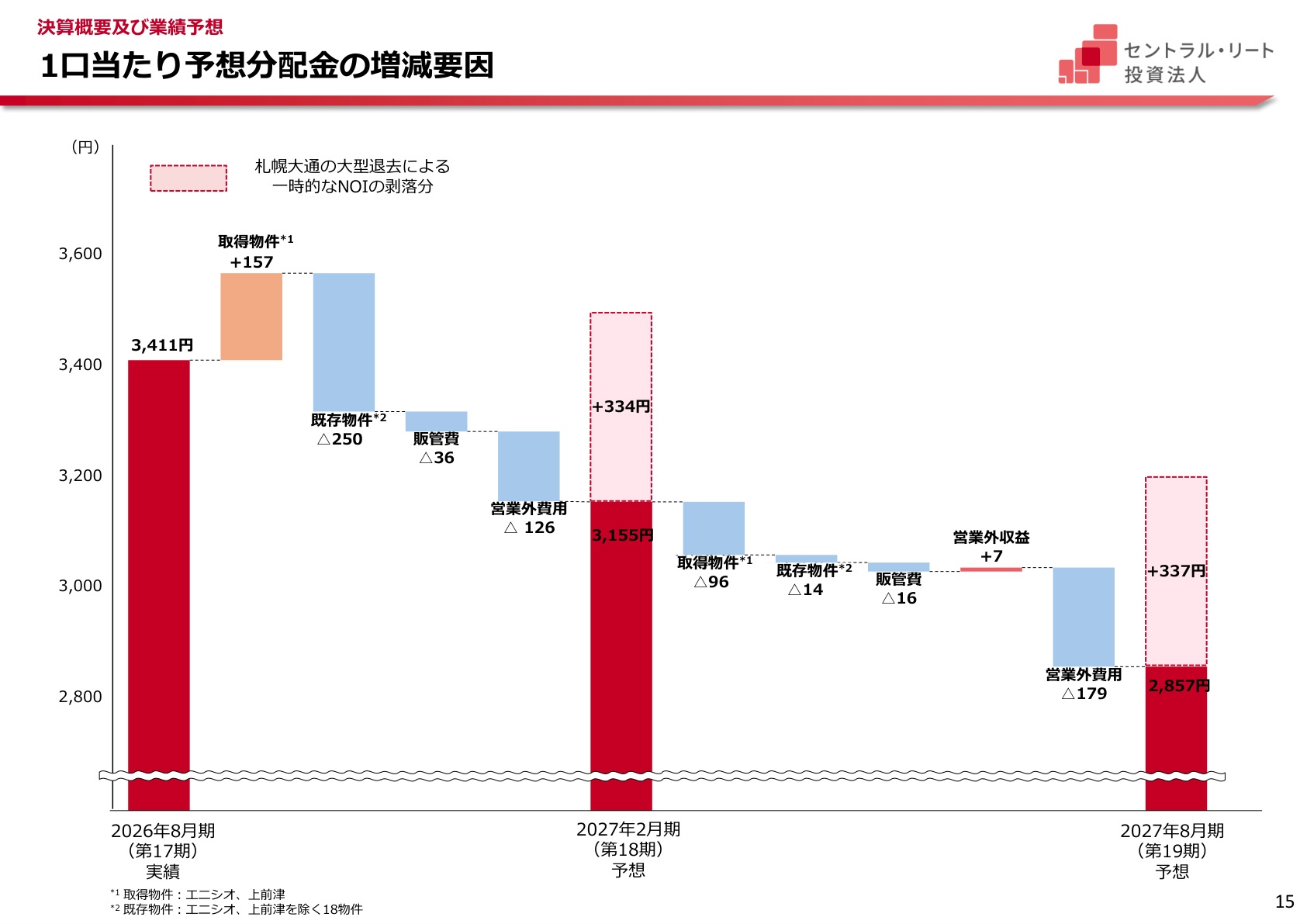
As is clear from this graph, the primary factor for the decrease in distributions in the 18th and 19th periods is the temporary loss of NOI due to a major tenant departure at the owned property "Xymax Sapporo Odori Building."
- 18th period impact : Temporary NOI loss equivalent to +334 yen per unit
- 19th period impact : Temporary NOI loss equivalent to +337 yen per unit
Adding this loss back to the publicly announced distribution forecasts (3,155 yen for the 18th period, 2,857 yen for the 19th period), it can be seen that the underlying cruising-base earning power is approximately 3,489 yen and 3,194 yen, respectively . While the 19th period incorporates the expensing of public taxes and dues (+26 million yen for Kamimaezu KD Building, etc.) and an increase in interest expenses due to rising interest rates, a scenario is drawn where the REIT recovers to its fundamental earnings level as re-leasing of the vacated space progresses.
6. Internal Growth of the Office Segment: Realization of Strong Rent Increases
In the office properties that make up the core of the portfolio, strong rent revisions have been realized, capturing the favorable market environment.
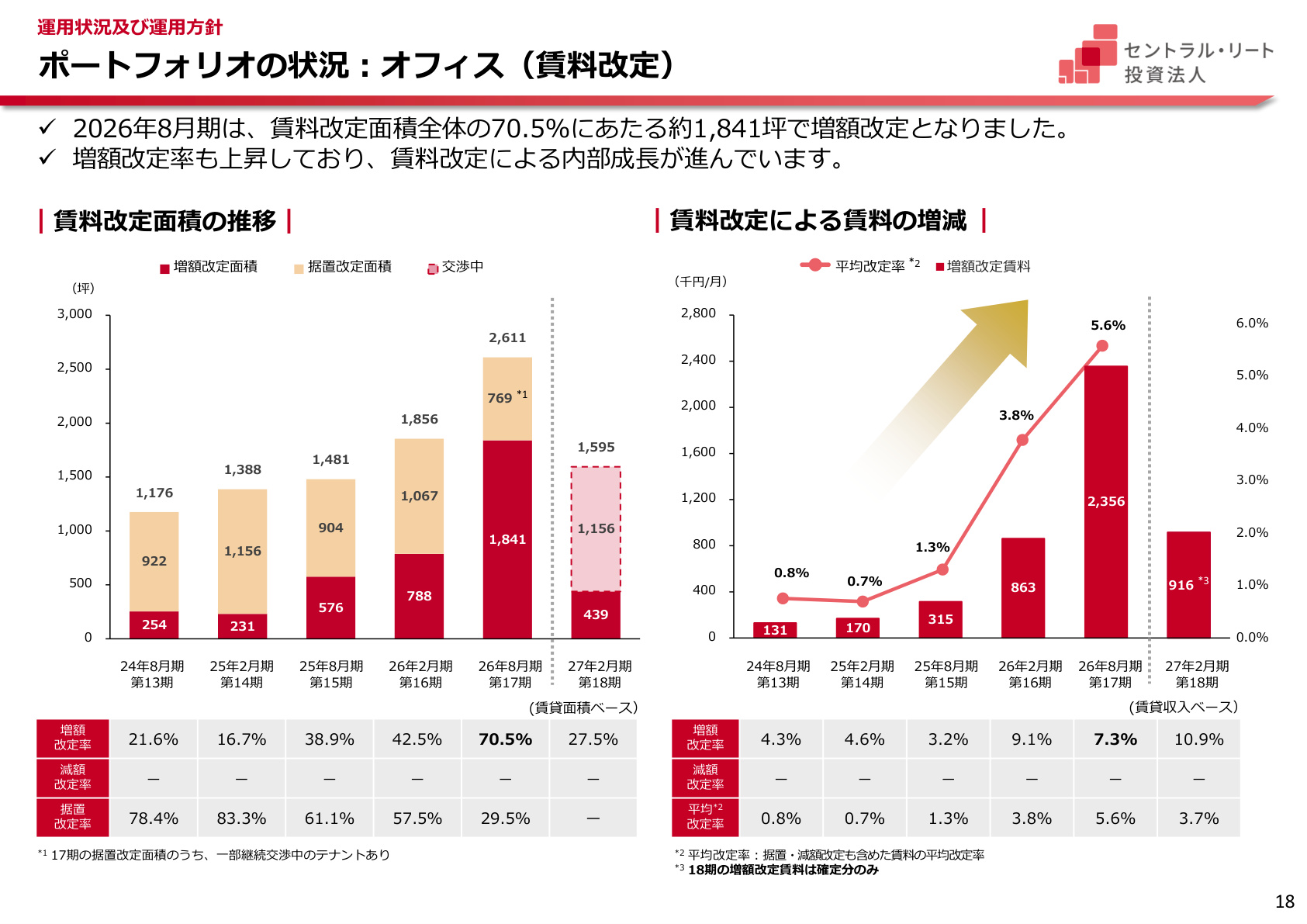
As shown in the left side of the slide, "Trends in Rent Revision Area," in the 17th period, rent increases were achieved for 70.5% (approximately 1,841 tsubo) of the target revision area . On the right side, "Increase/Decrease in Rent Due to Rent Revisions," the average revision rate has surged to +5.6% (the overall average revision rate including renewals, etc.), generating a rent increase effect of +2,356 thousand yen on a monthly basis. Furthermore, for the 18th period (ending February 2027), agreements have already been reached for a rent increase rate of +10.9% (average revision rate of +3.7%) on a confirmed basis, confirming that price pass-through and internal growth in an inflationary environment are progressing very smoothly.
7. Rent Gap and Potential for Rent Increases
Reflecting the rise in office market rents, the rent gap (the divergence rate between current contract rents for all tenants and market rents) in the Investment Corporation's portfolio has expanded to ▲13.3% (up from ▲9.1% at the end of the February 2026 period).
Space where current rents are below market levels accounts for 68% (7,163 tsubo) of the total , and the calculated potential for rent increases amounts to approximately 193.78 million yen per period (equivalent to over +32 million yen per month). Continuous earnings improvement is expected by promoting negotiations for revisions to appropriate rents sequentially for spaces reaching renewal over the coming periods.
8. Trends in Commercial Facility and Hotel Segments
- Commercial facilities : Located in the suburbs of major metropolitan areas, daily-use tenants handling daily necessities such as supermarkets account for 73% (retail sales) , and sales are solid. A +5.0% rent increase has been decided for some spaces in the 18th period. In addition, by utilizing land-only properties (Valor Kachigawa store) and master lease agreements, the REIT achieves both stable earnings and rent increases at the time of renewal.
- Hotels : Owns two properties: "Hotel Vista Sendai" and "Karaksa Hotel Sapporo." Since variable rent is introduced in addition to fixed rent, the REIT is capturing the recovery in inbound demand and the expansion of tourism demand. Sendai maintains a high occupancy rate (86.3%) and GOP ratio (57.6%), and in Sapporo, the REIT is aiming to improve ADR (Average Daily Rate) through guest room renovations (introduction of bunk beds for families).
9. Financial Foundation and Management Strategy Amid Rising Interest Rates
In response to the risk of rising interest rates following the Bank of Japan's monetary policy changes, the Investment Corporation is implementing a conservative and flexible financial strategy.
- LTV Control : The total asset LTV at the end of the 17th period was 44.7% , and the appraisal LTV considering unrealized gains was 35.8% , maintaining a sound level significantly lower than the J-REIT average (average for asset size of 200 billion yen or less: total asset LTV 48.0%, market value LTV 41.6%).
- Incorporating Interest Rate Rise Scenarios : In the assumptions for earnings forecasts, the REIT has adopted an extremely conservative scenario assuming two additional interest rate hikes within the next year, with policy interest rates at 1.50% at the end of the 18th period and 1.75% at the end of the 19th period , and average period interest rates of 1.52% and 1.88%, respectively.
- Controlling Borrowing Costs : In response to the phase where fixed interest rate costs are rising rapidly, the fixed interest rate ratio is set at 55.4% , strategically utilizing floating interest rates. Furthermore, the REIT has newly invited regional financial institutions in the Chubu region (Ogaki Kyoritsu Bank, Hyakugo Bank, etc.) and expanded the banking syndicate to 19 companies to strengthen its procurement base.
10. Sustainability and ESG Initiatives
The REIT is also focusing on reducing environmental impact and strengthening governance. The environmental certification acquisition rate has reached 86.5% based on total floor area, and it has acquired "4 Stars" and the highest "A Level" disclosure rating in the GRESB Real Estate Assessment. In the period ended August 2026, it newly acquired the CASBEE Real Estate Assessment Certification (A Rank) for "Kamimaezu KD Building," and is accelerating energy conservation and green leases in collaboration with tenants (82 cases introduced), such as the introduction of 100% renewable energy electricity to 9 owned properties and the planned promotion of LED installation work (power reduction effect of approximately 60–76% in private and common areas).
Summary
CENTRAL REIT Investment Corporation's 17th period financial results achieved distribution growth exceeding expectations through the monetization of newly acquired properties and strong office rent increases. Although forecasted distributions show a downward trend in the short term due to the temporary NOI decrease associated with the major departure at "Sapporo Odori" and the incorporation of conservative interest rate hike scenarios, the cruising-base earning power excluding temporary factors is robust . Going forward, the realization of rent increases against the backdrop of a ▲13.3% rent gap and the progress of medium- to long-term asset scale expansion (100 billion yen and 200 billion yen targets) leveraged by the support of the dual sponsors will be the key to improving unitholder value.
This content is not intended as investment advice or a recommendation. Any opinions expressed are solely the personal views of each article.