

SANKEI REAL ESTATE Inc. Fiscal Period Ended August 2026 (15th Fiscal Period) Earnings Deep Dive: Significant Profit Recovery, Support for TOB, and Progress in Portfolio Restructuring

Sentiment Analysis
Executive Summary
SANKEI REAL ESTATE Inc. (the "Investment Corporation") reported a significant recovery in its earnings for the fiscal period ended August 2026 (15th fiscal period) , following the impairment loss recorded in the previous 14th fiscal period. The Investment Corporation achieved operating revenue of 3,729 million yen (+29.4% compared to the previous period) , net income of 1,719 million yen (a turnaround to profit with an increase of 5,728 million yen compared to the previous period) , and distributions per unit (DPU) of 3,680 yen , exceeding the initial forecast (3,560 yen) by 120 yen.
During this period, the Investment Corporation underwent a series of critical corporate actions that will shape its future, including the completion of the sales agreement for the "Fukuoka Green Building" (sale price of 5,500 million yen), a large-scale property that had been a challenge and the subject of an impairment loss in the previous period, and the expression of support for the tender offer bid (TOB) by City Index Fifth Co., Ltd. (while remaining neutral and leaving the decision to tender to the discretion of unitholders). Office rent increases progressed significantly with an average of +14.2% , and hotel occupancy remained at a high level, laying the groundwork for asset stabilization in the coming periods.
1. 15th Fiscal Period Earnings Highlights and Key Performance Indicators
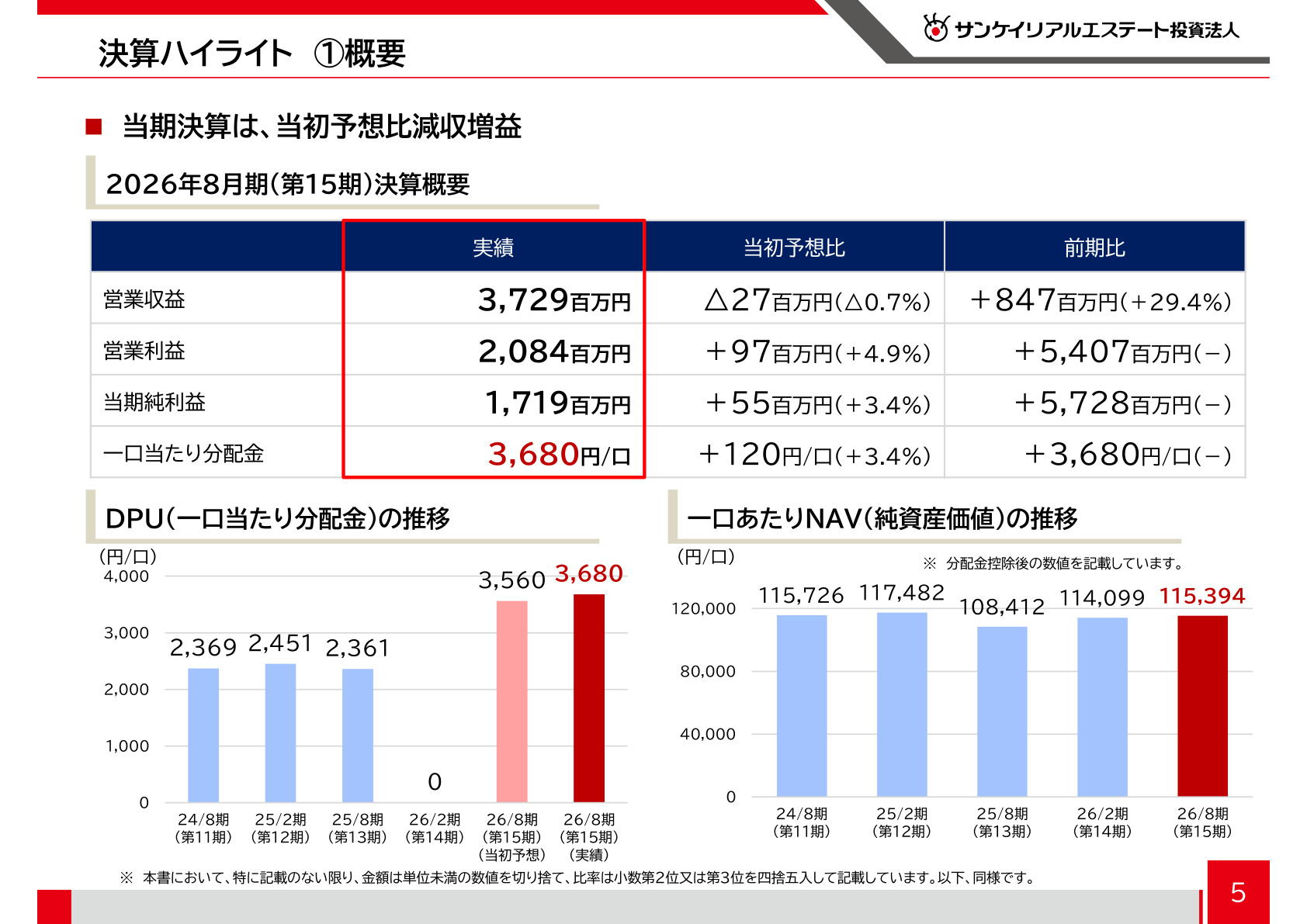
The slide above shows the overall earnings summary for the 15th fiscal period, as well as the trends in DPU and NAV per unit. In the previous 14th fiscal period, the Investment Corporation recorded an impairment loss of 4,933 million yen related to the "Fukuoka Green Building," resulting in a net loss (4,009 million yen) and an anomalous distribution of 0 yen. However, in the current period, this recovered dramatically to 3,680 yen .
Compared to the initial forecast, although operating revenue fell short by 27 million yen, the Investment Corporation achieved an increase of 97 million yen (+4.9%) in operating income and 55 million yen (+3.4%) in net income due to reductions in leasing expenses, primarily repair costs (133 million yen), and the containment of non-operating expenses. Furthermore, NAV per unit was 115,394 yen , rising from 114,099 yen at the end of the previous fiscal year, reflecting the resilience of appraisal values.
2. Portfolio Restructuring and Major Capital Market Topics
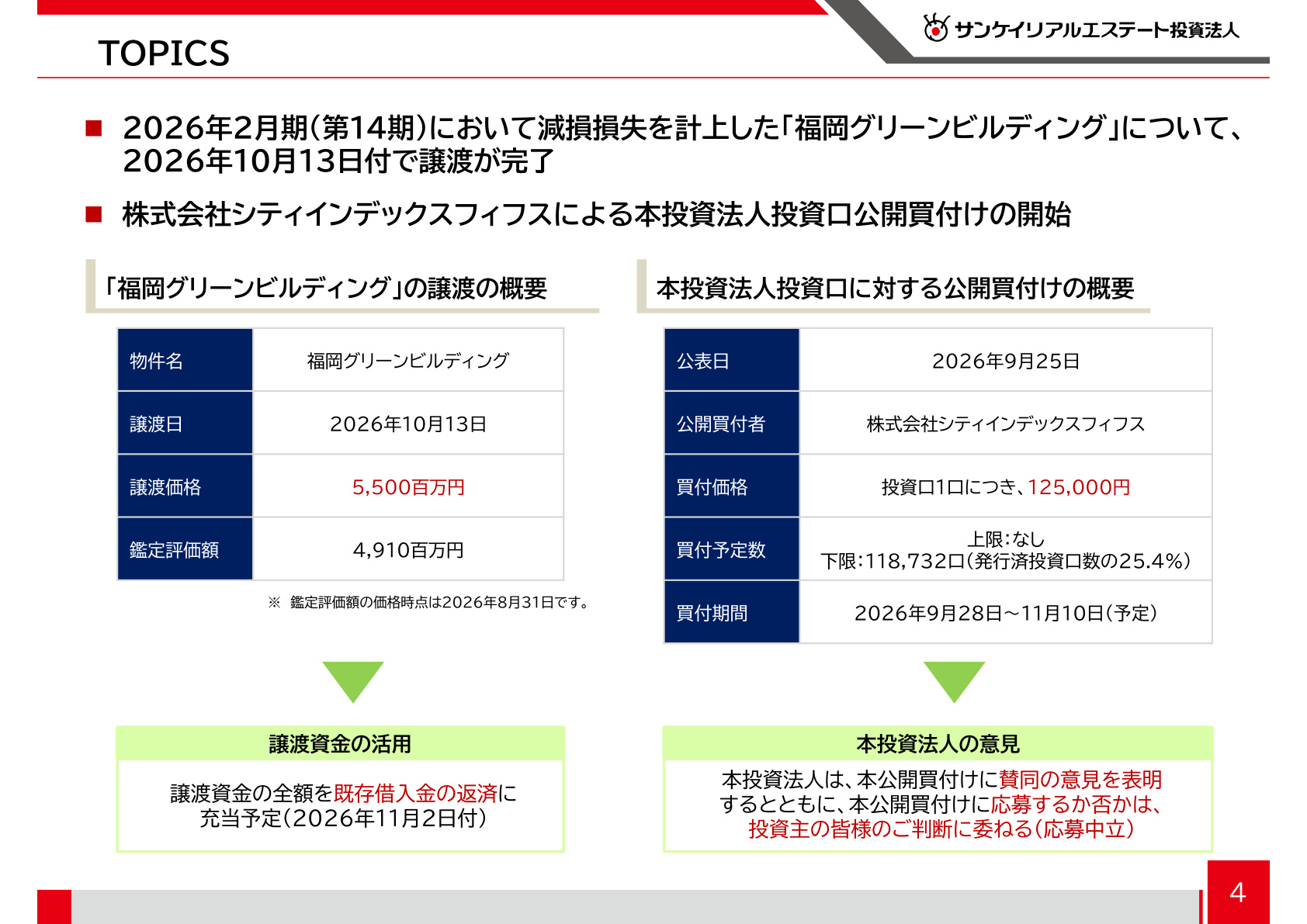
Two major topics announced from the end of the 15th fiscal period to the present will have a direct impact on future management policies.
① Completion of the Sale of Fukuoka Green Building and Financial Impact
The sale of the "Fukuoka Green Building," which had recorded a large impairment loss in the previous period and was the primary cause of the decline in occupancy rates, was completed on October 13, 2026 . Notably, the sale price of 5,500 million yen was established at a level exceeding the appraisal value of 4,910 million yen as of the end of August 2026. This sale provides an effect of boosting the overall office occupancy rate, which had been temporarily sluggish, and the entire proceeds from the sale are scheduled to be used for the repayment of existing borrowings (November 2, 2026) , thereby reducing interest burdens and improving financial health.
② Commencement of TOB by City Index Fifth Co., Ltd.
On September 25, 2026, a tender offer by City Index Fifth Co., Ltd. was announced. The purchase price is 125,000 yen per unit , which is set at a level higher than the latest NAV (115,394 yen). There is no upper limit on the number of units to be purchased, and the minimum is 118,732 units (25.4% of the total issued investment units) . The Investment Corporation expressed its "support" for the tender offer itself, while deciding to leave the decision of whether or not to tender to the "discretion of unitholders (neutral)." Market attention is focused on how changes in the capital structure will link to future governance and management policies.
3. Segment Performance: Office Rent Increases and Hotel Resilience
Internal Growth of Offices (Realization of Significant Rent Increases)
Active rent increase negotiations have borne fruit for the office buildings held. In the rent revision results for the 15th fiscal period, 73.2% of the target area saw rent increases , 26.8% remained unchanged, and 0% saw decreases. The average rent increase rate upon contract renewal reached +14.2% compared to the previous contracts, strongly capturing the rise in market rents. A rent gap (the discrepancy between the average rent of held properties and market rent) of 11.7% still exists, leaving room for continuous internal growth for the 16th fiscal period (1,429 tsubo scheduled for renewal) and the 17th fiscal period (1,244 tsubo).
Hotel Asset Occupancy and Inbound Composition
The three major hotels that have introduced variable rents ("Hotel Intergate Kyoto Shijo Shinmachi," "Hotel Intergate Kanazawa," and "Grids Premium Hotel Osaka Namba") have maintained high occupancy. Although "Osaka Namba" showed a slight cooling in demand with RevPAR decreasing from 23,297 yen in the previous period to 19,148 yen, "Kyoto" remained solid with an ADR of 20,210 yen and RevPAR of 16,109 yen, and "Kanazawa" with a RevPAR of 10,049 yen. Looking at the composition of guests by nationality, the ratio of inbound tourists reached approximately 58.7% at "Kyoto Shijo Shinmachi" and approximately 90.7% at "Osaka Namba," with robust inbound lodging demand directly supporting the revenue base.
4. Financial Operations: Changes in Borrowing Structure Amid Rising Interest Rates
With changes in interest rate trends, the characteristics of a transition period are appearing in financial strategy. As of September 2, 2026, the balance of interest-bearing debt was 49.5 billion yen , and, as of the end of the fiscal period ended August 2026, the total asset LTV was 48.9% , which is controlled within the cruising target range (45-50%).
On the other hand, reflecting the current interest rate environment, the long-term debt ratio has fallen to 54.9% and the fixed interest rate ratio to 47.7% , with the average procurement interest rate trending upward to 1.36%. The 16.4 billion yen refinancing that arrived in September 2026 was handled with short-term borrowings at a 6-month floating interest rate (base rate + 0.50%) . Of this, 7.5 billion yen is scheduled to be repaid on November 2, 2026.
5. Future Earnings Forecasts and Medium-Term Outlook
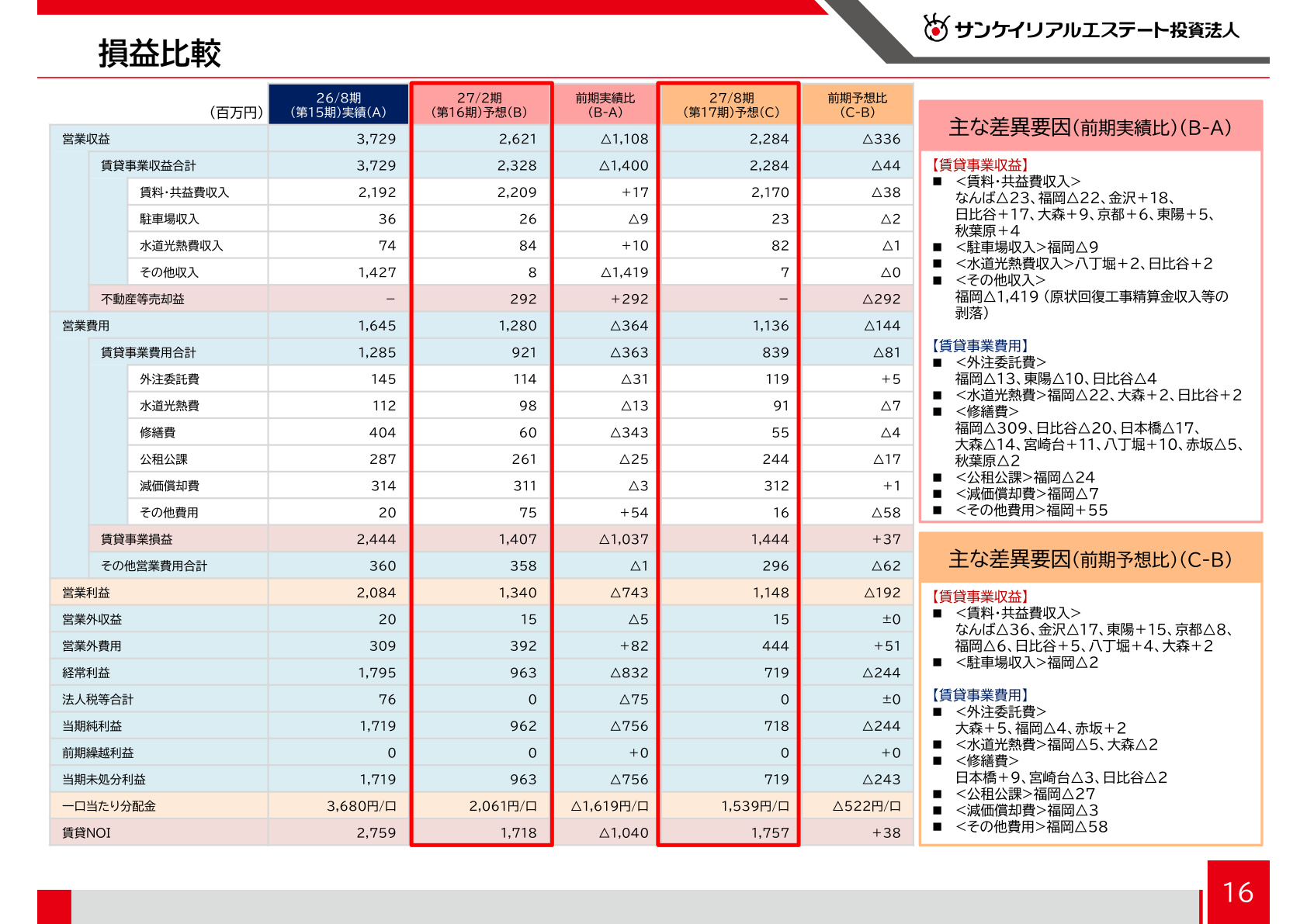
The slide above shows the earnings forecasts for the 16th fiscal period (ending February 2027) and the 17th fiscal period (ending August 2027). With the sale of the Fukuoka Green Building, temporary gains on sale will occur, followed by their disappearance in the next period, and changes in the scale of rental revenue are expected.
-
Forecast for the Fiscal Period Ending February 2027 (16th Fiscal Period) :
- Operating revenue: 2,621 million yen (1,108 million yen decrease compared to the previous period)
- Operating income: 1,340 million yen (743 million yen decrease compared to the previous period)
- Net income: 962 million yen (756 million yen decrease compared to the previous period)
- Forecasted DPU: 2,061 yen
- While the gain on sale of the Fukuoka Green Building of 292 million yen will contribute, a decrease in revenue and profit is expected due to the disappearance of other income such as restoration settlements recorded in the previous period and the normalization of leasing expenses.
-
Forecast for the Fiscal Period Ending August 2027 (17th Fiscal Period) :
- Operating revenue: 2,284 million yen (336 million yen decrease compared to the previous period forecast)
- Operating income: 1,148 million yen (192 million yen decrease compared to the previous period forecast)
- Net income: 718 million yen (244 million yen decrease compared to the previous period forecast)
- Forecasted DPU: 1,539 yen
- With the disappearance of property sale gains, the net income level will normalize. Interest expense is expected to increase from 316 million yen in the 16th fiscal period (676 yen in DPU terms) to 379 million yen in the 17th fiscal period (811 yen in DPU terms).
Planned portfolio occupancy is expected to improve significantly to 97.9% at the end of the 16th fiscal period and 98.7% at the end of the 17th fiscal period due to the sale of the low-occupancy Fukuoka property. Moving forward, the core challenge will be to raise the cruising DPU while absorbing the increase in interest expenses by continuing rent increases through the resolution of the office rent gap and maximizing the occupancy rate of remaining properties.
This content is not intended as investment advice or a recommendation. Any opinions expressed are solely the personal views of each article.