

[Caster Co.Ltd. Fiscal Year Ended August 2026 Financial Results] Achieving Operating Profitability Through Rigorous Cost Structure Reform, Evolution into "AI-BPaaS," and Next-Growth Scenario Centered on CASTER NEO

Sentiment Analysis

1. FY2026 Financial Results Summary: Return to Profitability with 50 million yen in Operating Profit Through Thorough Cost Optimization
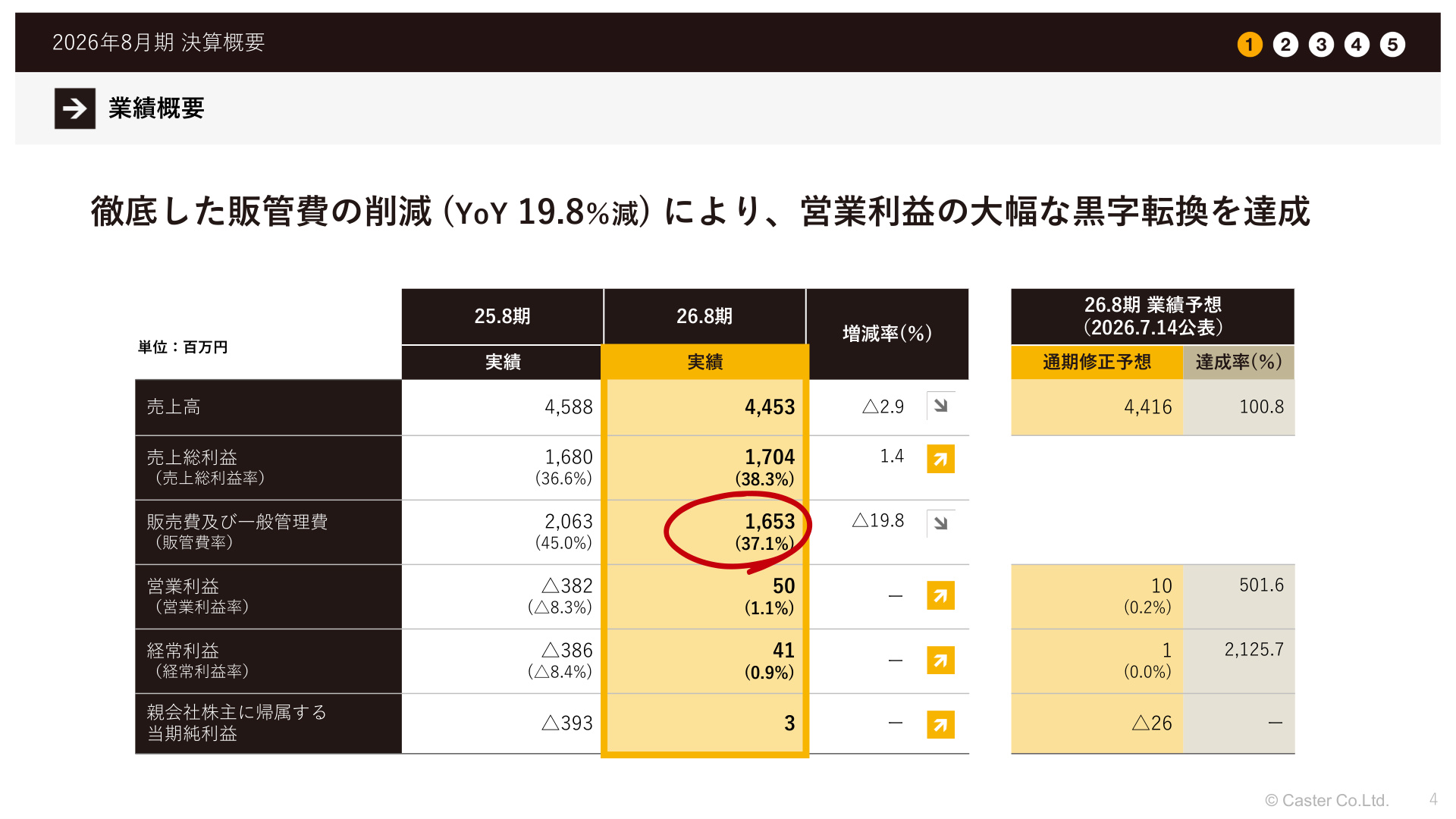
Caster Co.Ltd.'s consolidated financial results for the fiscal year ended August 2026 were as follows: net sales of 4,453 million yen (down 2.9% year-on-year) , operating profit of 50 million yen (compared to an operating loss of 382 million yen in the previous fiscal year) , ordinary profit of 41 million yen (compared to an ordinary loss of 386 million yen in the previous fiscal year) , and net profit attributable to owners of the parent of 3 million yen (compared to a net loss of 393 million yen in the previous fiscal year) .
Compared to the revised forecast announced on July 14, 2026 (net sales of 4,416 million yen, operating profit of 10 million yen, and net loss attributable to owners of the parent of 26 million yen), net sales progressed as planned, while the operating profit achievement rate reached 501.6%, and the company secured a bottom-line profit. Although net sales saw a slight decline due to adjustments in the timing of service commencement, the financial results were marked by a significant improvement in the profit and loss structure.
Background and Factors for Profit and Loss Structure Improvement
As shown in the performance summary in the slide above, the primary factors behind the return to operating profitability were a significant reduction in selling, general and administrative (SG&A) expenses (down 19.8% year-on-year to 1,653 million yen) and an improvement in the gross profit margin (up 1.7 percentage points from 36.6% to 38.3%) .
Breaking down the factors for the change in operating profit, while the decrease in net sales had a negative impact of 134 million yen, the decrease in cost of sales provided a positive impact of 158 million yen, and the reduction in SG&A expenses provided a further boost of 409 million yen. Regarding the breakdown of SG&A expenses, in particular, marketing strategies were reviewed in line with changes in the business environment such as the spread of AI, and advertising expenses were significantly optimized from 239 million yen in the previous fiscal year to 89 million yen . In addition, salaries and wages were rationalized from 729 million yen to 652 million yen, and the company-wide SG&A expense ratio was significantly reduced from 45.0% to 37.1%.
2. Segment Trends and KPI Analysis
The segment performance and core business indicator trends for the fiscal year ended August 2026 are as follows:
-
BPaaS Business :
- Net sales: 3,396 million yen (down 1.7% year-on-year)
- Operating profit: 826 million yen (up 27.0% year-on-year)
- Although net sales saw a slight decline due to a review of customer acquisition methods and adjustments in the number of active clients, the efficiency of the service provision system and the gross profit margin improved. In terms of profit, the business achieved a significant 27.0% increase, strongly driving the company's overall earnings.
- The number of active clients at the end of each quarter, a key KPI, moved from 987 in Q1 to 975 in Q2, 992 in Q3, and 939 in Q4. ARPU (average revenue per user) remained stable at a high level, moving from 290,000 yen in Q1 to 288,000 yen in Q4.
-
HR Business :
- Net sales: 693 million yen (down 9.4% year-on-year)
- Operating profit: 77 million yen (down 26.7% year-on-year)
- The HR business, which operates "Zaitaku Haken" (remote staffing) and "Reworker," saw a decline in both sales and profit due to the impact of the corporate hiring demand environment, but it maintained profitability and continues to serve as a foundation for customer referrals to the BPaaS business.
-
AI Tech Business :
- Net sales: 363 million yen (down 0.5% year-on-year)
- Operating profit: 3 million yen (compared to an operating loss of 275 million yen in the previous fiscal year)
- In addition to the contribution from existing business sales of the subsidiary Grams, the optimization of advertising allocation and SG&A expenses, as well as the effect of intra-group transactions related to company-wide AI training usage, led to a turnaround from a significant loss in the previous fiscal year to a profit.
Financial Position and Cash Flows
As of the end of August 2026, total assets were 1,975 million yen (up 103 million yen from the end of the previous fiscal year), and net assets were 713 million yen (equity ratio of 36.1%). Regarding cash flows, cash flows from operating activities turned to a positive 17 million yen (compared to a negative 371 million yen in the previous fiscal year) , and free cash flow, combined with cash flows from investing activities of negative 93 million yen, was negative 76 million yen (an improvement of 277 million yen year-on-year). With cash flows from financing activities of 125 million yen, the balance of cash and cash equivalents at the end of the period was 1,233 million yen (up 49 million yen year-on-year), ensuring the liquidity necessary for business operations.
3. FY2027 Earnings Forecast and New Segment Structure
Change in Reporting Segments: Reorganization into "AI-BPaaS Business"
From the fiscal year ending August 2027, the company will rename its existing "BPaaS Business" to the "AI-BPaaS Business" and has set a policy to fully integrate the achievements in technology and product development accumulated in the AI Tech domain into its core business. The goal is to complete the phase of treating AI merely as an investment and development area and to deeply embed AI into core back-office support operations to enhance competitive advantage and profitability.
FY2027 Consolidated Earnings Forecast
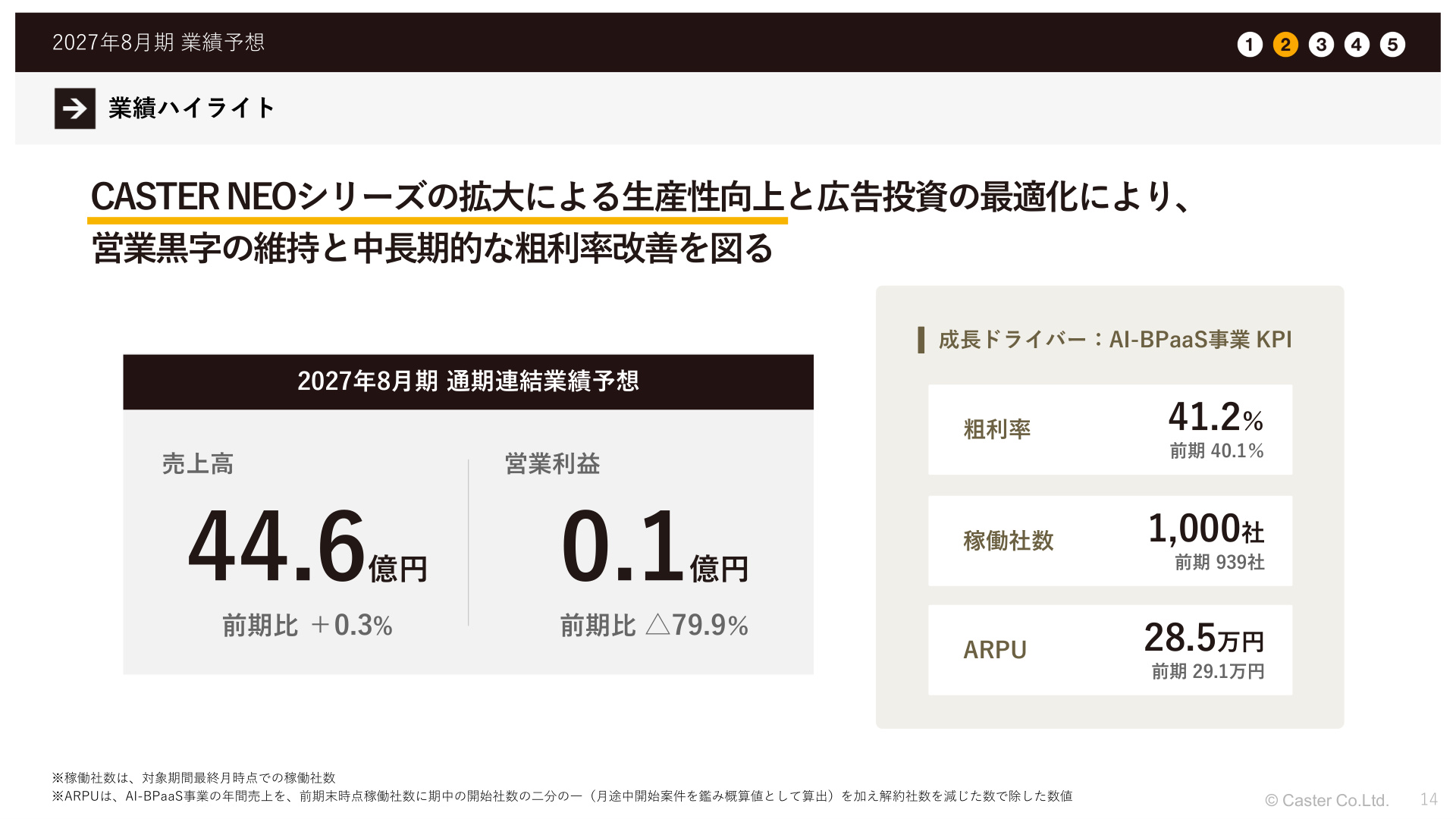
- Net sales: 4,468 million yen (up 0.3% year-on-year)
- Operating profit: 10 million yen (down 79.9% year-on-year)
- Ordinary profit: negative 5 million yen
- Full-year forecast for net loss attributable to owners of the parent: negative 11 million yen
Significance of Performance Highlights and Key KPI Targets
As shown in the slide above, the fiscal year ending August 2027 is positioned as an investment and transition period focused on establishing the structure and growth foundation for the expansion of the new flagship "CASTER NEO" series . Net sales are expected to increase slightly to 4.468 billion yen, and the company plans for an operating profit of 10 million yen, aiming to maintain a trend of operating profitability.
As KPI targets for the growth driver "AI-BPaaS Business," the following figures have been set:
- Gross profit margin: 41.2% (target of 1.1 percentage point improvement from 40.1% in the previous fiscal year)
- Number of active clients at year-end: 1,000 (target of net increase from 939 at the end of the previous fiscal year)
- ARPU: 285,000 yen (expected to remain stable, though slightly lower than the 291,000 yen of the previous fiscal year)
Note that the potential subsidy (up to 94 million yen) related to the AI reskilling training for all employees conducted in the previous fiscal year has not been factored into the full-year earnings forecast because the decision on the grant and the timing of receipt are uncertain. If receipt is confirmed, it will be a factor that boosts performance.
4. Growth Strategy: Productivity Revolution Through "CASTER NEO" and Internal AI Implementation
The most important product that will determine Caster Co.Ltd.'s sustainable growth is the AI-powered next-generation back-office support service, the "CASTER NEO" series .
Operation Model and Competitiveness of the "CASTER NEO" Series
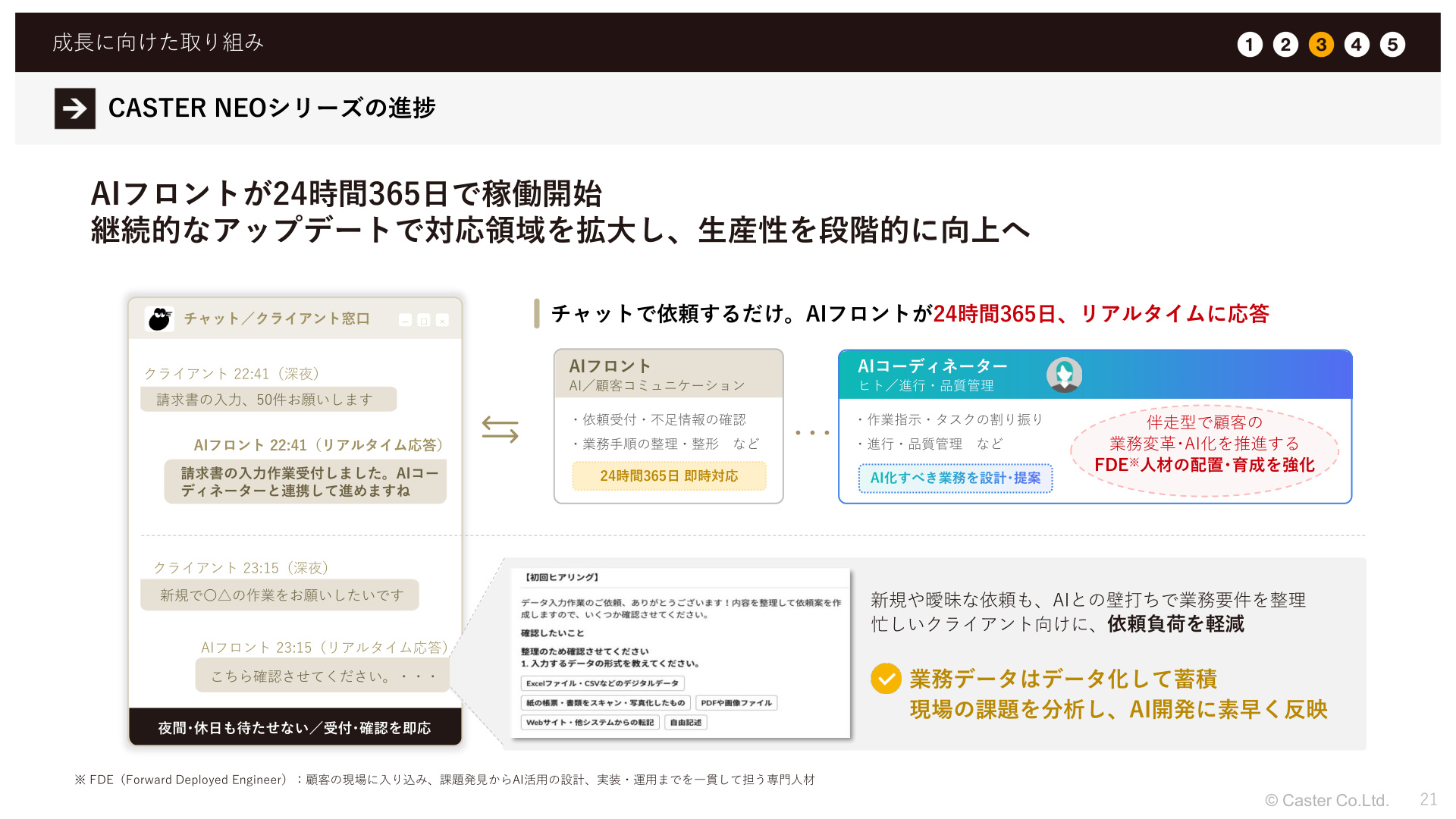
As illustrated in the slide above, CASTER NEO is a hybrid operational foundation where an "AI front that operates 24/7/365" and "highly specialized AI coordinators (humans)" work together. Even when a client requests work via chat at night or on holidays, the AI front organizes and confirms requirements and inquires about missing information in real-time. This significantly reduces the client's burden of making requests and eliminates the waiting time that occurred in the past.
The greatest management impact brought by this model is the "expansion of supply capacity independent of the number of hires." In conventional BPO and online assistant businesses, there was a structure where the cost of hiring and training new operators preceded the expansion of orders, putting pressure on profit margins. With CASTER NEO, by advancing primary response by AI and automation of business processes, it becomes possible to accept more clients with fewer AI coordinators, which is the basis for the improvement to a 41.2% gross profit margin targeted for the fiscal year ending August 2027.
Development of Field-Driven "FDEs" and Internal AI Utilization "Tier System"
To support the evolution of the product, the company is rapidly promoting the internal development of FDEs (Forward Deployed Engineers: specialized personnel who enter client sites and handle AI implementation) .
- Self-driven FDE model for non-IT backgrounds : Employees with diverse backgrounds, such as CS, accounting, regional banks, and bridal industries, are creating and deploying internal business automation tools using generative AI tools like Claude and Gemini, as well as GAS.
- Introduction of internal AI utilization "Tier System" : By defining a four-stage standard for all employees, from "Tier 1 (immediate practical level of AI tools)" to "Tier 2 (Web/server/DB knowledge)," "Tier 3 (self-creation/build of AI agents)," and "Tier 4 (harness engineering linking multiple agents)," the company is achieving both the improvement of AI literacy across the organization and the infrastructure development led by the development team.
5. Regional Expansion and External Market Development Initiatives
In addition to improving internal productivity, the approach to external markets is also being diversified.
- External sales of AI training business : The company has packaged the know-how of company-wide AI reskilling practiced internally and provides an "AI training service" for corporate DX needs. By providing practical curricula tailored to the actual work environments of various industries, such as the service industry (where internal AI utilization rate improved from 50% to 80%) and the construction and engineering industry, it aims to capture share in the training market (a 630 billion yen market projected for fiscal 2026).
- Regional collaboration model (Fukuoka/Kitakyushu area) : In Kitakyushu City, where the startup rate is high and startups are accumulating, but 60.4% of local offices feel a labor shortage, the company has started collaboration with "COMPASS Kokura," a core facility for startup support. It proposes AI-BPaaS as a solution to business and human resource issues for local companies and startups, and is proceeding with the establishment of a new customer acquisition base in regional cities.
6. Conclusion
In the fiscal year ended August 2026, Caster Co.Ltd. achieved a significant turnaround to operating profit (50 million yen) through thorough cost management and optimization of advertising investment, thereby strengthening its financial and earnings base. For the fiscal year ending August 2027, the company is implementing a segment reorganization into the "AI-BPaaS Business" with AI technology at its core, and has set goals of improving the gross profit margin (target 41.2%) and reaching 1,000 active clients through the full-scale deployment of "CASTER NEO." The structural shift from a hiring-dependent model to a productivity-improvement model through AI utilization is steadily progressing, and the future progress of business KPIs is noteworthy.
This content is not intended as investment advice or a recommendation. Any opinions expressed are solely the personal views of each article.