

OXIDE Corporation FY2027 Q2 Earnings Deep Dive: Growth Scenario Driven by Surging Semiconductor Inspection Lasers and Accelerated Investment for Generative AI Data Centers

Sentiment Analysis
Executive Summary
OXIDE Corporation (Securities Code: 6521), a specialist in optical passive components, single crystals, and laser light sources, achieved a significant turnaround to profitability in the second quarter (interim period) of the fiscal year ending February 2027, delivering results that substantially exceeded initial forecasts. The company is witnessing a notable surge in demand for its advanced optical technologies, driven by a sharp recovery in demand for single crystals and deep ultraviolet (DUV) lasers used in semiconductor wafer inspection equipment, as well as increased shipments and expanded production capacity for Faraday rotators used in optical communications and data centers amid the rapid expansion of generative AI.
Against this backdrop of strong business conditions, the company has significantly upwardly revised its full-year consolidated earnings forecast for the fiscal year ending February 2027 . Revenue is expected to surpass the 10 billion yen milestone to reach 10.323 billion yen, and the operating profit margin is projected to achieve the mid-term management target one year ahead of schedule, signaling a shift into a phase of full-scale profit growth.
1. Overview of H1 FY2027 Results and Significant Profitability Improvement
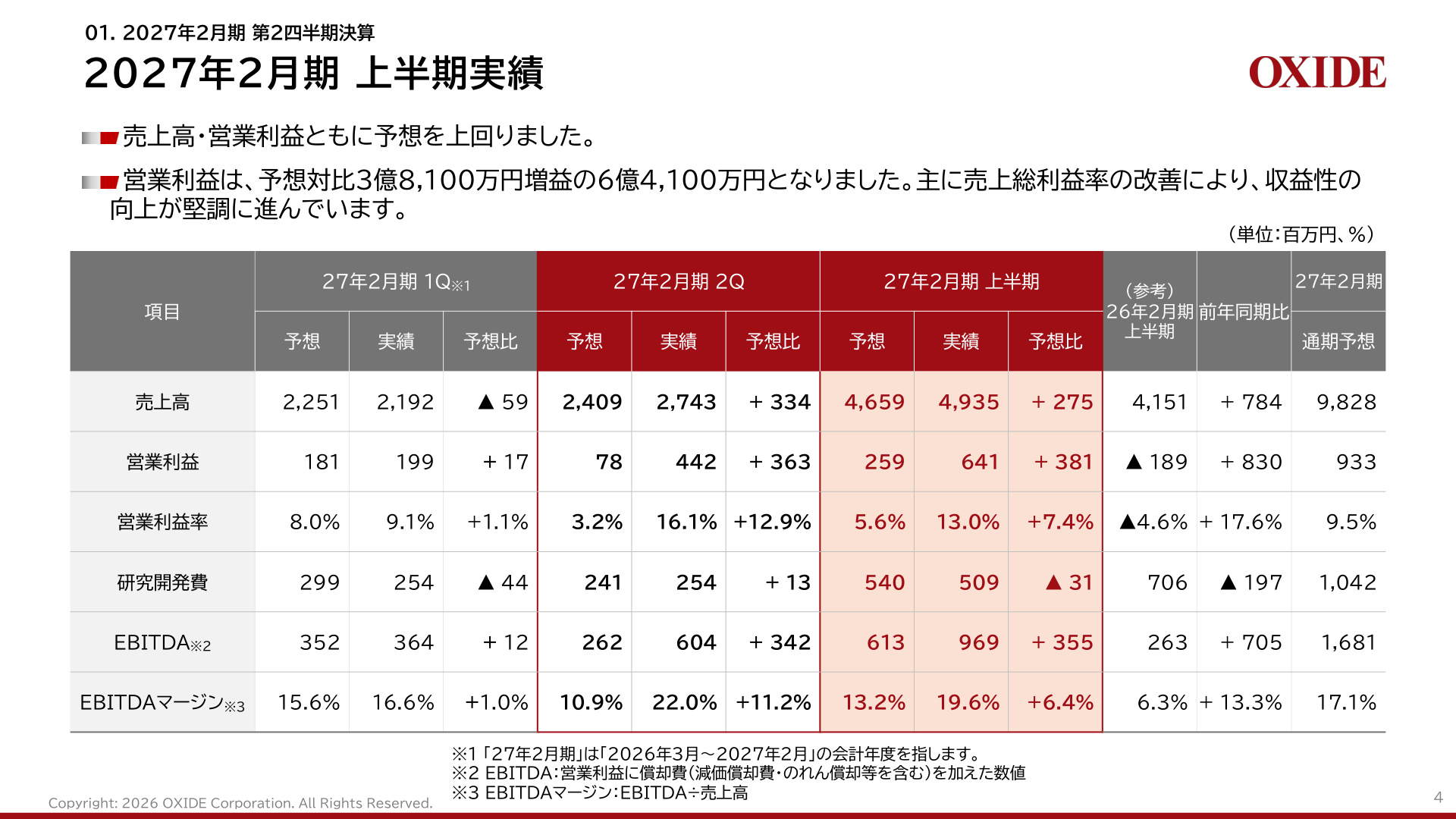
For the first half of the fiscal year ending February 2027, consolidated revenue was 4.935 billion yen (an increase of 784 million yen or +18.9% year-on-year), and operating profit was 641 million yen (a turnaround from a 189 million yen loss in the same period last year, representing an improvement of 830 million yen). Both revenue and profit at all levels landed well above initial forecasts and recent performance trends.
Analysis and Background of Slide (Page 4)
The slide above illustrates the dramatic shift in the profit structure from Q1 to Q2 of the fiscal year ending February 2027. Notably, there was a sharp expansion in operating profit in the second quarter (Q2 standalone) . Compared to an operating profit of 199 million yen (9.1% operating margin) in Q1, Q2 saw revenue of 2.743 billion yen and an operating profit of 442 million yen (16.1% operating margin) , indicating a substantial increase in profitability. The EBITDA margin for the quarter reached 22.0% .
The primary driver of this rapid margin improvement is the increased revenue share of the semiconductor business and improved gross profit margins . The concentration of shipments for high-value-added advanced inspection laser products and improved capacity utilization helped absorb fixed costs, confirming a structure where marginal profit contributes directly to operating profit. Regarding R&D expenses, the company has steadily invested 509 million yen in the first half against a full-year forecast of 1.042 billion yen, while still securing a high level of operating profit.
2. Detailed Trends by Business Segment
(1) Semiconductor Business: A Powerful V-Shaped Recovery Driving Performance
The company's core semiconductor business showed extremely strong growth, supported by market recovery and increased demand for products from key customers.
- Revenue : H1 results reached 3.259 billion yen , a 70% year-on-year increase (exceeding the forecast by 338 million yen). Demand for the company's single crystal and DUV laser products is growing at a pace exceeding the expansion of the 2026 semiconductor manufacturing equipment (WFE) market as projected by SEMI (a 23.2% year-on-year growth forecast).
- Order Trends : Orders received in the first half reached 3.456 billion yen , marking a record high for a first half . Following the resolution of component defect issues seen in the fiscal year ended February 2024, the order backlog remains at a high level of 3.39 billion yen , providing a foundation for production and shipments in the second half.
(2) Healthcare Business: Reviewing Transactions for Profitability and Conservative Outlook
- Revenue : H1 results were 874 million yen (a decrease of 285 million yen year-on-year, but +36 million yen against forecast). The company provides scintillator single crystals used in PET inspection equipment.
- Challenges and Response : The procurement environment for key raw materials remains difficult, and procurement prices continue to rise. The company is continuing negotiations to review transaction terms (price corrections) with major customers. Regarding the second-half outlook, the company has clearly adopted a policy of prioritizing profitability over volume expansion by restructuring its plan to focus on high-certainty projects.
(3) New Business: Supported by Optical Communications for Generative AI
- Revenue : H1 results were 800 million yen (a decrease of 271 million yen year-on-year, and 99 million yen below forecast).
- Breakdown : While Faraday rotators for data centers performed steadily as planned, some projects in other areas were delayed to the second half. However, a rapid recovery is planned from the second half onward, accompanying the sharp increase in demand for optical transceivers for AI servers.
3. Capital Investment and Growth Strategy Capturing the Generative AI Market
Importance and Background of Slide (Page 15)
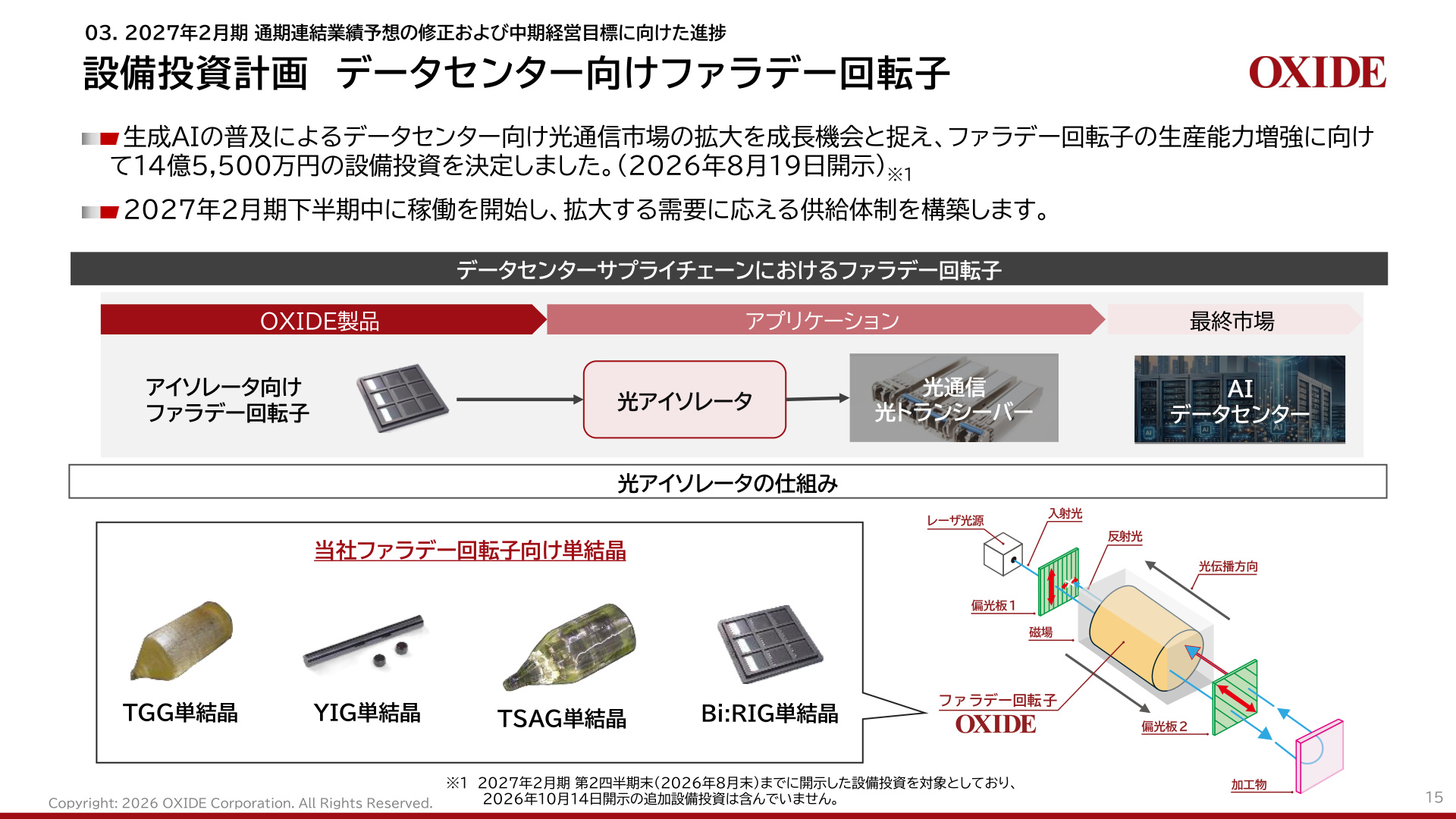
The slide above shows the core positioning of OXIDE Corporation in the generative AI data center market and its supply chain structure. For the training and inference of large language models (LLMs) in generative AI, optical communications (optical transceivers) that connect servers with high speed, low latency, and low power consumption are essential. The key material required to prevent laser light source damage and signal degradation in the optical isolators within these transceivers is the "Faraday rotator" (single crystals such as Bi:RIG, TGG, and TSAG).
To meet the surging AI data center demand, the company decided on a 1.455 billion yen capital investment (disclosed on August 19, 2026). This will allow new equipment to begin operation during the second half of the fiscal year ending February 2027, realizing a significant increase in supply capacity. Combined with the 1.555 billion yen in the initial plan, the total full-year capital investment is expected to reach nearly 3 billion yen , reflecting a strong commitment to a growth strategy centered on the company's strength in single crystal growth technology.
Furthermore, the following initiatives are underway to expand the mid-to-long-term technology portfolio:
- Development of "Deep UV Femtosecond Lasers" for semiconductor back-end microfabrication (disclosed August 2026): Integrating the company's wavelength conversion technology with the femtosecond laser technology of Fluence (Poland). This enables sub-micron precision microfabrication that minimizes thermal impact, aiming to open new markets such as advanced semiconductor packaging like CoWoS and CoPoS, co-packaged optics (CPO) , and glass substrate processing.
- Appointment of Mr. Susumu Kayama as Management Strategy Advisor (disclosed September 2026): Leveraging the expertise of Mr. Kayama, who led the semiconductor business at Toshiba and spearheaded the MBO of Toshiba Ceramics (now CoorsTek), to promote global business expansion and portfolio growth.
4. Upward Revision of Full-Year Consolidated Earnings Forecast and Progress on Mid-Term Targets
Analysis and Implications of Slide (Page 12)
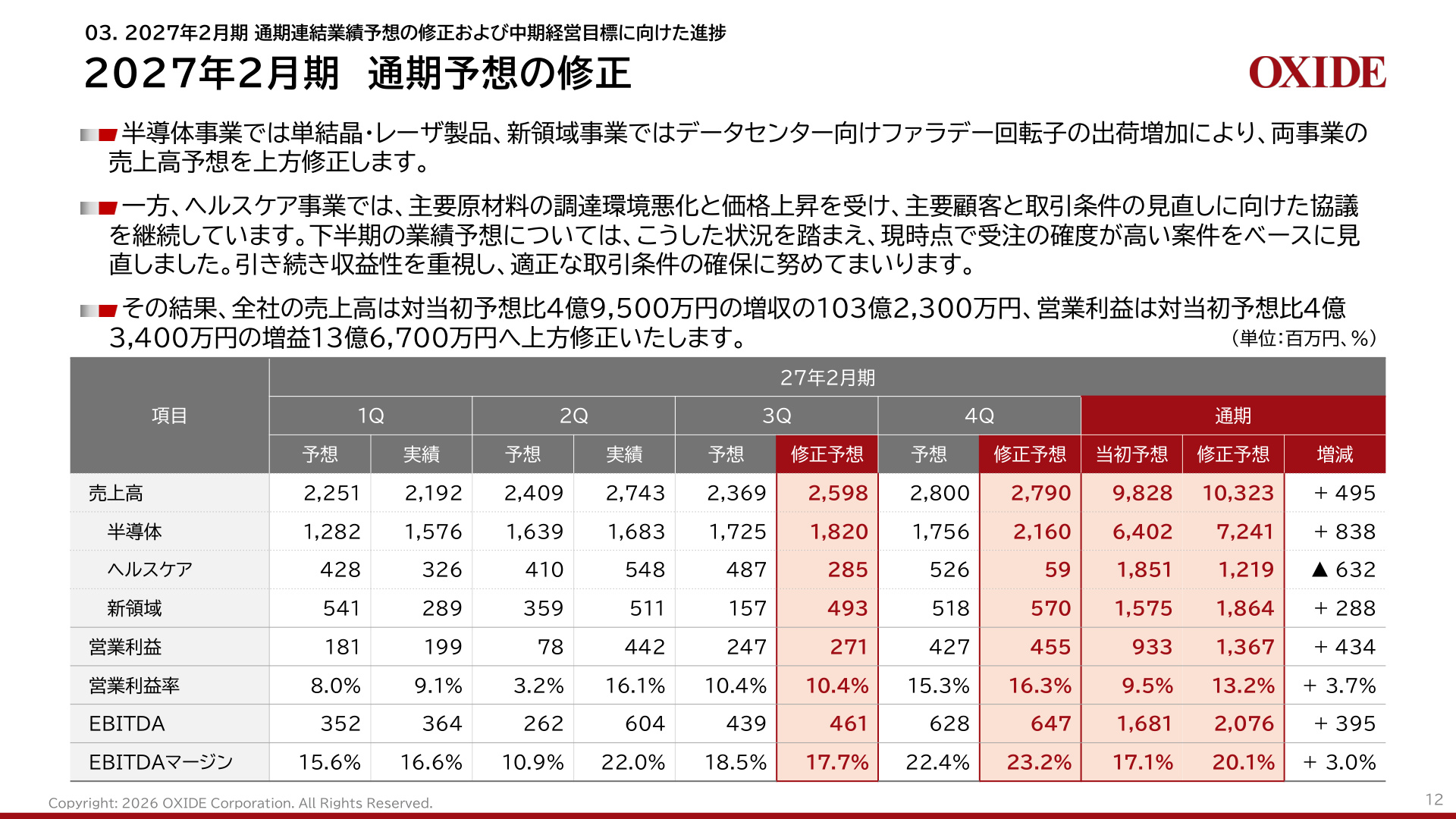
The slide above shows the breakdown of the full-year consolidated earnings forecast for the fiscal year ending February 2027, revised based on H1 progress and current order environments.
- Full-Year Consolidated Revenue Forecast : Revised upward from the initial 9.828 billion yen to 10.323 billion yen (an increase of 495 million yen).
- Full-Year Consolidated Operating Profit Forecast : Significantly raised from the initial 933 million yen to 1.367 billion yen (an increase of 434 million yen, a +46.5% upward revision in profit growth ).
Looking at the segments, the contrast between businesses and the stance of "selection and concentration" are clear.
- Semiconductor Business : Full-year revenue forecast revised upward from 6.402 billion yen to 7.241 billion yen (+838 million yen). Further shipment expansion is expected in the second half (Q3: 1.82 billion yen, Q4: 2.16 billion yen).
- New Business : Revised upward from 1.575 billion yen to 1.864 billion yen (+288 million yen) due to increased shipments of Faraday rotators and the contribution of delayed projects.
- Healthcare Business : Due to rising raw material costs and prolonged price negotiations, the revenue forecast was revised downward from 1.851 billion yen to 1.219 billion yen (a decrease of 632 million yen).
The portfolio is structured such that the growth in high-margin semiconductor and new business segments significantly compensates for the revenue decline in the healthcare business. As a result, the full-year forecast for operating profit margin is planned to improve significantly from the initial 9.5% to 13.2% (+3.7pt improvement) , and the EBITDA margin from 17.1% to 20.1% (+3.0pt improvement) .
Achieving Mid-Term Management Targets (FY2028) One Year Early
The mid-term management targets disclosed in April 2026 aimed for an "operating profit margin of 12% and EBITDA margin of 22%" by the fiscal year ending February 2028. With this full-year forecast (13.2% operating profit margin), the company is expected to achieve its operating profit margin target one year ahead of schedule . The EBITDA margin (revised forecast of 20.1%) is also within range of the 22% target, and a review of the mid-term targets themselves is planned after assessing progress in the second half.
5. Improvement of Financial Soundness and Optimization of Leverage
While continuing large-scale capital investment, the balance sheet is steadily improving alongside the rapid recovery in profitability.
- Net Debt / EBITDA : Significantly decreased from 7.1x in the fiscal year ended February 2024 to 3.7x at the end of the fiscal year ended February 2026, and to 2.6x at the end of the second quarter of the fiscal year ending February 2027. Financial soundness is rapidly increasing due to improved cash generation.
- Debt-to-Equity Ratio : Decreased from 1.6x at the end of the previous fiscal year to 1.3x .
- Equity Ratio : Increased from 31.8% at the end of the previous fiscal year to 34.7% (+2.9 percentage points), with net assets increasing to 5.349 billion yen.
Conclusion and Future Focus Points
OXIDE Corporation's Q2 FY2027 earnings results strongly convey a complete turnaround from the past several periods, during which the company faced component issues and a sluggish market.
Key points to monitor in future business development include:
- Continuity of shipments for semiconductor wafer inspection equipment : Whether the planned shipments of approximately 1.8 billion to 2.1 billion yen per quarter in Q3 and Q4 proceed smoothly.
- Ramp-up of production capacity investment for data centers : How much of the AI optical communication demand can be captured as the Faraday rotator production line, which received a 1.455 billion yen investment, begins operation as planned in the second half.
- Market penetration of new products for advanced packaging : The timeline for sample shipments and commercialization of deep UV femtosecond lasers for the CoWoS/CPO market.
- Profitability improvement in the healthcare business : The conclusion of price revision negotiations and the bottoming out of profit margins.
Attention is focused on the company's business development, which has increased its direct exposure to the two major growth markets of advanced semiconductor manufacturing and generative AI infrastructure, leveraging its core technologies of single crystal growth and optical wavelength conversion.
This content is not intended as investment advice or a recommendation. Any opinions expressed are solely the personal views of each article.