

BABY JOB FY2/2027 Q2 Earnings Deep Dive: Surging Diaper Subscription Service Drives Growth, Achieving 25.8% Market Penetration in Childcare Facilities and 69.1% Progress Toward Profit Targets

Sentiment Analysis
Introduction
BABY JOB Co., Ltd. (Securities Code: 293A), a provider of subscription services for diapers and other childcare supplies to childcare facilities, announced its financial results for the second quarter of the fiscal year ending February 2027 on October 15, 2026.
Guided by the vision of "creating a society where everyone can enjoy raising children," the company operates a childcare support business centered on flat-rate, all-you-can-use diaper and baby wipe services for childcare facilities. During the first half of the fiscal year, the company achieved significant growth in both revenue and profit , driven by a steady increase in the number of participating parents and facilities. This report provides a multi-faceted analysis of the company's performance trends, structural changes in profitability, key KPI developments, and financial position based on disclosed materials.
1. Q2 Earnings Highlights: Scale Expansion of Core Subscription Service Drives Revenue and Profit Growth
The company's performance during the first half of the fiscal year showed strong growth in both revenue and profit.
Slide Commentary (Highlights)
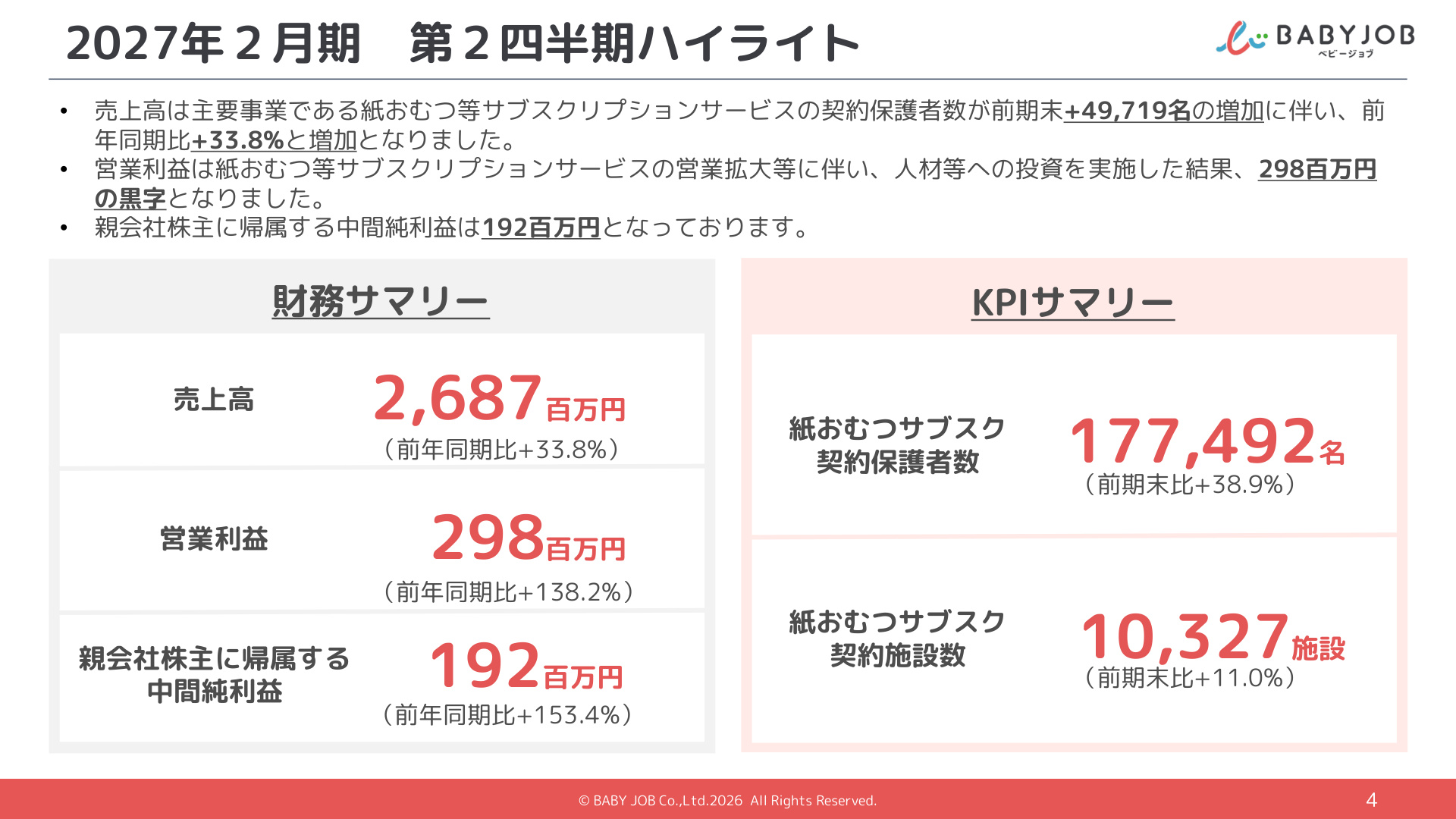
The Q2 highlights slide above is a critical overview of the company's current performance momentum and growth drivers.
- Net sales grew to 2,687 million yen (+33.8% year-on-year) . The primary driver was an increase of 49,719 contracted parents compared to the end of the previous fiscal year for its core diaper subscription service.
- Operating profit surged to 298 million yen (+138.2% year-on-year) , more than doubling, while net income attributable to owners of the parent reached 192 million yen (+153.4% year-on-year) . The company has significantly improved its profit-generating capacity alongside top-line growth, even while actively making growth investments such as talent acquisition to support business expansion.
- In terms of KPIs, the number of diaper subscription contracted parents reached 177,492 (+38.9% from the end of the previous fiscal year) , and the number of contracted facilities grew to 10,327 (+11.0% from the end of the previous fiscal year) , quantitatively demonstrating the solid expansion of the service foundation.
2. Detailed Analysis of the Income Statement and Full-Year Progress
Significant Profitability Improvement Year-on-Year
A comparison of the consolidated income statement with the same period last year reveals that profit at each level is growing at a pace exceeding revenue growth.
- Gross profit : 1,006 million yen (+48.2% year-on-year)
- Gross profit margin : 37.5% (a 3.6 percentage point improvement year-on-year)
- Operating profit margin : 11.1% (a 4.8 percentage point improvement year-on-year)
- Ordinary profit : 297 million yen (+143.1% year-on-year)
- Net income margin attributable to owners of the parent : 7.2% (a 3.3 percentage point improvement year-on-year)
The improvement in the gross profit margin from 33.8% to 37.5% is likely attributable to economies of scale from the growing number of subscribers and improvements in procurement and logistics efficiency. Furthermore, achieving a double-digit operating profit margin (11.1%) while continuing to invest in human resources suggests that operational leverage is beginning to take effect.
High Progress Rate Against Full-Year Earnings Forecasts
Progress against the full-year plan is also proceeding extremely smoothly.
Slide Commentary (Current Period Progress)
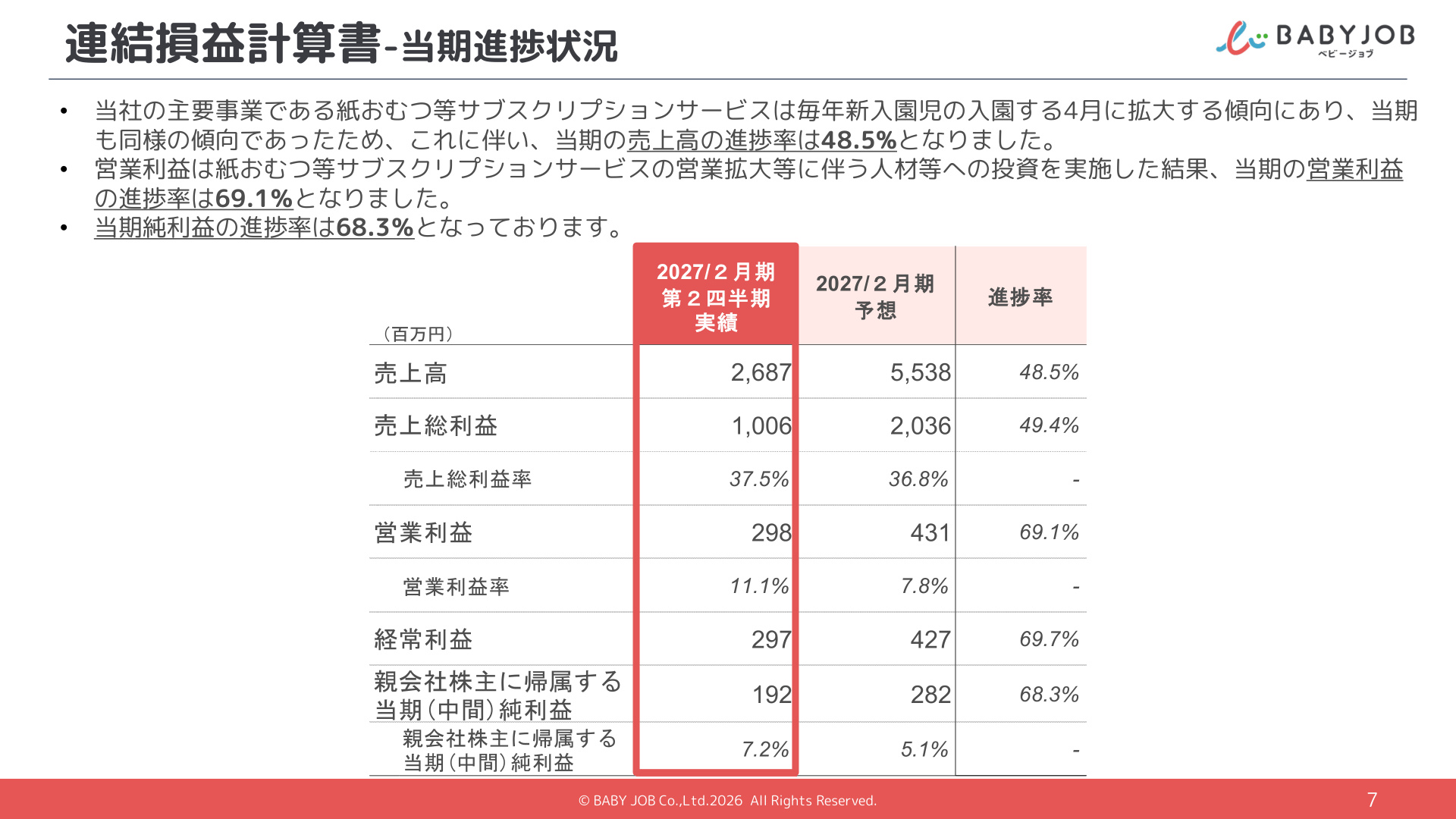
The slide above shows the progress as of the second quarter against the full-year forecast, providing key information for assessing the annual performance outlook.
- Net sales progress rate : 48.5% against the full-year forecast of 5,538 million yen (actual: 2,687 million yen)
- Gross profit progress rate : 49.4% against the full-year forecast of 2,036 million yen (actual: 1,006 million yen)
- Operating profit progress rate : 69.1% against the full-year forecast of 431 million yen (actual: 298 million yen)
- Ordinary profit progress rate : 69.7% against the full-year forecast of 427 million yen (actual: 297 million yen)
- Progress rate for net income attributable to owners of the parent : 68.3% against the full-year forecast of 282 million yen (actual: 192 million yen)
The company's core diaper subscription service has a seasonal pattern where the number of contracts jumps significantly in April and May , when new children enter childcare facilities. As a result of this seasonality, new acquisitions were concentrated in the first half, leading to a high progress rate of nearly 70% against full-year profit forecasts as of the second quarter.
3. KPI Trends: Expansion of Contracted Facilities and Parents
Essential indicators for evaluating the strength of the company's business model are the trends in "number of contracted facilities" and "number of contracted parents."
Slide Commentary (Trends in Contracted Facilities)
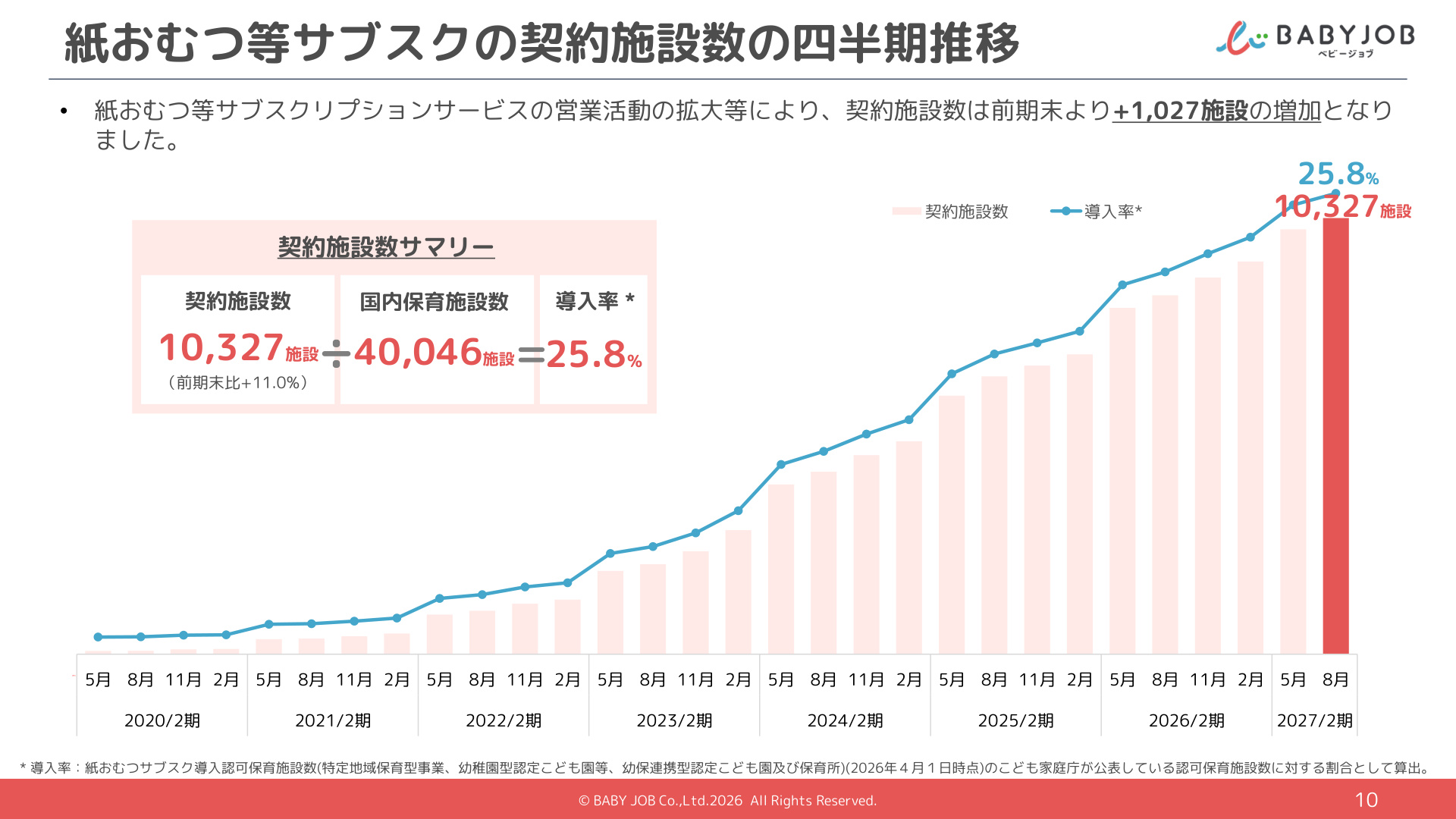
The slide above is a graph showing the "facility adoption rate," indicating how widely the company's service has penetrated childcare facilities nationwide.
- The number of contracted facilities increased by 1,027 from the end of the previous fiscal year due to strengthened sales activities, reaching 10,327 (+11.0% from the end of the previous fiscal year) .
- Based on the number of licensed childcare facilities in Japan published by the Children and Families Agency (40,046 facilities, including specific regional childcare businesses, kindergarten-type certified centers for early childhood education and care, etc.), the adoption rate is 25.8% .
- As the graph shows, the adoption rate has been on an upward trend since the fiscal year ended February 2020, meaning that the company's service is now used in more than one out of every four licensed childcare facilities in Japan . This robust facility network acts as a high barrier to entry and creates significant switching costs for competitors.
Seasonality and Rapid Growth in Contracted Parents
Meanwhile, the number of contracted parents (see Index 10) has reached 177,492 . The number of contracted parents tends to surge in April and May, the enrollment period for licensed childcare facilities, and increased by 56,320 at the beginning of the current fiscal year (as of May 2026) . As the number of contracted facilities increases, the opportunity to approach parents enrolling in those facilities automatically expands, accelerating the pace of parent acquisition year by year.
4. Financial Position and Cash Flows
Balance Sheet Trends (Financial Soundness)
Total assets at the end of the second quarter were 1,706 million yen , an increase of 180 million yen from the end of the previous fiscal year.
- Assets : While trade receivables increased by 166 million yen to 583 million yen due to higher sales, cash and deposits remained at a high level of 851 million yen (a decrease of 2 million yen from the end of the previous fiscal year).
- Liabilities : Although trade payables increased by 86 million yen to 290 million yen due to higher procurement, interest-bearing debt was reduced, with long-term borrowings decreasing by 32 million yen to 124 million yen .
- Net Assets : With the recording of interim net income, retained earnings increased by 171 million yen , bringing total net assets to 879 million yen (+174 million yen from the end of the previous fiscal year) .
Cash Flow Trends
Cash flows for the first half of the fiscal year reflect a structure that consistently generates healthy cash from business activities.
- Cash flows from operating activities : +101 million yen inflow (compared to a 49 million yen inflow in the same period last year), primarily due to the recording of 297 million yen in interim net income before taxes.
- Cash flows from investing activities : 39 million yen outflow (compared to a 24 million yen outflow in the same period last year), mainly due to the acquisition of intangible fixed assets related to software development.
- Cash flows from financing activities : 64 million yen outflow (compared to a 72 million yen outflow in the same period last year), primarily due to 42 million yen in repayments of long-term borrowings.
The company is steadily investing in future IT infrastructure (software) and repaying debt using funds generated from operating cash flow, while maintaining a healthy cash and deposit balance of 851 million yen.
5. Growth Strategy and Future Business Development
Looking back at the company's history (see Index 15), since launching "Tebura-en" (Hands-free Childcare) in collaboration with Unicharm in 2019, the company expanded into public childcare facilities starting with a partnership with Miyake Town, Nara Prefecture, in 2020. Furthermore, it has built strong alliances with major hygiene product manufacturers and logistics companies one after another, such as "Kao Smile-en" with Kao in 2022 and "Niko Niko-en" with Seino Shoji in 2024.
Beyond diaper subscriptions, the company is diversifying its business domain into a platform that comprehensively supports DX in childcare and childcare support . This includes the "Dare-demo Kessai" (Anyone Payment) cashless service for childcare facilities, the "En-sagasot♪" information site connecting facilities and parents, and the welfare service third-party evaluation business through "Hoiku Daisansha Hyoka Co., Ltd.," established in 2025.
With the diaper subscription adoption rate in domestic childcare facilities currently at 25.8%, there remains a 74.2% untapped market . Amidst the persistent nationwide shortage of childcare workers and the need to reduce the burden on parents, there is significant room for new approaches to facilities that have not yet adopted the service, including public childcare centers.
6. Conclusion
BABY JOB's financial results for the second quarter of the fiscal year ending February 2027 demonstrate a successful combination of strong top-line growth and improved profit margins , with net sales up 33.8% and operating profit up 138.2%.
The progress rate against the full-year operating profit plan has reached 69.1% , indicating an extremely smooth trajectory even when accounting for seasonality. Leveraging its established customer base of 25.8% share in domestic licensed childcare facilities and 177,000 contracted parents, the company's focus will now shift to penetrating the remaining untapped facilities and enhancing LTV (Life Time Value) through the expansion of peripheral services such as payment and evaluation businesses.
This content is not intended as investment advice or a recommendation. Any opinions expressed are solely the personal views of each article.