

Arcs Co., Ltd. FY2027/2 Interim Financial Results Deep Dive: Record-High Interim Sales Achieved; Advancing Toward the 1 Trillion Yen Vision Through Cost Absorption and the "New Convincing Price" Strategy

Sentiment Analysis

Arcs Co., Ltd. (Securities Code: 9948), a leading food supermarket operator based in Hokkaido, Tohoku, and Northern Kanto, has released its financial results for the second quarter (interim period) of the fiscal year ending February 2027. Despite a challenging external environment characterized by high inflation, the reactionary decline in demand following last year's extreme heat, and fluctuations in rice market prices, the company achieved record-high interim sales by strengthening its produce, seafood deli, and value-added product offerings. Conversely, operating profit saw a slight year-on-year decline, impacted by rising labor costs associated with wage increases.
This report extracts 10 key topics from the released financial briefing materials, providing a comprehensive analysis ranging from current performance trends, cost control, and store/product strategies to shareholder return policies and the long-term outlook toward the "1 trillion yen sales" goal.
1. FY2027/2 Interim Financial Results: Record-High Interim Sales
Arcs' consolidated sales for the interim period of the fiscal year ending February 2027 reached 318.6 billion yen (101.6% year-on-year, +4.9 billion yen compared to the previous year) , marking a record high for an interim period. By quarter, performance remained steady, with 158.4 billion yen in Q1 (102.7% year-on-year) and 160.2 billion yen in Q2 (100.5% year-on-year).
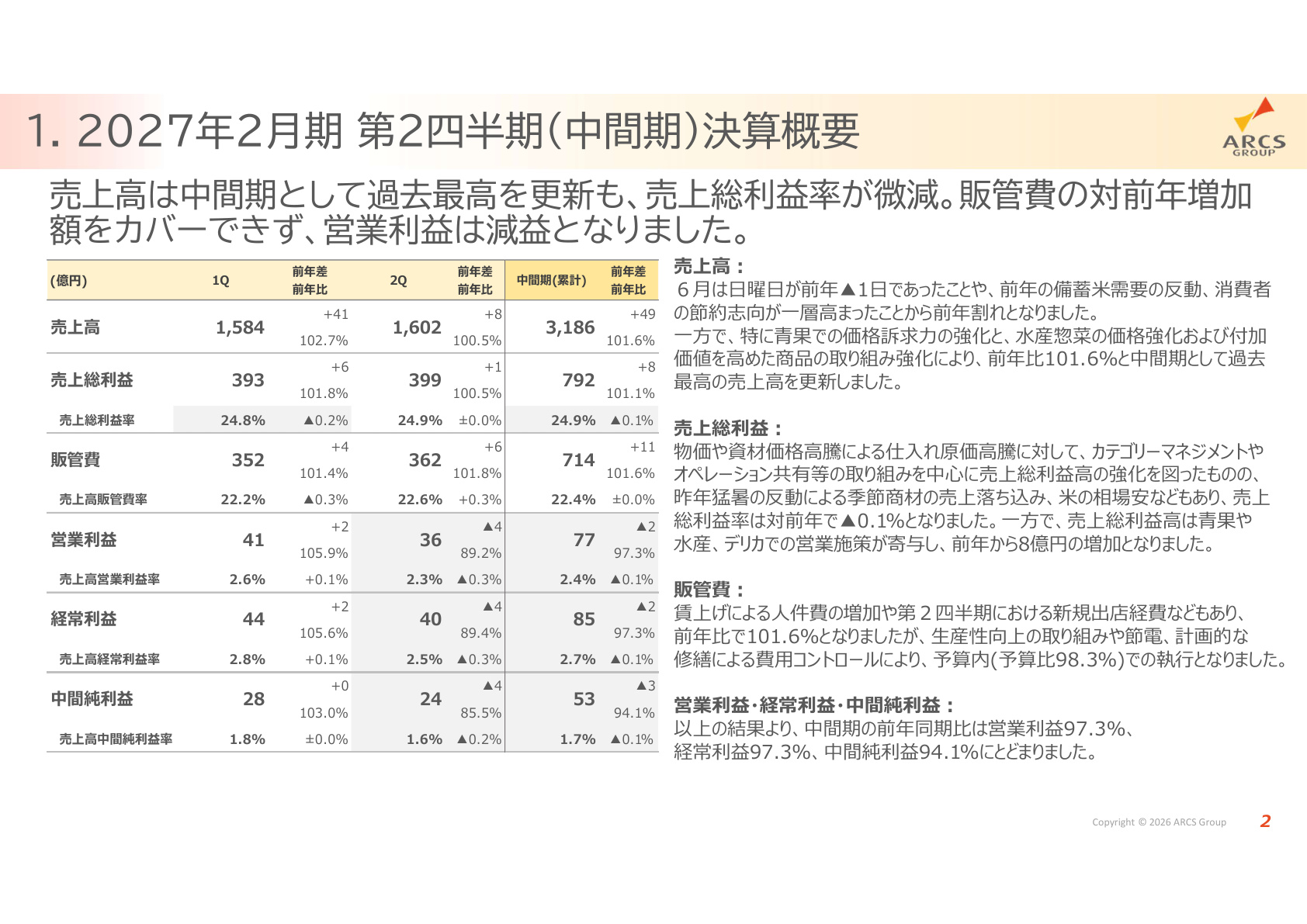
The slide above provides a concise overview of the interim period and changes in the profit structure, serving as a critical reference for understanding these results. While sales steadily expanded, profit figures all fell below the previous year's levels: operating profit was 7.7 billion yen (97.3% year-on-year, -0.2 billion yen) , ordinary profit was 8.5 billion yen (97.3% year-on-year, -0.2 billion yen) , and net income attributable to owners of parent was 5.3 billion yen (94.1% year-on-year, -0.3 billion yen) . The gross profit margin saw only a slight decline to 24.9% (-0.1% year-on-year), but the company was unable to fully absorb the increase in selling, general and administrative (SG&A) expenses caused by wage hikes, resulting in a decline in profit.
2. Analysis of Profit Structure: Breakdown of Slight Gross Margin Decline and SG&A Increase
Breaking down the factors behind the change in operating profit, the figure moved from 7,981 million yen in the same period last year to 7,766 million yen this term (-215 million yen).
- Gross Profit Trends : Sales initiatives in produce, seafood, and deli were successful, contributing a +1,246 million yen increase to gross profit. However, rising prices for commodities and materials, a decline in seasonal items due to the reactionary effect of last year's heatwave, and lower rice market prices led to a decline in the gross profit margin, which acted as a -359 million yen drag.
- SG&A Trends : The largest factor for the increase was labor costs, which rose by 1,333 million yen (103.3% year-on-year) due to wage hikes and minimum wage revisions. Additionally, other expenses increased by 69 million yen due to new store opening costs for Ito Chain Co., Ltd.
- Cost Reduction Achievements : Conversely, energy-saving investments such as switching to LED lighting, installing dimming systems, and adopting reach-in freezer cases reduced electricity consumption to 97.8% and electricity costs to 94.5% year-on-year, resulting in an improvement of +280 million yen to operating profit (a +311 million yen difference in electricity costs compared to the previous year) .
3. Sales Trends by Product Category: Reaction to Heatwave, Rice Price Drop, and Growth in Fresh/Deli
As consumer cost-consciousness intensifies, performance varied by category.
- Struggling Categories : The "Rice" category saw sales fall below the previous year due to the reactionary decline from last year's stockpiling demand and lower market prices; in August 2026, the unit price per item fell year-on-year for the first time in 42 months. Additionally, "Alcohol & Beverages" (Alcohol at 97.0%, Beverages at 98.2%) and "Japanese/Western Daily Foods" (chilled noodles, ice cream, pickled plums, etc.) dropped significantly due to the reactionary effect of last year's extreme heat.
- Strong Categories : "Produce" was supported by price-conscious promotions centered on seasonal vegetables and health-oriented products. "Seafood" grew due to strengthened promotions for eel and abundant bonito catches, alongside growth in seafood deli items. "Deli" drove sales and gross profit expansion by introducing ready-to-eat, high-volume, and community-focused products.
4. Thorough Expense Control and Operational Sharing
Amidst mounting pressure from rising labor costs, the Group is curbing expenses by leveraging group synergies. Labor costs were kept to 99.3% of the budget by horizontally deploying best practices for productivity improvement across the group from the planning stage. Furthermore, total SG&A expenses were held to 98.3% of the budget through planned maintenance and thorough energy conservation. Looking toward the second half, the company is promoting multifaceted cost control, including standardizing tasks through video manuals, reducing overtime via labor management using task acquisition charts and RPA (Robotic Process Automation), and reducing disposal costs by converting industrial waste—which previously incurred disposal fees—into valuable resources.
5. FY2027/2 Full-Year Earnings Forecast and Progress
Regarding the full-year consolidated earnings forecast for the fiscal year ending February 2027, the company has maintained the figures announced at the beginning of the period.
- Full-Year Sales Forecast : 648 billion yen (+21 billion yen year-on-year)
- Full-Year Operating Profit Forecast : 18 billion yen (+0.3 billion yen year-on-year)
- Full-Year Ordinary Profit Forecast : 19.6 billion yen (+0.4 billion yen year-on-year)
- Full-Year Net Income Attributable to Owners of Parent Forecast : 12.4 billion yen (-0 billion yen year-on-year)
Comparing the sum of interim results and second-half plans (Sales: 643.1 billion yen, Operating Profit: 17.3 billion yen, Ordinary Profit: 18.9 billion yen, Net Income: 11.7 billion yen) against the full-year forecast, a recovery is required in the second half to meet the targets. The company plans to achieve its goals through second-half targets of 324.5 billion yen in sales (+11.2 billion yen year-on-year) and 9.5 billion yen in operating profit (-0 billion yen year-on-year), driven by strengthening fresh food sales during the year-end shopping season and expanding the online shop business.
6. Store Expansion Strategy: Promoting "Super Arcs" Conversion and Accelerating Renovations
In terms of store expansion, a key growth driver, the company plans 3 new stores (1 opened in the interim period) and 17 renovations (10 completed in the interim period) for the full year. Particular focus is placed on store renovations, including format changes to "Super Arcs," the large-scale food supermarket format. By evolving the existing robust store network into more competitive formats, the company aims to expand market share and improve profitability.
7. Sophistication of Shareholder Return Policy: Progressive Dividends Focused on DOE and Increased Employee Stock Ownership Incentives
Arcs is actively working to improve capital efficiency and enhance shareholder returns.
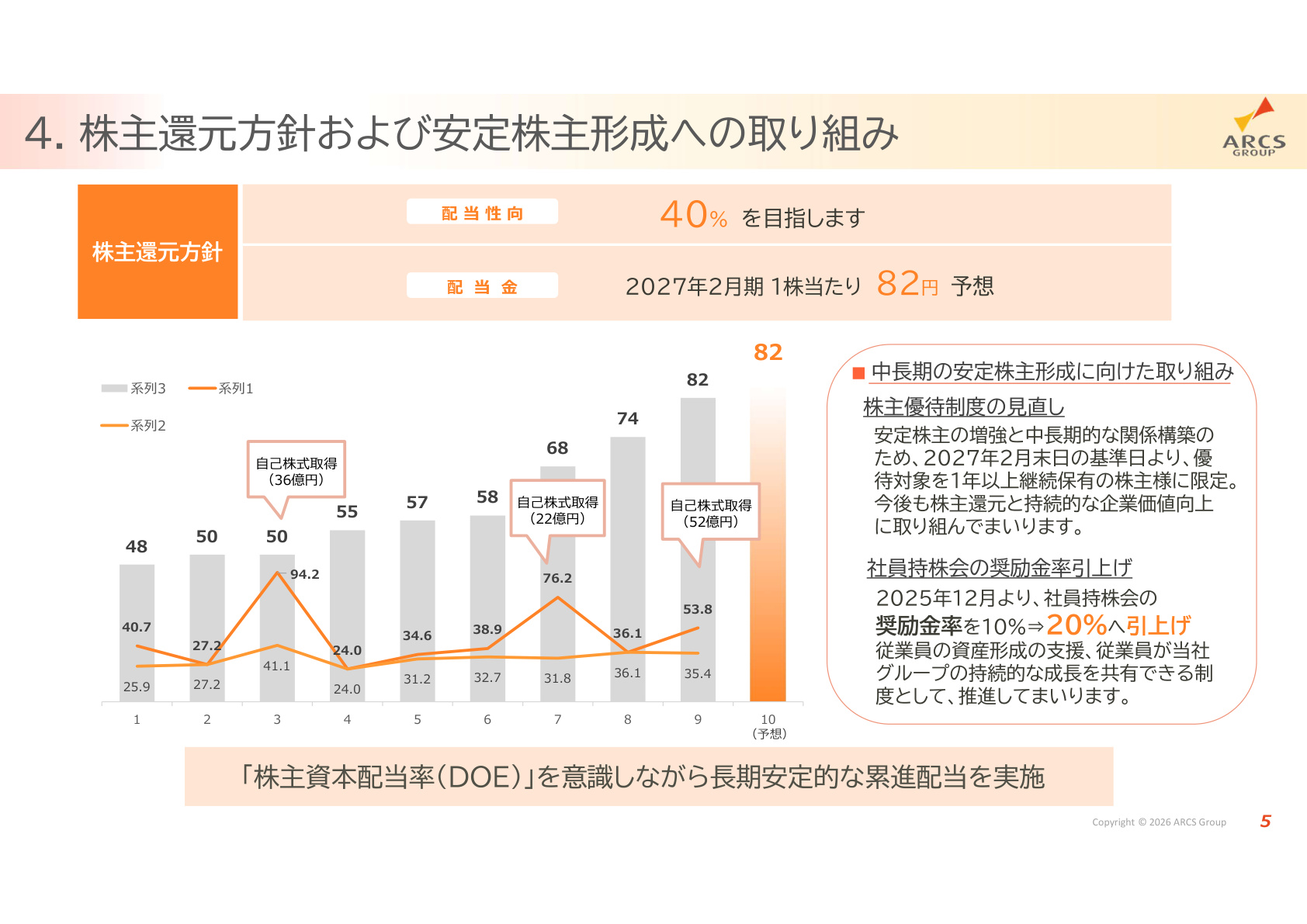
The slide above covers the company's mid-to-long-term shareholder return policy and key measures for forming a stable shareholder base. Regarding dividend policy, the company clearly states its aim for a "payout ratio of 40%" while implementing long-term, stable, progressive dividends with a focus on the "Dividend on Equity (DOE) ratio." The annual dividend forecast for the fiscal year ending February 2027 is 82 yen per share (the same as the previous year's actual) . The company has also demonstrated a track record of flexibly executing share buybacks on the scale of 3.6 billion yen, 2.2 billion yen, and 5.2 billion yen. Furthermore, starting in December 2025, the incentive rate for the employee stock ownership plan was significantly increased from 10% to 20% , fostering a solid management foundation by supporting employee asset formation and sharing in sustainable growth.
8. Formation of Mid-to-Long-Term Stable Shareholders via Review of Shareholder Benefit Program
As a measure to encourage long-term stock ownership, a review of the shareholder benefit program has been announced. Starting from the record date of the end of February 2027, the program will be limited to "shareholders who have held shares for one year or more." This change aims to curb short-term rights-seeking and build strong relationships with individual investors and stable shareholders who support the company's growth over the mid-to-long term.
9. Differentiation Strategy Amidst High Inflation: "New Convincing Price" and "Yatsugatake Mountain Range Management"
Amidst ongoing inflation and rising raw material and commodity costs, Arcs advocates for the "New Convincing Price," which distinguishes itself from simple price-cutting competition. This initiative seeks to achieve a price setting that balances "taste," "freshness," and "price" to the utmost, ensuring satisfaction for all three parties: consumers, producers, and suppliers. Supporting this is the company's unique "Yatsugatake Mountain Range Management." Operating companies such as Ralse, Universe, Beljois, Fukuhara, Doto Arcs, Toko Store, Donan Ralse, Dohoku Arcs, Ito Chain, Otani, and L.D. stand together like independent peaks while maintaining their regional individuality. By pooling the group's collective procurement power and know-how, the company achieves both economies of scale and deep community roots.
10. Long-Term Growth Vision "Try One Trillion!": Paving the Way to a 1 Trillion Yen Sales Structure
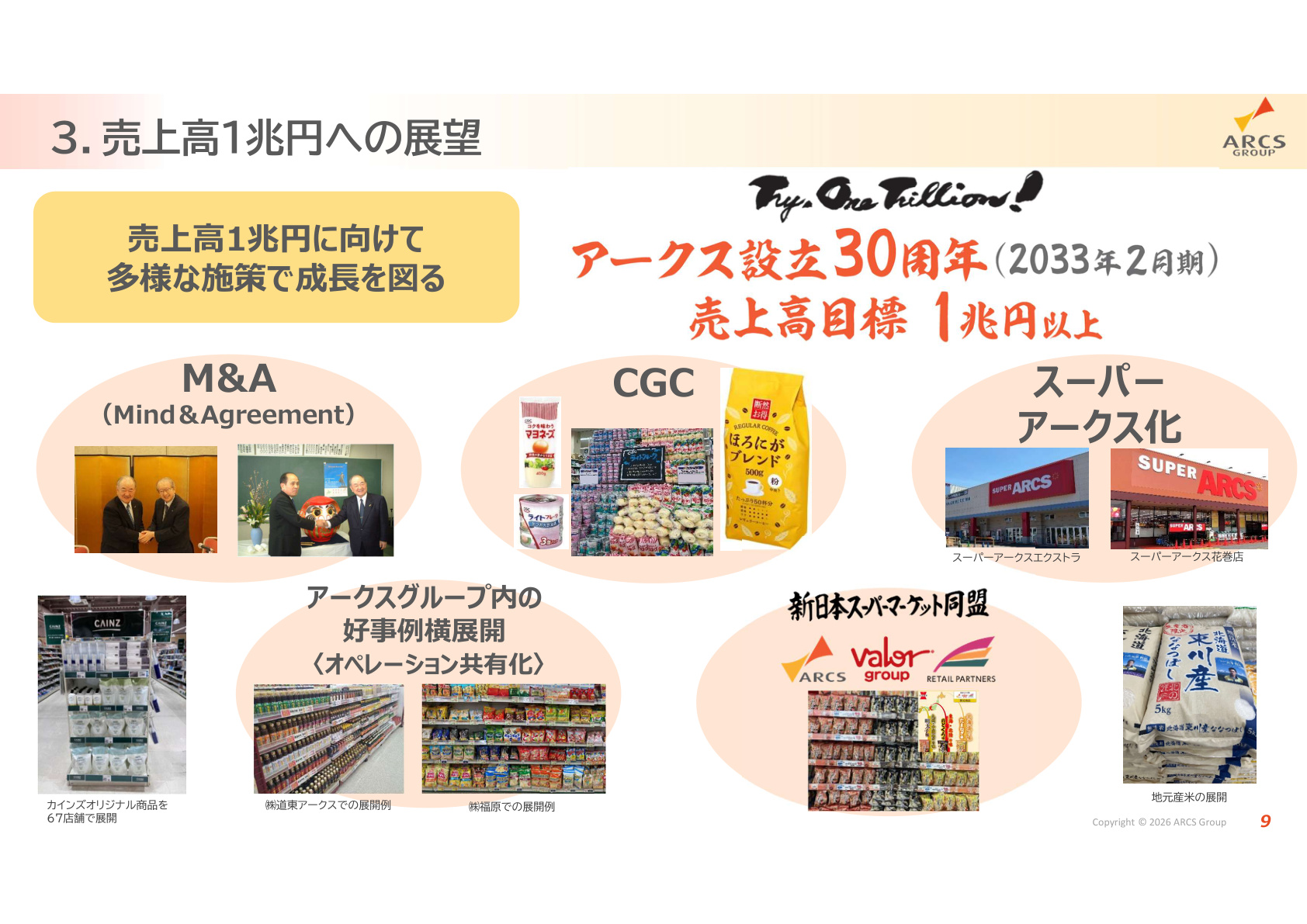
As shown in the slide above, Arcs is promoting the long-term vision "Try One Trillion!," which sets a "sales target of 1 trillion yen or more" for the fiscal year ending February 2033 , the year it celebrates its 30th anniversary. To reach this ambitious goal, the following multifaceted measures are being implemented:
- M&A (Mind & Agreement) : Continuously exploring friendly business integrations based on shared philosophies.
- Strengthening Alliances : Promoting joint procurement and information sharing through the "New Japan Supermarket Alliance" formed with Valor Holdings and Retail Partners.
- Utilization of CGC Products & Strengthening PB : Maximizing the use of Co-operative Chain (CGC) private brand products to balance gross profit margins with price competitiveness.
- Expansion of Cross-Industry Collaboration : Improving customer attraction, including in non-food sectors, such as by deploying Cainz original products across 67 group stores.
- Conversion to "Super Arcs" and Operational Sharing : Horizontally deploying success stories and efficient operational methods from group companies to raise productivity across the entire chain.
Summary
In the interim period of the fiscal year ending February 2027, Arcs maintained record-high interim sales and solid profitability despite headwinds such as poor weather, the reactionary decline in rice demand, and soaring labor costs, thanks to the strengthening of fresh foods and delis and thorough cost control, including electricity savings. Looking toward the second half, the company aims to achieve its full-year plan by permeating the "New Convincing Price" strategy and accelerating store renovations, while deepening returns to shareholders and employees through progressive dividends focused on DOE and the strengthening of the employee stock ownership plan. In the long term, the company is advancing its growth story toward achieving 1 trillion yen in sales by the fiscal year ending February 2033 by fully leveraging the synergies of the "New Japan Supermarket Alliance" and "Yatsugatake Mountain Range Management."
This content is not intended as investment advice or a recommendation. Any opinions expressed are solely the personal views of each article.