

Vitabrid Japan Q2 FY2027 Earnings Deep Dive: Progress in D2C Investment Recovery and Customer Base Expansion

Sentiment Analysis
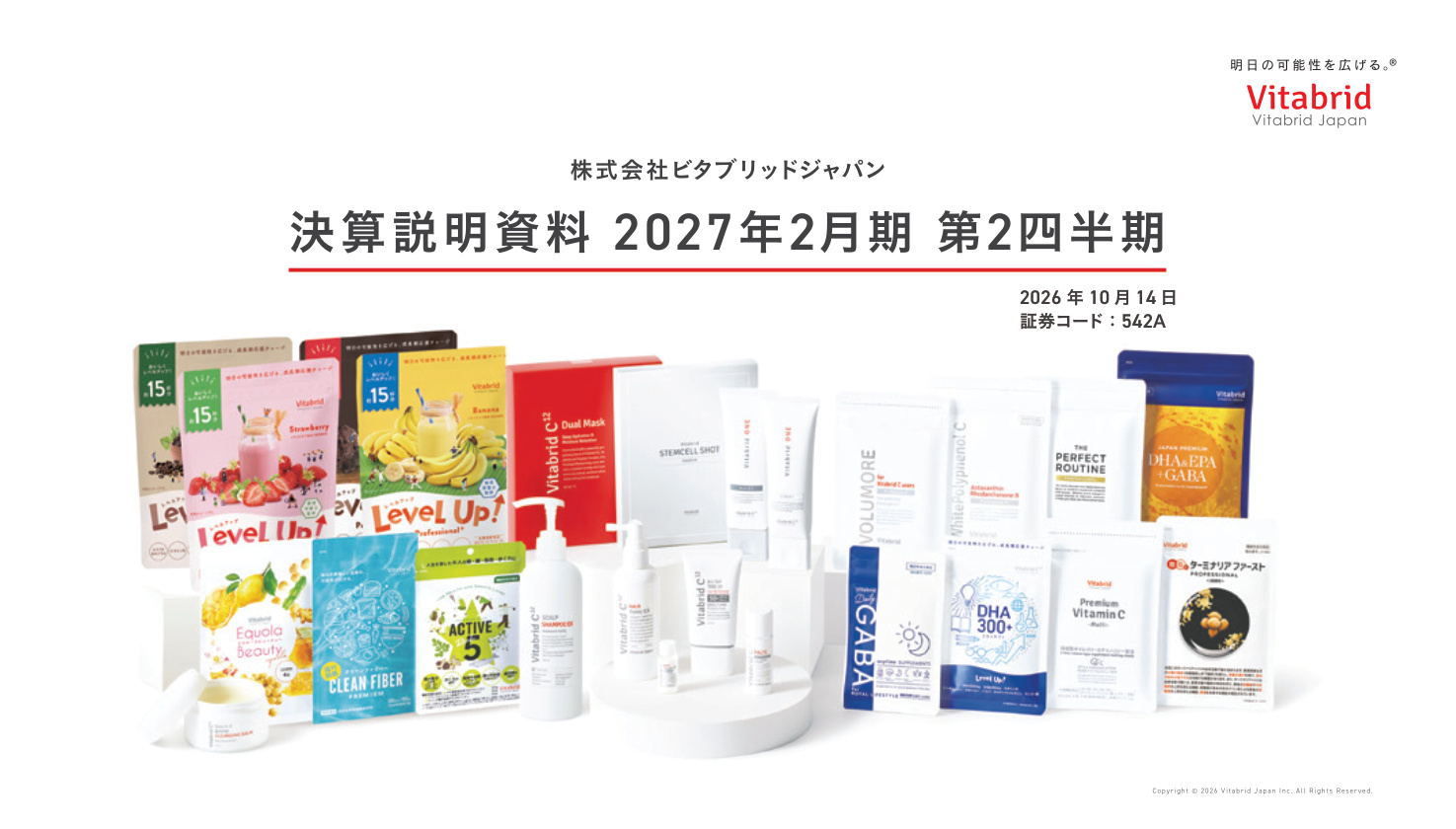
The Q2 FY2027 (interim) financial results announced by Vitabrid Japan Inc. (Securities Code: 542A) demonstrate increased revenue and significant operating profit growth , driven by the solid performance of core products and efficient investment control. This report provides a comprehensive analysis of the company's performance trends, its proprietary D2C revenue model, key performance indicators (KPIs), and mid-to-long-term growth strategies, based on the disclosed earnings presentation materials.
1. Q2 Cumulative Earnings Highlights
For the first half of the fiscal year ending February 2027 (March to August 2026), the company achieved year-on-year revenue growth and a significant turnaround from an operating loss in the same period last year to a substantial profit.
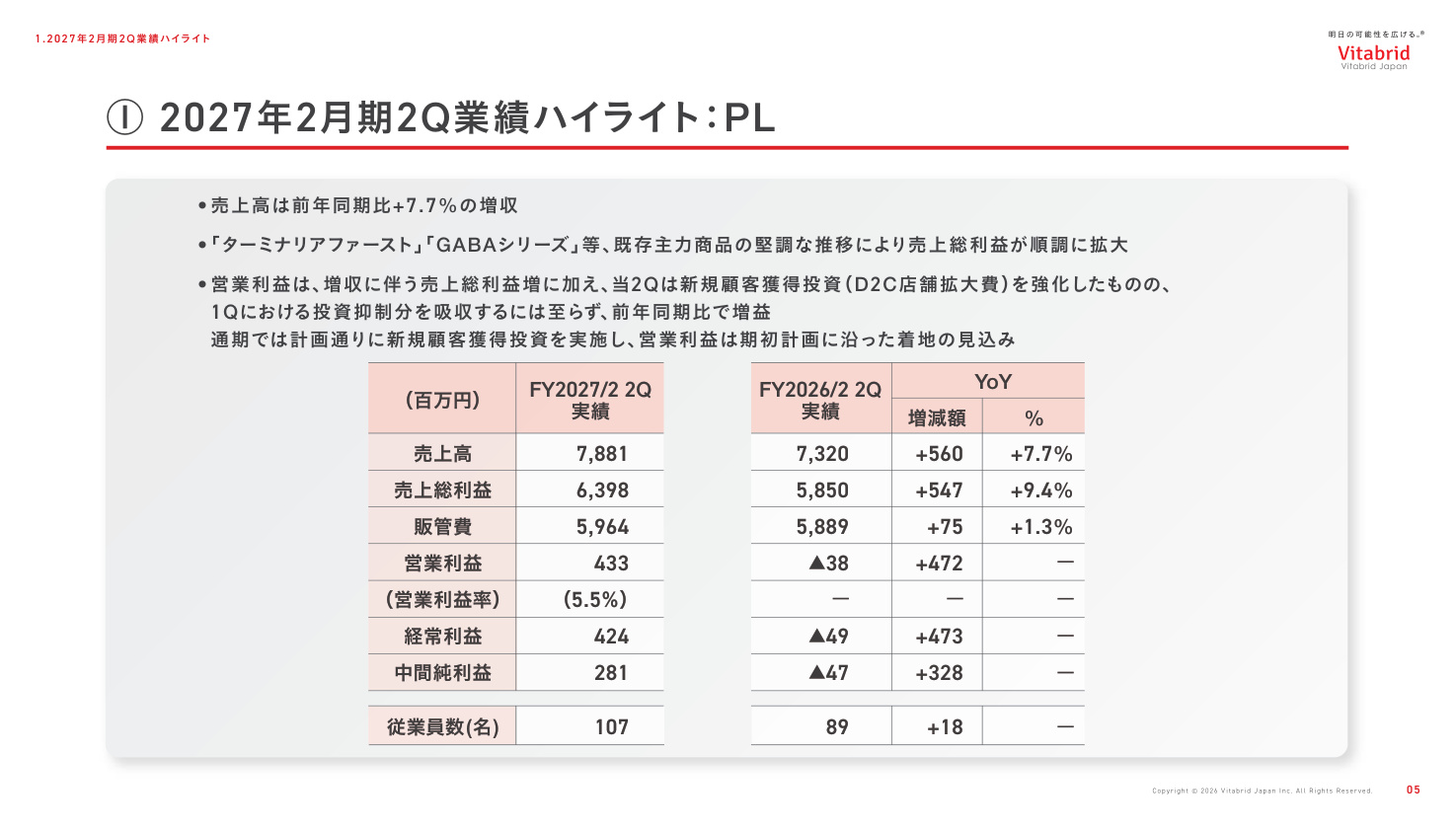
As shown in the slide above, the key Profit and Loss (PL) figures are as follows:
- Net Sales : 7.881 billion yen (+7.7% YoY, +560 million yen)
- Gross Profit : 6.398 billion yen (+9.4% YoY, +547 million yen)
- Selling, General and Administrative (SG&A) Expenses : 5.964 billion yen (+1.3% YoY, +75 million yen)
- Operating Profit : 433 million yen (compared to an operating loss of 38 million yen in the same period last year, a change of +472 million yen)
- Operating Profit Margin : 5.5%
- Ordinary Profit : 424 million yen (compared to an ordinary loss of 49 million yen in the same period last year, a change of +473 million yen)
- Net Income for the Interim Period : 281 million yen (compared to an interim net loss of 47 million yen in the same period last year, a change of +328 million yen)
In addition to the growth in net sales, the gross profit margin remained at a high level of 81.2% (compared to approximately 79.9% in the same period last year), serving as the foundation for profit expansion. Furthermore, the impact of one-time product disposals associated with the transition of hair care products to an online medical platform, which was observed in Q4 of the previous fiscal year, has been resolved, returning to normal levels.
Non-operating expenses include costs related to the new stock listing (9 million yen) incurred in April of this year. However, there is no significant divergence from the operating profit level, and the company's fundamental earning power is reflected in the interim net income.
2. Quarterly Trends and the Mechanism of the D2C Revenue Model
Looking at the quarterly trends, there is a significant difference in operating profit between Q1 and Q2. While Q2 standalone net sales grew steadily to 4.086 billion yen (+5.2% YoY, +7.7% QoQ), operating profit resulted in a minor loss of 9 million yen (compared to an operating profit of 442 million yen in Q1).
Behind this profit fluctuation lies the investment recovery cycle inherent to the company's D2C business model .
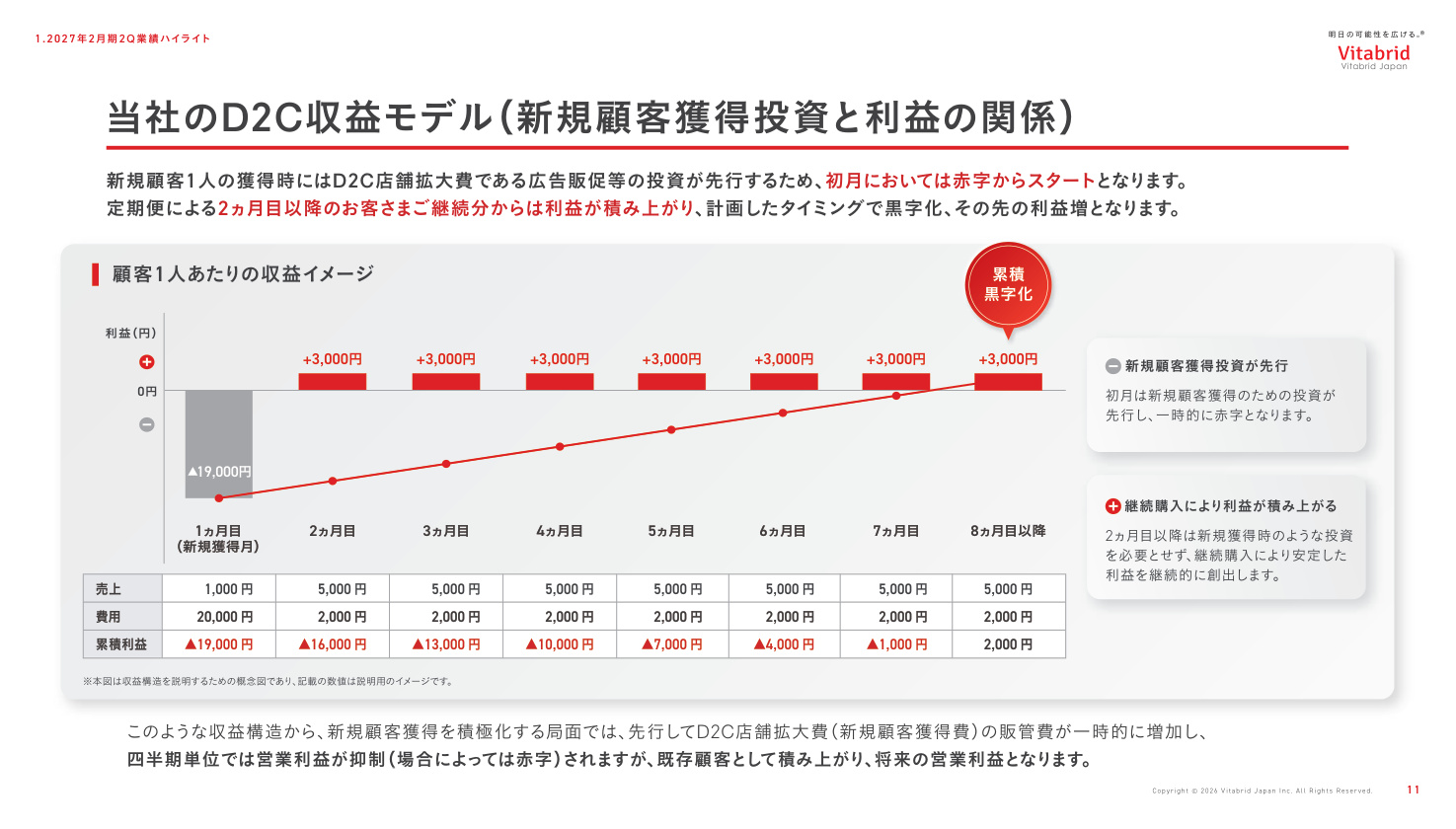
In the company's revenue structure, D2C store expansion costs (advertising and promotional expenses such as web ads and TV media aimed at attracting and engaging customers to its own e-commerce site) are concentrated in the first month of acquiring a new customer, resulting in a temporary loss per customer in the first month . However, since no additional acquisition costs are incurred for repeat purchases from the second month onwards via subscription, profits accumulate as stock month after month (the model shows cumulative profitability from the 8th month onwards).
In the current period, the company conducted multiple tests (trials) regarding new appeal directions in Q1 and restrained advertising investments, which led to high operating profit in Q1. Subsequently, based on the Q1 results, the company actively deployed D2C store expansion costs in Q2 while confirming efficiency (SG&A expenses increased by 701 million yen QoQ). As a result, while the number of new customers increased, the Q2 operating profit for the accounting period was temporarily pressured. This is a result of strategic investment execution in line with the plan.
3. Key KPI Trends: Improving LTV through Loyal Customers and Cross-selling
All key indicators supporting the company's sustainable growth are performing extremely well.
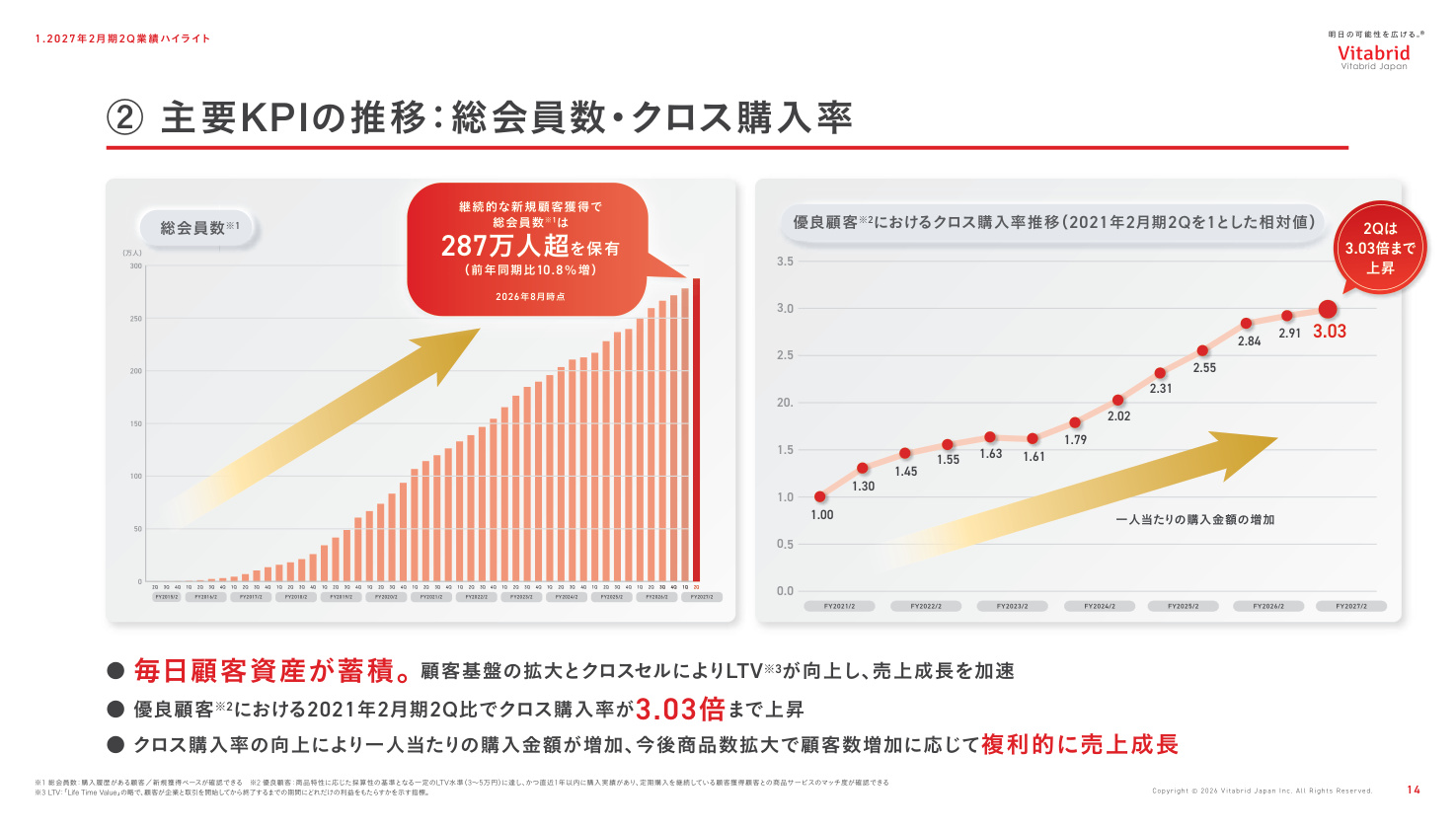
① Total Membership and Cross-purchase Rate
- Total Membership : Recorded over 2.87 million members (+10.8% YoY), indicating steady expansion of the customer base.
- Cross-purchase Rate : The cross-purchase rate among loyal customers has grown to 3.03 times the relative value, using Q2 of the fiscal year ending February 2021 as the baseline (1.00). The increase in customers purchasing multiple products rather than a single product has improved the purchase unit price per customer and the Lifetime Value (LTV) .
② Number of Loyal Customers and Retention Rate
- Loyal Customer Retention Rate : Maintained an extremely high level of 96.69% as of Q2. Looking at past trends, it has remained stable at around 96%, forming a stock revenue stream with low churn rates and high predictability.
- Loyal Customer Growth Index : Using Q1 of the fiscal year ending February 2025 as 1.00, it has expanded to 1.28 in the current Q2, showing that the quality of the customer base is steadily strengthening even under controlled investment.
4. Trends by Category and Sales Channel
Category Performance
Instead of focusing on localized growth in specific categories, the company adopts a policy of flexibly allocating investments to highly efficient categories.
- Inner Care Segment : The GABA series, including the flagship " Terminalia First ," as well as " Vitabrid Daily GABA " and " Japan Premium DHA&EPA+GABA ," are strongly driving the overall performance. Additionally, " Active Reach 5 ," launched in July 2025, has entered a full-scale growth phase, contributing to sales expansion.
- Outer Care Segment : This segment focuses on skin care and hair care, with continuous lineup development.
Channel Performance
- Direct E-commerce : Net sales of 6.860 billion yen (+7.1% YoY), growing steadily as the main pillar of the business.
- E-commerce Malls : Net sales of 458 million yen (+5.7% YoY), expanding as a touchpoint complementing direct e-commerce.
- Wholesale/Other : Net sales of 562 million yen (+16.3% YoY), showing progress in multi-channel expansion.
5. Progress Against Full-Year Plan, New Product Launches, and Mid-to-Long-Term Strategy
Progress Against Full-Year Earnings Forecast
The full-year consolidated earnings forecast for the fiscal year ending February 2027, announced at the beginning of the period, remains unchanged.
- Net Sales : 7.881 billion yen against a plan of 17.6 billion yen ( 44.8% progress )
- Operating Profit : 433 million yen against a plan of 1.1 billion yen ( 39.4% progress )
- Ordinary Profit : 424 million yen against a plan of 1.082 billion yen ( 39.2% progress )
- Net Income for the Full Year : 281 million yen against a plan of 717 million yen ( 39.3% progress )
As a business characteristic, the company actively invests in advertising for new customer acquisition in the first half, with stock revenue from acquired customers peaking in the second half. Compared to the same period last year, when operating profit progress was zero (a loss of 38 million yen), the company has secured approximately 40% of the planned operating profit in the first half, progressing at an expected pace. From Q3 onwards, the company plans to optimize the allocation of D2C store expansion costs while monitoring sales performance and profitability to achieve the full-year targets.
New Product Pipeline and Development System
With a goal of "continuously launching at least 3 products per year," active product development is underway.
- Current Period Achievements : Launched "Uwasa no Juso Kuen-san Aojiru PREMIUM" in April, the sustainable online clinic "Isotretinoin Treatment" in July, the e-commerce mall exclusive "Carbonated Oral Tablet" in August, and the Level Up series "Level Up Totono-u Dashi" and "Level Up BOOST PRO" in September.
- Future Pipeline : Over 20 products are under development/verification, and 18 products are in preparation for launch (including 11 growth candidates and 7 small-scale products), with main product launches planned from Q3 onwards.
Establishment of Shareholder Benefit Program
To promote long-term stock ownership and build a fan base of shareholders, the establishment of a shareholder benefit program was announced. Depending on the number of shares held (100 to 1,000+ shares) and the holding period (3 months to 3+ years), shareholders will receive points ranging from 2,500 to a maximum of 75,000 points usable at the official online shop. The company has also begun an approach to encourage existing customers, who number over 2.87 million, to become shareholders through product inserts.
Mid-to-Long-Term Growth Strategy
Even after reaching the 10 billion yen revenue scale, the company aims for sustainable growth with a Compound Annual Growth Rate (CAGR) of over 15% . In addition to huge and stable existing target markets such as healthcare (TAM 922.7 billion yen), skin care (1.227 trillion yen), and hair care (516.8 billion yen), the company is accelerating expansion into growth markets such as femcare (88.8 billion yen) and the online medical field (projected to grow from 124.8 billion yen in 2026 to 259.1 billion yen in 2040). The company plans to leverage its exclusive contract with HYUNDAIBIO, a drug discovery company with global patented technology, and its network of over 130 partners to pursue horizontal expansion centered on its proprietary D2C engine.
This content is not intended as investment advice or a recommendation. Any opinions expressed are solely the personal views of each article.