

Juntendo H1 FY2027 Earnings Analysis: Profit Growth Driven by Improved Margins and Cost Reductions, with Deepened JA Collaboration and Path to Full-Year Profitability

Sentiment Analysis
Juntendo H1 FY2027 Earnings Analysis: Profit Growth Driven by Improved Margins and Cost Reductions, with Deepened JA Collaboration and Path to Full-Year Profitability
Juntendo Co., Ltd. (Securities Code: 9835), a home center operator primarily based in the Chugoku region, has released its financial results and supplementary materials for the second quarter (interim period) of the fiscal year ending February 2027.
Despite a challenging environment characterized by a decline in top-line revenue due to consumer spending restraint amid rising prices and intensified competition, the company achieved profit growth across all profit lines compared to the same period last year. This success was driven by initiatives to improve gross profit margins and thorough company-wide cost reductions . This report provides a detailed analysis of the company's overall performance, key drivers, financial position, the progress of its unique collaboration with JA (Japan Agricultural Cooperatives), and the outlook for achieving full-year profitability.
1. H1 FY2027 Earnings Highlights
In this interim period, the company reported a decline in revenue but an increase in operating profit, ordinary profit, and interim net profit.
- Operating Revenue : 22,523 million yen (down 4.1% YoY / 95.9% of previous year)
- Total Sales: 22,065 million yen (down 4.1% YoY)
- Home Center (HC) Business: 22,065 million yen (down 4.0% YoY)
- Book Center (BC) Business: N/A (Terminated as of April 2025)
- Operating Revenue (excluding sales): 457 million yen (down 3.0% YoY)
- Total Sales: 22,065 million yen (down 4.1% YoY)
- Gross Profit : 6,994 million yen (down 0.6% YoY)
- Operating Profit : 958 million yen (up 9.9% YoY / 109.9% of previous year)
- Ordinary Profit : 918 million yen (up 8.1% YoY / 108.1% of previous year)
- Interim Net Profit : 632 million yen (up 10.4% YoY / 110.4% of previous year)
Although operating revenue decreased by 965 million yen year-on-year, operating profit increased by 86 million yen due to improved gross profit margins and the compression of selling, general, and administrative (SG&A) expenses.
2. Sales Trends by Segment and Consumer Environment
An analysis of sales in the HC business (totaling 22,065 million yen, down 925 million yen YoY) highlights the impact of consumer spending restraint driven by heightened cost-of-living concerns.
- Agriculture & Gardening : Down 320 million yen (the largest downward factor)
- Hobbies & Interests : Down 228 million yen (restraint in pet supplies, etc.)
- Construction & DIY : Down 205 million yen (slowdown in demand for building materials)
- Household Goods & Appliances : Down 136 million yen
- Others (Kerosene, etc.) : Down 34 million yen
Conversely, certain product categories captured demand. Air conditioners (appliances) saw increased demand due to revised energy-saving standards, while petroleum-derived products (household goods) such as trash bags and plastic wrap experienced temporary demand spikes due to tensions in the Middle East. Additionally, paints, adhesives, and certain building materials performed well for repair purposes. However, these were insufficient to offset the widespread restraint in core categories like agriculture/gardening, daily necessities, and pet supplies.
3. Mechanisms for Margin Improvement and SG&A Control
The company attributes the structural increase in operating profit during a period of declining revenue to both improved gross profit margins and effective SG&A expense control.
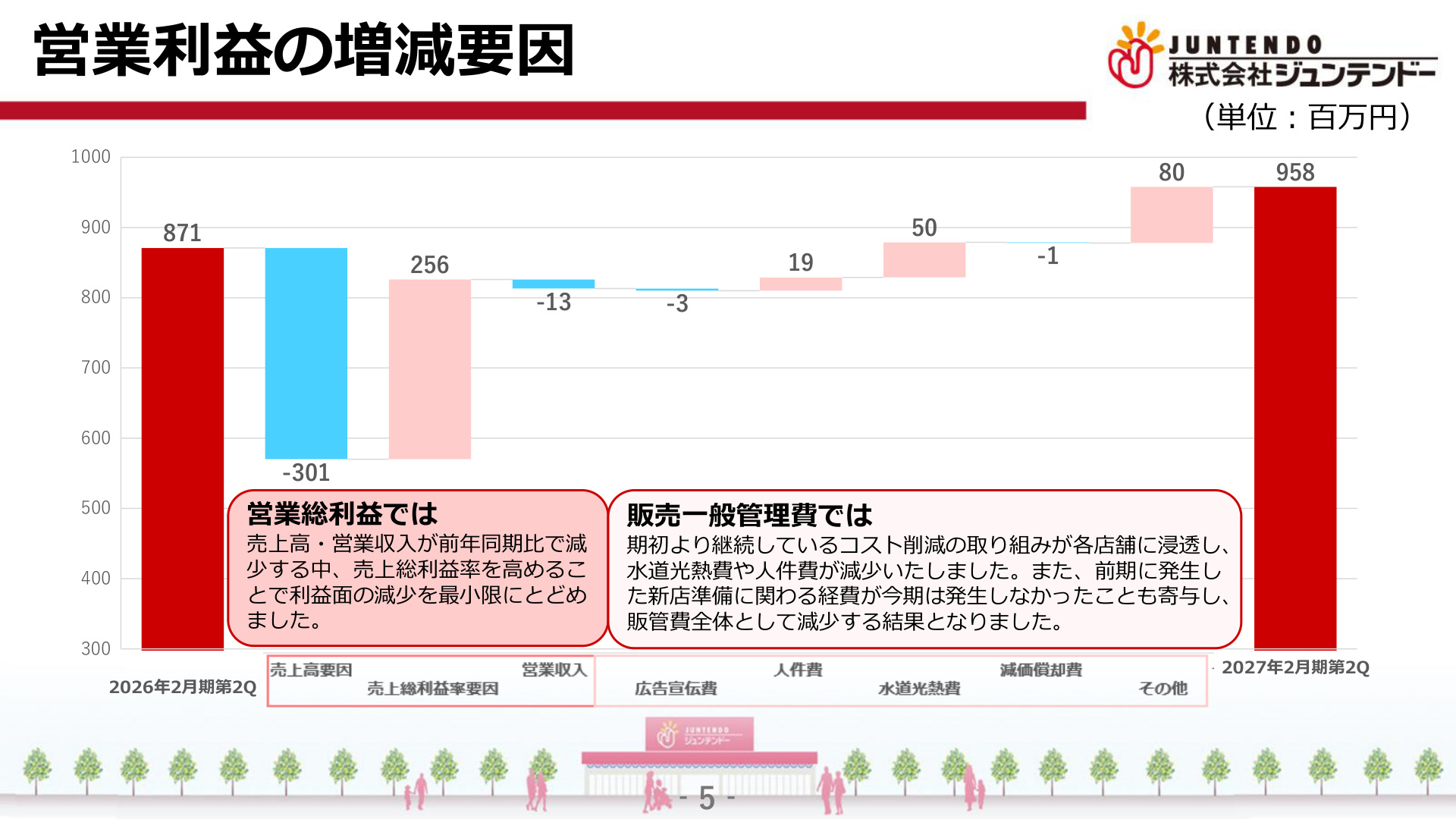
The waterfall chart above (factors for operating profit fluctuation) clearly illustrates how the company offset the impact of declining operating revenue.
- Improvement in Gross Profit Margin (+256 million yen) : The initiatives to improve mark-up rates , which have been promoted since the fiscal year ending February 2025, have taken firm root, resulting in an improvement of approximately 1.12 percentage points in the gross profit margin compared to the same period last year. This significantly offset the negative impact of declining sales (-301 million yen).
- Reduction in SG&A Expenses (+145 million yen effect) : Through energy conservation and operational efficiency improvements at each store, utility costs decreased by 50 million yen and personnel expenses decreased by 19 million yen . Furthermore, other expenses decreased by 80 million yen, partly due to the absence of new store preparation costs that were incurred in the same period last year.
As a result, total SG&A expenses were reduced by 145 million yen from 6,639 million yen in the previous year to 6,493 million yen, leading to an operating profit of 958 million yen (+86 million yen YoY).
4. Financial Position and Cash Flow Trends
The company is making progress in strengthening its financial foundation and reducing interest-bearing debt.
Balance Sheet (B/S) Highlights
- Total Assets : 40,879 million yen (down 441 million yen from the end of the previous fiscal year)
- Cash and deposits decreased by 594 million yen (to 1,258 million yen), and property, plant, and equipment decreased by 443 million yen due to depreciation, while inventory increased by 305 million yen (to 13,486 million yen).
- Total Liabilities : 27,585 million yen (a significant decrease of 1,145 million yen from the end of the previous fiscal year)
- Short-term loans decreased by 700 million yen (to 500 million yen) and long-term loans decreased by 675 million yen (to 10,901 million yen), resulting in a total reduction of 1,460 million yen in borrowings .
- Total Net Assets : 13,294 million yen (up 703 million yen from the end of the previous fiscal year)
- Capital was bolstered by the recording of 632 million yen in interim net profit.
- Equity Ratio : Increased by 2.0 points from 30.5% at the end of the previous fiscal year to 32.5% .
Cash Flow (C/F) Status
- Operating C/F : 1,082 million yen (contributed by 911 million yen in pre-tax interim net profit and 589 million yen in depreciation)
- Investing C/F : -45 million yen (expenditures for fixed asset acquisition were limited to 99 million yen)
- Financing C/F : -1,632 million yen (proactive repayment of borrowings)
The company's stance of prioritizing debt repayment using generated operating cash flow to improve its financial balance is clearly evident.
5. Store Network and Community-Based Strategy: Expanding JA Collaboration
As of the end of August 2026, the store network consists of 115 stores (total sales floor area of 248,707㎡, down 1 store from the end of the previous fiscal year) across the Chugoku and Kinki regions. The breakdown is: 31 in Hiroshima, 21 in Yamaguchi, 18 in Shimane, 12 in Okayama, 11 in Hyogo, 10 in Tottori, 6 in Kyoto, 5 in Wakayama, and 1 in Nara.
A key focus of the company's differentiation strategy for agricultural support and community engagement is its collaboration with JA (Japan Agricultural Cooperatives) .
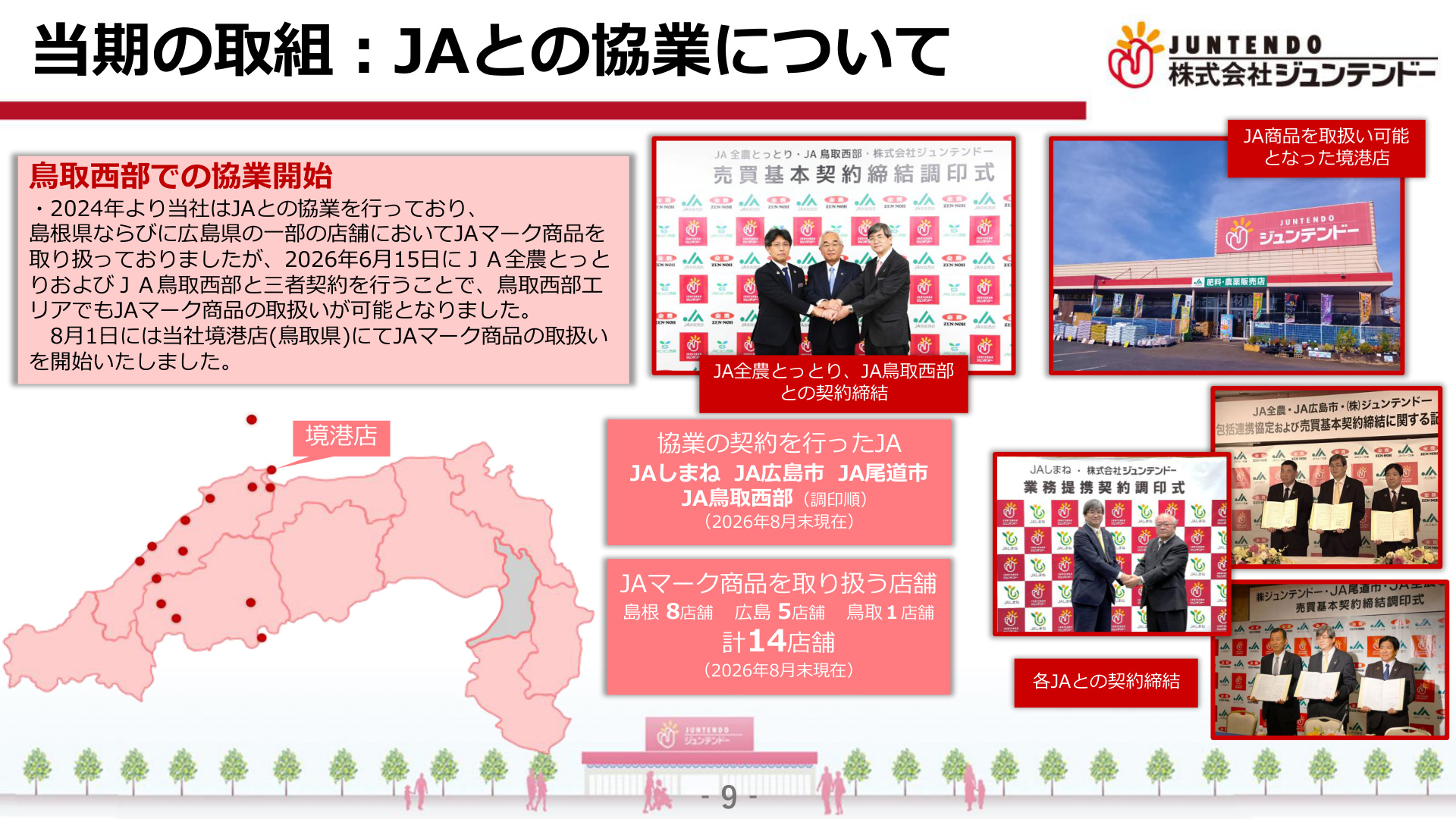
This initiative is a strategic alliance aimed at improving convenience for local farmers and members while strengthening customer traffic to Juntendo stores.
- Background and Development : Starting in 2024, the company began handling JA-branded products at select stores in Shimane and Hiroshima prefectures. Partnerships have expanded in the order of JA Shimane, JA Hiroshima City, and JA Onomichi City .
- New Expansion in Western Tottori : On June 15, 2026, a tripartite agreement was signed with JA Zen-Noh Tottori and JA Tottori Seibu , and the handling of JA-branded products began at the Sakaiminato store in Tottori Prefecture on August 1.
- Number of Participating Stores : As of the end of August 2026, the initiative has expanded to a total of 14 stores : 8 in Shimane, 5 in Hiroshima, and 1 in Tottori.
This is positioned as an effort to strengthen the company's function as regional infrastructure and solidify its customer base in the specialized agricultural sector.
6. Information Dissemination and Sustainability Initiatives
To reinforce the strengths of its physical stores, the company is enhancing information dissemination using social media and video platforms.
- Instagram (Short Videos) : Distributing practical product usage tips and lifestyle information through three channels: "Gardening Channel," "Lifestyle Channel," and "DIY Channel."
- YouTube : Continuously posting short video content, including repair tutorials for agricultural machinery by employees, interviews, and product introductions.
In terms of sustainability, the company is engaged in activities for coexistence with local communities, such as environmental conservation efforts in collaboration with the Kao Group (donating a portion of sales to the Shimane Prefecture Greening Promotion Committee) and accepting local elementary and junior high school students for home center work experience programs.
7. Full-Year Earnings Forecast for FY2027
The company has maintained its initial full-year consolidated earnings forecast.
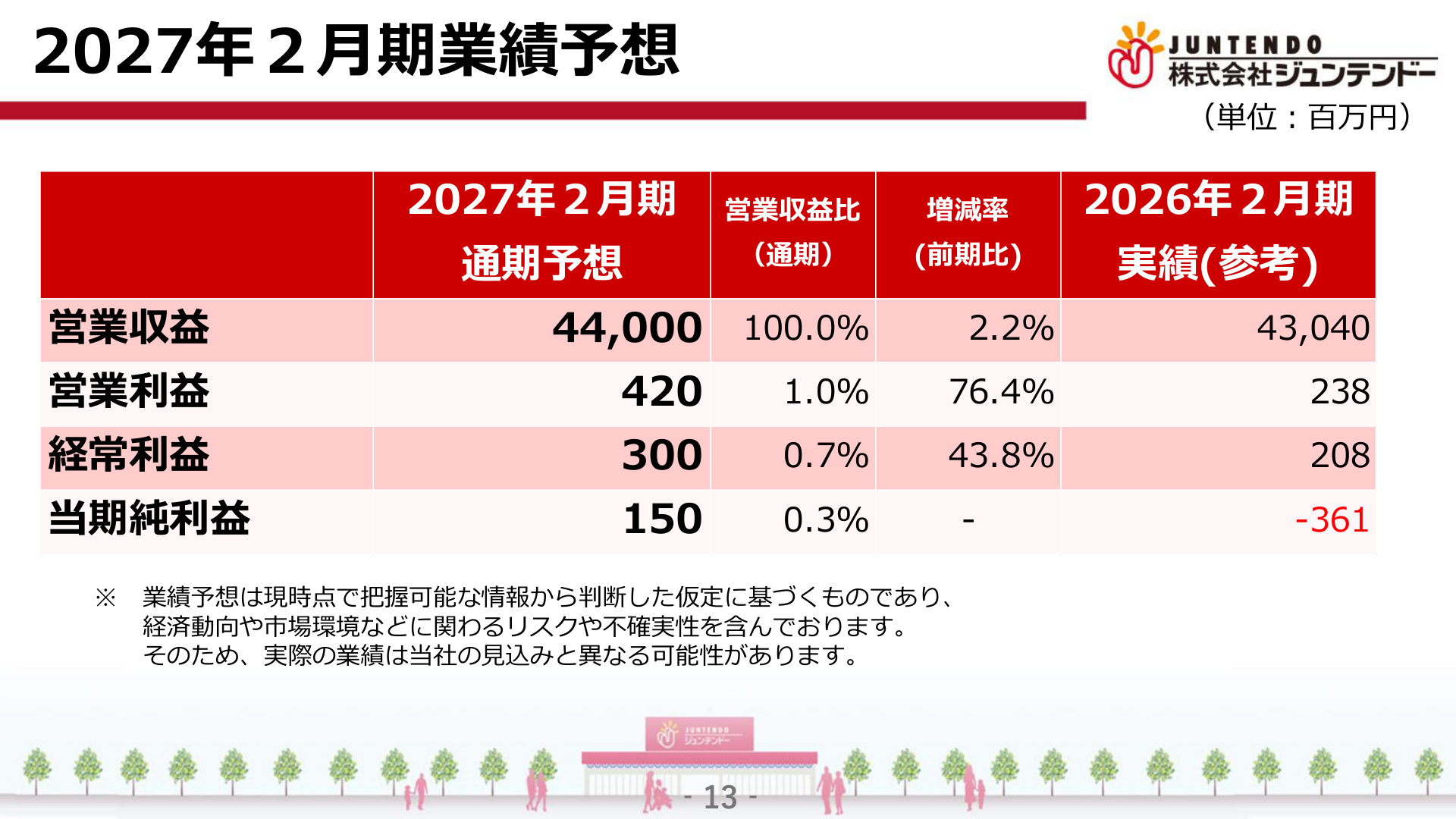
The full-year forecast figures are as follows:
- Operating Revenue : 44,000 million yen (up 2.2% YoY)
- Operating Profit : 420 million yen (up 76.4% YoY)
- Ordinary Profit : 300 million yen (up 43.8% YoY)
- Net Income : 150 million yen (a turnaround to profitability from the previous year's loss of 361 million yen)
The cumulative results for the second quarter (Operating Profit: 958 million yen, Ordinary Profit: 918 million yen, Interim Net Profit: 632 million yen) have already exceeded the full-year plan figures. The company will continue its efforts to achieve full-year profit growth and a return to net profitability, while closely monitoring seasonal factors in the second half (demand for heating materials and snow removal supplies, and agricultural off-season trends), price trends, and cost fluctuations.
This content is not intended as investment advice or a recommendation. Any opinions expressed are solely the personal views of each article.