

Sanyo Shokai FY2027/2 Interim Results and Capital Strategy: Navigating First-Half Headwinds Toward a Second-Half Rebound Through Brand Restructuring and Aggressive Capital Allocation

Sentiment Analysis

Sanyo Shokai Ltd.'s financial results for the first half of the fiscal year ending February 2027 were challenging, marked by an operating loss. Following a solid start in the first quarter, the company faced a slowdown in the second quarter due to unfavorable weather and a deteriorating market environment. However, preliminary data for September shows a sharp recovery, with in-store sales reaching 111% year-on-year, leading the company to maintain its full-year earnings forecast. Sanyo Shokai is currently advancing initiatives to establish a "Japan Luxury" segment, expand sales channels beyond department stores, fundamentally strengthen its e-commerce operations, and execute a capital strategy centered on a "5% DOE" (Dividend on Equity) target to balance growth investment with shareholder returns. This report provides a detailed analysis of the interim performance, the recovery plan for the second half, long-term growth strategies, and the overall capital policy.
1. Overview of FY2027/2 Interim Consolidated Results
For the first half of the fiscal year ending February 2027 (March 1, 2026, to August 31, 2026), consolidated results were as follows: Net Sales of 25.95 billion yen (-1.09 billion yen YoY) , Gross Profit of 15.67 billion yen (-0.70 billion yen YoY) , Operating Loss of 0.50 billion yen (-0.29 billion yen YoY) , Ordinary Loss of 0.42 billion yen (-0.27 billion yen YoY) , and Net Loss attributable to owners of the parent of 0.56 billion yen (-0.26 billion yen YoY) .
Compared to the revised plan (announced August 28, 2026), net sales exceeded expectations by 0.25 billion yen. However, due to gross profit falling 0.03 billion yen short of the plan and selling, general and administrative (SG&A) expenses increasing by 0.07 billion yen, operating profit fell 0.10 billion yen below the target. The gross profit margin was 60.4% (-0.2pt YoY, -0.7pt vs. plan), and the operating profit margin was -1.9% (-1.1pt YoY, -0.4pt vs. plan).
2. Monthly Trends and Analysis of Performance Factors
Looking at sales trends by quarter, the first quarter (March–May) remained resilient at 101% of the previous year, but the second quarter (June–August) slowed significantly to 91%.
- March–May (Q1) : The launch of spring/summer items went smoothly, and the recovery in inbound tourism helped offset the impact of a reduction in the number of sales floors. Sales remained at previous-year levels: March (101%), April (100%), and May (102%).
- June : Unfavorable weather across the country during the final phase of the spring/summer full-price sales season led to a market-wide slump. Consequently, full-price sales struggled, causing net sales to drop to 90% of the previous year.
- July–August : The company prioritized KPI improvements, curbing sales promotions to focus on full-price sales. As a result, full-price sales recovered to 107% in July and 109% in August, and the gross profit margin improved significantly by +2.3pt and +4.1pt, respectively. However, total sales remained at 92% in July and 89% in August, failing to fully recover the losses incurred through June.
3. Cost Control and Financial Position
Despite the earnings shortfall, progress in controlling SG&A expenses remains steady.
- SG&A Expenses : Interim SG&A expenses totaled 16.171 billion yen, a decrease of 0.42 billion yen year-on-year. This was driven by a 0.31 billion yen reduction in sales commissions linked to sales, and a 0.45 billion yen reduction in selling expenses through the optimization of Fashion Advisor (FA) salaries. Fixed costs, excluding upfront investments for new brand launches, continue to be suppressed.
- Financial Position : As of the end of August 2026, total assets stood at 54.039 billion yen (-0.919 billion yen from the end of the previous interim period), and net assets were 37.024 billion yen (-1.538 billion yen). The equity ratio is 68.5% (-1.7pt YoY) , and the Debt-to-Equity Ratio (DER) is maintained at 0.20x . Cash and deposits are secured at 19.800 billion yen (+0.720 billion yen YoY) through the sale of investment securities.
4. September Preliminary Data and Background for Maintaining Full-Year Forecasts
Although the interim period ended in a loss, preliminary in-store sales for September show a strong rebound, with company-wide sales at 111% of the previous year . By brand, flagship labels are performing well: "MACKINTOSH LONDON" (117%), "MACKINTOSH PHILOSOPHY" (116%), "LOVELESS" (127%), and the "Corporate Brand Group" (SANYOCOAT, S.ESSENTIALS, Sanyo Yamacho, ECOALF) at 134%. By channel, department stores (111%), directly managed stores (123%), and outlets (119%) are all showing growth. With this strong start to the autumn/winter season, the company expects to achieve its full-year earnings forecast.
5. FY2027/2 Full-Year Plan: A Scenario for Significant Second-Half Profit Rebound
The company has set a quantitative plan to recover the interim shortfall during the second half (September to February).
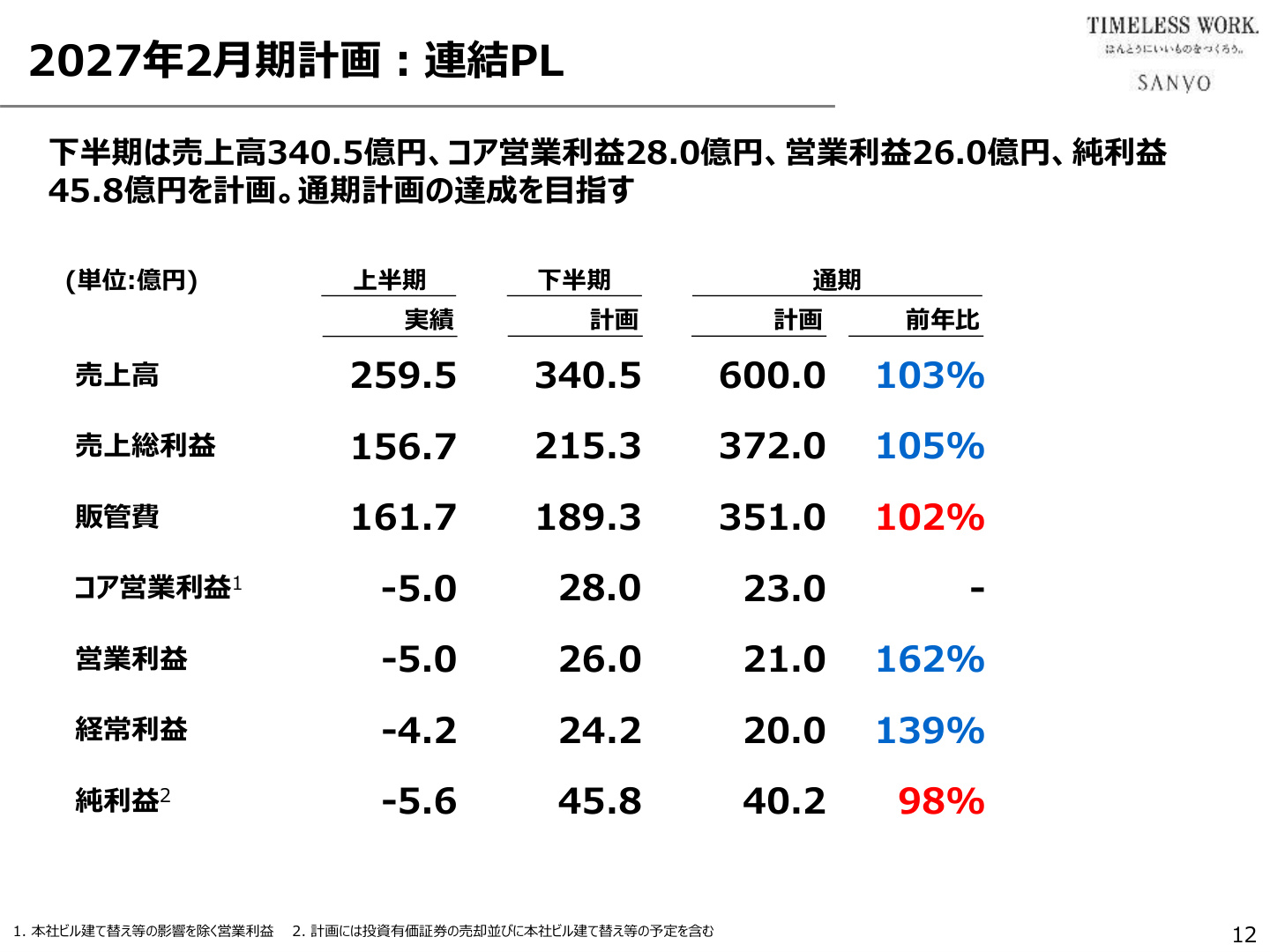
The slide above is critical data illustrating the significant gap between "first-half results" and "second-half plans." The company projects second-half net sales of 34.05 billion yen , operating profit of 2.60 billion yen , and net income of 4.58 billion yen . For the full year, it aims to achieve net sales of 60.00 billion yen (103% YoY) and operating profit of 2.10 billion yen (162% YoY) . The plan assumes a second-half gross profit margin of 63.2% (62.0% for the full year) and an operating profit margin of 7.6% (3.5% for the full year). Success in the high-unit-price winter season and improvements in gross margins are the decisive keys to achieving these targets.
6. Quantitative and Qualitative Approaches to Improving Gross Margins
To achieve the full-year gross margin target of 62.0% (+1.1pt YoY) , the following three measures are being promoted:
- Optimization of Procurement Costs : Strengthening ties with major suppliers to optimize the supply chain, expanding direct trade and imports, and standardizing material sourcing.
- Improvement of Full-Price Sales Ratio : Reducing the number of SKUs, consolidating merchandising (MD), and shortening the MD cycle to enhance responsiveness to actual demand. The target for the full-year full-price sales ratio is 61.7% (+2.2pt YoY).
- Strengthening Inventory Control : Implementing a "pool operation" for 20% of purchases to prevent overstocking and building a Quick Response (QR) system for best-selling items. The company is strictly managing carry-over inventory, with a target of 8.4 billion yen in product inventory by the end of February 2027 (+0.3 billion yen YoY).
7. Long-Term Structural Reform: Rebuilding Brand Positioning
The company has formulated a new positioning strategy to break away from the traditional department-store-dependent business model and tap into growth markets.
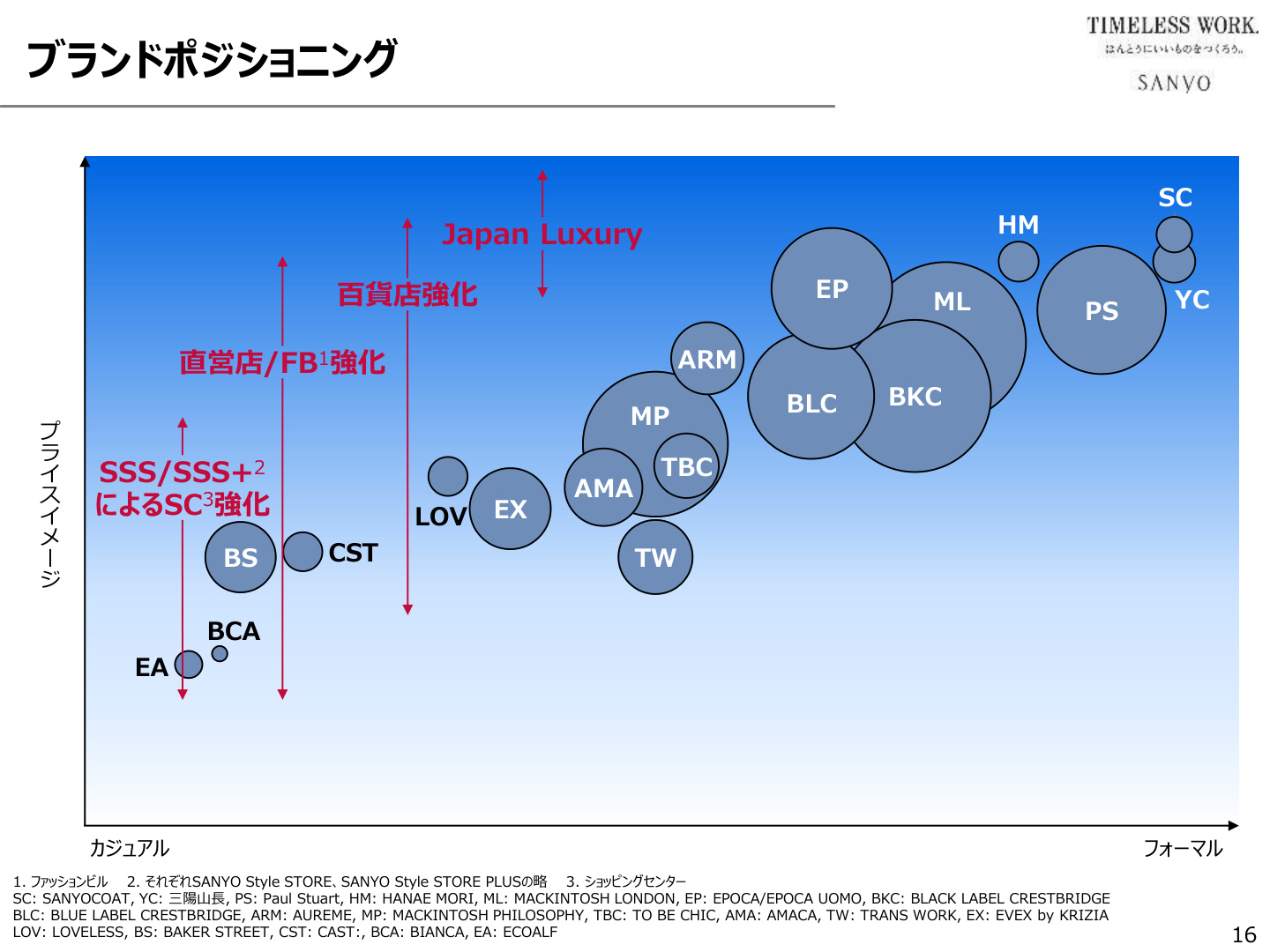
This matrix is a vital strategic map visualizing the company's future portfolio. It clearly shows a structure that expands from the traditional mid-price/department store channel into new vertical and horizontal business domains.
- Japan Luxury Segment (High Value-Added/Formal) : Establishing a unique luxury identity leveraging the company's peak craftsmanship, including SANYOCOAT, Aomori Down, Fukushima Jackets, Sanyo Yamacho, and HANAE MORI.
- Strengthening Directly Managed Stores/Fashion Buildings (FB) : Launching the new brand "AUREME," which focuses on channels outside of department stores. The first store opened at NEWoMan Shinjuku in September 2026, with a goal of 10 stores and 2 billion yen in sales within five years.
- Shopping Center (SC)/Complex Shop Development : Accelerating store openings through "SANYO Style STORE (SSS)" and the new "SANYO Style STORE PLUS (SSS+)" formats. Including the launch of the "Le Jour" line, the company aims to cultivate the SC market and maximize sales floor efficiency.
8. Roadmap for Fundamental E-commerce Strengthening
In the e-commerce business, the company is shifting from a simple sales channel to an "information and experience-based e-commerce" model. Quantitative targets for the fiscal year ending February 2029 include 13 billion yen in e-commerce sales , an e-commerce ratio of 20% , and a 40% full-price sales ratio within e-commerce . Plans include expanding the customer base through enhanced CRM, OMO (Online Merges with Offline) initiatives, utilizing AI recommendations, and developing exclusive e-commerce products.
9. Cash Allocation and Optimization of Capital Efficiency
Backed by strong liquidity, the company has announced an ambitious capital allocation plan to balance growth investment with shareholder returns.
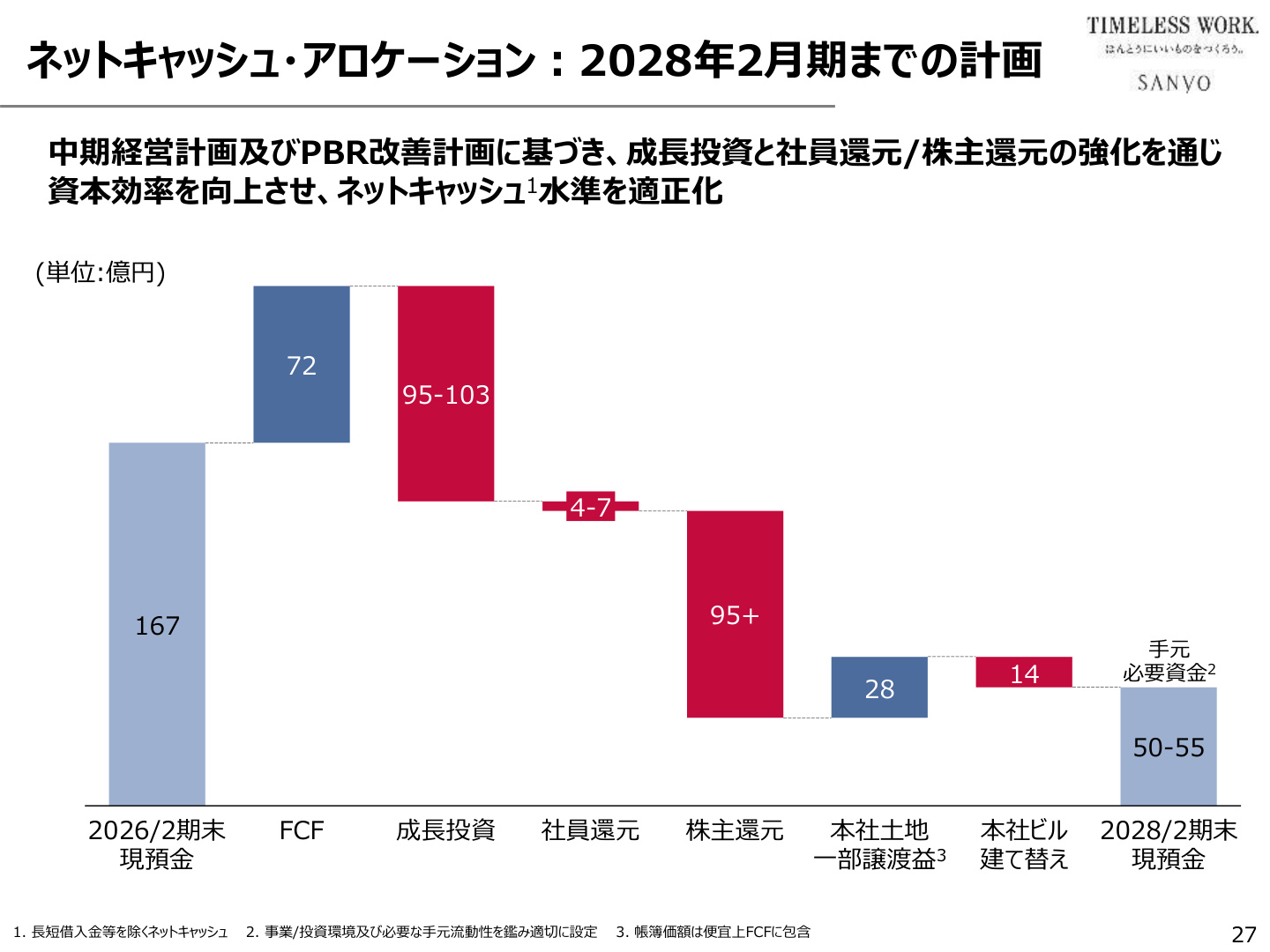
This waterfall chart systematically outlines the cash flow generation and allocation policy through the fiscal year ending February 2028. Using the 16.7 billion yen in cash and deposits as of the end of February 2026, along with 7.2 billion yen in projected Free Cash Flow (FCF) and 2.8 billion yen from the partial sale of head office land, the company will execute strategic allocations:
- Growth Investment (9.5–10.3 billion yen) : 1.6 billion yen for brand growth, 2.0 billion yen for renovating the Sanyo Sewing Aomori factory, and over 5.6 billion yen for M&A and trademark acquisitions.
- Employee Returns (0.4–0.7 billion yen) : Base pay increases, higher incentives, and human capital investment.
- Shareholder Returns (9.5 billion yen or more) : Expansion of dividends and flexible share buybacks.
- Optimization of Cash on Hand : The policy is to slim down cash and deposits to approximately 5.0–5.5 billion yen by the end of February 2028, redirecting idle funds toward improving capital efficiency.
10. Fundamental Strengthening of Shareholder Returns: Adoption of 5% DOE and Dividend Increase
As a pillar of its capital strategy, the company has explicitly stated its commitment to improving PBR and maintaining an ROE of 10% through enhanced shareholder returns. Starting in FY2027/2, the company has adopted a new dividend policy of "5% DOE (Dividend on Equity)." Consequently, the annual dividend for FY2027/2 is planned at 56.33 yen per share (25.33 yen interim, 31.00 yen year-end forecast), representing a 10.00 yen increase from the previous year (46.33 yen, adjusted for the 1-for-3 stock split on September 1, 2026). Additionally, the company plans to flexibly execute share buybacks based on earnings progress to improve the total return ratio.
Summary
Although Sanyo Shokai experienced a temporary setback in the first half of FY2027/2 due to factors such as unfavorable weather, the company has made progress in tightening its cost structure and reviewing inventory management. Building on the strong recovery seen in the September preliminary data, the company is focused on a significant profit rebound in the second half, the creation of "Japan Luxury" for the long term, the expansion of e-commerce and new channels, and the execution of aggressive shareholder returns and growth investments based on a 5% DOE.
This content is not intended as investment advice or a recommendation. Any opinions expressed are solely the personal views of each article.