

Nagaileben (7447) FY2026 Earnings Analysis: Growth Strategy Driven by Recovery in Gross Margin to 40% Range, Overseas Production, and High Value-Added Products

Sentiment Analysis
1. FY2026 Earnings Summary and Key Financial Highlights
Nagaileben’s full-year results for the fiscal year ended August 2026 showed growth in both revenue and profit: net sales of 17.205 billion yen (+1.3% YoY) , operating profit of 3.625 billion yen (+1.2% YoY) , ordinary profit of 3.835 billion yen (+3.5% YoY) , and net profit of 2.650 billion yen (+3.0% YoY) . Although performance trailed the previous year through the third quarter, a significant rebound in the fourth quarter (net sales +8.8% YoY) ensured the company achieved revenue growth for the second consecutive year .
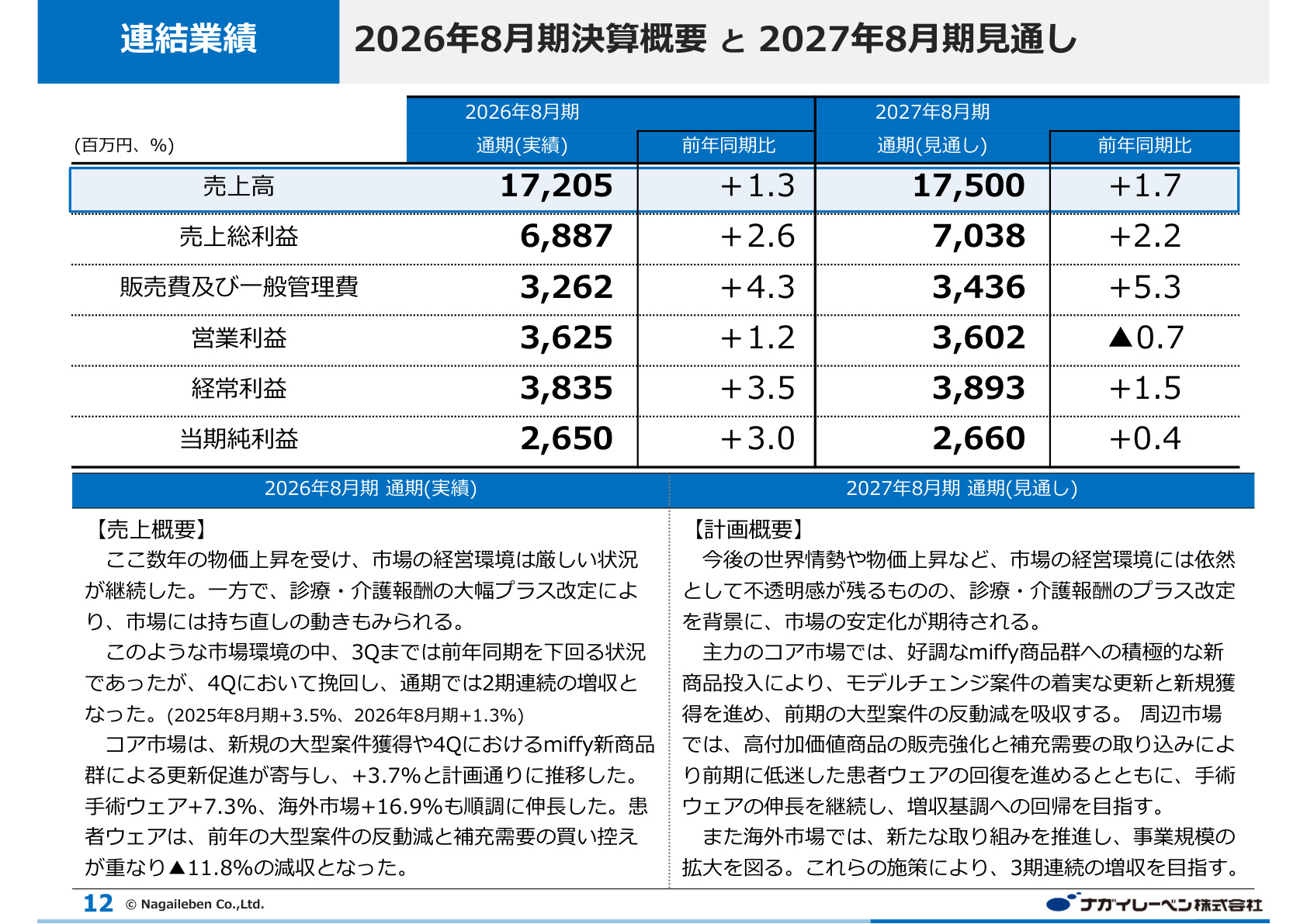
As shown in the slide above, despite a challenging business environment characterized by rising market prices throughout FY2026, performance was driven by growth in the core market (+3.7%) and strong performance in overseas markets (+16.9%) . In the core market, primarily healthcare wear, the new "miffy" product line launched in the fourth quarter strongly stimulated replacement demand, contributing significantly to the overall sales recovery.
For the upcoming fiscal year ending August 2027, the company forecasts net sales of 17.5 billion yen (+1.7% YoY) , operating profit of 3.602 billion yen (-0.7% YoY) , ordinary profit of 3.893 billion yen (+1.5% YoY) , and net profit of 2.660 billion yen (+0.4% YoY) , anticipating continued steady business growth.
2. Analysis of Profit Structure and Profitability Trends
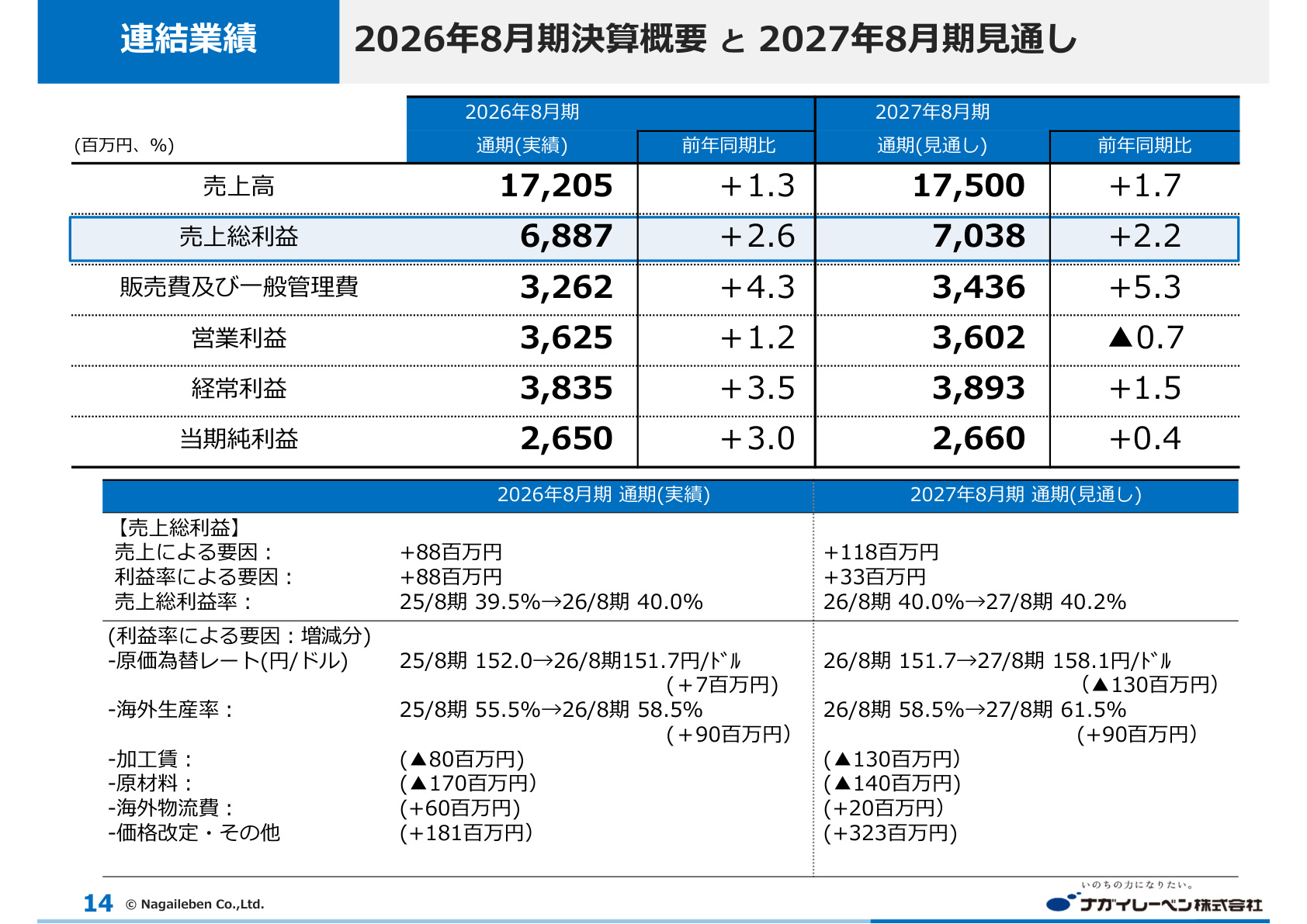
A notable aspect of the company's profit structure is the recovery of the gross profit margin to 40.0% (+0.5pt YoY) , despite facing rising costs and currency headwinds.
A detailed breakdown of the factors affecting gross profit reveals that the following structural approaches have been successful:
- Price Revisions/Other (+181 million yen) : Appropriate price pass-through implemented in response to rising costs.
- Increase in Overseas Production Ratio (+90 million yen) : Expanded the overseas production ratio from 55.5% in the previous year to 58.5% , promoting a reduction in manufacturing costs.
- Optimization of Overseas Logistics Costs (+60 million yen) : Cost containment through improved logistics efficiency.
- Absorption of Cost Increases : The aforementioned measures successfully offset downward pressures, such as rising processing fees (-80 million yen) and soaring raw material costs (-170 million yen).
For the fiscal year ending August 2027, the company anticipates further headwinds, including a weaker yen assumption for raw material costs (151.7 yen/dollar to 158.1 yen/dollar, impact of -130 million yen) and higher domestic processing fees due to the revision of the minimum wage in Akita Prefecture (impact of -130 million yen). However, by further increasing the overseas production ratio to 61.5% (+90 million yen) and advancing price revisions (+323 million yen) , the company expects to maintain a high gross profit margin of 40.2% .
3. Trends by Market, Product, and Segment
Nagaileben's business is composed of the "Core Market," which serves as the backbone of sales; the "Peripheral Market," which offers room for expansion; and the "Overseas Market," which acts as the engine for future growth.
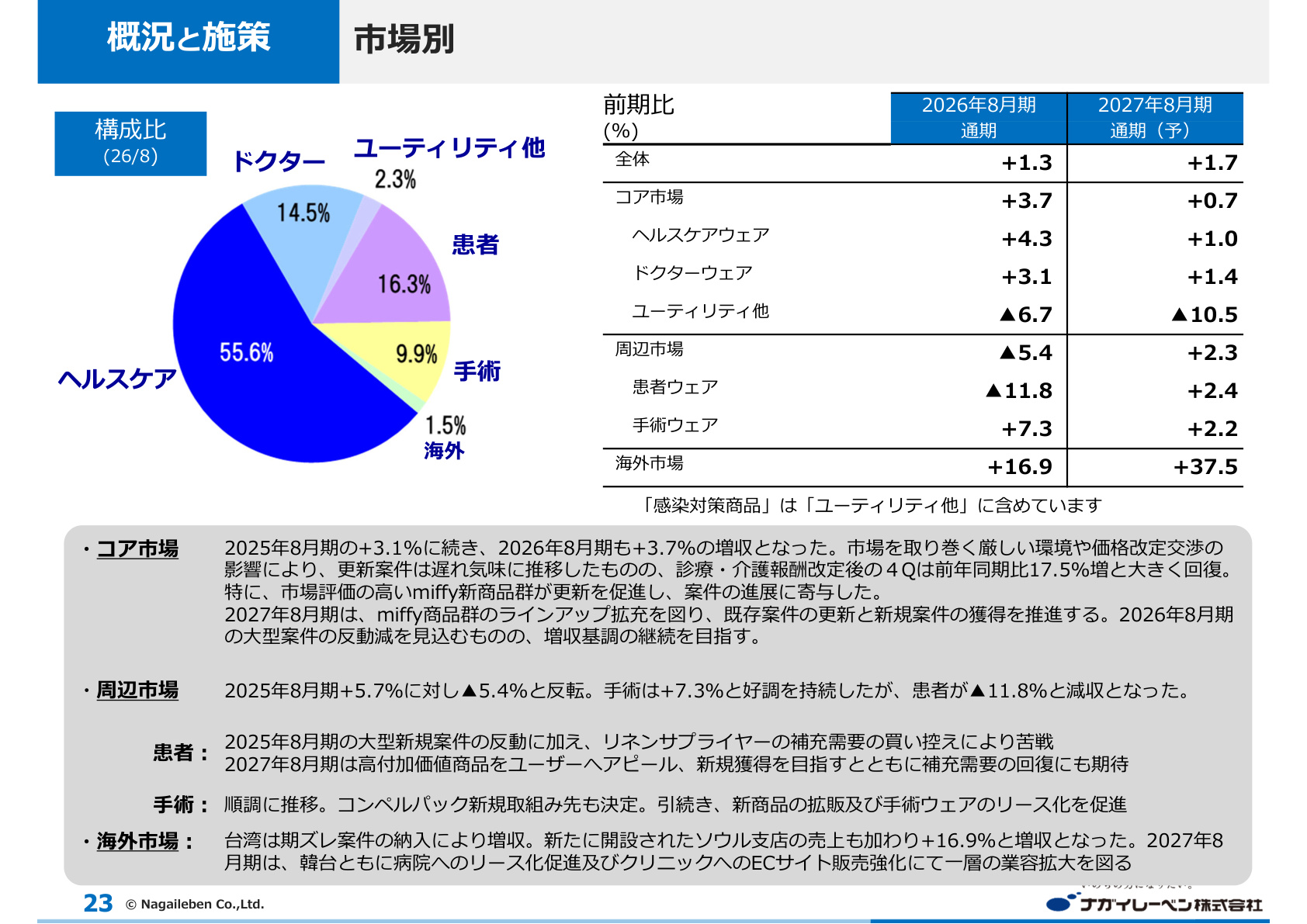
① Core Market (Sales Composition: Healthcare 55.6%, Doctor 14.5%)
- Healthcare wear (+4.3% YoY) and Doctor wear (+3.1% YoY) performed steadily.
- High value-added products combining design and functionality gained support in replacement projects for hospitals and medical institutions, with the core market surging 17.5% YoY in the fourth quarter.
② Peripheral Market (Sales Composition: Patient 16.3%, Surgery 9.9%)
- Surgery wear (+7.3% YoY) grew steadily, supported by the acquisition of new Compel Pack clients and the promotion of leasing models.
- Conversely, Patient wear (-11.8% YoY) declined due to the reactionary drop from large-scale projects in the previous year and restrained replenishment demand from linen suppliers. The company expects a 2.4% recovery in the next fiscal year (ending August 2027) through strengthened proposals for high value-added products.
③ Overseas Market (Sales Composition: 1.5%)
- Overseas sales recorded a significant increase of +16.9% YoY .
- In addition to the delivery of delayed projects in Taiwan, sales from the newly established Seoul Branch (South Korea) began to contribute. Moving forward, the company will deploy a dual strategy of promoting hospital leasing and direct e-commerce sales for clinics.
④ Trends by Product Price Range
- "High value-added products," the premium and high-functionality category, remained strong with +3.7% YoY growth .
- In the fiscal year ending August 2027, the company will pursue a value-driven growth model by renewing the high-end "Beadsberry" brand and expanding the full lineup of "miffy" products.
4. Business Environment and Long-term Structural Demand
The macro environment surrounding the medical, nursing, and long-term care industries contains factors that serve as tailwinds for Nagaileben in both the short and long term.
- Trends in Medical and Nursing Care Fee Revisions : The 2026 revisions to medical fees (+3.09%) and nursing care fees (+1.95%) have contributed to the stabilization of management for medical and nursing institutions struggling with inflation. This is creating an environment where investment in uniform and linen replacements is beginning to recover.
- Expanding Demand for Nursing and Care Staff : According to Ministry of Health, Labour and Welfare estimates, the number of nursing staff is expected to increase by approximately 400,000 (from 1.698 million to 2.101 million) and care staff by approximately 600,000 (from 2.126 million to 2.720 million) between 2024 and 2040. This growth in the target workforce provides a foundation that will support the steady expansion of demand for the company's uniforms over the long term.
5. Mid-term Management Goals and Capital/System Investment Plan
The company has set a mid-term management goal of achieving 18.5 billion yen in net sales by the fiscal year ending August 2029. The target sales composition is 70% for the Core Market, 26% for the Peripheral Market, and 4% (750 million yen) for the Overseas Market .
Production and Logistics Strategy
While maintaining multi-product, small-lot, quick-response (QR) production at its domestic base (Akita), the company plans to increase its overseas production ratio, centered on Indonesia, Vietnam, and China, to 67% by the fiscal year ending August 2029 . It will also promote logistics efficiency by utilizing bonded warehouses (PLB) in Indonesia.
System Investment (DX Investment)
To improve operational efficiency and strengthen the supply chain, the company is currently implementing system investments totaling approximately 1.1 billion yen . Centered on the renewal of core systems (planned at 808 million yen), the company expects to complete infrastructure development sequentially through the fiscal year ending August 2028.
6. Financial Foundation and Shareholder Return Policy
As of the end of the fiscal year ended August 2026, the balance sheet maintains an equity ratio of over 90% (net assets of 39.056 billion yen, total assets of 42.192 billion yen) , boasting an extremely sound financial base with 22.399 billion yen in cash and deposits.
Shareholder Return Measures
- Dividends : The year-end dividend for FY2026 was increased from 60 yen to 70 yen (a 10 yen increase) .
- Share Buybacks : As part of a flexible capital policy, following buybacks in Nov–Dec 2025 (990 million yen) and June–Aug 2026 (990 million yen), the company is currently executing another share buyback of up to 1 billion yen (600,000 shares) from October 2 to December 31, 2026.
Based on strong financial discipline, the company clearly demonstrates its commitment to improving capital efficiency and proactive shareholder returns.
This content is not intended as investment advice or a recommendation. Any opinions expressed are solely the personal views of each article.