

Zuiko (6279) FY2026 Interim Results: From First-Half Deficit to Sharp Second-Half Recovery, Supported by ¥18.5 Billion Backlog and Diversification Strategy

Sentiment Analysis
1. FY2026 First-Half Financial Overview and Summary
For the first half of the fiscal year ending February 2027 (FY2026), Zuiko Corporation reported net sales of ¥10,899 million (+3.9% YoY) . Despite the increase in revenue, the company recorded operating losses at all levels: operating loss of ¥222 million (compared to a profit of ¥386 million in the same period last year), ordinary loss of ¥158 million (profit of ¥422 million), and net loss attributable to owners of the parent of ¥146 million (profit of ¥316 million).
The primary driver for the revenue increase was the addition of ¥2,089 million in sales from the cotton spunlace business , acquired from Unitika at the end of the previous fiscal year. Conversely, profitability was significantly pressured by a sharp decline in sales within the core hygiene product manufacturing machinery business—due to the second-half weighting of sales at the Chinese subsidiary, Zuiko Shanghai—as well as delivery delays and increased costs associated with launching new product projects domestically.
2. Segment Trends and Product Sales Performance
Performance trends by segment and product are as follows:
- Hygiene Product Manufacturing Machinery Business : Sales reached ¥8,656 million (-16.0% YoY) , with an operating loss of ¥227 million (compared to a profit of ¥408 million). By product, sales of baby diaper manufacturing machines were ¥2,256 million, adult diaper manufacturing machines were ¥3,041 million, and sanitary napkin manufacturing machines were ¥1,012 million, reflecting a transitional period where core machinery sales fell below the previous year's levels.
- Cotton Spunlace Business : Having commenced full-scale operations in January 2026, this segment recorded ¥2,089 million in sales and an operating profit of ¥3 million (0.2% margin) . The business achieved profitability in its first year of operation, establishing itself as a new pillar of revenue.
- Regional Sales (Hygiene Product Manufacturing Machinery) : While sales to Japan (¥2,860 million) and China (¥2,406 million) remained solid, driven primarily by adult diaper machinery, sales to Europe declined to ¥1,518 million. This was due to the absence of large-scale projects in Greece seen in the previous year, combined with the second-half weighting of shipments from the Italian subsidiary, DELTA.
3. Order Intake, Backlog, and Future Pipeline
Although first-half earnings were sluggish, the leading indicators for order intake show extremely strong expansion.
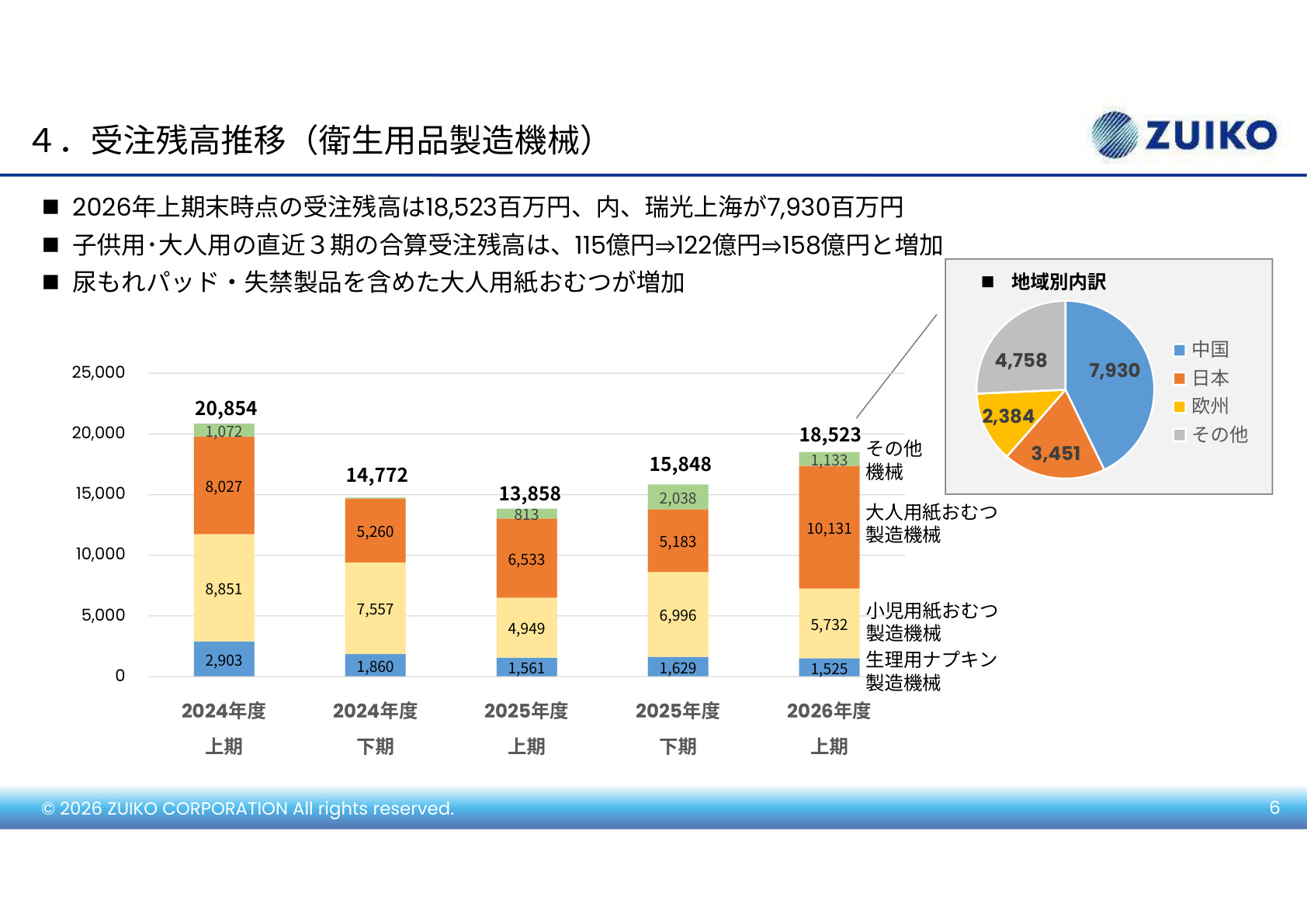
[Slide Commentary: Trends in Order Backlog]
As shown in the slide above, the order backlog for hygiene product manufacturing machinery reached ¥18,523 million at the end of the first half of FY2026, a significant increase of +33.7% from the end of the same period last year (¥13,858 million). Key highlights include:
- Rapid Expansion in Adult Diaper Manufacturing Machinery : The combined order backlog for baby and adult diaper machines swelled to ¥15.8 billion (¥11.5 billion in the same period last year), with adult diaper machinery accounting for ¥10,131 million , or over 50% of the total backlog. The company is successfully capturing global demand driven by aging populations, including products for incontinence.
- Strengthened Regional Portfolio : By region, Zuiko Shanghai’s backlog accounts for over 40% of the total at ¥7,930 million , complemented by robust backlogs in Japan (¥3,451 million), Europe (¥2,384 million), and other regions (¥4,758 million).
- High Level of First-Half Order Intake : New orders in the first half totaled ¥11,331 million , maintaining the same level as the previous year. Approximately 70% of this, or ¥7,988 million, consists of adult diaper manufacturing machinery .
This substantial order backlog provides a solid foundation for a sharp increase in revenue recognition and a recovery in performance from the second half onward.
4. Analysis of Operating Profit Variance and Financial/Cash Flow Status
The ¥608 million decline in operating profit compared to the same period last year is broken down as follows:
- Impact of Sales Fluctuations (-¥268 million) : Sales decreased by ¥300 million at headquarters and ¥1.3 billion at Zuiko Shanghai.
- Impact of Gross Margin Fluctuations (-¥340 million) : At Zuiko Shanghai, the gross margin declined by 10 percentage points due to lower capacity utilization and price competition in China. At headquarters, margins fell by 1.2 percentage points due to costs associated with new product delivery delays.
- Changes in SG&A Expenses (-¥26 million) and Contribution from New Businesses (+¥27 million) .
Balance Sheet and Cash Flow Highlights
Regarding assets, inventories surged to ¥10,551 million (+¥3,047 million from the previous fiscal year-end) , primarily due to work-in-progress intended for concentrated shipments in the second half. This led to increased working capital requirements and short-term borrowing, bringing interest-bearing debt to ¥7,543 million (+¥1,317 million). However, the company maintains a robust financial position with an equity ratio of 66.7% and a D/E ratio of 0.21x . Operating cash flow was -¥2,260 million due to the increase in inventories, but it is expected to normalize as sales are collected in the second half.
5. Full-Year Forecast and V-Shaped Recovery Scenario
The company has maintained its full-year earnings forecast announced at the beginning of the fiscal year.
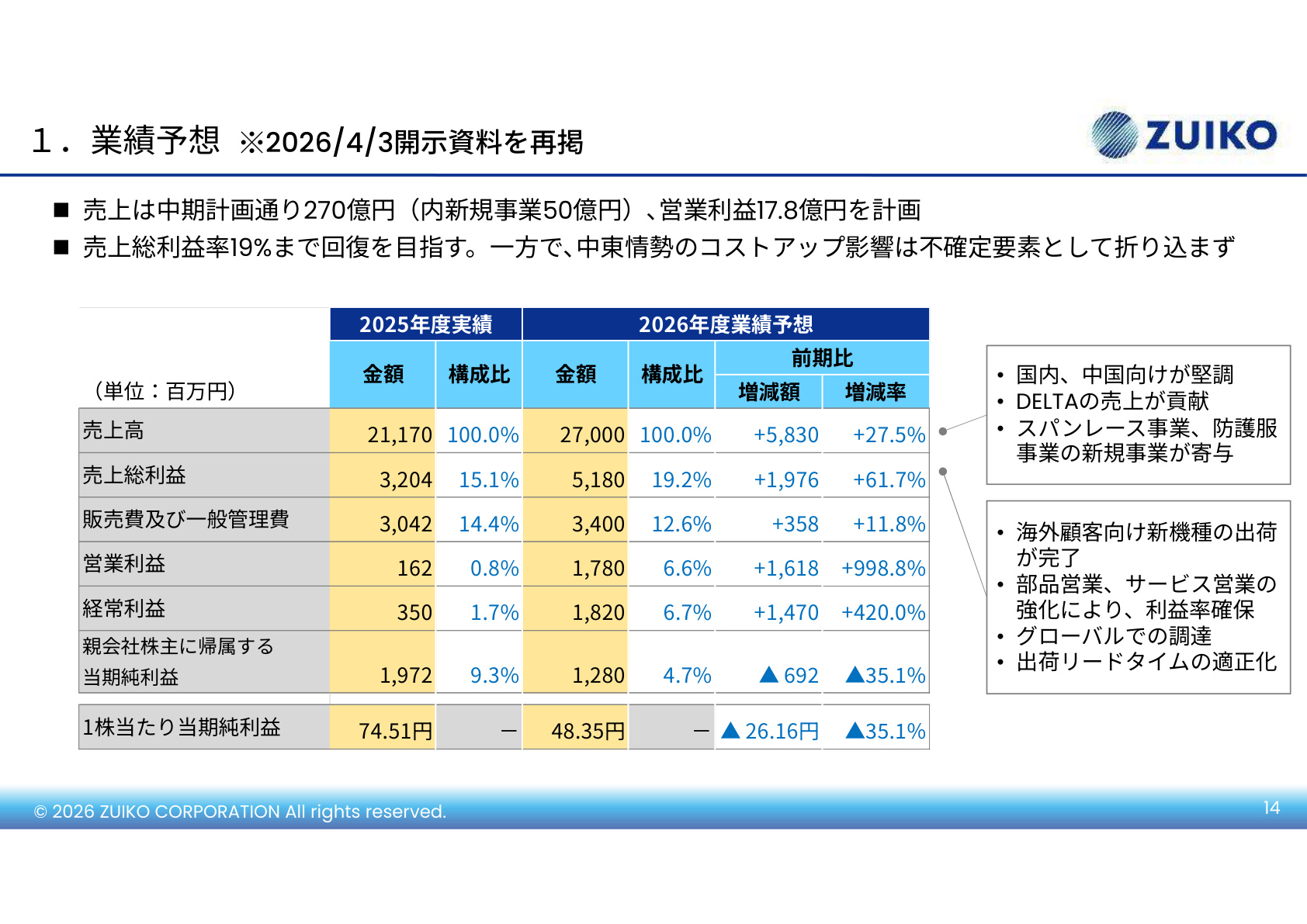
[Slide Commentary: FY2026 Full-Year Earnings Forecast]
The full-year plan anticipates net sales of ¥27,000 million (+27.5% YoY) , operating profit of ¥1,780 million (+998.8% YoY) , ordinary profit of ¥1,820 million (+420.0% YoY) , and net income of ¥1,280 million (-35.1% YoY) . The rationale for the V-shaped recovery from the first-half deficit is as follows:
- Concentration of Shipments and Margin Improvement : Large-scale project shipments from Zuiko Shanghai and Europe’s DELTA are concentrated in the second half, and additional costs will subside following the completion of new model shipments for overseas customers. Consequently, the full-year gross profit margin is expected to recover to 19.2% (+4.1pt YoY) .
- Full Contribution of New Businesses : New business groups, including the cotton spunlace and protective clothing businesses, are expected to contribute ¥5 billion in sales for the full year.
- Profitability Enhancement Measures : The company aims to increase profit margins by strengthening parts sales and after-sales services, promoting global procurement, and optimizing shipment lead times.
6. Shareholder Return Policy
Zuiko’s basic policy is to provide stable returns based on a consolidated dividend payout ratio, with a target of around 35% . For FY2026, the company plans an annual dividend of ¥20.00 per share , consisting of a regular dividend of ¥16.00 plus a ¥4.00 commemorative dividend for the 80th anniversary of its founding (compared to ¥12.00 in the previous year). Furthermore, the company completed a share buyback of 500,000 shares at the end of February 2026, demonstrating its commitment to improving capital efficiency and shareholder returns.
7. New Business and Strategic Topics for Mid-to-Long-Term Growth
The company is accelerating its diversification from a manufacturer of hygiene product machinery into peripheral areas and the environmental/healthcare sectors.
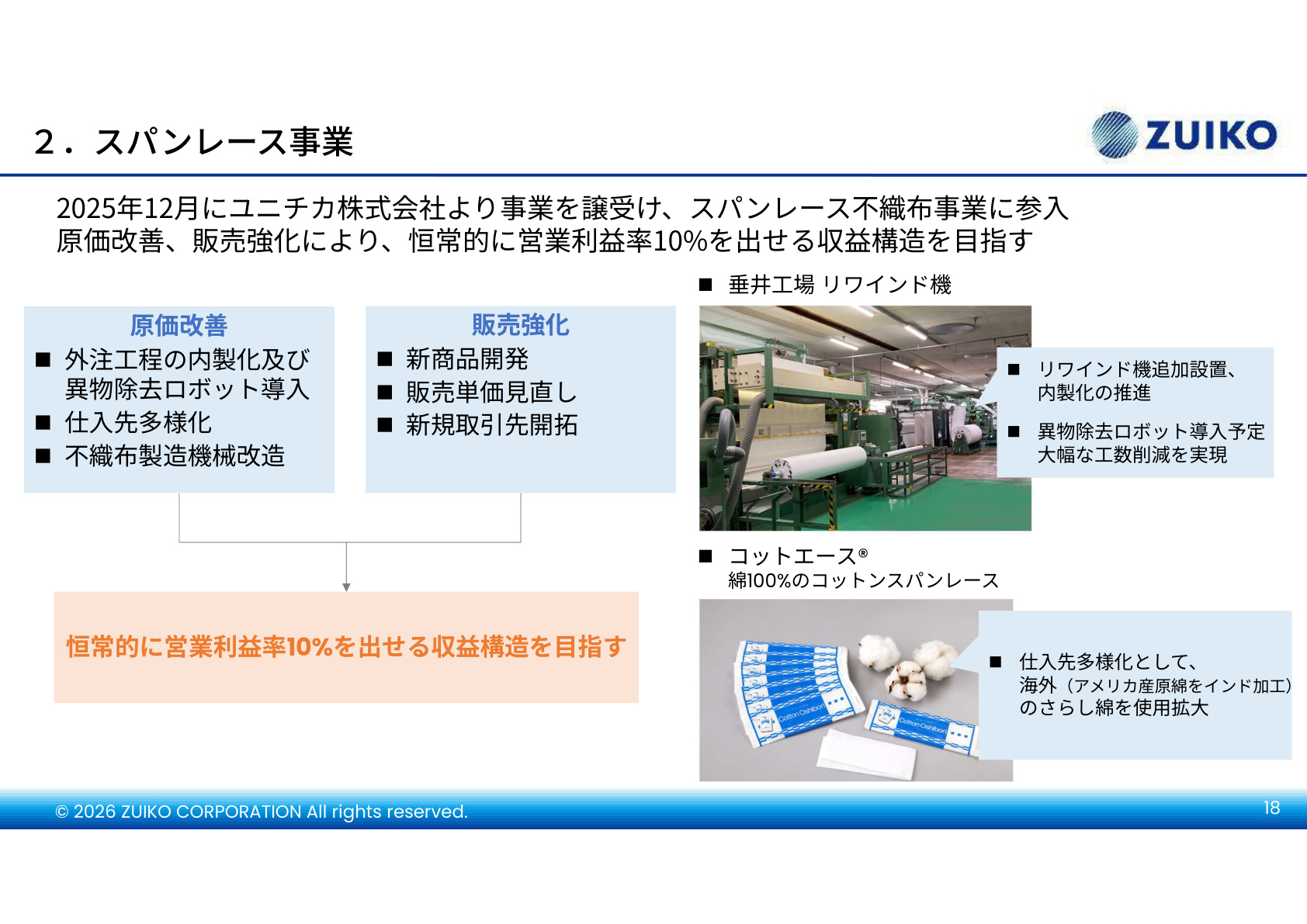
① Profit Structure Reform in the Spunlace Business
The company is pursuing a roadmap to achieve a constant operating profit margin of 10% in the acquired cotton spunlace non-woven fabric business (Brand: CottoAce®).
- Cost Improvement : In-house production of outsourced processes (installation of additional rewinding machines), labor reduction through the introduction of foreign matter removal robots, in-house modification of non-woven fabric manufacturing machines, and diversification of suppliers, such as utilizing "bleached cotton" processed in India from U.S.-grown raw cotton.
- Sales Enhancement : Developing new products leveraging the 100% cotton characteristics, reviewing sales prices, and cultivating new business partners.
② Other Focus Business Developments
- Protective Clothing Business (Fully Automatic Coverall Processing Machine) : Developed the world's first fully automatic coverall processing machine, with the first unit scheduled for shipment in the spring of 2027. By fully automating traditional pattern-cutting and sewing processes, the company achieves significant cost reductions and aims for global expansion through its Korean affiliate, PROGA ZUIKO (the target market is expected to grow to $4.5 billion by 2033).
- Excretion Care Business (Automatic Excretion Disposal Device "Seia") : Developed an automatic excretion disposal device for the nursing care market, featuring space-saving, deodorizing, and warm-water cleaning functions. Following an exhibition in South Korea in October 2026, the company plans to expand into the South Korean and Japanese markets.
- Used Disposable Diaper Recycling Business : Anticipating growing demand for recycling from local governments (targeting 150 municipalities by 2030), the company has begun prototyping the new "ZRM-1000/2000" dry, low-cost, modular-type machines (1-ton/2-ton processing capacity).
- Growth Investment in Automatic Packaging Machinery : Exploring capital and business alliances to expand operations and complement technology in the packaging machinery sector.
- Internal Operational Reform : In July 2026, an automated warehouse was introduced at the headquarters factory, expanding internal storage capacity from 700 pallets to 2,200 pallets . This reduces external warehouse rental costs by ¥20–30 million annually while shortening shipping lead times and improving inventory management efficiency.
This content is not intended as investment advice or a recommendation. Any opinions expressed are solely the personal views of each article.