


Ichigo Hotel REIT Investment Corporation: Fiscal Period Ended July 2026 (22nd Period) Earnings Deep Dive: NAV Growth and Portfolio Restructuring Driven by Asset Sale Gains and 'Shin-Chiku' Strategy

StockClub
Published: Sep 17, 2026, 06:52 PM GMT+9
Sentiment Analysis
The fiscal period ended July 2026 (22nd period) for Ichigo Hotel REIT Investment Corporation (3463) achieved high levels of both Distribution Per Unit (DPU) and Net Asset Value (NAV) per unit, driven by the booking of gains on asset sales and the promotion of strategic renovation projects known as 'Shin-Chiku' (value-add). The results demonstrate a growth model that steadily advances asset value-up and portfolio replacement while absorbing fluctuations in the external environment. This report provides a detailed analysis of the period's confirmed financial results, operational performance of individual hotels, strategic value-add initiatives, financial foundation, and future earnings outlook.
1. Fiscal Period Ended July 2026 Earnings Highlights
For this period, the Distribution Per Unit (DPU) was 3,761 yen , exceeding the initial forecast (3,016 yen) by 745 yen (+24.7%) . Furthermore, NAV per unit reached 183,437 yen , an increase of 7,636 yen (+4.3%) from the end of the previous period, marking a record high .
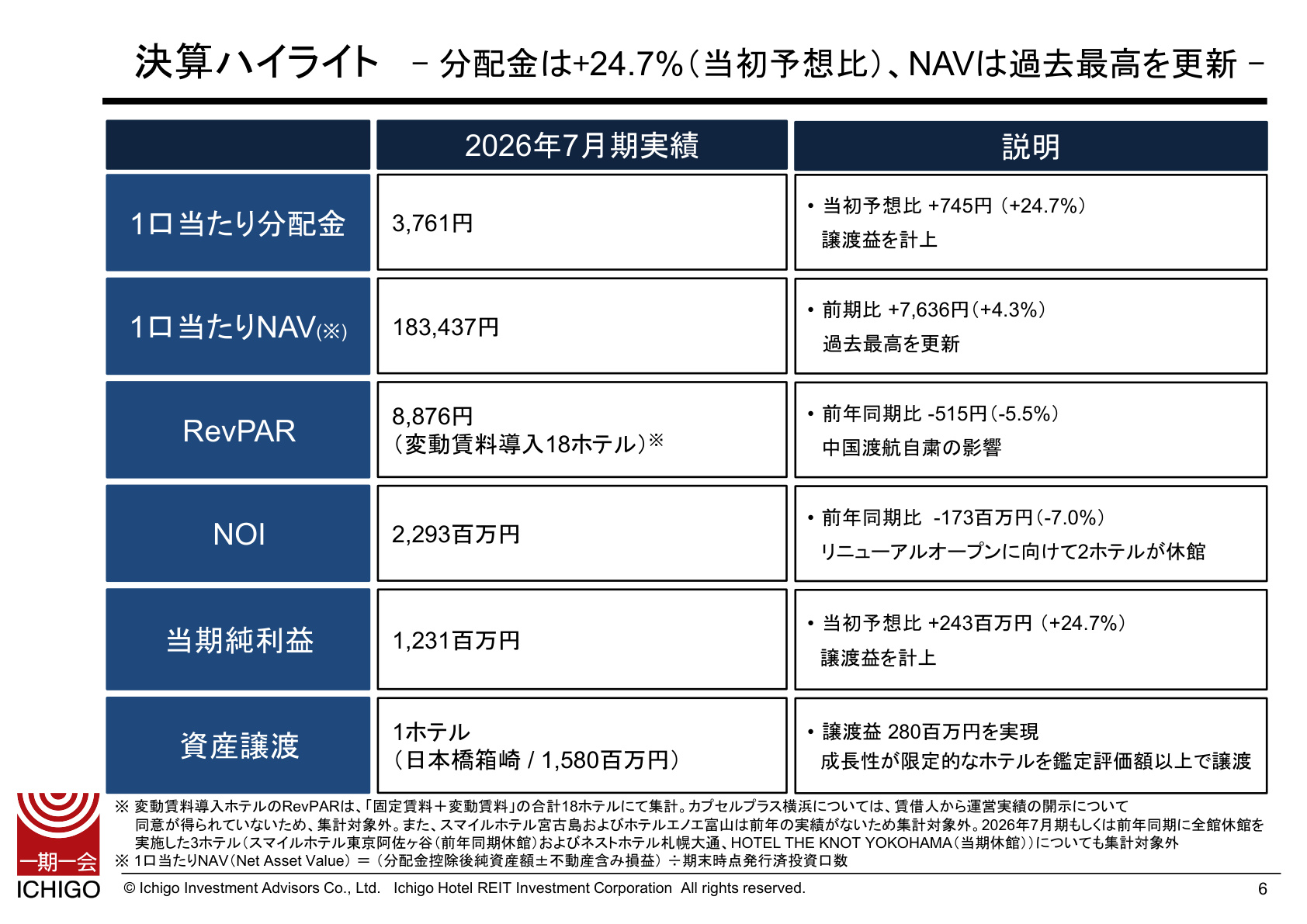
As shown in the highlights above, operating revenue was 2,902 million yen (+235 million yen vs. initial forecast), operating profit was 1,625 million yen (+226 million yen), and net income was 1,231 million yen (+243 million yen). The primary driver for significantly exceeding the initial forecast was the booking of 280 million yen in gains from the sale of "Hotel Livemax Nihonbashi Hakozaki" as part of portfolio optimization. By selling fixed-rent properties with limited growth potential at a premium (1.1x the appraisal value and 1.3x the book value), the REIT has realized a virtuous cycle of returning profits to unitholders while securing funds for future value-add investments.
Meanwhile, the RevPAR for the 18 hotels with variable rent was 8,876 yen (-5.5% YoY), and the portfolio-wide NOI was 2,293 million yen (-7.0% YoY). This was impacted by special factors, including temporary closures for large-scale renovations (Nest Hotel Sapporo Odori and HOTEL THE KNOT YOKOHAMA), a decline in demand in certain regions (such as Osaka) due to the self-restraint on travel by Chinese tourists, and supply restrictions on heavy oil in Okayama/Kurashiki.
2. Hotel Operational Performance and Regional Trends
Looking at the operational performance of the hotels in detail, excluding the three hotels that were fully closed, the occupancy rate for the 18 hotels with variable rent was 85.2% (-1.9pt YoY), and the ADR (Average Daily Rate) was 10,418 yen (-3.4% YoY).
Regionally, performance varied significantly:
- Strong Areas : Tokyo (RevPAR +1%), Tokai/Chubu (RevPAR +3%), and Kyushu (RevPAR +7%) maintained stable growth by capturing robust business demand, domestic event demand, and inbound demand, particularly from Western countries.
- Areas in Adjustment Phase : Osaka (RevPAR -30%, occupancy -2%, ADR -29%) and Chugoku/Shikoku (RevPAR -9%) saw temporary softening in demand due to the post-Expo reaction, travel self-restraint by Chinese tourists, and region-specific supply constraints.
In contrast to these external factors, the monetization of recently acquired properties has progressed extremely well. "Smile Hotel Miyakojima," acquired in July 2025, and "Hotel Enoe Toyama," which opened in August of the same year, achieved significant earnings growth within about a year of acquisition through proactive marketing and service quality improvements. Hotel Enoe Toyama won the "Jalan Award 2025: Best Hotel to Stay In (Prefectural Category)," and Smile Hotel Miyakojima has seen earnings contributions significantly exceeding both the previous year and initial forecasts through initiatives such as the launch of a dedicated promotional website.
3. Category-Up Strategy via 'Shin-Chiku' and Transformation of Revenue Structure
The greatest growth driver for Ichigo Hotel REIT is the 'Value Creation Cycle (Shin-Chiku)' , which involves large-scale renovations and operator reviews upon the expiration of lease agreements. This period saw significant progress in symbolic projects: "Nest hotel alt. Sapporo Odori" and "HOTEL THE KNOT YOKOHAMA."
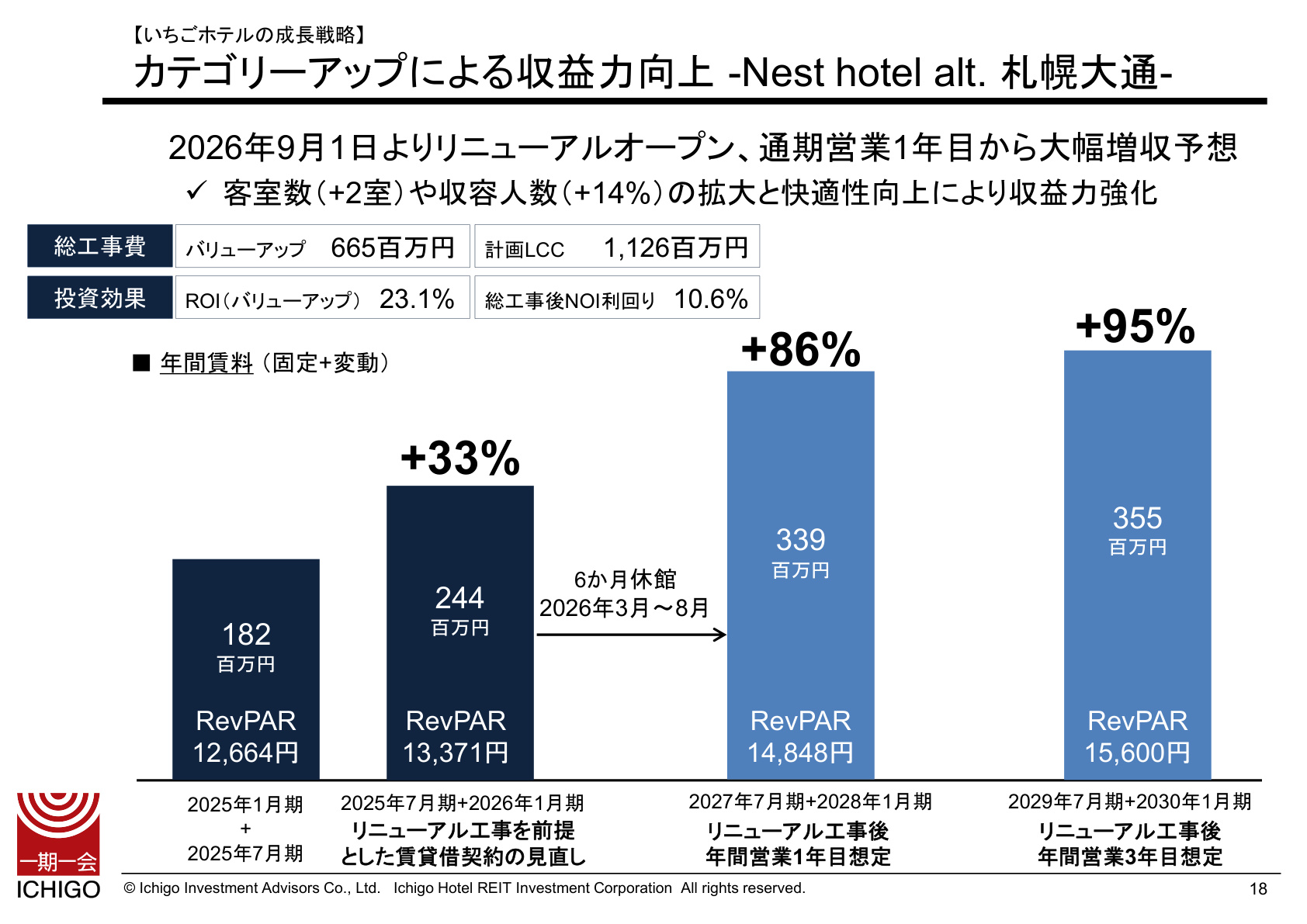
As shown in the slide above, for "Nest hotel alt. Sapporo Odori (formerly Nest Hotel Sapporo Odori)," a total of 1,126 million yen (665 million yen for value-add, 461 million yen for planned LCC) was invested to increase the number of rooms (+2 rooms), expand capacity through layout changes (+14%), and renew common areas. Following the reopening on September 1, 2026, the projected annual rent for the first full year of operation is 339 million yen ( +86% vs. pre-renovation), and 355 million yen ( +95% ) in the third year. The plan achieves high investment efficiency with an ROI on value-add investment of 23.1% and a post-renovation NOI yield of 10.6% .
Similarly, for "HOTEL THE KNOT YOKOHAMA," the REIT is proceeding with a renewal involving a change of operator to OneFive Hotels and a full renovation of the restaurant (supervised by a San Francisco Michelin three-star chef). The annual fixed rent is set to double to 334 million yen (+114% vs. previous) , balancing revenue stability with upside potential.
Furthermore, as value-up measures not involving large-scale construction, the REIT continues to boost revenue through meticulous asset management, such as rent revisions upon contract renewal for Nest Hotel Matsuyama and Kumamoto (Matsuyama: variable rent +19%, Kumamoto: +24%), rent increases for restaurant tenants at Ichigo Shinsaibashi Building (+16%), and changing the parking lot sublease company (revenue +84%).
4. Sustainable Growth of NAV per Unit and Portfolio Strategy
Through continuous improvement of asset value and appropriate asset replacement, the REIT's NAV per unit has continued to grow steadily .
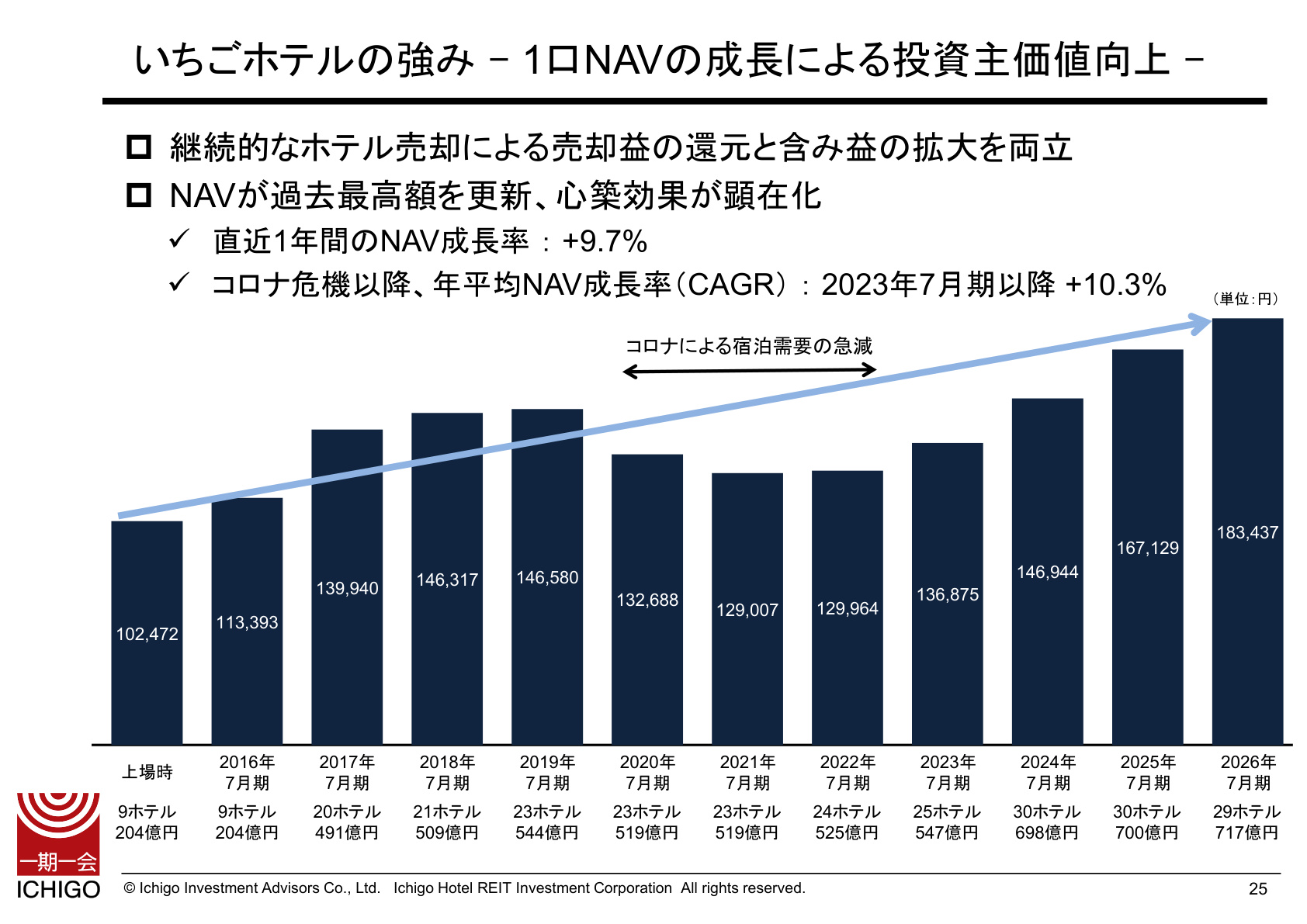
As this trend graph shows, following the sharp decline in lodging demand during the COVID-19 pandemic from 2020 to 2022, the Compound Annual Growth Rate (CAGR) of NAV since the July 2023 period has reached +10.3% . The NAV growth rate for the most recent year also shows a strong increase of +9.7% , proving that both the expansion of unrealized gains through improved occupancy/ADR and the premium sale of properties where unrealized gains have materialized (cumulative historical gains on sale of 3,144 million yen) are functioning effectively.
Collaboration with the sponsor, Ichigo Group, remains robust, with a rich sponsor pipeline of 15 hotels (approx. 85.4 billion yen scale, including 11 proprietary brand hotels) nationwide. This ensures flexible external growth opportunities in response to market conditions.
5. Financial Strategy and Maintenance of Soundness
To address the rising interest rate environment, the REIT is advancing the leveling of refinancing risk and appropriate control of interest rate risk.
- Fixed Interest Rate Ratio : 61.6% (maintaining a portfolio centered on long-term fixed-rate debt)
- LTV (Loan-to-Value) : Book-value LTV 47.0% , Market-value LTV 37.6% (reflecting unrealized gains)
- Diversification of Repayment Dates : Leveling refinancing amounts to approximately 3.0 to 4.0 billion yen per period to reduce the risk of repayment concentration.
In August 2026, the refinancing of 8.2 billion yen in maturing debt was completed (4.15 billion yen fixed, 4.05 billion yen variable), establishing a structure to support future growth investments under a solid financial foundation.
6. Future Earnings Forecast and Outlook
The published earnings forecasts are as follows:
| Fiscal Period | Operating Revenue | Operating Profit | Ordinary Profit | Net Income | DPU |
|---|---|---|---|---|---|
| Jan 2027 (23rd Period Forecast) | 2,917 million yen | 1,478 million yen | 1,013 million yen | 1,012 million yen | 3,091 yen |
| July 2027 (24th Period Forecast) | YoY Revenue Growth | - | - | - | Based on 87.9% occupancy, 10,926 yen ADR |
For the period ending January 2027, a decrease in profit and an adjustment in distribution (3,091 yen) are expected due to the absence of property sale gains recorded in the previous period, the impact of closures for renovations (Sapporo Odori until August, KNOT Yokohama from August to November), and an increase in interest expenses (+97 million yen) due to rising interest rates.
However, from the period ending July 2027 onwards, the full-year contribution from the two major renovated hotels (Sapporo Odori and KNOT Yokohama) will materialize, in addition to the rent increase effects from contract renewals such as Sunshine Utsunomiya. The structure is designed to further enhance the earnings power and cash flow quality of the entire portfolio once the temporary closure costs are overcome.
This content is not intended as investment advice or a recommendation. Any opinions expressed are solely the personal views of each article.