


Advance Residence Investment Corporation: Fiscal Period Ended July 2026 Deep-Dive Earnings Analysis

StockClub
Published: Sep 17, 2026, 06:52 PM GMT+9
Sentiment Analysis
1. Earnings Highlights: 11 Consecutive Distribution Increases Driven by Robust Internal Growth
Advance Residence Investment Corporation (3269) maintained exceptionally strong performance for the 32nd fiscal period (ended July 2026), driven by rent growth against the backdrop of a favorable residential leasing market. The Distribution Per Unit (DPU) for the period was 3,225 yen , marking a 5-yen increase from the previous period and extending the streak of 11 consecutive distribution increases (from the period ended July 2021 to the period ended July 2026) .
The performance trends of the REIT's key KPIs are as follows:
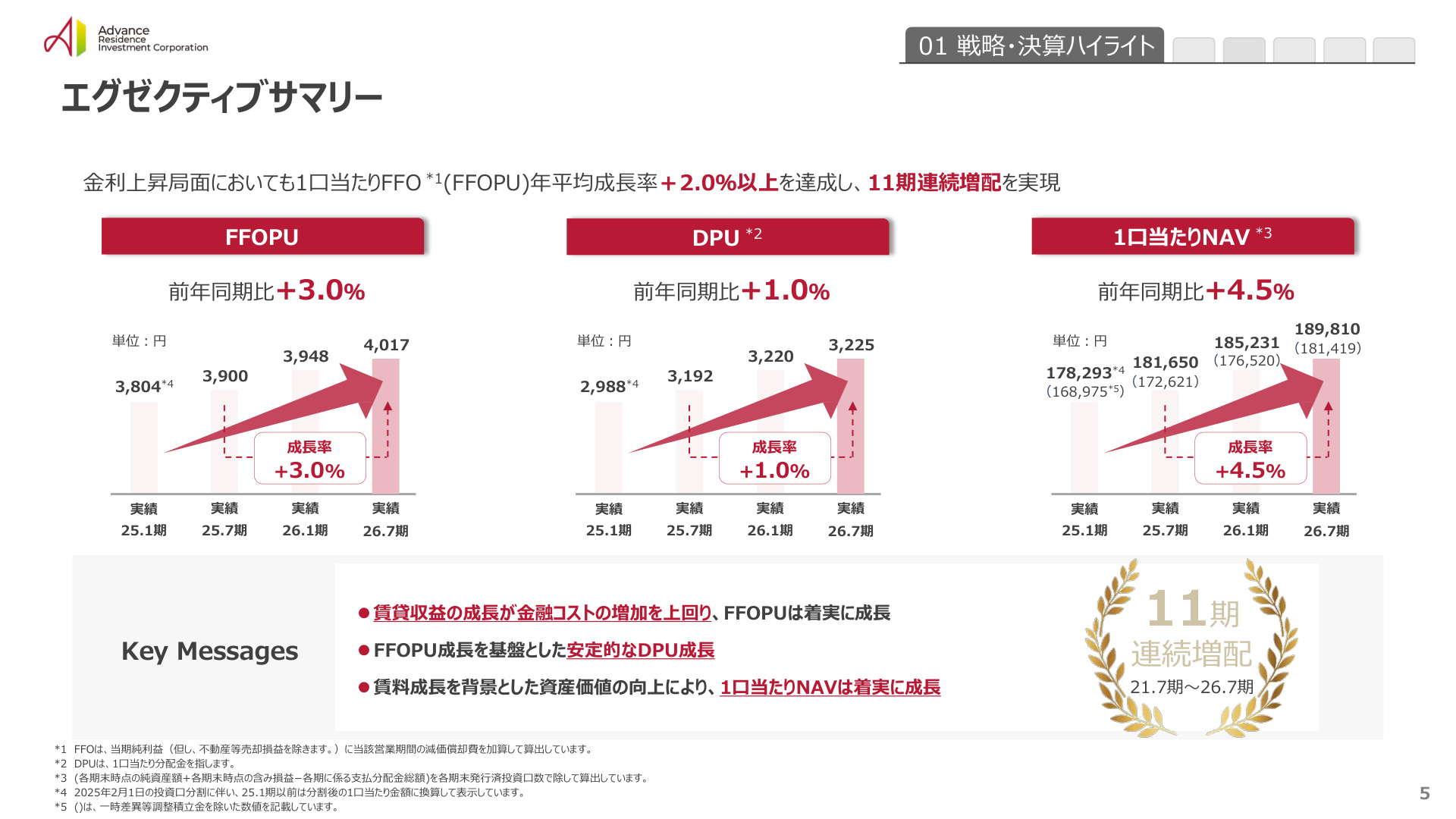
As shown in the executive summary above, the REIT places significant emphasis not only on accounting profits but also on FFO Per Unit (FFOPU) , a core metric representing actual cash-generating capability. FFOPU for the period reached 4,017 yen (+3.0% YoY) , as the expansion in rental revenue successfully outpaced the rise in financial costs. Furthermore, in line with the appreciation of property appraisals, the NAV Per Unit expanded to 189,810 yen (+4.5% YoY) , confirming steady improvements in both asset value and profitability.
2. Revenue Structure Analysis and Operational Strategy for Sustainable FFOPU Growth
Amidst a rising interest rate environment initiated by the Bank of Japan, the REIT has clearly articulated a model where "revenue expansion through rent growth absorbs the increase in financial costs."
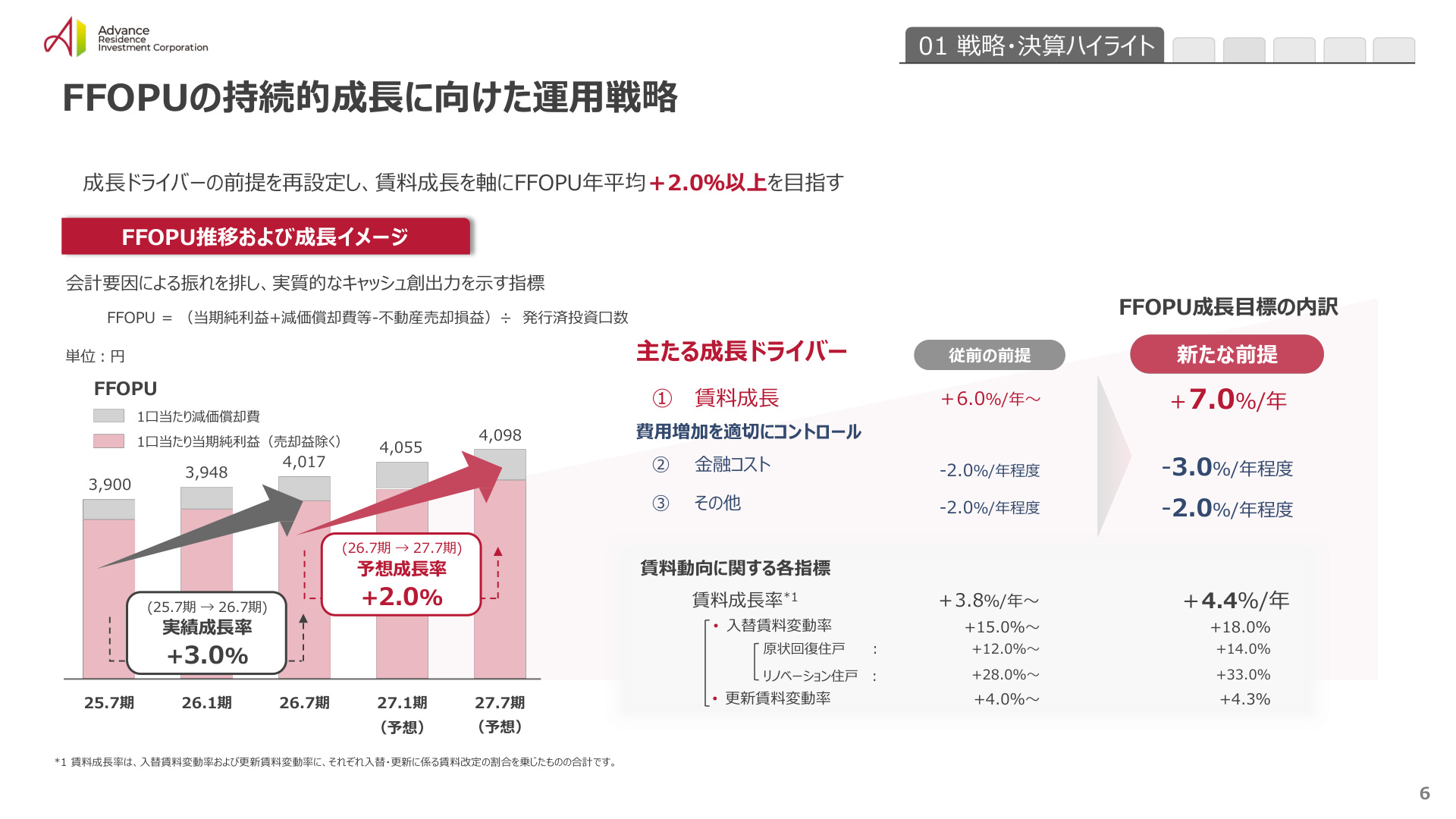
The figure above illustrates the roadmap for an operational strategy aimed at sustainable FFOPU growth (average annual growth of +2.0% or more). The following precise controls have been implemented in reviewing the primary drivers and assumptions for growth:
- Upward Revision of Rent Growth Assumptions : The assumption for annual rent growth has been revised upward from "+6.0% or more" to "+7.0% or more." Specifically, the assumption for rent change upon tenant turnover was raised from +15.0% to +18.0%, and the assumption for rent renewal increases was raised from +4.0% to +4.3%.
- Control of Financial Costs and Expenses : While anticipating the impact of increased financial costs (approx. -3.0% annually) and other cost increases (approx. -2.0% annually), the REIT has established a structure to achieve net FFOPU growth of +2.0% or more annually by fully offsetting these through rent increases (approx. +7.0% annually).
From the actual FFOPU of 4,017 yen for the period ended July 2026, the REIT projects stable cruising growth to 4,055 yen for the period ending January 2027 and 4,098 yen for the period ending July 2027.
3. Core of Internal Growth: High Investment Efficacy of Unit Renovations
A key driver of rent growth is the unit renovation program executed by a specialized team. By implementing layout changes (such as opening up kitchens) and upgrading specifications to enhance design and functionality, even in older properties, the REIT effectively captures market rental demand.
As shown in the figure above, the results of these renovations are clearly reflected in the following quantitative data:
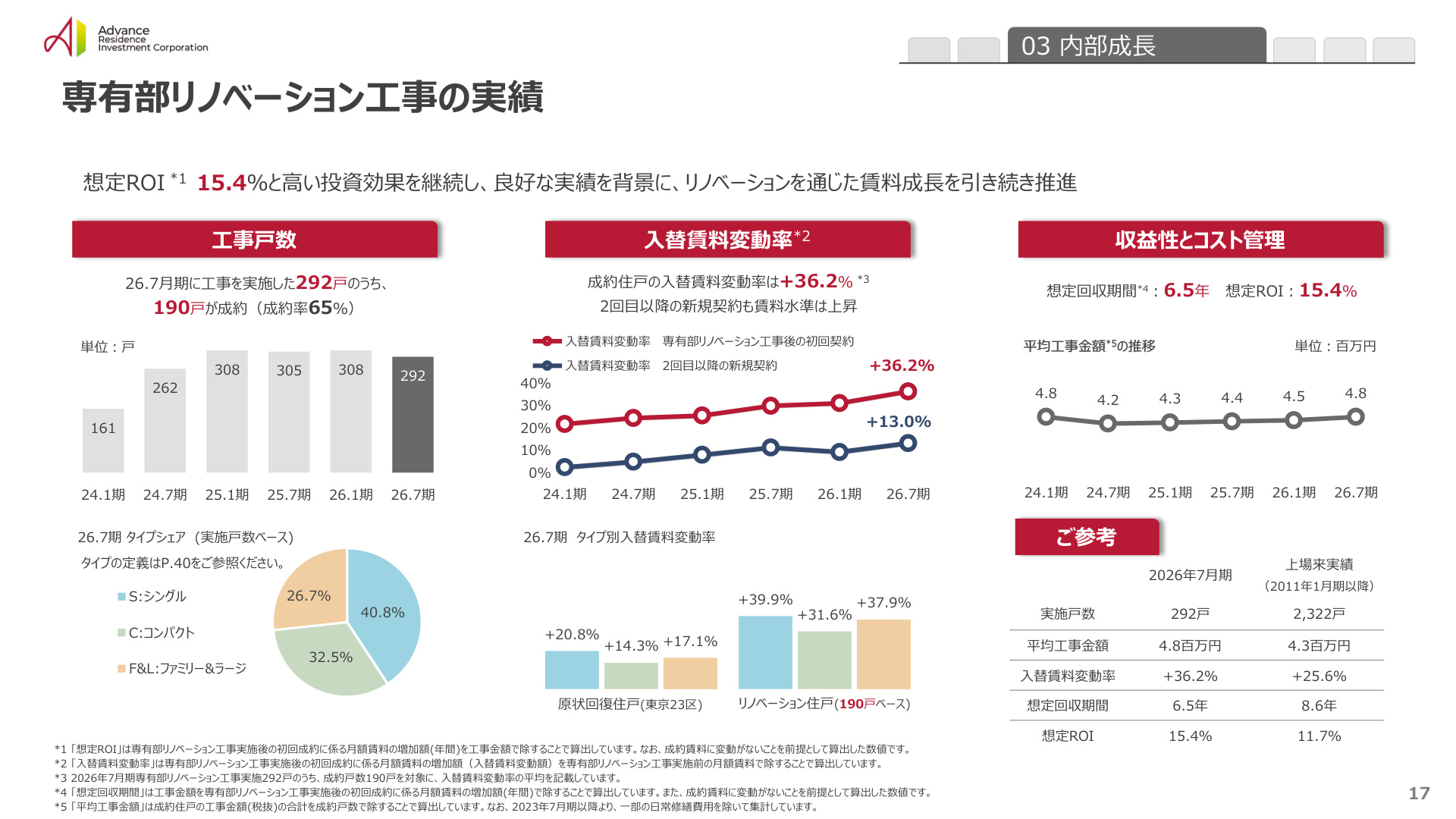
- High Level of Investment Yield : For the 292 units renovated during the period (190 of which were leased), the projected ROI is 15.4% , with a projected payback period of 6.5 years , demonstrating exceptional investment efficiency.
- Surge in Rent Change upon Turnover : The rent change rate for renovated units upon initial contract reached +36.2% , achieving an overwhelming rent increase compared to standard restoration units (+17.8% in Tokyo's 23 wards). Furthermore, even in subsequent new contracts after the first post-renovation lease, rent increased by +13.0% , proving that these renovations provide a lasting boost to asset value rather than a temporary effect.
- Future Expansion Potential : Approximately 40% of the total portfolio (over 90% of which is in Tokyo's 23 wards) has been identified as candidates for renovation, with progress at the end of the current period standing at only about 20%. Promoting these works in remaining units holds the potential to boost FFOPU by +12.8% in the future .
4. Rental Market Trends: Record-High Rent Revisions for Both Turnover and Renewals
Against the backdrop of tight supply and demand in the residential leasing market, rent revisions are progressing smoothly for both new contracts and renewals.
① Rent Trends upon Turnover
The rent change rate for the entire portfolio reached a record high of +18.7% . A nationwide upward trend is evident, particularly in Tokyo's 23 wards (+22.0%) , the Tokyo Metropolitan Area (+18.4%), and government-designated cities (+8.3%). By unit type, strong double-digit growth was recorded across the board: Single (+19.8%), Compact (+19.6%), and Family & Large (+16.4%).
② Rent Trends upon Renewal
The rate of rent increase proposals at the time of renewal rose to 80.6% , and the tenant acceptance rate for these proposals improved significantly to 74.3% (up from 64.5% in the previous period). As a result, the renewal rent change rate reached +4.4% (a monthly rent increase of 20,779 thousand yen), providing a stable upward lift. The average length of stay has extended to 4.8 years , demonstrating that rent increases are functioning effectively while maintaining high tenant retention.
5. Asset Replacement Strategy and Cash Allocation
The REIT proactively executes asset replacement (portfolio rebalancing) by selling properties that are relatively older with limited internal growth potential and acquiring properties in central urban areas with higher growth prospects.
- Track Record and Plans for Property Transactions : Between the periods ended July 2026 and January 2027, the REIT sold 3 properties (totaling 3.82 billion yen, with 1.50 billion yen in gains) while acquiring 7 properties primarily in Tokyo's 23 wards (totaling 10.92 billion yen, with an average NOI yield of 3.9–4.0%). The average age of the portfolio was rejuvenated to 18.7 years, with acquired properties averaging 11.7 years compared to 23.0 years for sold properties.
- Allocation Policy for Sale Proceeds : In addition to prioritizing proceeds for new property acquisitions (growth investment), 2.04 billion yen will be allocated to unitholder returns (distribution of gains). Furthermore, unrealized gains on properties held have reached 304.1 billion yen (unrealized gain ratio of 64.6%) , providing a substantial buffer for future returns and financial defense.
- Utilization of Negative Goodwill and Retained Earnings : The REIT holds 21.4 billion yen in negative goodwill (after projected distributions for the period ending July 2027), one of the largest in the J-REIT sector, along with 2.9 billion yen in funds available for distribution from gains. These serve as a powerful cushion to support the smoothing of DPU and stable growth over the medium to long term.
6. Future Earnings Outlook and Conclusion
In the published earnings forecasts, DPU is expected to continue its upward trend, reaching 3,253 yen for the period ending January 2027 (+28 yen YoY) and 3,258 yen for the period ending July 2027 (+5 yen YoY) .
In response to macroeconomic changes such as inflation and rising interest rates, the REIT has established a framework to achieve robust cash-generating capability (FFOPU) and sustainable improvement in unitholder value through a multi-layered strategy: "value creation through unit renovations," "aggressive rent revisions upon turnover and renewal," and "agile asset replacement combined with the utilization of substantial negative goodwill."
This content is not intended as investment advice or a recommendation. Any opinions expressed are solely the personal views of each article.