


Eternal Hospitality Group FY2026 Earnings Deep Dive: Reviewing Domestic and International Expansion, Mid-Term Plan Revisions, and the Path to Future Growth

StockClub
Published: Sep 17, 2026, 06:51 PM GMT+9
Sentiment Analysis

Eternal Hospitality Group FY2026 Earnings Deep Dive Report
Based on the earnings presentation materials for the fiscal year ended July 2026 from Eternal Hospitality Group Co., Ltd. (Securities Code: 3193) , which operates the "Torikizoku" restaurant chain, this report provides an objective analysis of the company's performance highlights, domestic and international business trends, revisions to its mid-term management plan, and future growth strategies.
1. FY2026 Consolidated Earnings Highlights
For the fiscal year, the company reported net sales of 51.254 billion yen (+10.6% YoY) , operating profit of 2.797 billion yen (-10.4% YoY) , ordinary profit of 2.8 billion yen (-9.8% YoY) , and net profit attributable to owners of the parent of 1.318 billion yen (-23.4% YoY) .
While net sales achieved double-digit growth driven by strong domestic existing-store performance, new store openings, and full-year contributions from overseas expansion, the results fell short of initial forecasts (net sales of 52.801 billion yen, operating profit of 3.43 billion yen). Profitability was impacted by rising store operating expenses, including labor costs, one-time expenses associated with store openings concentrated in the fourth quarter, and expanding upfront losses in the China (Shanghai) business . Furthermore, net profit was weighed down by an impairment loss of 391 million yen recorded as an extraordinary loss, related to certain domestic stores and the closure of four directly operated stores in China.
2. Domestic Torikizoku Business Overview: Traffic-Driven Same-Store Growth and Marketing DX
"Torikizoku," the core domestic business, maintained solid same-store sales.
- Same-Store Sales Trend : Cumulative full-year performance reached 106.7% YoY , exceeding the initial plan (103.8%).
- Breakdown of Customer Traffic and Average Spend : Customer traffic increased by 3.8% YoY , and average spend rose by 2.8% YoY , with both factors contributing to growth.
- Effectiveness of Initiatives : The continuation of the "40th Anniversary Unubore-tsuzukete Thank You Fair" (featuring 2-month cycle limited menus) and collaborations with apparel, protein, and capsule toy brands helped attract new and dormant customers.
- Expansion of Marketing DX Infrastructure : The total number of registered users for the official app surpassed 2.75 million . The company is advancing the strengthening of reservation funnels based on customer IDs and implementing recommendation features tailored to specific usage scenarios.
Regarding store expansion, while the company passed on some properties that did not meet investment criteria due to rising construction costs and urban rent, it steadily opened new stores in previously unentered areas (Fukushima and Oita Prefectures). The total number of domestic group stores reached 1,163 (424 Torikizoku direct-operated, 271 TCC stores, 463 Yakitori Daikichi FC stores, etc.).
3. Progress in Overseas Business: Regional Divergence and Strategic Restructuring
In the overseas business, progress varies significantly depending on the region and store format.
- South Korea (5 direct-operated stores) : Existing stores in busy districts like Hongdae performed stably, achieving full-year profitability at the store-level EBITDA . Following a review of costs and labor expenses, the company is pursuing a dominant strategy, including the opening of a fourth store in the Euljiro business district.
- United States (3 direct-operated stores) : TORIKIZOKU, zoku, and HASU all achieved full-year profitability at the store-level EBITDA . Moving forward, the company is developing a fast-food model better suited for multi-store expansion (with a test opening planned in Anaheim) and preparing for franchise expansion through a transition to an intermediate holding company structure.
- East Asia & Southeast Asia (FC/JV expansion) : Operations in Hong Kong (5 FC stores) and Taiwan (6 JV stores) are growing steadily by leveraging partner resources. Expansion into ASEAN regions, such as Singapore and the Philippines, is also proceeding sequentially.
Conversely, the China (Shanghai) market, where the company aggressively pursued direct operations, faced a difficult situation.
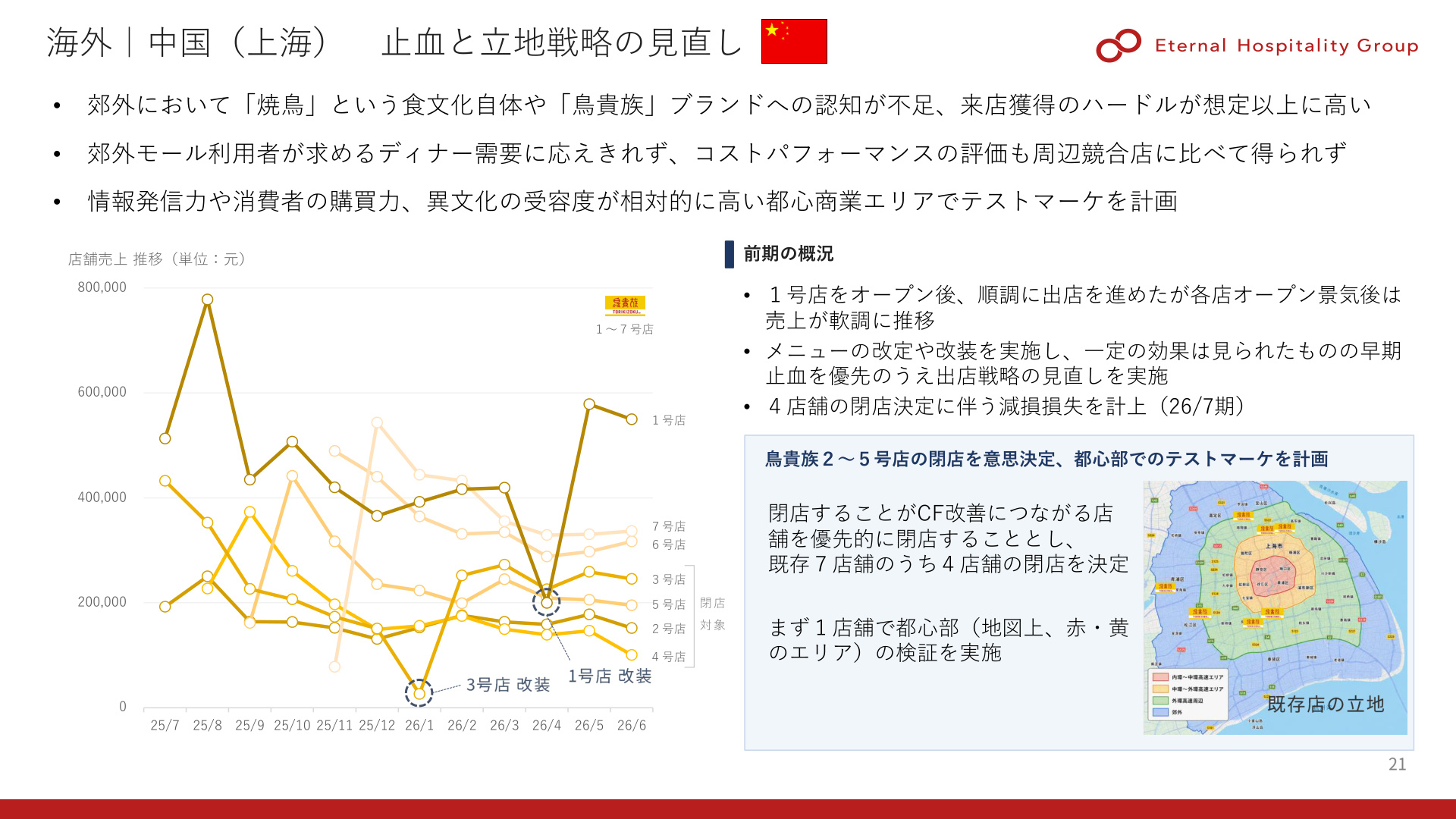
Challenges in the China (Shanghai) Business and the Significance of "Hemostasis"
In the Shanghai market, sales softened after the initial post-opening boom due to intensifying competition with local Japanese restaurant chains and delays in brand appeal. In particular, suburban shopping malls struggled to align with the dinner demand of families, resulting in a structure where it was difficult to gain recognition for cost-performance.
In response, the company swiftly decided to close four unprofitable suburban direct-operated stores (stores 2-5) and recorded an impairment loss. Moving forward, the company is focusing on "hemostasis" (stopping cash flow leakage) while fundamentally revising its strategy to focus on test marketing (1 store) in central commercial areas with high purchasing power and information dissemination capabilities. The ability to recognize issues early and make decisions to withdraw or pivot is a critical point from a risk management perspective.
4. Downward Revision of Mid-Term Management Plan Targets and Factor Analysis
The company has revised its final-year targets for the mid-term management plan covering the period from the fiscal year ending July 2025 to the fiscal year ending July 2027.
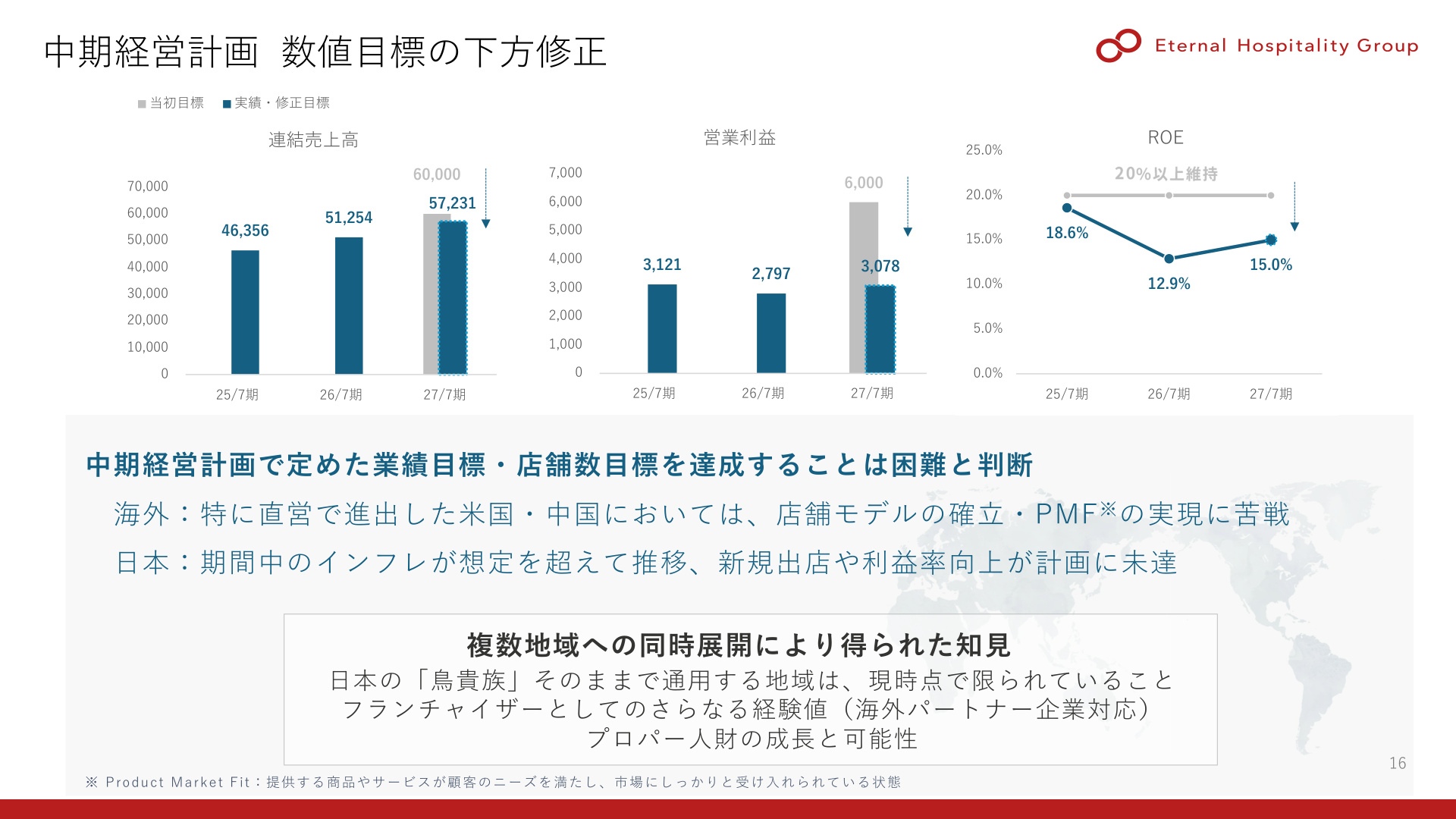
Background and Assumptions for Mid-Term Plan Revision
The revised targets for the fiscal year ending July 2027 are: net sales of 57.2 billion yen (initially 60 billion yen) , including overseas sales of 2 billion yen (initially 6 billion yen); operating profit of 3 billion yen (initially 6 billion yen) , with an operating margin of 5.4% (initially 10%); and ROE of 15% or higher (initially 20% or higher) .
Key factors for the downward revision include:
- Delays in launching overseas direct-operated businesses : Establishing product-market fit (PMF) and multi-store expansion models in the U.S. and China took longer than initially anticipated.
- Prolonged domestic inflation : Cost pressure from raw materials, utilities, labor, and construction exceeded expectations, slowing the pace of margin improvement.
By leveraging the insights gained from simultaneous expansion into multiple regions—such as identifying regions where the "Japanese-style" model works as-is and gaining operational know-how as a franchisor—the company plans to build a foundation for the next mid-term plan (FY2028-FY2030).
5. FY2027 Full-Year Consolidated Earnings Outlook and Key Initiatives
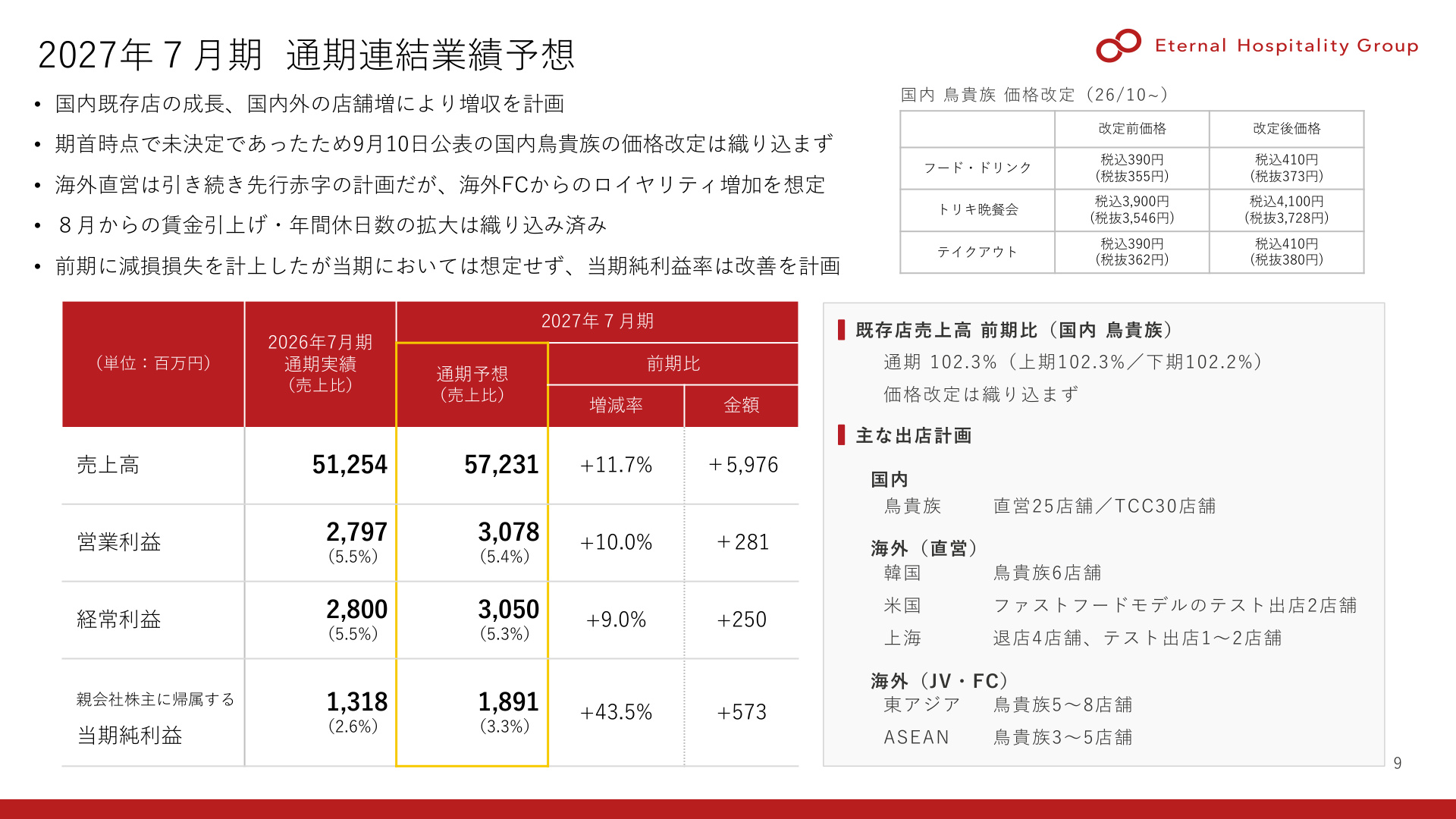
FY2027 Earnings Forecast and Assumptions
The consolidated earnings forecast for the fiscal year ending July 2027 anticipates net sales of 57.231 billion yen (+11.7% YoY) , operating profit of 3.078 billion yen (+10.0% YoY) , ordinary profit of 3.05 billion yen (+9.0% YoY) , and net profit attributable to owners of the parent of 1.891 billion yen (+43.5% YoY) .
Key points to note include:
- Inclusion of Price Revisions : The domestic "Torikizoku" price revision announced on September 10, 2026 (from 390 yen to 410 yen including tax, scheduled for October 2026) was not included in the earnings forecast assumptions as it had not been decided at the time the initial forecast was prepared. The same-store sales assumption is calculated at 102.3% YoY.
- Inclusion of Cost Factors : Talent investment costs, such as the wage base-up (average 1.9%) starting in August 2026 and the expansion of annual holidays (to 116 days), have been factored in.
- New Store Opening Plan : The company plans to open 25 direct-operated and 30 TCC stores (55 total) for domestic Torikizoku. Overseas, it plans to open 6 direct-operated stores in South Korea, 2 fast-food model stores in the U.S., and 8-13 stores via FC/JV in East Asia and ASEAN.
6. Financial Soundness and Shareholder Returns (Stock Split, Dividends, and Perks)
Financial Foundation and Cash Flow
- Equity Ratio : Maintained a sound level of 46.2% as of the end of July 2026 (+0.5pt improvement from the previous fiscal year-end).
- Cash Flow Status : Operating cash flow generated 4.05 billion yen (compared to 2.492 billion yen in the previous year), and the year-end balance of cash and cash equivalents was 7.167 billion yen, maintaining liquidity to support growth investment and shareholder returns.
Expansion of Shareholder Return Measures
- Dividend Policy : The company implements a "progressive dividend" policy, aiming for a consolidated dividend payout ratio of 20% or more, with a principle of stable and sustainable dividend increases. The annual dividend for the fiscal year ending July 2027 is projected at 23 yen per share (11.5 yen interim, 11.5 yen year-end).
- Stock Split : A 2-for-1 stock split was implemented on August 1, 2026, to lower the investment unit price and improve liquidity.
- Expansion of Shareholder Benefit Program : A new tier was established for holders of 100 shares post-split (equivalent to the former 50 shares) worth 1,000 yen annually, and a long-term holding benefit was introduced, providing "four 5% discount coupons" to shareholders who have held their shares for one year or longer.
Summary
For Eternal Hospitality Group, the fiscal year ended July 2026 was a milestone period where the company confirmed the solid performance of domestic existing stores while simultaneously revising its mid-term plan due to challenges in its overseas direct-operated business (particularly in Shanghai). Moving forward, the key areas to watch will be the "hemostasis" of the Shanghai business, the development of the fast-food format in the U.S., and the progress of price revision effects and marketing DX in the domestic market.
This content is not intended as investment advice or a recommendation. Any opinions expressed are solely the personal views of each article.