

AEON REIT Investment Corporation 27th Fiscal Period Results: Implementing a 'Two-Year Restructuring Period' to Address Inflation and Rising Interest Rates, Driving Revenue Structure and Financial Strategy Overhaul for Sustainable Growth

StockClub
Published: Sep 14, 2026, 09:58 AM
Sentiment Analysis
Executive Summary
AEON REIT Investment Corporation (Ticker: 3292) reported its financial results for the 27th fiscal period (ending July 2026), with operating revenue of ¥21.438 billion , ordinary profit of ¥6.061 billion , and net income of ¥5.968 billion . Distributions per unit (DPU) landed at ¥3,390 , in line with forecasts. Despite recording an extraordinary loss (¥106 million) due to earthquake damage, the REIT maintained stable distributions by reducing leasing business expenses and utilizing excess profit distributions (¥551), including the reversal of the reserve for temporary difference adjustments.
However, the operating model established at the time of listing, which assumed a deflationary and low-interest-rate environment, is now facing significant pressure from shifting external conditions, specifically rising inflation (increased repair costs and capital expenditures) and higher interest rates (increased interest expenses) . In response, the REIT has announced a "two-year restructuring period" through the fiscal period ending January 2028 (30th period). During this time, it will initiate fundamental revenue structure reforms, including asset recycling, a review of contract structures (considering the introduction of variable rent components), and the implementation of agile financial strategies.
1. 27th Fiscal Period Highlights and Variance Analysis
Performance for the 27th period showed steady progress against initial forecasts.
- Operating Revenue : ¥21,438 million (+¥138 million vs. forecast, +¥131 million vs. previous period)
- Operating Profit : ¥7,197 million (+¥165 million vs. forecast, -¥781 million vs. previous period)
- Ordinary Profit : ¥6,061 million (+¥169 million vs. forecast, -¥804 million vs. previous period)
- Net Income : ¥5,968 million (+¥77 million vs. forecast, -¥851 million vs. previous period)
- Distributions per Unit (DPU) : ¥3,390 (±¥0 vs. forecast, -¥10 vs. previous period)
- Earnings per Unit (EPU): ¥2,839 (+¥38 vs. forecast)
- Excess Profit Distribution: ¥551 (Reserve for temporary difference adjustments: ¥119 + Other: ¥432)
Operating revenue exceeded forecasts due to insurance proceeds (+¥71 million), foreign exchange gains (+¥31 million), and gains from the partial sale of the Ibaraki Process Center (PC) (+¥6 million). On the expense side, despite recording repair costs and extraordinary losses (¥106 million) related to earthquake damage, net income exceeded forecasts by ¥77 million, supported by lower depreciation expenses (-¥33 million) and the timing of repair expenditures.
2. Changes in External Environment and the "Two-Year Restructuring Period"
The environment surrounding the REIT has shifted dramatically from deflation and low interest rates to an "inflationary and rising interest rate phase." The traditional business model, which relied on the stability of long-term fixed rents, is struggling to fully absorb rising operating costs, construction unit prices, and interest expenses.
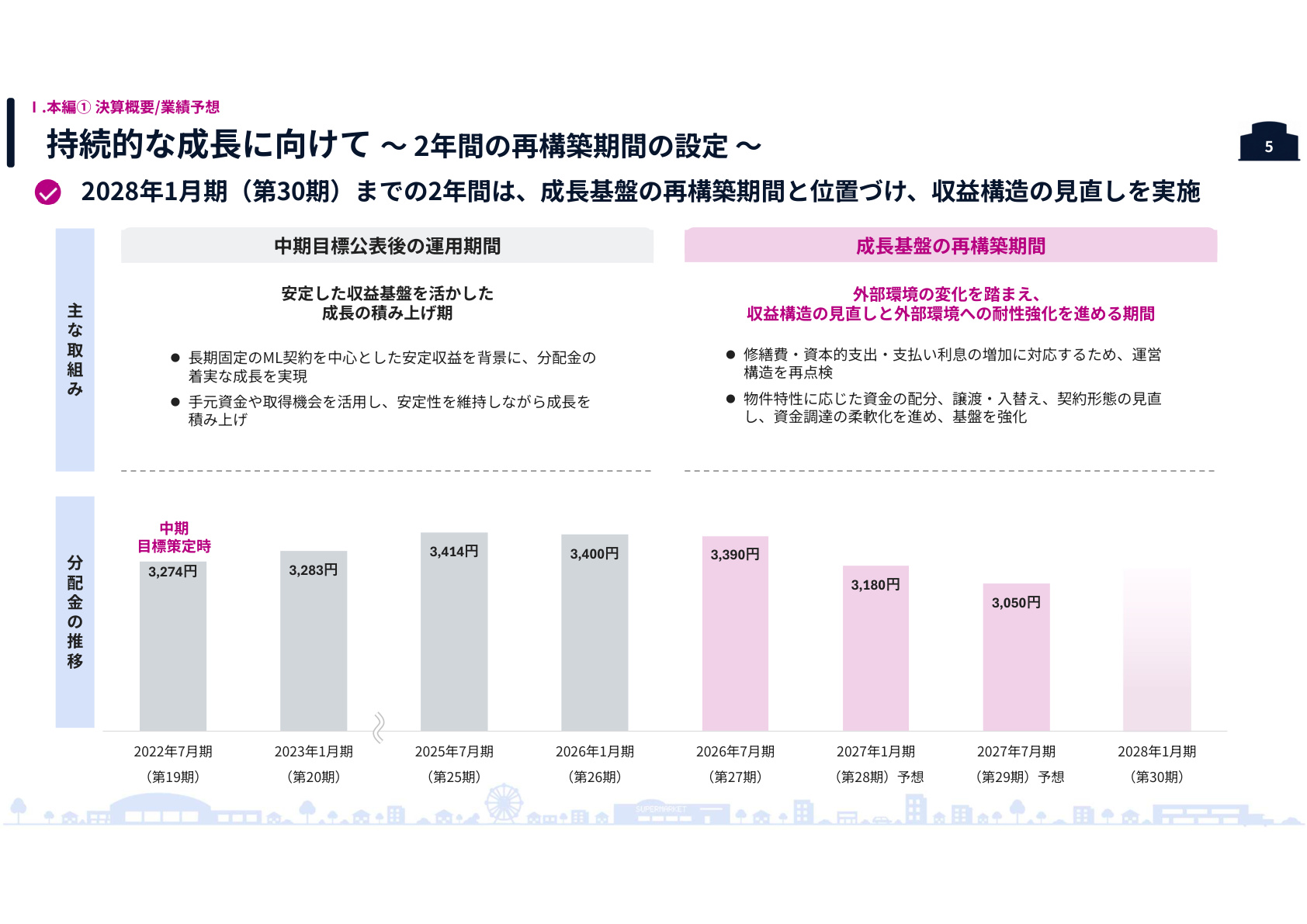
In response, the REIT has designated the two years leading up to the fiscal period ending January 2028 (30th period) as a "growth foundation restructuring period."
Explanation and Positioning of the Slide
The slide above is a critical policy roadmap outlining the REIT's future direction and distribution outlook. While the REIT has historically built distributions based on long-term fixed master lease (ML) contracts, the next two years will focus on revising the revenue structure and strengthening resilience against external factors. Consequently, the DPU forecast is expected to temporarily trend downward, with ¥3,180 for the 28th period and ¥3,050 for the 29th period . The goal is to rebuild the business foundation during this period to achieve a long-term cruising DPU target of ¥3,600 .
3. Revenue Structure Reform: Contract Review and Value-Add Investment
(1) Consideration of Rent Structures Incorporating Variable Elements
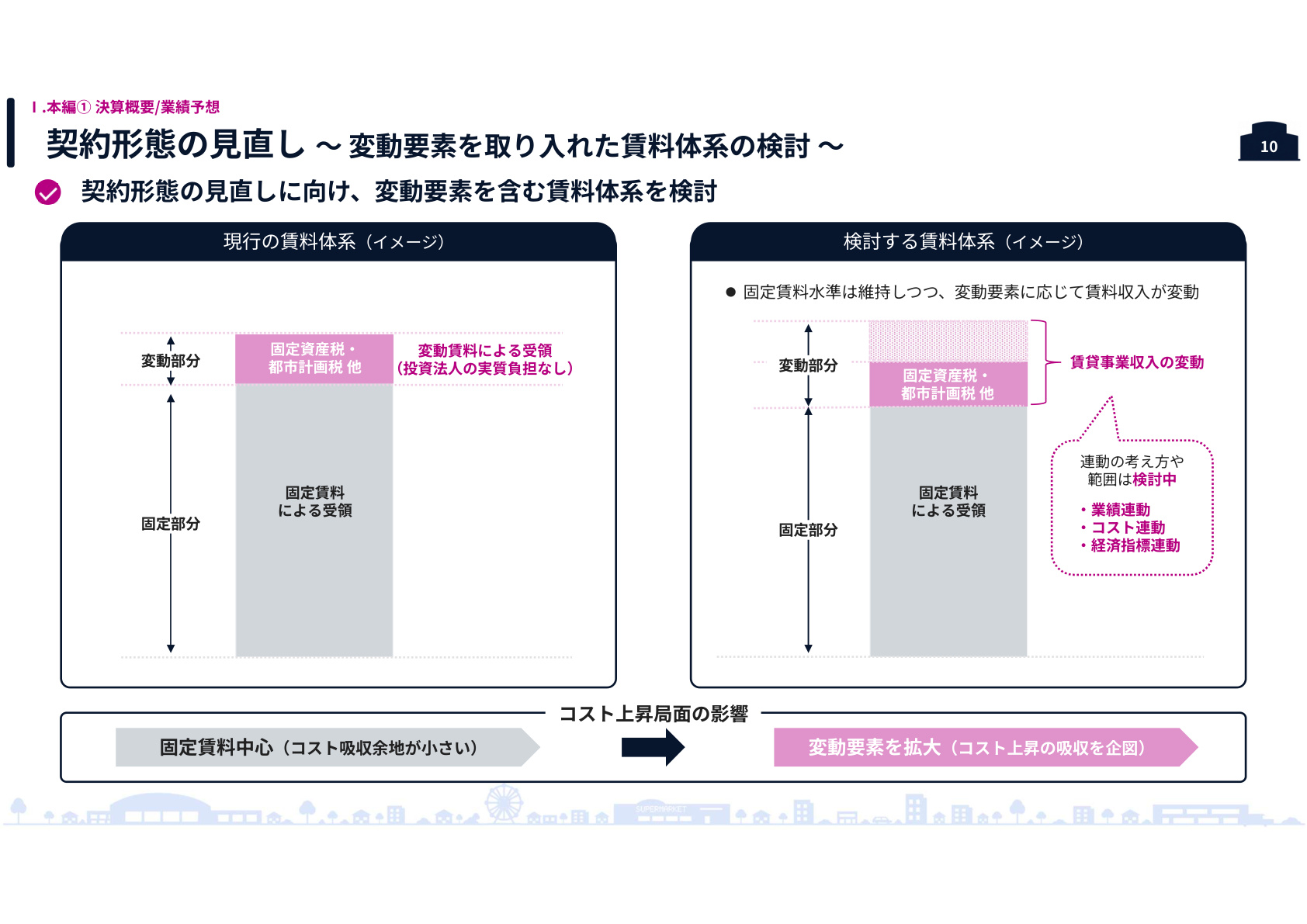
To absorb cost increases caused by inflation, the REIT is considering a shift from the current fixed-rent-centric model to a "rent structure that maintains fixed rent levels while incorporating variable elements linked to performance, costs, and economic indicators."
Explanation and Positioning of the Slide
Previously, the model involved receiving only public taxes (such as fixed asset tax and city planning tax) as variable rent, effectively shielding the REIT from these costs. In an inflationary environment, however, increases in repair costs and interest rates fall on the REIT. As shown in the slide, by designing variable components linked to tenant sales, operating costs, and CPI while maintaining the stability of fixed rent, the REIT aims to achieve both "absorption of cost increases during inflation" and "capturing upside from tenant sales growth."
(2) Value-Add Investment and Asset Selection
Rather than applying uniform investment across all 53 properties, the REIT is prioritizing investments through a matrix analysis of the rent-to-sales ratio and the absorption capacity of the master lessees (AEON group companies).
- Essential Construction (All properties) : Implementing necessary work to ensure safety, legal compliance, and business continuity.
- Value-Add Investment (Priority area) : Allocating funds actively to properties where investment directly leads to rent increases or improved occupancy.
- Divestment/Replacement (Review area) : For properties with low absorption capacity and limited room for profit improvement, the REIT will conduct necessary repairs while considering divestment or asset replacement.
4. Asset Replacement Strategy and Recent Initiatives
The REIT is promoting asset replacement to improve portfolio quality and generate cash.
- Partial Divestment of Daiei Ibaraki Process Center (Main Building) :
- Divested an aging building (49 years old) for ¥103 million (gain of ¥6 million), avoiding future large-scale repair and capital expenditure burdens.
- Retained the land under a leasehold contract (ground rent income) to maintain revenue stability. Due to reduced expenditures and improved Net Cash Flow (NCF), the appraised value of the entire facility rose from ¥8.01 billion to ¥8.3 billion (+¥290 million) .
- Recent Asset Replacement Case :
- In February 2025, acquired five land plots (total acquisition price: ¥8.1 billion) and in March, divested "AEON MALL Yamagata Minami" (sale price: ¥1.5 billion). The proceeds were used to repay ¥6 billion in debt, balancing financial health with improvements in EPU/DPU.
5. Financial Strategy: High Fixed-Interest Ratio and Agile Use of Variable Rates
Controlling financial risk in a rising interest rate environment is a key focus.
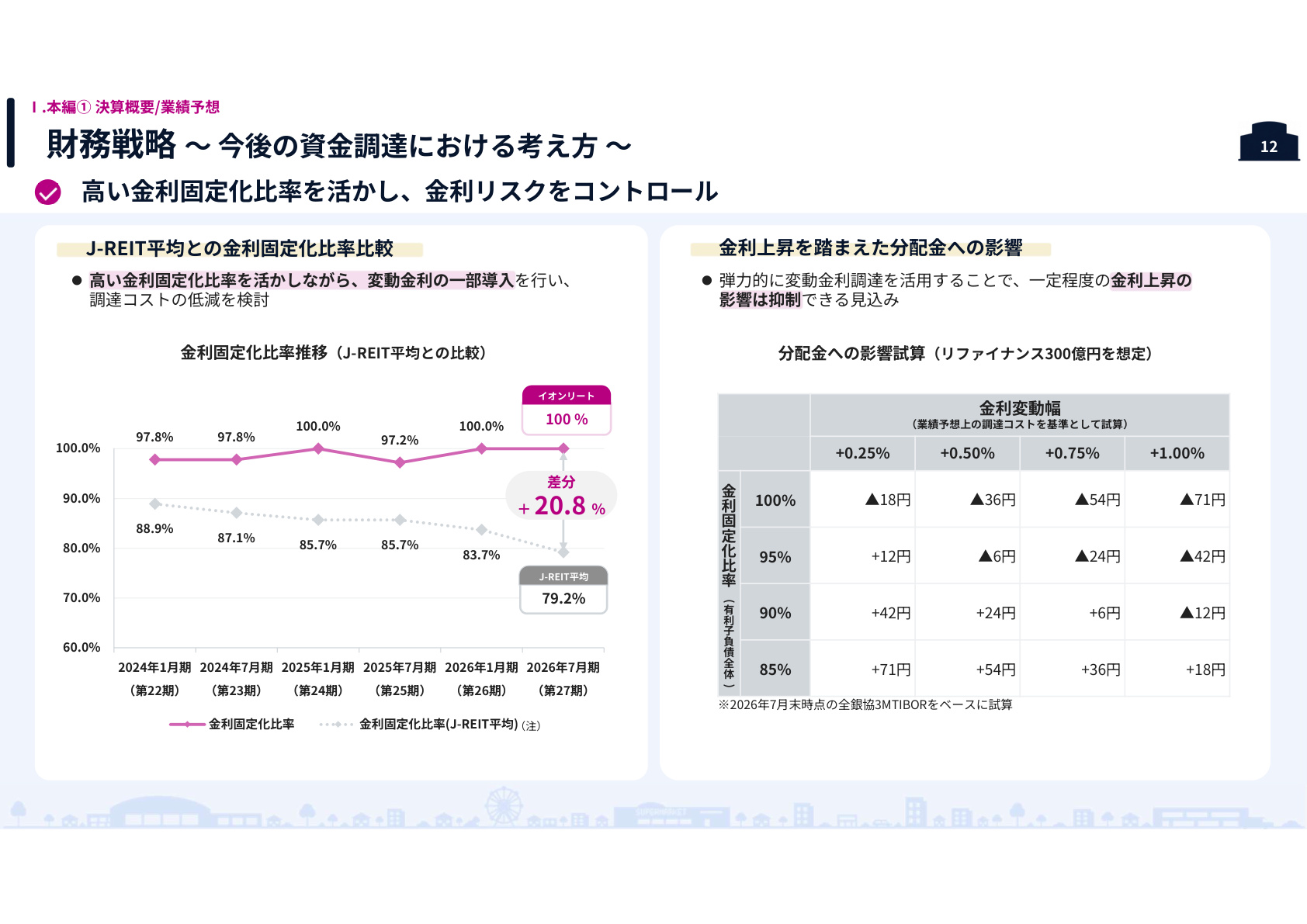
Explanation and Positioning of the Slide
The slide above illustrates the REIT's robust financial position and flexible future interest rate approach. As of the end of the 27th period, the REIT maintains a 100% fixed-interest ratio and an average procurement duration of 7.4 years , a defensive structure significantly higher than the J-REIT average (79.2%). Even with sharp market rate hikes, the impact on existing debt is extremely limited.
Moving forward, the REIT intends to leverage this high fixed-rate buffer to introduce a portion of variable-rate debt during refinancing (flexibly adjusting the fixed-rate ratio to approximately 85–95%) . As shown in the table on the right of the slide, by incorporating some variable rates, the REIT aims to suppress procurement costs and strategically mitigate the downward pressure on distributions during rate hikes.
6. Free Cash Flow (FCF) Generation and Utilization Policy
The REIT utilizes the abundant FCF generated from depreciation to improve capital efficiency.
- Profitability Enhancement : Used for capital contributions (¥1.5 billion) following public offerings for "AEON MALL Wakayama" and "AEON MALL Miyakonojo Ekimae," and the acquisition of the expansion wing of "AEON MALL Ota" (¥5.5 billion).
- Financial Stability : Controlling LTV through debt repayment, such as the ¥4 billion repayment in 2014 and ¥6 billion in 2025.
- Capital Policy : Executing agile capital policies to enhance unitholder value, such as the acquisition of treasury investment units (¥2.7 billion) conducted in 2024.
7. Progress in Internal Growth, Overseas Assets, and Sustainability
- Value-Add Investment Results : In the 27th period, rent revisions were achieved for 11 properties, resulting in an annual rent increase of +¥34 million . High investment returns were generated through the renewal of "AEON MALL Morioka" (investment: ¥111 million, rent increase: +10.7%) and "AEON MALL KAGOSHIMA BAY" (investment: ¥61 million, rent increase: +14.4%).
- Stable Growth of Overseas Assets in Malaysia : Secured an 8-year contract renewal for "AEON Taman Universiti" (+20% rent vs. acquisition). Through 3-year CPI-linked rent revisions , the REIT continues to achieve stable internal growth that captures inflation.
- Improved Sustainability Rating : Achieved an "AA" rating in the MSCI ESG Ratings (up from "A" in the previous period). The acquisition rate of high-rank DBJ Green Building certifications has progressed to over 85%, strengthening ESG capabilities.
8. Portfolio Indicators and Future Outlook
Key indicators at the end of the 27th period remain at healthy levels:
- Asset Size : 53 properties / ¥480.5 billion
- Portfolio NOI Yield : 5.6% (3.4% after depreciation)
- Unrealized Gain : +¥97.5 billion (Unrealized gain ratio: 20.3%)
- NAV per Unit : ¥158,772
- Total Asset LTV : 45.1% (41.8% excluding security deposits, 37.1% market value LTV)
- Average Remaining Lease Term : 11.0 years
Earnings Forecast (28th and 29th Periods)
| Item | 27th Period Actual | 28th Period Forecast (Jan 2027) | 29th Period Forecast (Jul 2027) |
|---|---|---|---|
| Operating Revenue | ¥21,438 million | ¥21,356 million | ¥21,369 million |
| Operating Profit | ¥7,197 million | ¥7,419 million | ¥7,265 million |
| Ordinary Profit | ¥6,061 million | ¥6,110 million | ¥5,835 million |
| Net Income | ¥5,968 million | ¥6,109 million | ¥5,834 million |
| DPU | ¥3,390 | ¥3,180 | ¥3,050 |
| (Incl. Excess Profit Dist.) | ¥551 | ¥275 | ¥275 |
| NOI | ¥13,328 million | ¥13,693 million | ¥13,505 million |
| Repair Costs | ¥2,256 million | ¥1,865 million | ¥2,043 million |
| Capital Expenditures | ¥3,097 million | ¥2,878 million | ¥3,564 million |
For the 28th and 29th periods, the REIT anticipates distributions in the low ¥3,000 range, accounting for sustained high repair costs and capital expenditures, as well as increased borrowing costs due to refinancing (non-operating expenses +¥106 million in the 29th period). Through this two-year restructuring period, the REIT plans to steadily execute rent structure reforms and asset replacements to transform into a robust, inflation-resilient portfolio.
This content is not intended as investment advice or a recommendation. Any opinions expressed are solely the personal views of each article.