

Mori Hills REIT Investment Corporation 40th Fiscal Period Results and Growth Strategy Deep Dive: Internal and External Growth Roadmap for a Premier Tokyo Portfolio

StockClub
Published: Sep 14, 2026, 09:58 AM
Sentiment Analysis
In-Depth Analysis: Mori Hills REIT Investment Corporation 40th Fiscal Period Results and Mid-to-Long-Term Growth Strategy
Mori Hills REIT Investment Corporation (the "Investment Corporation") is a J-REIT sponsored by Mori Building Co., Ltd., focusing on premium office, residential, and retail assets in central Tokyo. In its 40th fiscal period (ended July 2026), the Investment Corporation achieved stable performance and distributions through strategic asset recycling, high occupancy rates, and successful rent revisions. This report provides a multi-faceted analysis of the period's highlights, capital policy, portfolio competitiveness, and mid-to-long-term growth trajectory based on disclosed materials.
1. 40th Fiscal Period Highlights and Key KPIs
The operating results for the 40th fiscal period (ended July 2026) were solid and in line with projections:
- Operating Revenue : 11,126 million JPY (vs. plan: -58 million JPY; vs. previous period: -255 million JPY)
- Operating Income : 6,688 million JPY (vs. plan: -10 million JPY; vs. previous period: -193 million JPY)
- Net Income : 5,807 million JPY (vs. plan: -7 million JPY; vs. previous period: -317 million JPY)
- Distribution per Unit (DPU) : 3,100 JPY (vs. previous period: ±0.0% / Achieved as planned)
- NAV per Unit : 166,139 JPY (+0.6% vs. previous period)
- Period-end LTV : Book value basis 46.4% / Appraisal basis 36.5%
- Period-end Office Occupancy Rate : 99.0%
The year-on-year decline in revenue and profit was primarily due to the difference in gains from the partial sale of Laforet Harajuku (a 1,519 million JPY gain from a 7% stake sale in the previous period versus a 1,257 million JPY gain from a 5% stake sale this period, resulting in a -262 million JPY impact) and an increase in non-operating expenses such as interest payments (+117 million JPY). Conversely, rental business revenue remained robust at 9,689 million JPY (+24 million JPY vs. previous period). By utilizing gains from the Laforet Harajuku sale and the reversal of compressed reserve funds (11 million JPY), the Investment Corporation successfully maintained its target DPU of 3,100 JPY .
Furthermore, driven by rising appraisal values of held properties, NAV per unit has steadily expanded to 166,139 JPY .
2. Operational Policy and Capital Strategy Focused on Unit Price
Aiming for a recovery to a 1.0x NAV multiple in the market, the Investment Corporation is pursuing multi-faceted operational measures centered on maintaining a "DPU of 3,100 JPY or more" and "improving base DPU excluding gains on sales."
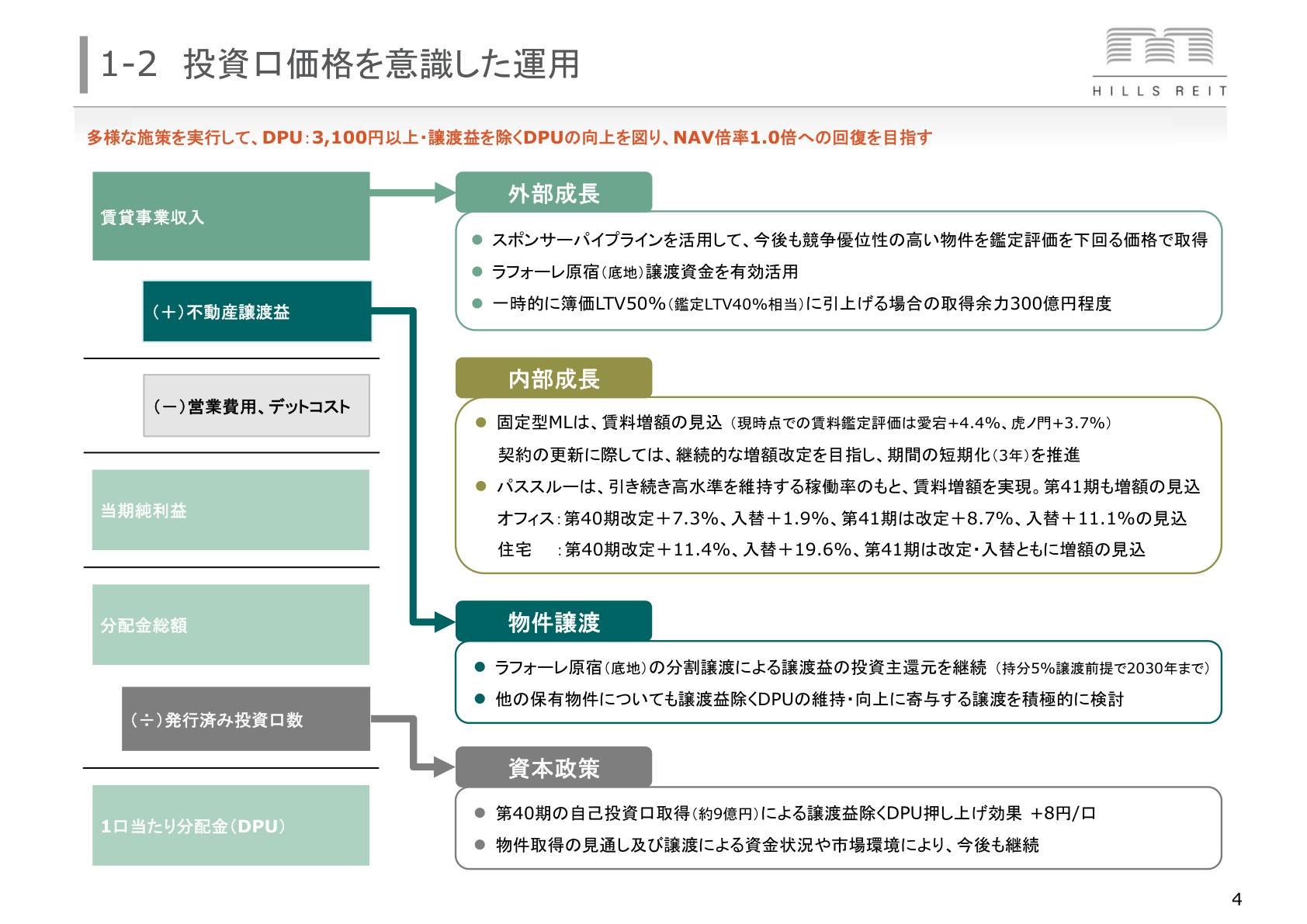
[Slide Commentary: Comprehensive Framework for Unit Price Enhancement]
The slide above (P4) illustrates the Investment Corporation's structural strategy for improving unit price and the quality of distributions. To maximize total distributions, the Investment Corporation integrates four pillars:
- External Growth : Leveraging the sponsor pipeline to acquire high-quality properties at prices below appraisal value.
- Internal Growth : Increasing rents through contract renewals for fixed-type Master Lease (ML) agreements and raising rents for pass-through properties.
- Asset Sales : Supporting distributions through gains from the partial sale of low-yield assets (Laforet Harajuku land).
- Capital Policy : Acquiring and canceling own investment units using cash on hand.
Notably, during this period, the Investment Corporation invested approximately 900 million JPY to acquire and cancel 6,800 own investment units (0.36% of total issued units) . This has created a permanent uplift of +8 JPY per unit to the base DPU (excluding gains on sales), demonstrating disciplined financial management focused on capital efficiency.
3. Mid-to-Long-Term Portfolio Recycling Strategy (Virtuous Cycle of Sales and Acquisitions)
The hallmark of the Investment Corporation's external growth is its "portfolio restructuring utilizing special tax provisions for replacement," which involves recycling capital from the partial sale of low-yield land assets into high-yield, high-quality sponsor properties.
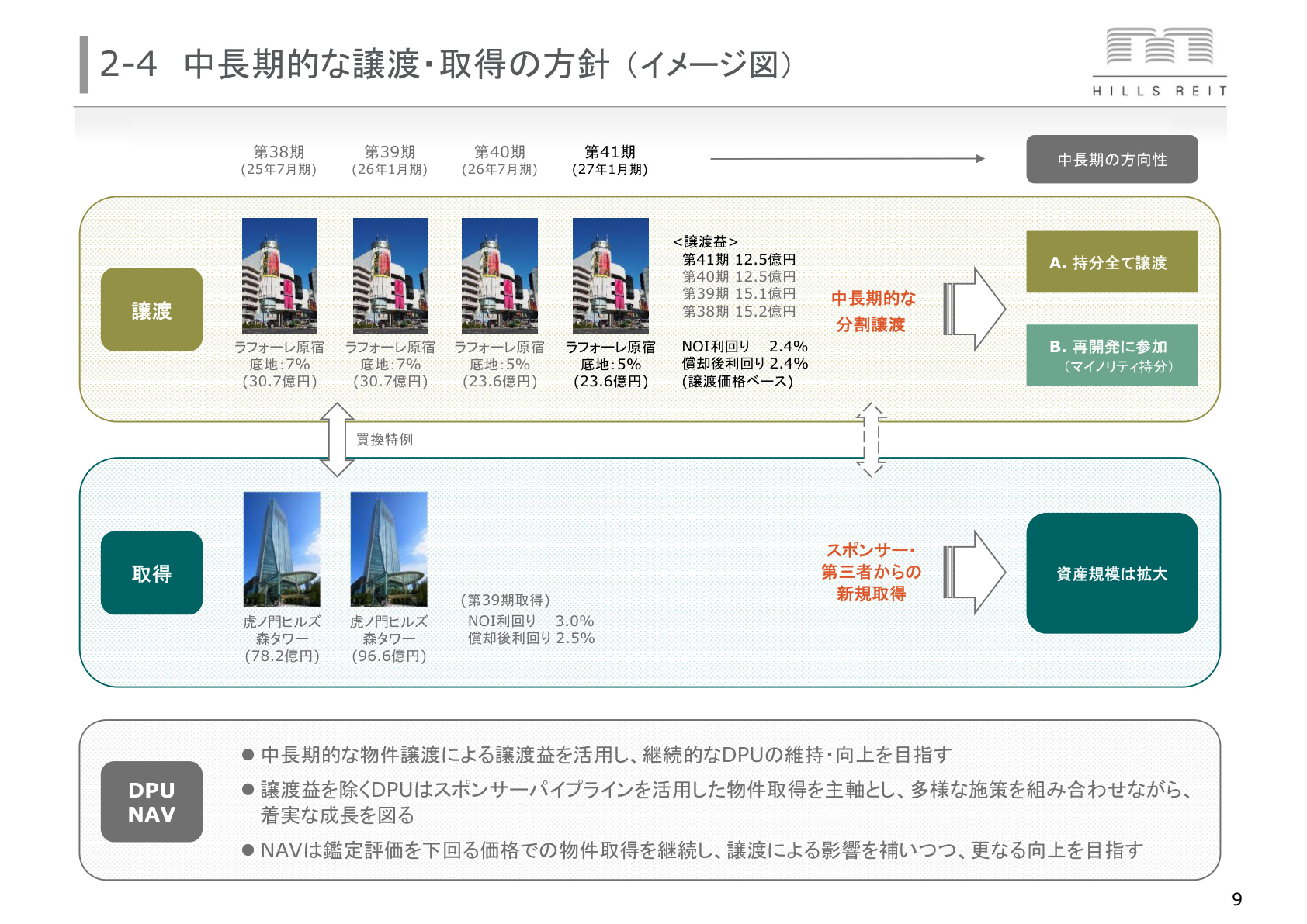
[Slide Commentary: Asset Recycling Cycle and DPU/NAV Enhancement Strategy]
The slide above (P9) diagrams the property acquisition cycle funded by the sale of Laforet Harajuku (land).
- Partial Sale of Laforet Harajuku (land) : Systematic sale of land interests with an NOI yield of 2.4% (2.4% after depreciation). A 5% stake was sold in the 40th period (sale price 2.36 billion JPY, gain 1.25 billion JPY), and another 5% sale is planned for the 41st period. The distribution of gains based on 5% stake sales is expected to be sustainable until 2030 .
- Acquisition of High-Yield Premium Properties : In the 39th period, the Investment Corporation acquired "Toranomon Hills Mori Tower" at an NOI yield of 3.0% (acquisition price 9.66 billion JPY, 16.7% below appraisal value) using replacement tax provisions.
By shifting assets from low-yield holdings to relatively high-yield, prime central Tokyo offices, the Investment Corporation achieves both temporary distribution support via gains on sales and the underlying growth of recurring rental revenue and expansion of NAV per unit .
4. Internal Growth Roadmap: Fixed ML Renewals and Pass-Through Rent Increases
Clear growth drivers are also visible in internal growth.
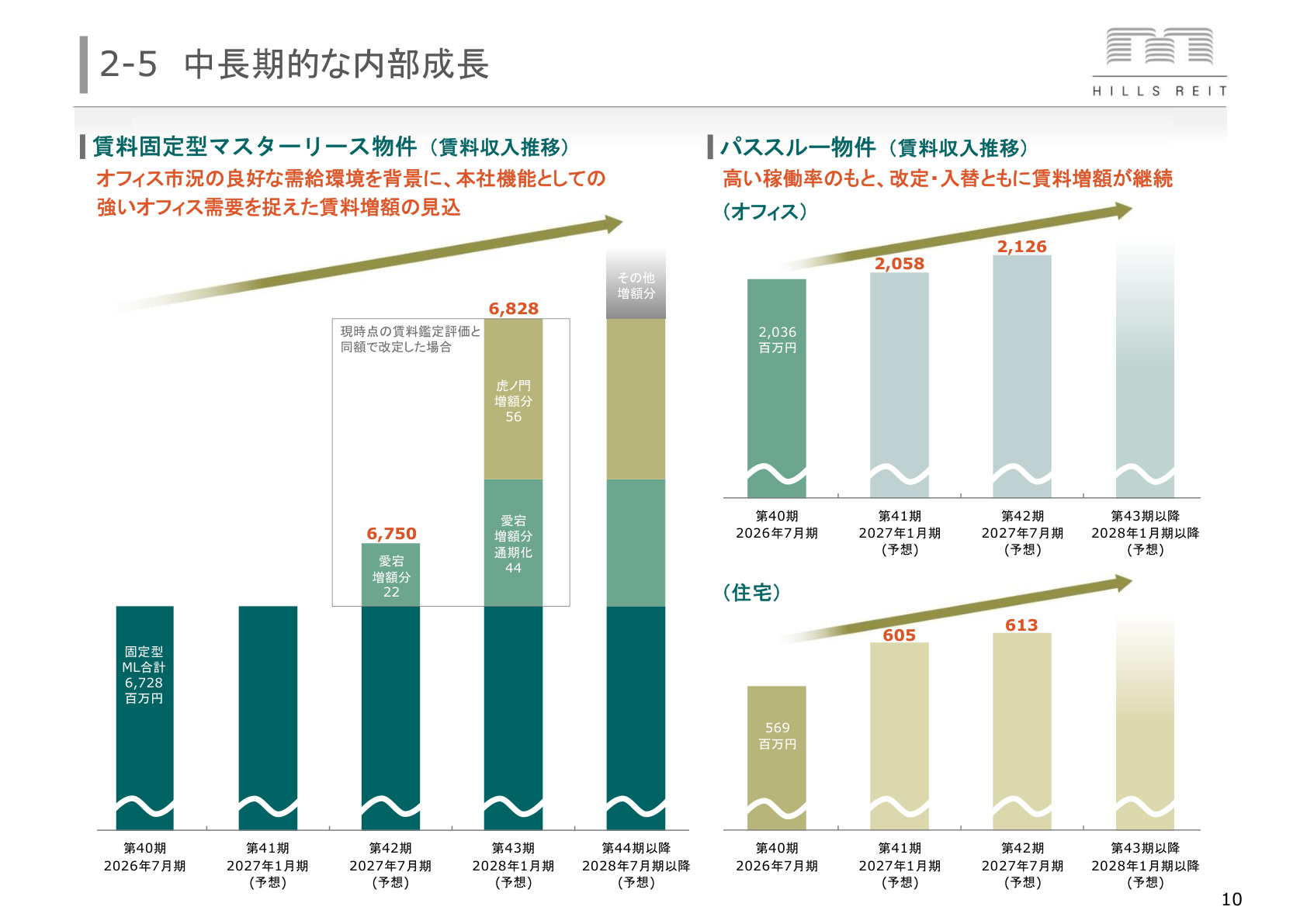
[Slide Commentary: Two Engines Driving Internal Growth]
The slide above (P10) shows the rental revenue trends and future outlook for fixed-type ML properties and pass-through properties.
① Upside Potential in Fixed-Type Master Lease (ML) Properties
Fixed-type MLs, which account for 69.1% of the portfolio's total monthly rent, are designed to mitigate downside risk while capturing upside through rent revisions during favorable market conditions.
- Atago Green Hills : Appraisal rent indicates an upside potential of +4.4% . Increases from revisions are expected to contribute starting from the 42nd period (ending July 2027).
- Toranomon Hills Mori Tower : Appraisal rent indicates an upside potential of +3.7% . Full contribution is expected from the 43rd period (ending January 2028) onwards.
- As 38.1% of total fixed-type MLs (approx. 426 million JPY in monthly rent) will reach contract maturity in 2027, the Investment Corporation is aiming for continuous rent increases while shortening contract terms (to 3-year cycles).
② Strong Rental Momentum in Pass-Through Properties
For pass-through properties directly linked to end-tenants, significant rent increases are underway, supported by robust office and residential demand.
- Office : The rent revision rate for the 40th period was +7.3% , with a tenant replacement rate of +1.9% . The 41st period forecast anticipates further acceleration with a revision rate of +8.7% and a replacement rate of +11.1% .
- Residential : Recorded an exceptionally high increase rate, with a revision rate of +11.4% and a replacement rate of +19.6% in the 40th period. A strong upward trend is expected to continue in the 41st period.
- Expansion of Rent Gap : With rising market rents, the rent gap for the entire office portfolio has widened from -7.5% in the previous period to -9.3% , further increasing the potential for rent hikes upon future contract renewals.
5. Absolute Advantage of Central Tokyo Premium Assets and Sustainability
The Investment Corporation's assets boast top-tier location characteristics and building specifications within the J-REIT sector.
- Overwhelming Central Tokyo Concentration : 100% in the five central wards of Tokyo , with 91.4% in the three central wards (Minato, Chiyoda, and Chuo) . Assets are concentrated in Minato Ward, where headquarters of major IT and global corporations are clustered.
- Superior Seismic Performance and Ground Quality : All properties feature high seismic performance based on sponsor standards, with PML values ranging from 1.1% to 2.7%. Properties are located on high, solid ground.
- Top-Tier Environmental Certifications : Excluding Laforet Harajuku (land), 93.8% of the portfolio holds green building certifications (84.7% at the highest rank). Numerous properties have achieved CASBEE Real Estate "S Rank" and DBJ Green Building "5-Star" ratings, providing a competitive edge in attracting ESG-conscious global tenants.
- Value-Added Area Management : Collaboration with large-scale mixed-use redevelopments led by Mori Building—such as Roppongi Hills, Toranomon Hills, and Azabudai Hills—creates rent resilience linked to the brand value of the entire district.
6. Future Earnings Outlook and Summary
The published earnings forecasts are as follows:
- 41st Period (ending Jan 2027) : Operating Revenue 11,158 million JPY, Net Income 5,545 million JPY, DPU 3,100 JPY (including 280 million JPY reversal of internal reserves, 149 JPY/unit)
- 42nd Period (ending July 2027) : Operating Revenue 11,229 million JPY, Net Income 5,320 million JPY, DPU 3,100 JPY (including 505 million JPY reversal of internal reserves, 268 JPY/unit)
Despite anticipating an increase in interest payments due to changing interest rate environments (+202 million JPY in the 41st period, +191 million JPY in the 42nd period), the Investment Corporation plans to maintain a stable distribution of 3,100 JPY per unit through gains from the Laforet Harajuku sale (approx. 1.25–1.27 billion JPY per period) and the strategic reversal of compressed reserve funds.
Backed by preferential negotiation rights for the Mori Building Group's abundant pipeline of 2.8 trillion JPY in total assets and 296,000 tsubo of leasable area , and leveraging a solid financial position (Appraisal LTV 36.5%, JCR rating AA), the Investment Corporation has secured room for external growth (approx. 30 billion JPY if LTV is temporarily raised to 50%). The Investment Corporation continues to maximize the strengths of its prime central Tokyo assets to achieve steady distributions and asset value appreciation.
This content is not intended as investment advice or a recommendation. Any opinions expressed are solely the personal views of each article.