


Digital Grid FY2026 Earnings In-Depth Analysis: 7 Consecutive Years of Revenue and Profit Growth Driven by Battery AS Business Scaling and Robust Recurring Revenue Base

StockClub
Published: Sep 10, 2026, 09:54 AM
Sentiment Analysis

Executive Summary
Digital Grid Corporation (Ticker: 350A) reported full-year financial results for the fiscal year ending July 2026, exceeding both previous year figures and revised forecasts, marking seven consecutive years of revenue and profit growth . The company’s performance was strongly driven by its core "Power PF Business," which offset fee adjustments through expanded contract capacity and transaction volumes, alongside the rapidly growing "Renewable Energy PF Business" and the "AS Business (Battery Aggregation Service)," which has entered a full-scale monetization phase.
Recurring revenue now accounts for 70.3% of total sales. Combined with improved churn rates, the company has established a highly profitable and sustainable business model with an operating margin of 42.4% . Furthermore, the company has made steady progress in laying the groundwork for future growth, including the near-completion of investment decisions for its 10 billion yen battery storage initiative within the first year of its three-year medium-term plan.
1. FY2026 Full-Year Performance Highlights and Analysis
Consolidated results for the fiscal year were as follows: Revenue of 7.113 billion yen (+15.6% YoY) , Operating Profit of 3.017 billion yen (+10.0% YoY) , Ordinary Profit of 2.909 billion yen (+11.3% YoY) , and Net Income of 2.037 billion yen (+9.0% YoY) .
The slide below summarizes the FY2026 results, year-on-year comparisons, and progress against the revised plan.
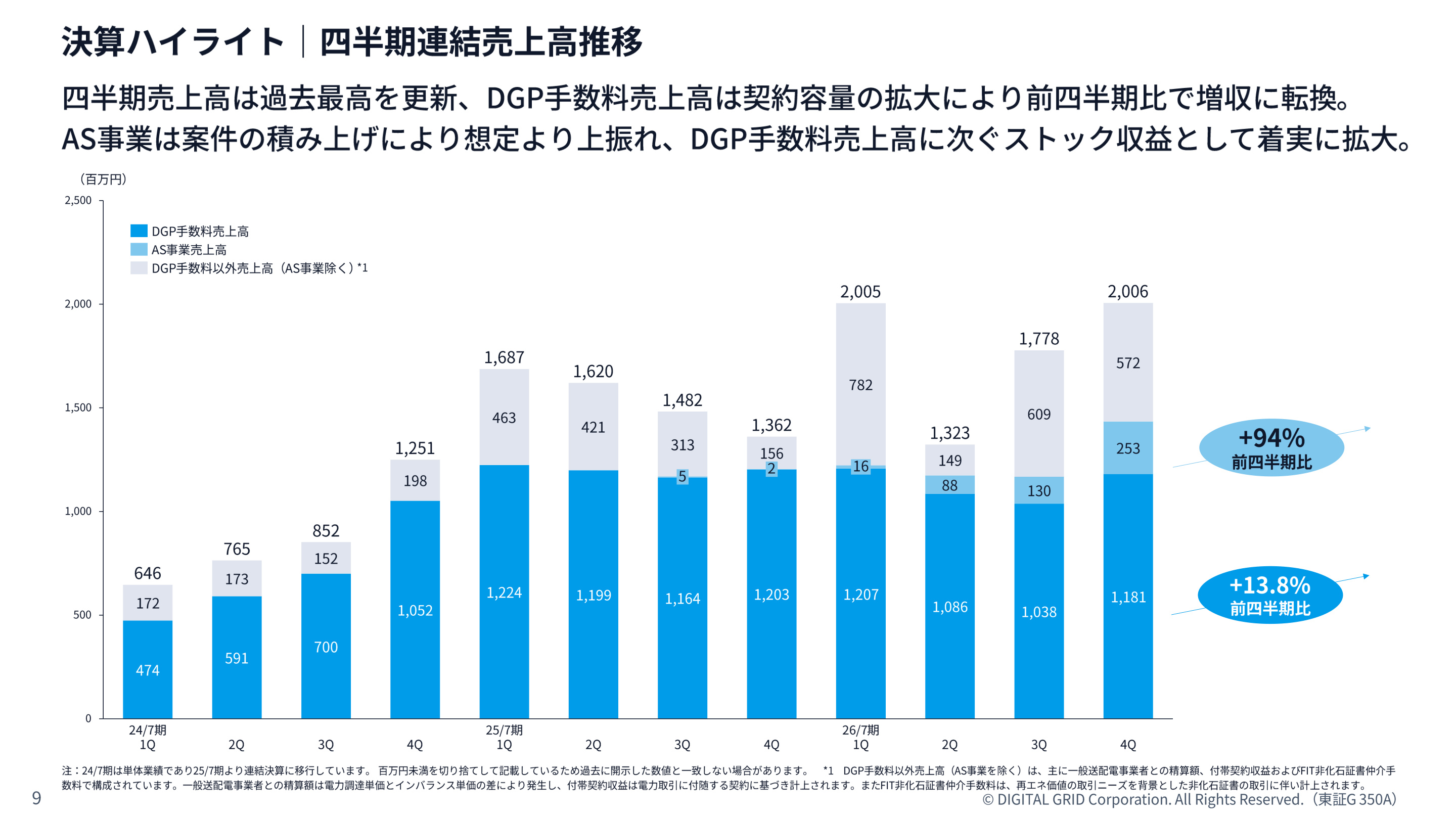
Key takeaways from these results include:
- Outperformance against revised plans : Driven by faster-than-expected acquisition of new contracts and increased utilization across all platforms, revenue and operating profit exceeded the revised plan by 7.9% and 6.4%, respectively.
- Maintenance of high profitability : The gross profit margin improved significantly to 81.4% (+7.0pt YoY) . Despite a 51.0% increase in SG&A expenses due to intensified recruitment—primarily for front-line staff to accelerate growth (+27.8% in headcount)—the company maintained an exceptionally high operating margin of 42.4% .
- High human capital productivity : Leveraging the strengths of its platform model, the company achieved an operating profit per employee of 33 million yen , demonstrating quality growth that stands out even when compared to traditional utility companies and other platform peers.
2. Non-Financial KPI Progress: Diversification of Total Contract Capacity Portfolio
Total contract capacity and the number of contracted companies, which serve as leading indicators for business expansion, continue to reach record highs.
The slide below shows the quarterly trends in total contract capacity across the consumer, renewable energy generator, and grid-scale battery segments.
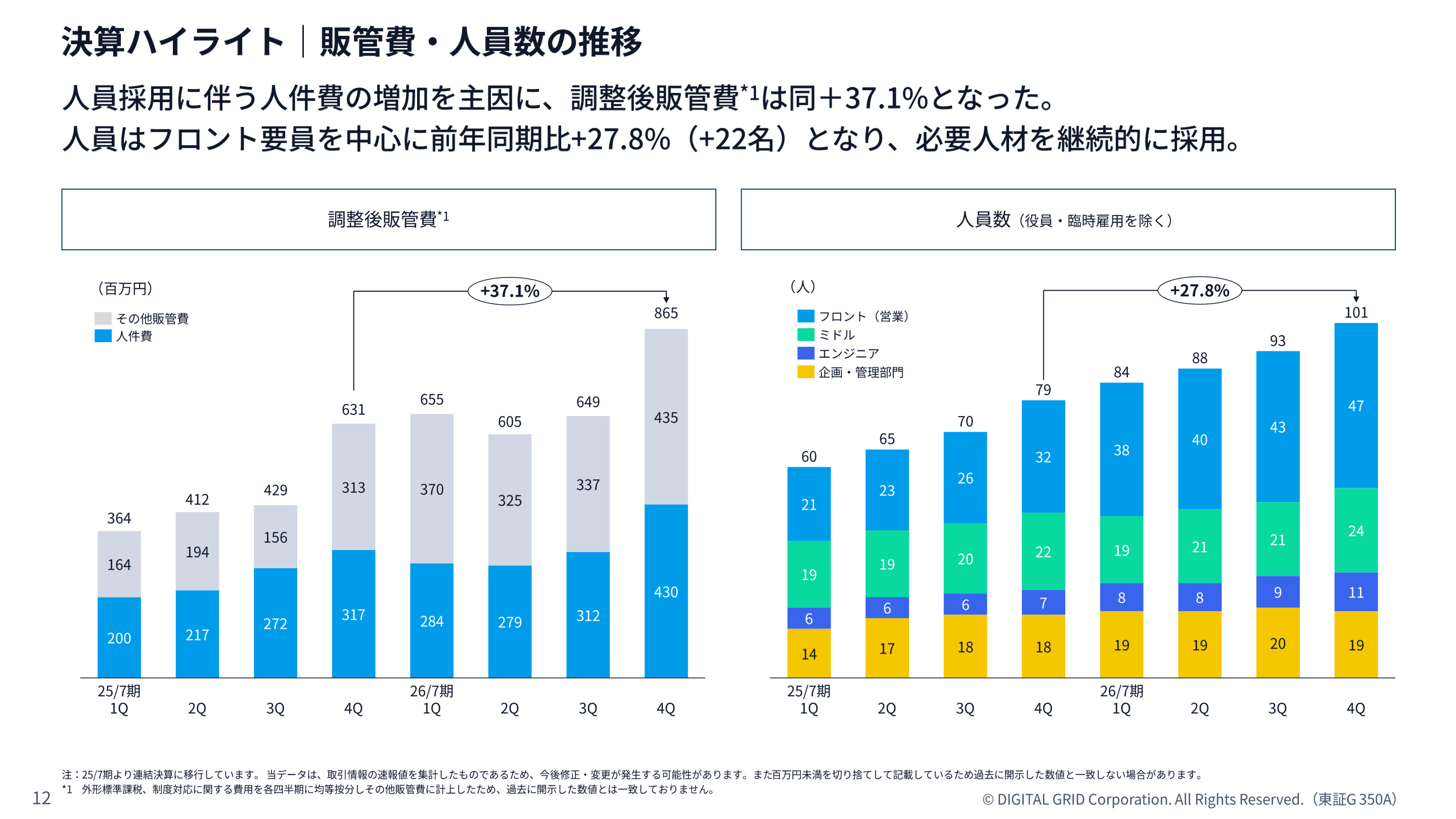
Strategic progress identified from this data includes:
- Reaching 1.4GW (1,429MW) in total contract capacity : A significant expansion of +38.3% year-on-year. The number of contracted companies also grew to 1,497 (+249 YoY) .
- Portfolio expansion from power trading to renewables and batteries : In addition to traditional consumer power contracts (871MW), capacity for renewable energy generators has surged to 393MW , and grid-scale battery management has reached 165MW , indicating a multi-layered business portfolio.
- Improved recurring nature and churn rates : The average monthly churn rate for the Power PF business dropped significantly to 1.64% (from 2.90% in the previous year) . With the Renewable Energy PF primarily focused on long-term contracts of around 20 years, a solid foundation of stock-based revenue has been established.
3. Segment Business Progress and Growth Strategy
① Power PF Business (82.7% of revenue)
Despite downward pressure on fee unit prices due to market competition, the company successfully captured demand for power switching in April through a strengthened sales structure (including the launch of an inside sales team), expanding year-end contract capacity to 871MW (+17% YoY) . Furthermore, to assist customers seeking protection against power price volatility caused by geopolitical risks, the company expanded its "Hedge-type products (fixed market price options)." As a result, the ratio of contracts including fixed-price transactions reached 19% on a capacity basis, contributing to the maintenance of customer unit prices and the prevention of churn.
② Renewable Energy PF Business (10.0% of revenue)
Driven by the accelerating shift toward non-FIT renewables and the resulting need for supply-demand management, handled capacity reached 393MW . The volume of "Econohashi," a proxy procurement service for FIT non-fossil certificates, grew rapidly by 60% year-on-year (3,263GWh) . Additionally, the corporate PPA matching platform "RE Bridge" has expanded its target power sources beyond traditional solar and wind to include geothermal and biomass , strengthening the company's ability to meet diverse procurement policies of its customers.
③ AS Business (Battery Aggregation) (6.9% of revenue)
With the increase in output curtailment and price volatility (spreads) accompanying the expansion of renewable energy, the need for grid-scale battery balancing capacity is surging. The AS business demonstrated exceptional growth and profitability, with full-year revenue of 489 million yen (+107.6% QoQ) and a segment profit margin of 57.9% (4Q standalone) .
The slide below shows the trends in grid-scale battery volume and future plans for the AS business.
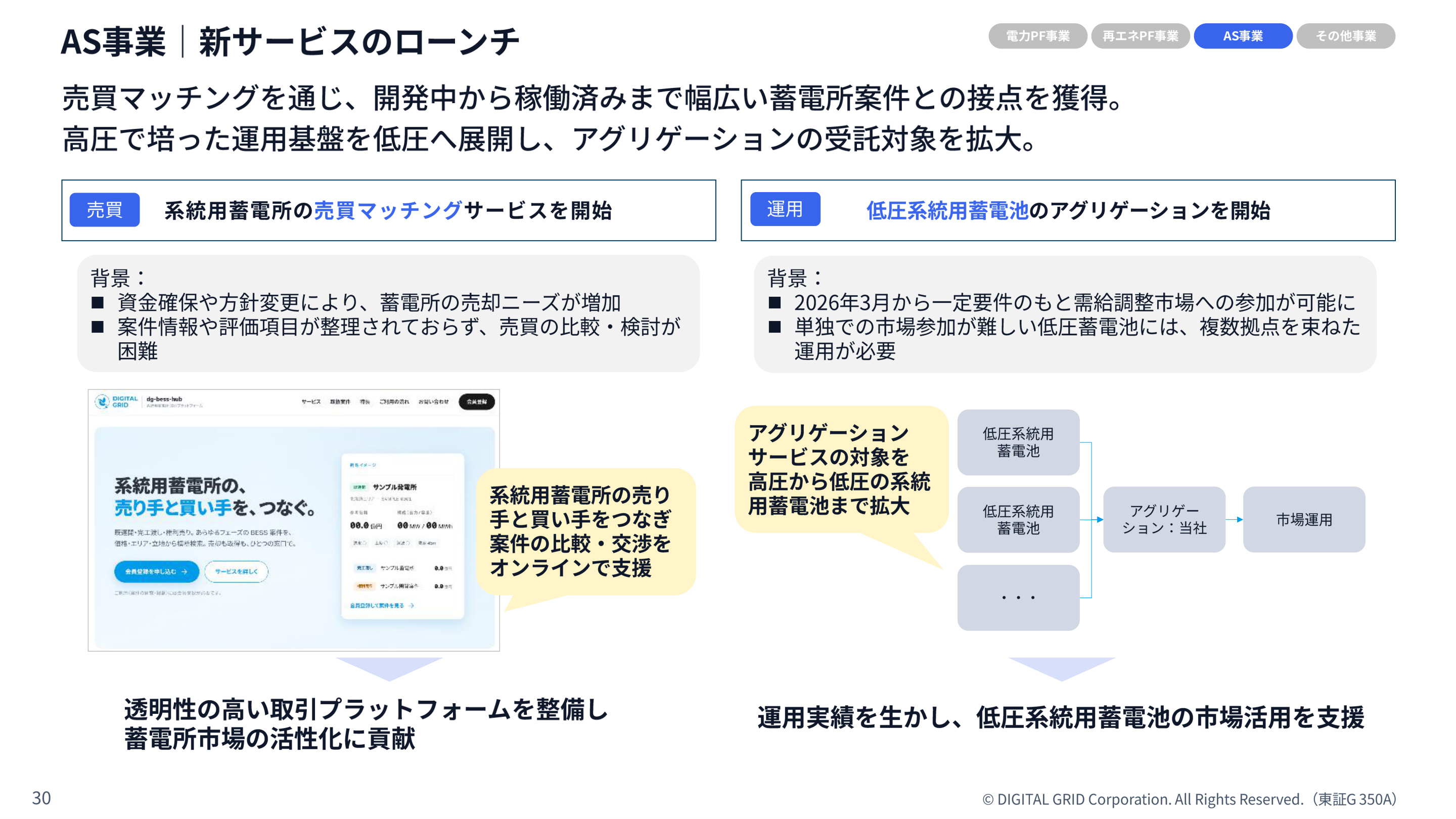
Key points from this progress data include:
- 165MW in managed volume and surpassing 100MW in EPRX (Electricity Supply-Demand Balancing Market) participation : Managed capacity is expanding rapidly as operational track records accumulate.
- Pipeline toward FY2028 : The company anticipates a managed capacity of 343MW , projecting AS business revenue for the next fiscal year to be four times higher than the current year .
- New service deployment : Beyond leveraging the algorithm base developed for high-voltage grid batteries for "low-voltage grid batteries," the company has launched a "trading matching platform" to broker the buying and selling of battery storage facilities online, promoting monetization across the entire ecosystem.
4. Financial Foundation and Outlook
To meet working capital requirements associated with battery investments and the expansion of JEPX (Japan Electric Power Exchange) trading volumes, the company has strengthened its partnerships with financial institutions. It has significantly increased its syndicated and bilateral commitment line limits from 10.2 billion yen to 16.35 billion yen , establishing a flexible financing structure. While maintaining sound financial discipline with an equity ratio of 34.1% and an ROE of 21.7% , the company is accelerating growth investments.
Digital Grid has established a unique position by leveraging its core data and algorithm infrastructure—which covers power, renewables, and batteries—to capture both the accumulation of recurring revenue and the profit opportunities presented by market volatility.
This content is not intended as investment advice or a recommendation. Any opinions expressed are solely the personal views of each article.