


Ateam Inc. FY2026 Full-Year Earnings Deep Dive: Impact of Crypto Valuation Losses and Progress Toward M&A-Driven Mid-Term Plan

StockClub
Published: Sep 04, 2026, 09:52 AM
Sentiment Analysis
Ateam Inc. (Securities Code: 3662) reported its financial results for the full fiscal year 2026 (August 2025 – July 2026), with net sales of 22,997 million yen, adjusted EBITDA of 1,100 million yen, operating profit of 1,095 million yen, ordinary profit of 584 million yen, and net profit attributable to owners of the parent of 359 million yen.
This report provides a detailed analysis of the company's overall performance, the unique profit structure between operating and ordinary profit, trends in key segments, and the progress and growth strategy of the Mid-Term Management Plan (FY2025–FY2028), which targets 34 billion yen in net sales and 4 billion yen in adjusted EBITDA.
1. Full-Year Performance Highlights and Profitability Anomalies
The full-year consolidated results showed a decline in both revenue and profit compared to the previous year, falling short of initial forecasts.
- Net Sales : 22,997 million yen (96.2% YoY, 93.9% vs. forecast)
- Adjusted EBITDA : 1,100 million yen (64.0% YoY, 73.4% vs. forecast)
- Operating Profit : 1,095 million yen (129.6% YoY, 121.7% vs. forecast)
- Ordinary Profit : 584 million yen (36.8% YoY, 64.9% vs. forecast)
- Net Profit Attributable to Owners of the Parent : 359 million yen (34.7% YoY, 60.0% vs. forecast)
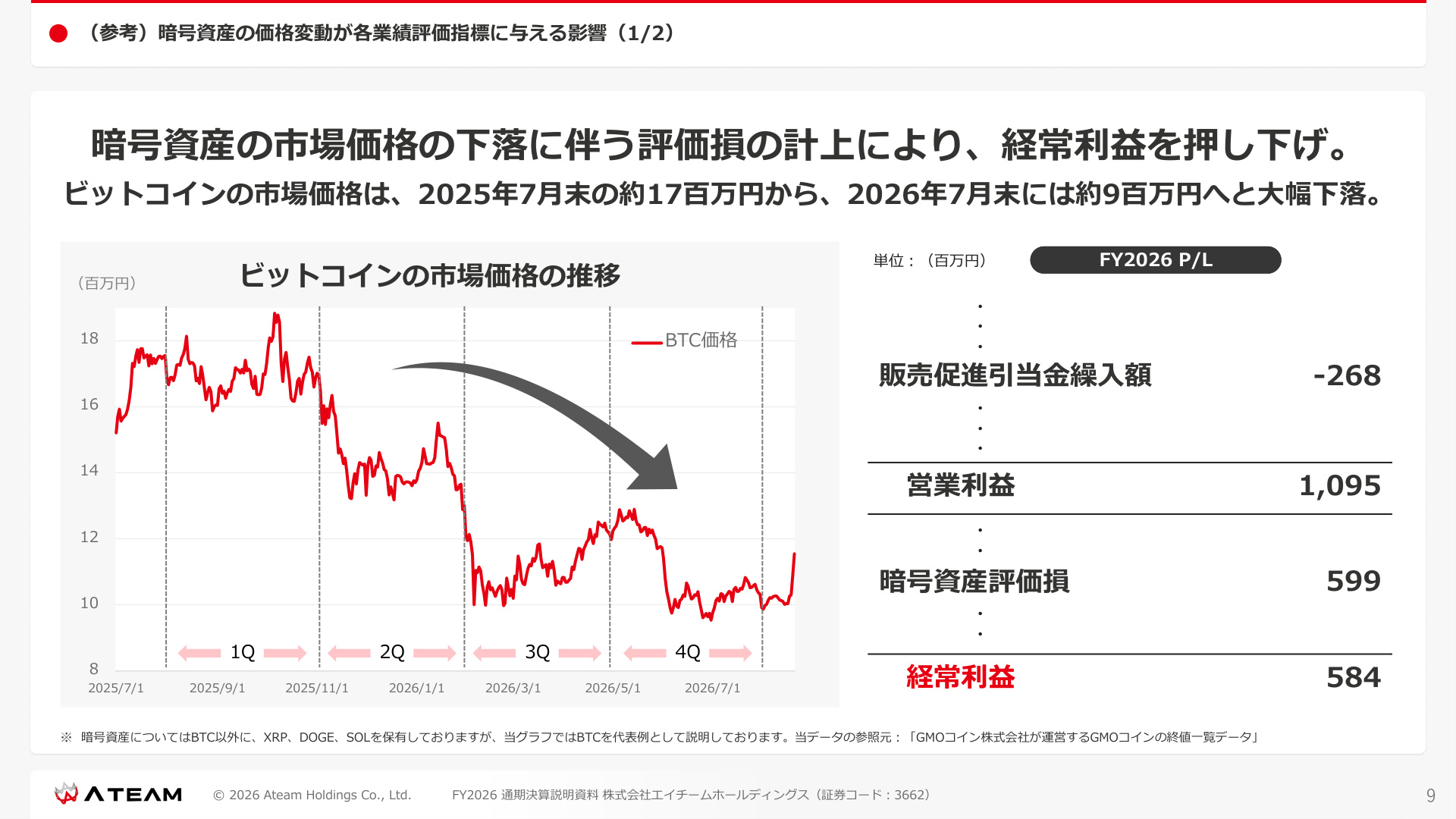
A notable point here is that while operating profit exceeded the company's forecast (900 million yen) at 1,095 million yen (+29.6% YoY), ordinary profit fell significantly to 584 million yen (-63.2% YoY). The primary cause of this divergence lies in the accounting treatment of crypto assets related to the acquired subsidiary, Paddle Inc.
2. Mechanism of Crypto Asset Price Volatility on Financial Metrics
Ateam Inc. owns Paddle Inc., which operates crypto-asset point apps such as "Bit Start" and "BitWalk." Because the business model involves holding crypto assets to exchange for points granted to users, price fluctuations in the crypto market impact multiple lines of the P&L.
Impact of Price Declines on Profit and Loss
During FY2026, the price of Bitcoin fell significantly from approximately 17 million yen at the end of July 2025 to approximately 9 million yen by the end of July 2026.
- Impact on Operating Profit (Positive Factor) : As the estimated future redemption cost for points held by users decreased, the provision for sales promotion expenses became negative (a cost reduction of 268 million yen) , which boosted operating profit.
- Impact on Ordinary Profit (Negative Factor) : A crypto asset valuation loss (599 million yen) was recorded as a non-operating expense for the crypto assets held, significantly dragging down ordinary profit.
To exclude such accounting volatility inherent to crypto assets and measure the underlying profitability of the business, the company has adopted "Adjusted EBITDA" as its primary management metric.
3. Segment Performance Trends
The company's business portfolio is centered on two main pillars: the "Digital Marketing Business" and the "Entertainment Business."
① Digital Marketing Business
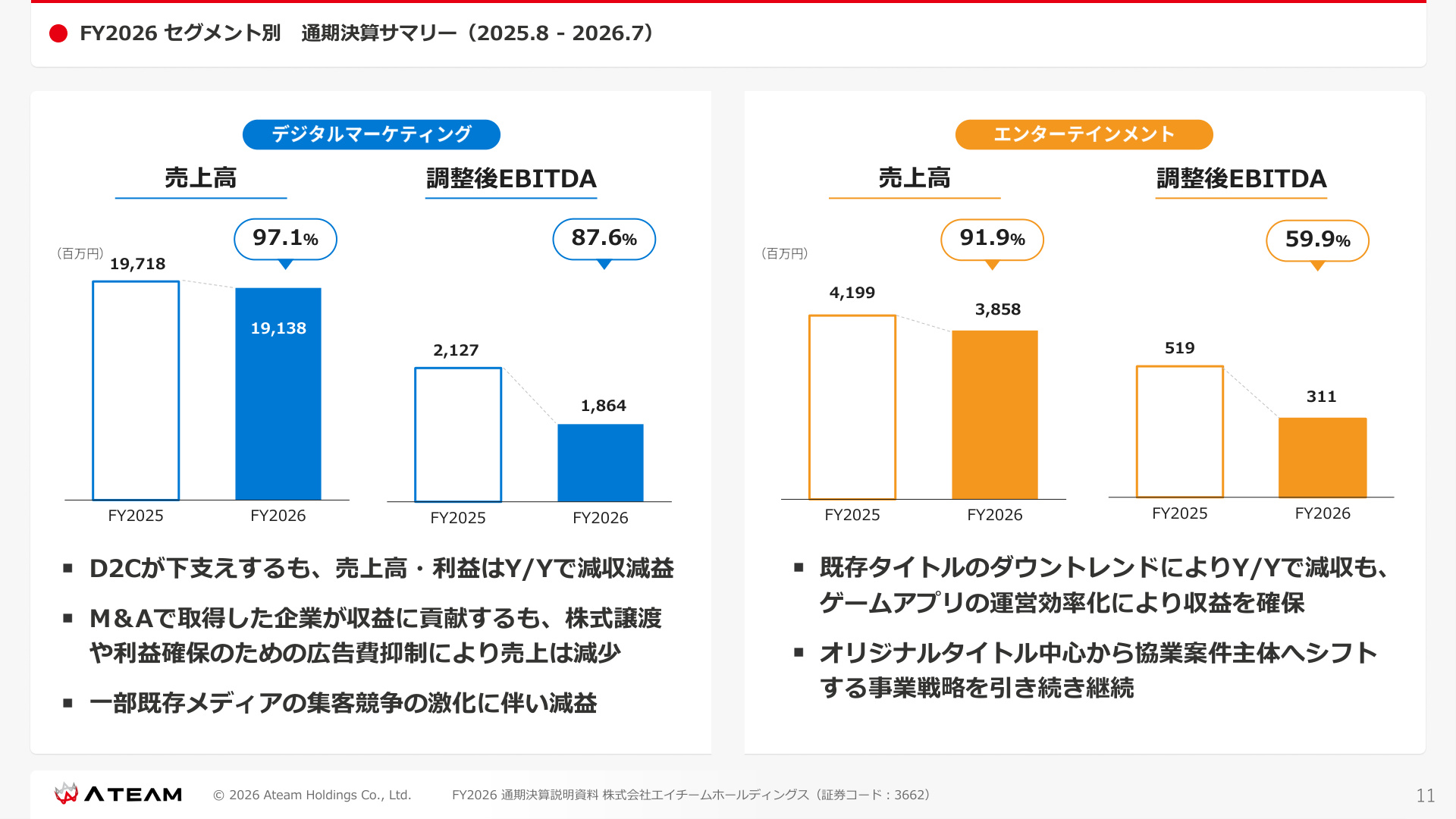
- Net Sales : 19,138 million yen (97.1% YoY)
- Adjusted EBITDA : 1,864 million yen (87.6% YoY)
While the D2C business performed well and provided support , and M&A-acquired companies (microCMS, Paddle, WCA, Strainer, and Signity) contributed to earnings, the segment saw a decline in revenue and profit overall. This was due to intensified competition for user acquisition in some existing media, leading the company to prioritize profit margins and curb advertising expenditures.
② Entertainment Business
- Net Sales : 3,858 million yen (91.9% YoY)
- Adjusted EBITDA : 311 million yen (59.9% YoY)
Although revenue declined due to the continued downward trend of existing game titles, the company maintained profitability through rigorous operational efficiency and cost optimization. Furthermore, as a strategy to mitigate development risks, the company is shifting from "original title-focused" to "collaboration-based" projects, with the quarterly collaboration ratio rising to 22.6% as of FY2026 Q4. The overseas sales ratio also remains high at 38% .
4. Q4 Trends and Signs of Recovery
In FY2026 Q4 (May 2026 – July 2026), net sales were 5,754 million yen (96.7% YoY), and adjusted EBITDA was 322 million yen (105.2% YoY, 122.8% QoQ). Driven by revenue growth in D2C within the Digital Marketing segment and successful cost control in the Entertainment segment, adjusted EBITDA increased both year-on-year and quarter-on-quarter , signaling a bottoming out of profitability.
5. Progress and Growth Strategy of the Mid-Term Management Plan (FY2025–FY2028)
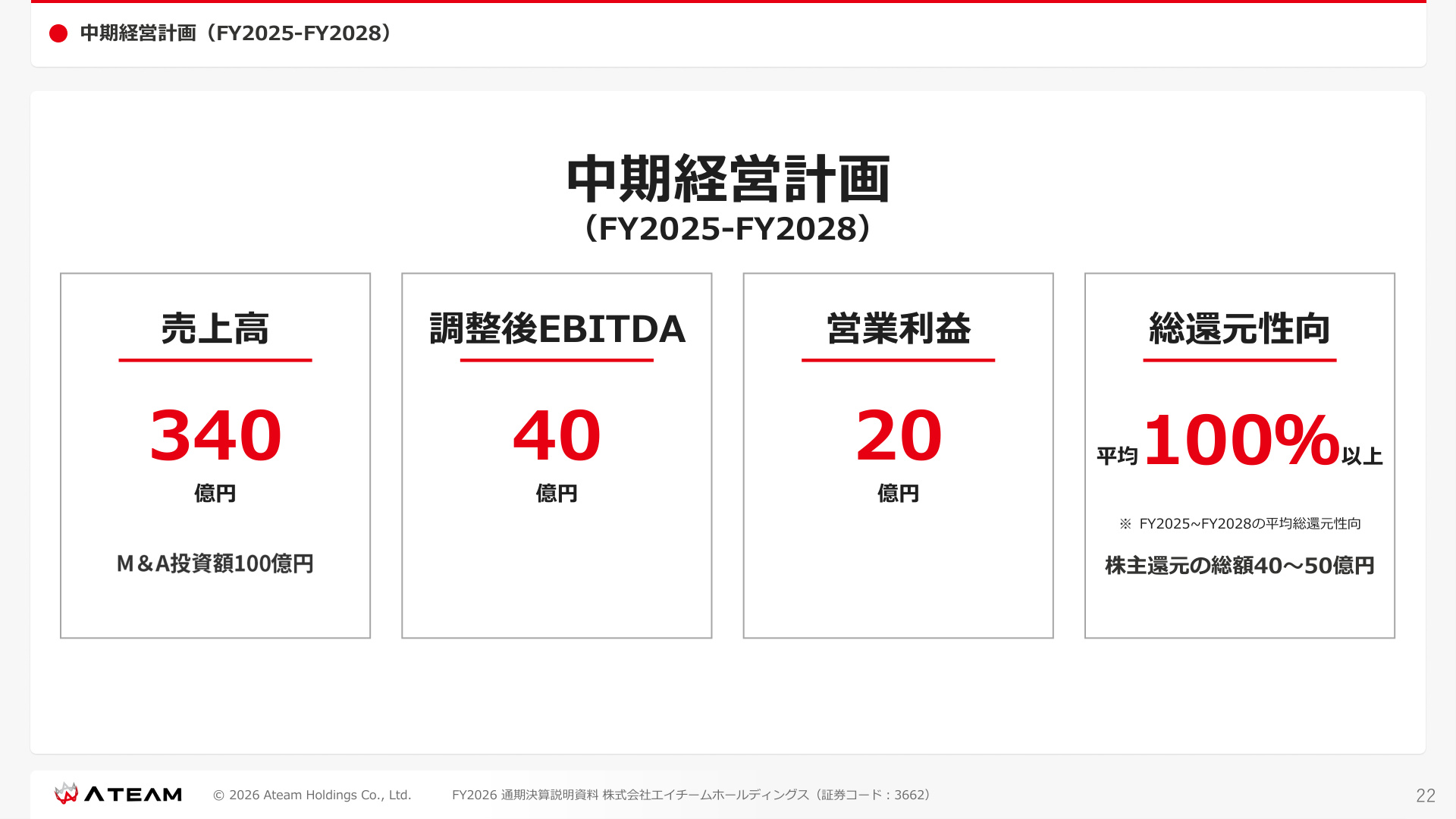
The company has set the following ambitious targets for its FY2028 Mid-Term Management Plan:
- Net Sales : 34 billion yen
- Adjusted EBITDA : 4 billion yen
- Operating Profit : 2 billion yen
- Total M&A Investment : 10 billion yen
- Total Payout Ratio : 100% or more on average over the period (4–5 billion yen in total returns)
The plan is based on three core themes: "Execution of growth strategies to improve growth potential," "Reduction of risk and volatility," and "Strengthening shareholder returns."
Progress of M&A Strategy
Regarding M&A, the key growth driver, the company has executed a total of 5 investments worth 3.3 billion yen by the end of FY2026 against the 10 billion yen target.
- microCMS (1.5 billion yen): Acquisition of headless CMS capabilities and strengthening B2B support.
- Signity (1.05 billion yen): Expansion of customer acquisition support via the push notification service "PUSH ONE."
- Paddle (368 million yen): Acquisition of crypto-asset point apps.
- Strainer (240 million yen): Acquisition of economic media and expansion of corporate clients.
- WCA (150 million yen): Acquisition of web marketing operational support.
The cumulative number of companies contacted reached 293, with 71 top-level meetings, accelerating the pipeline. As a result of promoting a "Federal-style PMI" that respects the autonomy of acquired companies, the ratio of M&A-acquired companies to Digital Marketing business sales reached 10% as of FY2026 Q4.
Governance and Execution Structure
To execute the remaining 6.7 billion yen in planned investments in a disciplined manner, the company established an "Investment Committee" chaired by the President and Representative Director, tightening due diligence and investment criteria. Simultaneously, the "M&A Promotion Office" was established as an independent specialized unit to strengthen end-to-end execution capabilities from sourcing to PMI.
6. Conclusion
Although FY2026 faced headwinds such as declining crypto asset prices and intensified competition in existing media, the company successfully diversified its business foundation through D2C growth, game operational efficiency, and five M&A executions. Moving forward, the company aims to achieve its mid-term targets of 34 billion yen in sales and 4 billion yen in adjusted EBITDA by leveraging the remaining 6.7 billion yen investment budget under the newly established investment governance structure.
This content is not intended as investment advice or a recommendation. Any opinions expressed are solely the personal views of each article.