

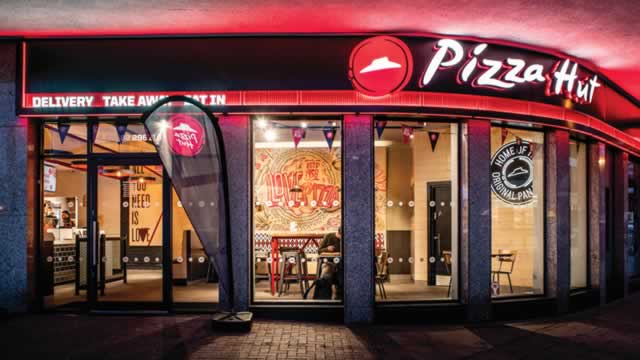
Dropping the Dough: Yum! Brands Strategically Trims the Fat
MarketBeat
Published: Sep 03, 2026, 05:15 PM
Sentiment Analysis
Yum! Brands sold its Pizza Hut business outside Mainland China to LongRange Capital for about $1.5 billion, with total carve-out proceeds reaching roughly $2.7 billion. The divestiture lets Yum! Brands shift toward a leaner, higher-margin franchising model concentrated on Taco Bell and KFC amid industrywide fast-food traffic declines. The company also authorized an approximately $4 billion share buyback and maintains an eight-year dividend growth streak, reinforcing shareholder returns despite short interest and executive turnover concerns.
The fast-food industry is facing a severe reality check. Menu price hikes are pricing out the core lower-income demographic, causing a decline in foot traffic across the sector. Yet amid this crisis, one operator just executed a masterclass in corporate defense. Yum! Brands NYSE: YUM successfully offloaded its underperforming Pizza Hut asset outside Mainland China for about $1.5 billion. By allowing a private equity buyer to absorb the legacy brand's looming turnaround risk, Yum! Brands quietly transitions into a high-return, pure-play franchising model. With Yum! Brands shielding its remaining portfolio behind an approximately $4 billion stock buyback, investors are witnessing a strategic pivot deployed right at the onset of brutal macro headwinds. Shedding the stagnant pizza chain fundamentally changes the business's financial trajectory, setting the stage for a shift in how Wall Street values Yum! Brands stock.
Corporate restructuring often looks messy on the surface, but the financial mechanics underneath reveal a clear path to value creation. The sale of the Pizza Hut brand to LongRange Capital serves as a textbook example of addition by subtraction. Factoring in the separate Mainland China transaction, the total Pizza Hut carve-out proceeds reach approximately $2.7 billion. For years, Pizza Hut operated as a chronic drag on system-wide metrics, actively suppressing the growth generated by Taco Bell and KFC. Public markets historically penalize parent companies burdened by capital-intensive turnaround projects. Investors saw this reflected in the numbers, with the return on equity for Yum! Brands recently dipping to -24.57%. That figure signals severe capital inefficiency prior to the asset sale. By transferring the operational weight of Pizza Hut to private equity, Yum! Brands protects its consolidated margin profile. Private equity buyers can pursue extensive operational restructuring without the immediate pressures of quarterly public-market reporting. For Yum! Brands, removing this drag clears the path for a re-rating of its stock. The business is now heavily concentrated in higher-margin, faster-growing assets. Its streamlined franchising model will require less overhead, allowing management to deploy capital much more aggressively toward concepts that actually drive unit growth.
Investors should connect the macro environment to the catalyst to understand why this sale is so critical right now. The broader quick-service restaurant space is experiencing significant demand reduction. Fast-food operators long believed their business models were recession-resistant, leaning on aggressive pricing power to offset inflation. That strategy has hit a wall. Anecdotal channel checks reveal localized traffic drops, with some Taco Bell locations r...
Source: MarketBeat
This content is not intended as investment advice or a recommendation. Any opinions expressed are solely the personal views of each article.