

Mercuria Holdings: Strengthening Revenue Base through AUM Growth and Multi-Asset Expansion — Launching Buyout Fund III and Large-Scale Aircraft Open-End Fund

Sentiment Analysis
Executive Summary
Mercuria Holdings Co., Ltd. (TSE Prime: 7347) , an independent asset management group specializing in alternative investments, is achieving sustainable growth by leveraging its robust shareholder base (Development Bank of Japan, ITOCHU Corporation, and Sumitomo Mitsui Trust Bank) and cross-border network.
According to the Q2 FY2026 earnings presentation, the company is strengthening its presence as a platform that facilitates the circulation of risk capital, bridging the gap between "illiquid markets (alternative assets)" and "capital markets." Assets Under Management (AUM) have reached ¥344.9 billion , and the company recently achieved record-high earnings with gross operating profit of ¥6.74 billion and ordinary profit of ¥2.55 billion.
Currently, as Buyout Fund I enters the performance fee stage (DPI 1.66x) , contributing steadily to profits, the company is progressing with the deployment of the ¥43.85 billion Buyout Fund II and the launch of Buyout Fund III , which targets a scale of ¥50 billion. Furthermore, in the asset investment division, the company is accelerating its multi-strategy approach to accumulate stable management fees and capture performance fees, including the launch of Japan's first full-scale "Aircraft Open-End Fund (target asset scale: ¥150 billion)."
1. Management Foundation and Key Metrics: The Leap to ¥344.9 Billion in AUM
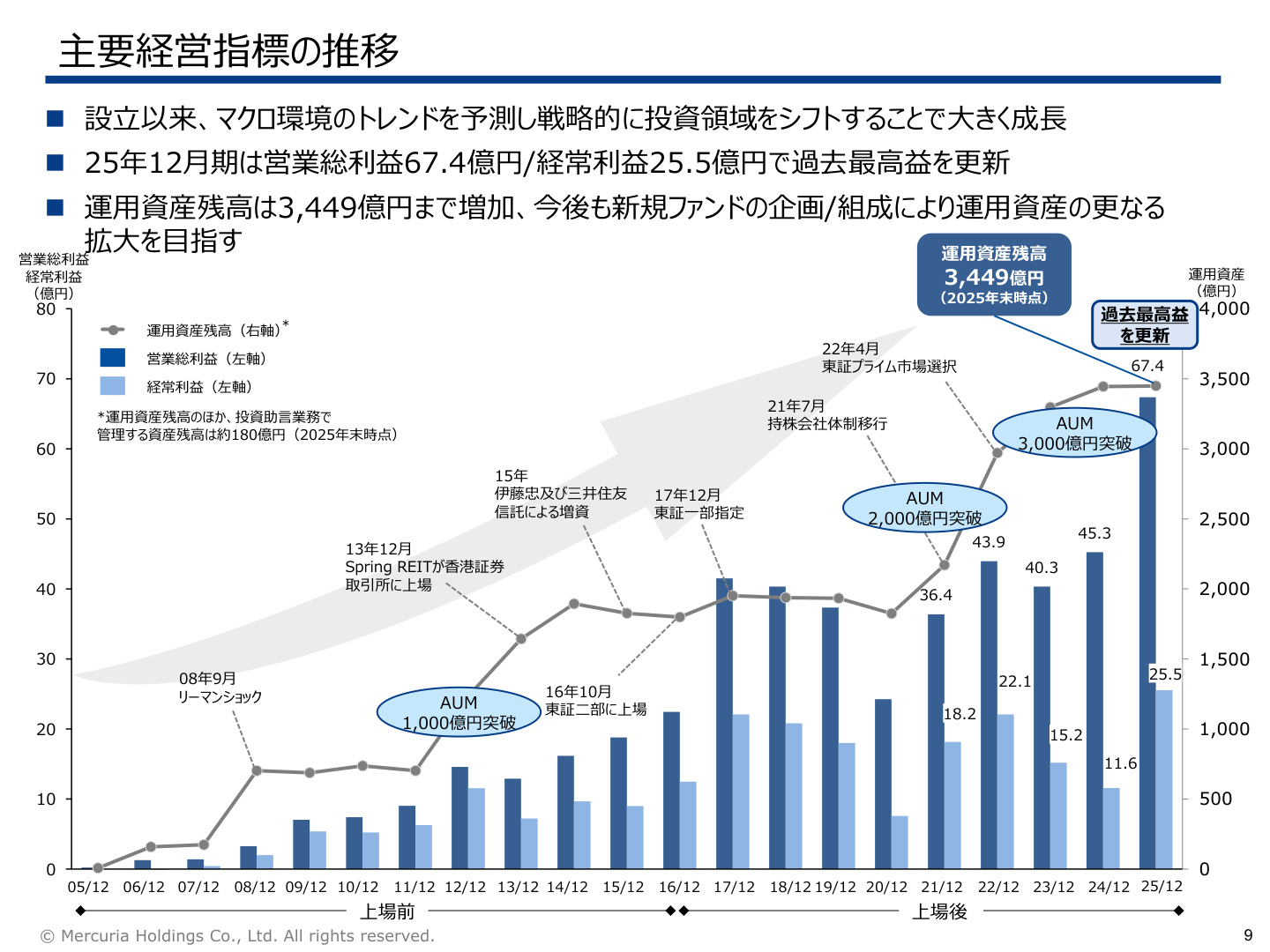
Since its establishment in 2005, the Mercuria Group has expanded its investment domains by anticipating shifts in the macro environment. Following its IPO in 2016 and the transition to a holding company structure in 2021, it has established high governance standards and credibility as a company listed on the TSE Prime Market.
The slide below illustrates how the company has expanded its entrusted assets and revenue scale.
[Slide Commentary: Growth Trajectory of Key Management Metrics]
As shown in the slide above, the company's AUM has trended upward, surpassing ¥344.9 billion . The pace of growth has accelerated from the ¥100 billion scale seen around 2011–2015, to breaking the ¥200 billion mark in 2021, and most recently exceeding ¥300 billion.
In terms of revenue, the company utilizes a structure that combines stable "management fees" with "performance fees" and "principal investment returns" generated during the divestment phase. In FY2025, the company achieved record-high earnings. While some periods are subject to temporary market fluctuations, the formation of new funds and the accumulation of AUM are steadily raising the company's medium-to-long-term revenue floor.
2. Progress in Business Investment: Buyout Fund Achievements and Future Outlook
In the business investment division, the company combines three approaches—"Buyout (majority) investment," "Structured Equity investment," and "Growth/Venture investment"—to support business succession, carve-outs, and corporate growth.
[Slide Commentary: Buyout Fund I & II Performance and Portfolio]
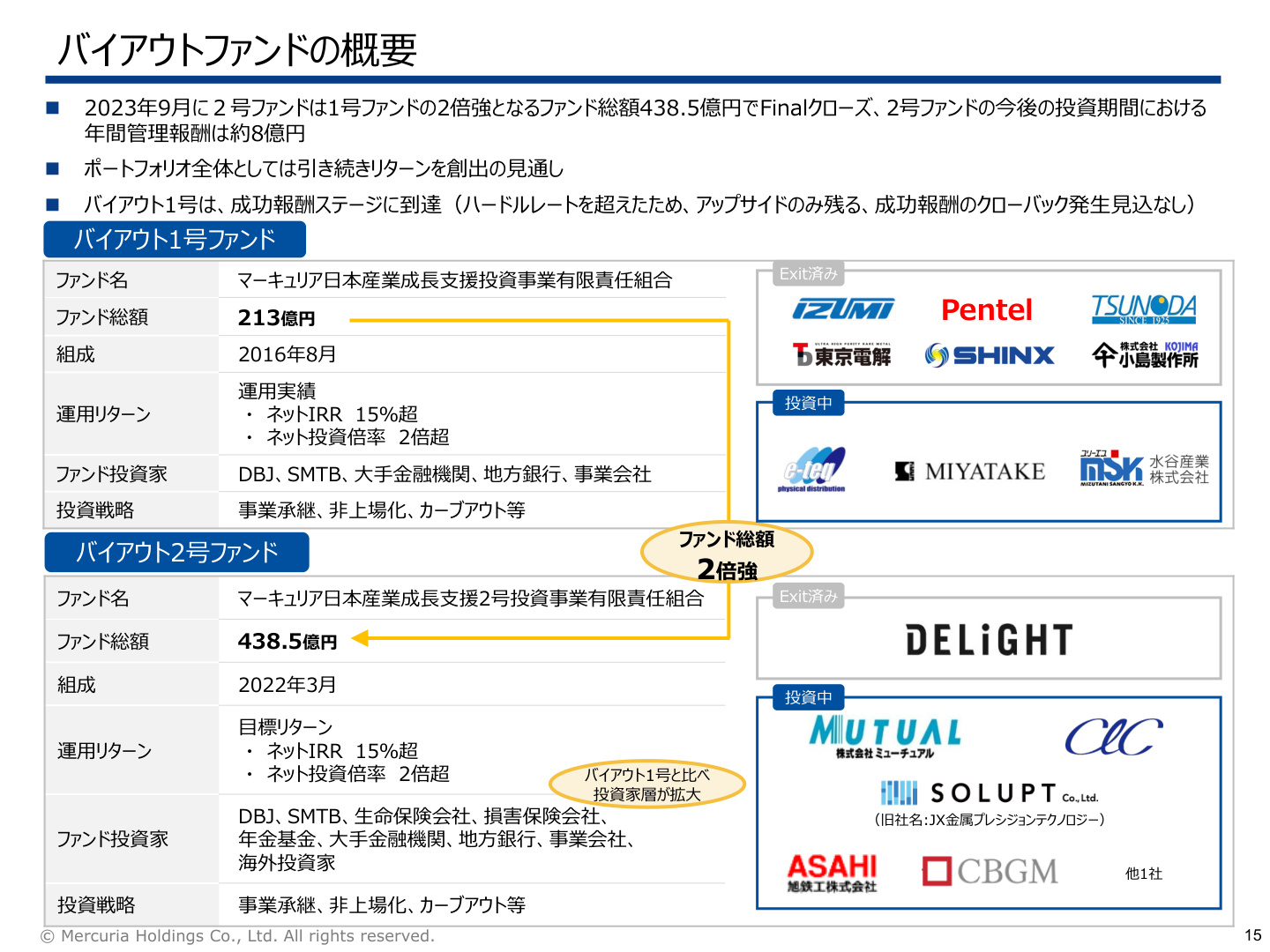
The slide above summarizes the scale expansion and operational track record of the company's core buyout funds.
-
Buyout Fund I (¥21.3 billion scale) :
- Established in August 2016. Executed 10 investments, with 6 exits already completed , including Izumi Kogyo, Pentel, Tsunoda, Tokyo Denkai, Shinx, and Kojima Seisakusho.
- Achieved net IRR of over 15% and net investment multiple of over 2x , surpassing the hurdle rate and entering the performance fee stage (DPI 1.66x) . The company aims to further accumulate performance fees through value-up and additional exits of the remaining three portfolio companies (Mizutani Sangyo, Miyatake Seisakusho, and E-Tech).
-
Buyout Fund II (¥43.85 billion scale) :
- Established in March 2022, with a final close in September 2023 at more than double the size of Fund I.
- Generates approximately ¥800 million in annual management fees during the investment period, serving as a stable revenue source. Eight investments have already been executed, including Mutual, SOLUPT, Asahi Tekko Group, and CBGM (one exit completed).
-
Buyout Fund III (Fundraising initiated) :
- Following the smooth investment progress of Fund II, the company has begun fundraising with a target scale of ¥50 billion , which is expected to further expand the base for management fees.
3. Diversifying Investment Strategies: The "En" Fund and Growth Investment
Beyond majority acquisitions, the company provides new investment solutions tailored to the needs of Japanese companies.
-
Structured Equity ("En" Fund / ¥18 billion scale) :
- Launched in February 2025 in collaboration with the Development Bank of Japan (DBJ) and the CP Group (Charoen Pokphand Group) , one of Thailand's largest conglomerates.
- Acquires 15–49% large minority stakes in both listed and unlisted companies. The concept involves designing flexible capital structures using CBs (convertible bonds) or preferred shares, while leveraging the CP Group's global network to support the overseas expansion (particularly in Asia) of portfolio companies.
-
BizTech Fund (¥3.1 billion) & Supply Chain Fund (¥3.0 billion) :
- Growth investments focused on DX and industrial innovation in real estate, logistics, and supply chains.
- The BizTech Fund has invested in 17 companies, including Hatch Work (TSE Growth), LUUP, and bitkey.
- The Supply Chain Fund has invested in cutting-edge technology firms such as LocationMind, MENOU, and RECOTECH, in addition to the successful IPO of Toyoko, driving industrial problem-solving and exit gains.
4. New Frontiers in Asset Investment: Aircraft Open-End Fund Strategy
In the asset investment division, "Aircraft Investment" is rapidly scaling as the third pillar alongside real estate (Spring REIT, etc.) and renewable energy/infrastructure.
[Slide Commentary: Entering a New Phase of Aircraft Investment Strategy]
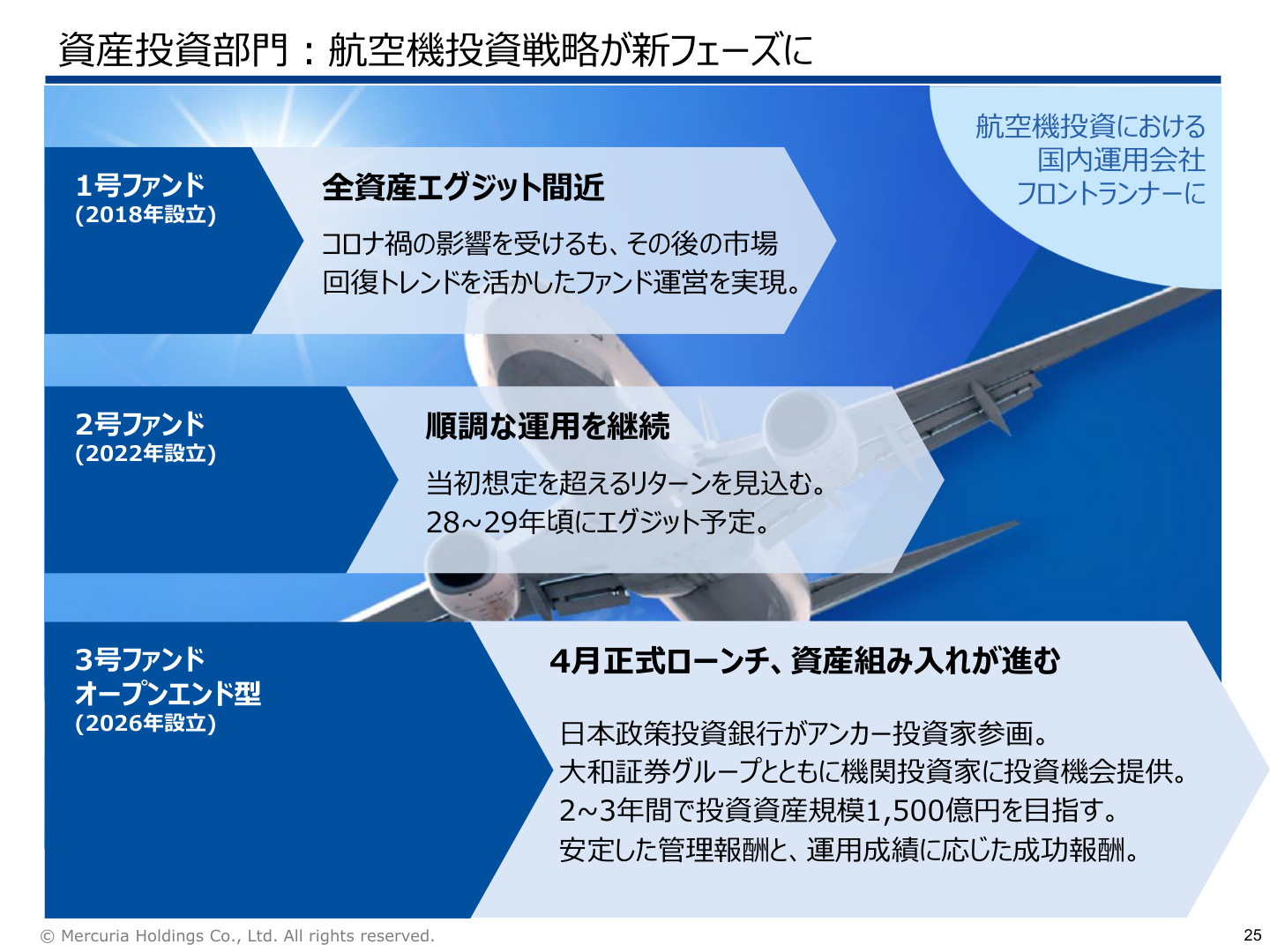
The slide above illustrates the company's strategic evolution as a frontrunner among domestic aircraft asset managers.
-
Fund Track Record :
- Fund I (Established 2018) : Overcame the COVID-19 pandemic and is nearing full asset exit as the market recovers.
- Fund II (Established 2022) : Operating smoothly with returns exceeding expectations (exit planned for around 2028–2029).
-
Fund III Open-End Fund (Full-scale launch in 2026) :
- Evolving from a closed-end fund to an "open-end" structure that allows for continuous asset expansion and management. Co-managed with Airborne Capital (Ireland).
- The Development Bank of Japan participates as an anchor investor , and a collaborative framework has been established with the Daiwa Securities Group. Asset acquisition has begun with two new Boeing 737 MAX 9 aircraft for United Airlines.
- The company aims to reach an investment asset scale of ¥150 billion over the next 2–3 years, with plans to expand sales to financial institutions, pension funds, corporate investors, and eventually individual investors.
Aircraft are real assets with global passenger demand, inflation resistance, and high liquidity (USD-denominated), making them a promising growth driver that aligns with the alternative investment needs of institutional investors.
5. Real Estate, Infrastructure, and Global Expansion
- Spring REIT (Listed on HKEX) :
- Holds premium office buildings in Beijing (145,000 sqm) and commercial facilities in Huizhou (145,000 sqm) (Total assets: ¥272 billion; Market cap: ¥49.1 billion).
- While maintaining high occupancy, the company is actively engaging with the market to address price declines resulting from China's macroeconomy and interest rate trends.
- Renewable Energy/Infrastructure Investment :
- Supporting the management of Enex Infrastructure Investment Corporation and promoting solar power projects in Taiwan. The company is scrutinizing early exits and the development of follow-on projects.
- Leveraging Asian Bases :
- Operates offices in China (Beijing), Hong Kong, Thailand (Bangkok), Vietnam (Ho Chi Minh City), and Singapore. 41% of consolidated employees are non-Japanese , providing a competitive edge in cross-border asset sourcing and management.
6. Summary and Future Growth Story
Mercuria Holdings is establishing the following growth cycle:
- Expansion of Stable Management Fees : By combining the management of Buyout Fund II (¥43.85 billion) with the formation of Buyout Fund III (target ¥50 billion) and the asset accumulation of the Aircraft Open-End Fund (target ¥150 billion) , the company is significantly expanding its fixed management fee base.
- Sustainable Acquisition of Performance Fees : Through exits from remaining Fund I assets (building on the 1.66x DPI) and exit returns from Buyout Fund II and Aircraft Funds I/II.
- Establishment of Unique Positioning : Leveraging strategic alliances with the DBJ, major trading houses, and the CP Group to solidify its status as an "illiquid alternative manager" connecting Japan and Asia.
The company's future developments, including its adherence to Prime Market listing criteria and further evolution of governance and market dialogue—such as the disclosure of fair value for principal investments—warrant close attention.
This content is not intended as investment advice or a recommendation. Any opinions expressed are solely the personal views of each article.