


Welby Q2 FY2026 Earnings Report: Advancing the Disease Platform Model with Expanding Recurring Revenue and Healthcare Partnerships

StockClub
Published: Aug 28, 2026, 09:52 AM
Sentiment Analysis
1. Executive Summary
Welby Inc. reported strong revenue growth for the second quarter of the fiscal year ending December 2026, with revenue reaching ¥376 million (+30.7% YoY) and gross profit totaling ¥255 million (+27.8% YoY) . The core Disease Solution Business was the primary growth driver, surging to ¥244 million (+81.2% YoY) .
While the company continues to prioritize upfront investments in organizational expansion and platform development—resulting in an operating loss of -¥256 million (compared to -¥249 million in the same period last year) —the business structure is undergoing a strategic shift. The company is transitioning from traditional "drug-specific Patient Support Programs (PSP)" to a "disease-area platform model." This shift is steadily building a mid-to-long-term revenue base, with the recurring revenue ratio reaching 61% (¥231 million) .
2. Earnings Highlights and Financial Position
Key Performance Indicators
The key financial results for the first half of the fiscal year are summarized in the table below.
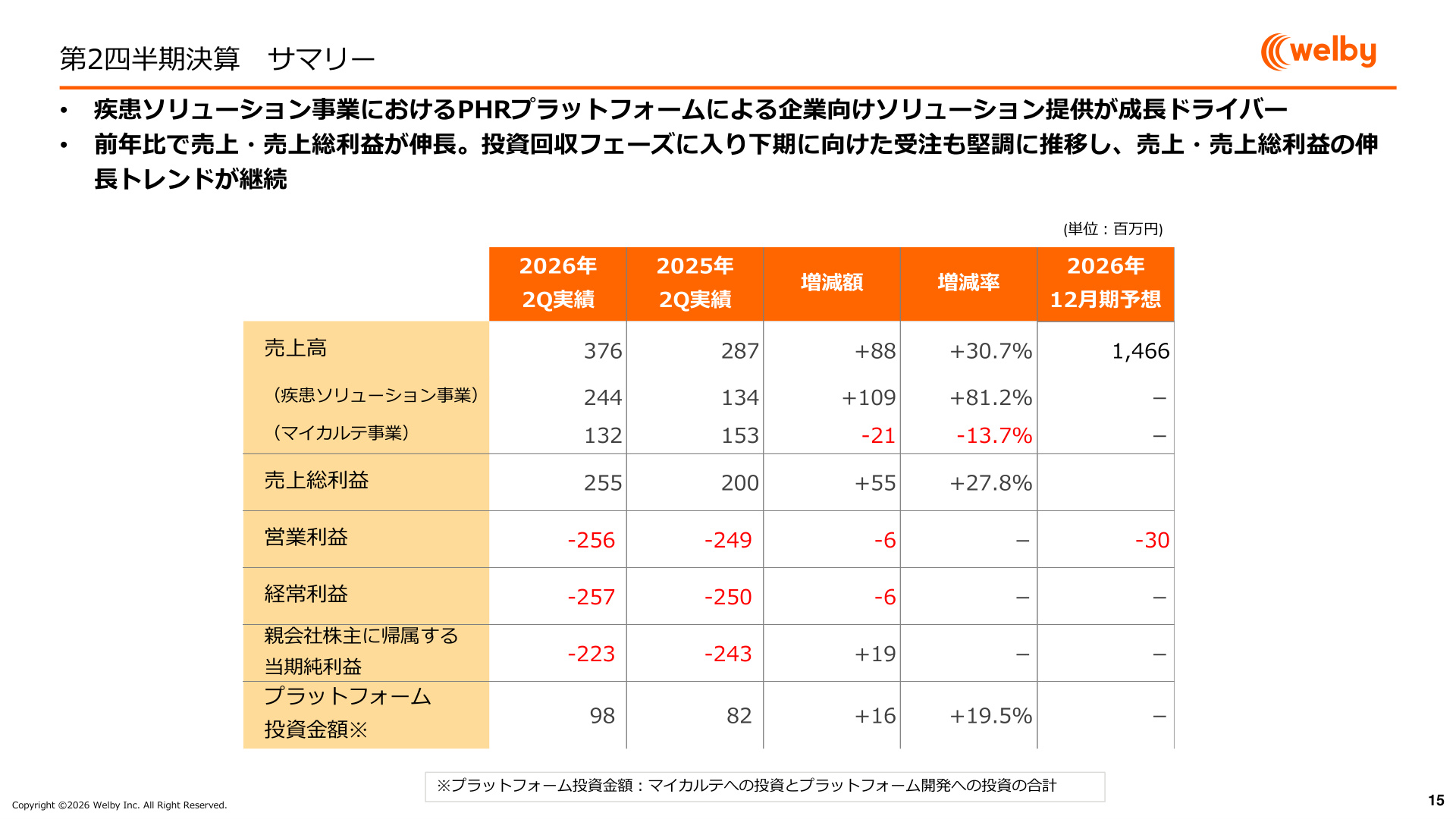
As shown in the earnings summary above, revenue increased by ¥88 million (+30.7%) year-on-year. To achieve the full-year forecast of ¥1,466 million in revenue and -¥30 million in operating profit , the company plans to accumulate orders in the second half and transition into a phase of investment recovery.
- Revenue : ¥376 million (+30.7% YoY)
- Disease Solution Business : ¥244 million ( +81.2% YoY )
- MyKarte Business : ¥132 million (-13.7% YoY)
- Gross Profit : ¥255 million (+27.8% YoY)
- Gross Profit Margin : 68.0% (maintaining a high level of profitability)
- Operating Profit : -¥256 million (vs. -¥249 million in the same period last year)
- Quarterly Net Profit Attributable to Owners of Parent : -¥223 million (an improvement of ¥19 million YoY)
- Platform Investment : ¥98 million (+19.5% YoY)
Revenue Structure: High Margins and Increasing Recurring Revenue
By leveraging its PHR (Personal Health Record) platform for corporate solutions, Welby maintains a high gross profit margin of 68% . Furthermore, recurring revenue accounted for ¥231 million (+11% YoY, 61% of total revenue) . This represents a steady increase in absolute terms from ¥121 million (66%) in Q2 2024 and ¥207 million (72%) in Q2 2025. Additionally, flow revenue (initial development fees, licenses, etc.) increased significantly from ¥79 million in the same period last year to ¥145 million , creating a structure that will drive further recurring revenue accumulation in subsequent periods.
Factors Affecting Operating Profit and Financial Health
While the increase in revenue contributed to gross profit, operating profit was impacted by higher cost of sales and development costs (-¥55 million), increased sales costs for organizational expansion (-¥15 million), and higher indirect costs (-¥23 million). These upfront investments are expected to yield results as the business scales.
Financially, as of the end of Q2 2026, the company held ¥593 million in current assets (including ¥435 million in cash and deposits) and ¥108 million in net assets . Management has indicated its intention to implement appropriate measures to strengthen net assets and cash reserves, including promoting the exercise of stock acquisition rights and bonds with stock acquisition rights through share price enhancement initiatives.
3. Business Progress and KPIs in Focus Areas
Welby has designated "Primary Care (lifestyle diseases, cardiovascular, etc.)" and "Oncology (cancer, etc.)" as its priority areas, rapidly advancing healthcare institution partnerships and social implementation.
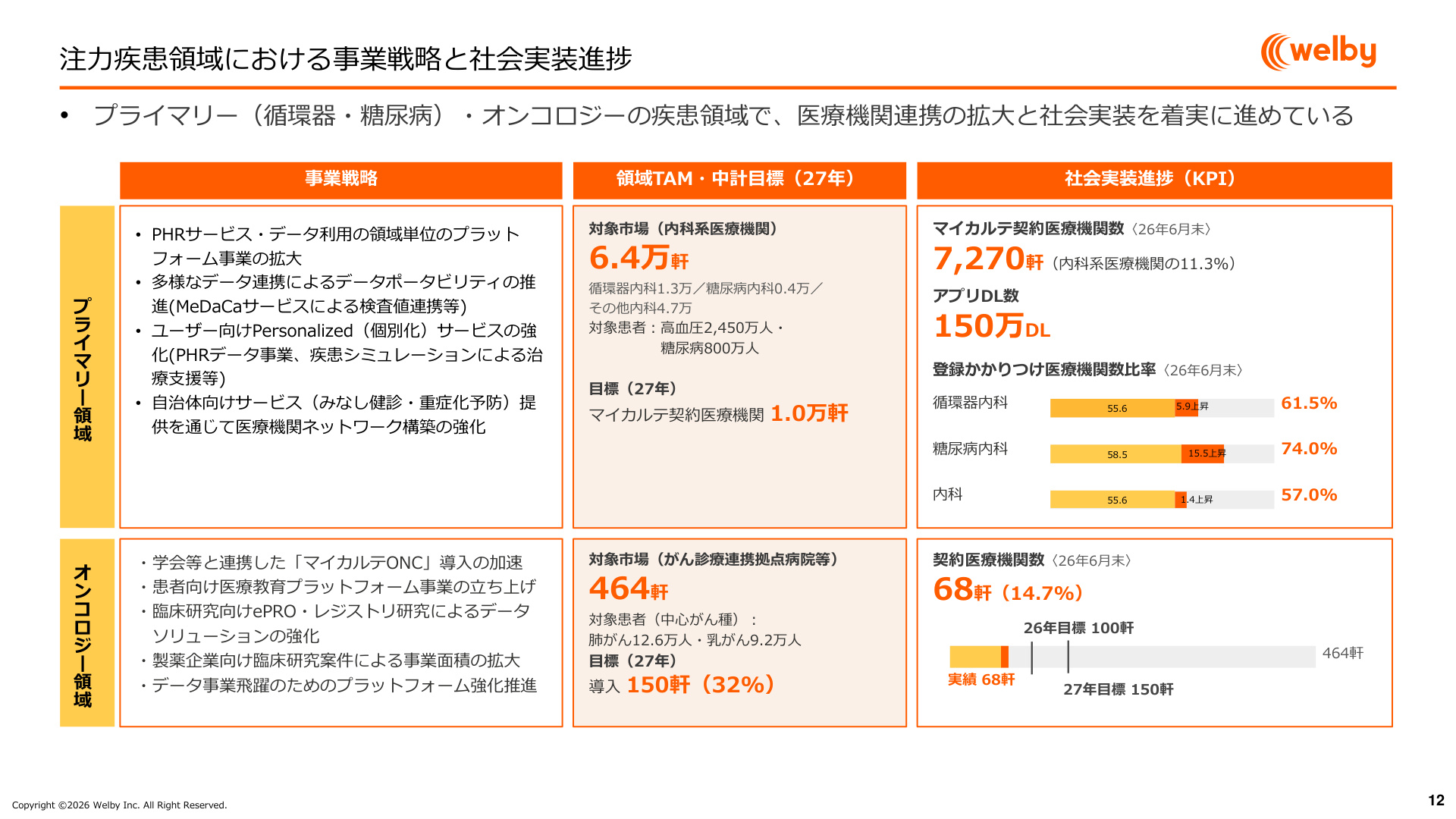
The slide above summarizes the key KPIs that demonstrate the depth of the company's business foundation.
Social Implementation KPIs for Primary Care
- Number of MyKarte Contracted Medical Institutions : 7,270 (covering 11.3% of the 64,000 target internal medicine clinics).
- Progress is on track toward the mid-term goal (2027) of 10,000 institutions .
- Cumulative App Downloads : Surpassed 1.5 million .
- Primary Care Institution Penetration Rate : Adoption in specialized departments is notably high, with 61.5% in cardiovascular medicine (+5.9pt), 74.0% in diabetes clinics (+15.5pt), and 57.0% in general internal medicine.
Progress in Oncology
- Contracted Institutions (Cancer Centers, etc.) : Reached 68 institutions (14.7% market share) .
- The company is accelerating the introduction of "MyKarte ONC" in collaboration with medical societies such as the Japanese Lung Cancer Society, aiming for 100 institutions by 2026 and 150 institutions (32% share) by 2027 .
4. Business Model Transformation and Competitive Advantage
The primary driver for the company's sustainable growth is the transition from the traditional single-drug-specific PSP to a disease-area platform model .
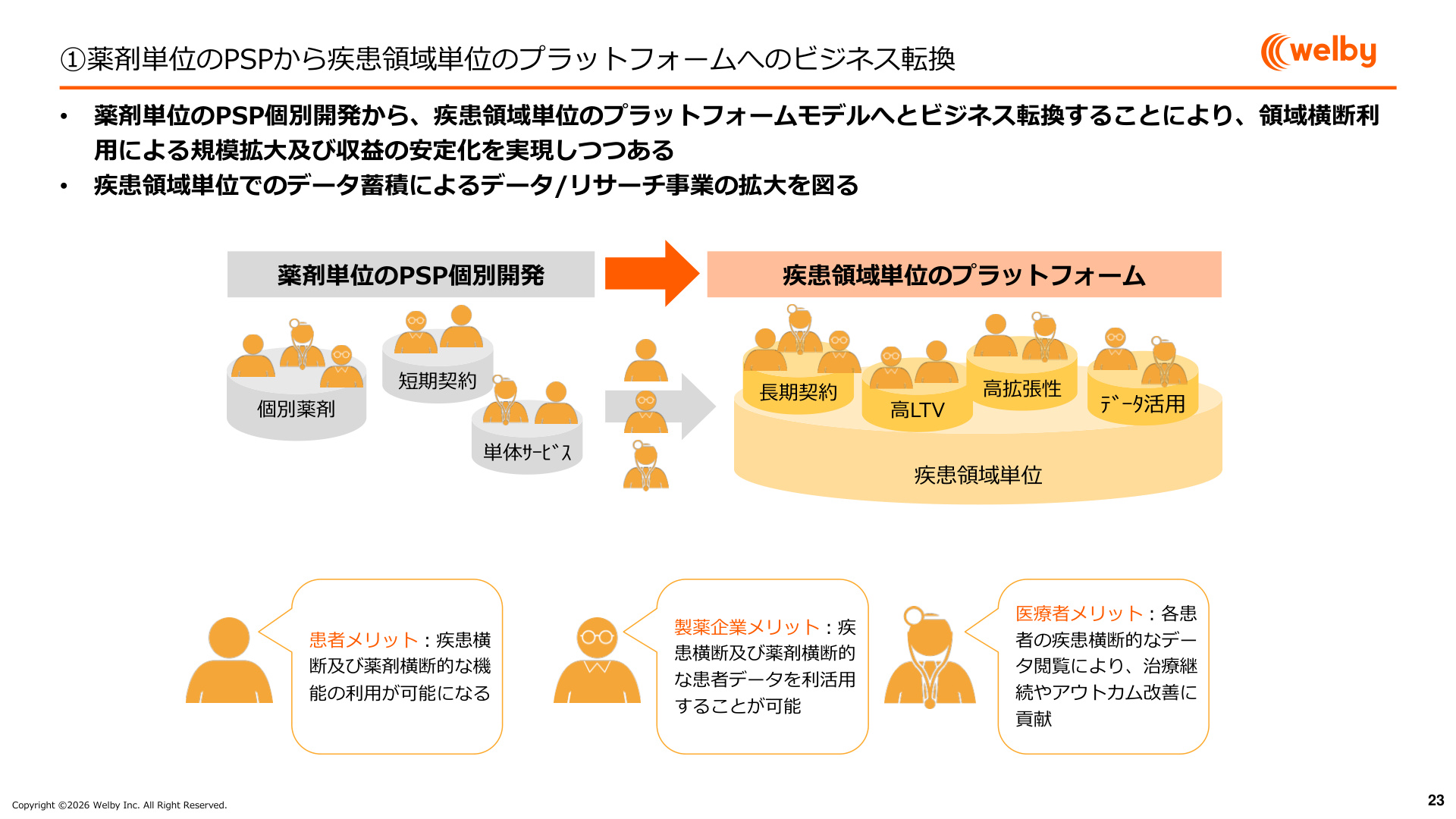
Value Transformation through Model Shift
As shown in the figure above, the traditional business model involved developing separate apps for each drug, often resulting in one-off, short-term contracts. Integration into a disease-area platform offers the following benefits:
- Benefits for Pharmaceutical Companies : Enables the utilization of cross-disease and cross-drug Real-World Data (RWD/PHR data), leading to long-term contracts and higher LTV .
- Benefits for Patients : Allows for integrated self-management via a single UI/UX, even for patients with multiple conditions or medications.
- Benefits for Medical Institutions : Provides a centralized view of cross-disease patient data, directly contributing to improved clinical efficiency and treatment outcomes.
Technical Foundation and Alliances
Welby has built the "Welby PHR & Data-Portability Platform (WPDP)," which complies with the international HL7 FHIR standard. This enables comprehensive integration with vital measurement devices (Omron, Terumo, Abbott), health checkup and prescription information from Myna Portal, and electronic medical records/testing companies. Furthermore, the company is accelerating social implementation through powerful alliances with major players such as Japan Post, NTT Docomo, Nippon Life Insurance, and Suzuken.
5. Mid-to-Long-Term Growth Strategy and Roadmap
Welby aims to enhance corporate value sustainably by developing the following four business domains:
- Disease-Area PHR Platform Business (Core Business, B2B) : Expanding beyond lifestyle diseases and oncology into central nervous system disorders, rare diseases, and autoimmune diseases. Strengthening the recurring revenue base by shifting from contract development to OEM and monthly subscription models.
- Municipal Business & Severity Prevention (Expansion Business, B2B2C) : Providing programs to improve specific health checkup rates and prevent disease progression, deepening ties between regional medical networks and local governments.
- Patient Medical Education Platform (Core Business, B2B) : Delivering medical content from pharmaceutical companies at optimal times, linked to individual patient PHR data.
- PHR Data Utilization Business (Expansion Business, B2B) : With patient consent (informed consent), providing and monetizing "patient journey data"—such as daily symptoms and medication logs—to pharmaceutical companies, insurance firms, and research institutions.
Future Growth Outlook
In the short term, the company will focus on investment recovery through revenue growth in the Disease Solution and MyKarte businesses. In the mid-to-long term, it plans to evolve into a comprehensive medical IT platform by layering on the PHR Data and Personalized Service businesses, centered on accumulated medical big data.
This content is not intended as investment advice or a recommendation. Any opinions expressed are solely the personal views of each article.