


Willplus Holdings FY2026 Earnings Analysis: Overcoming Market Headwinds through Recurring Revenue Growth and M&A Synergies

StockClub
Published: Aug 28, 2026, 09:51 AM
Sentiment Analysis

1. FY2026 Consolidated Financial Highlights and Overview
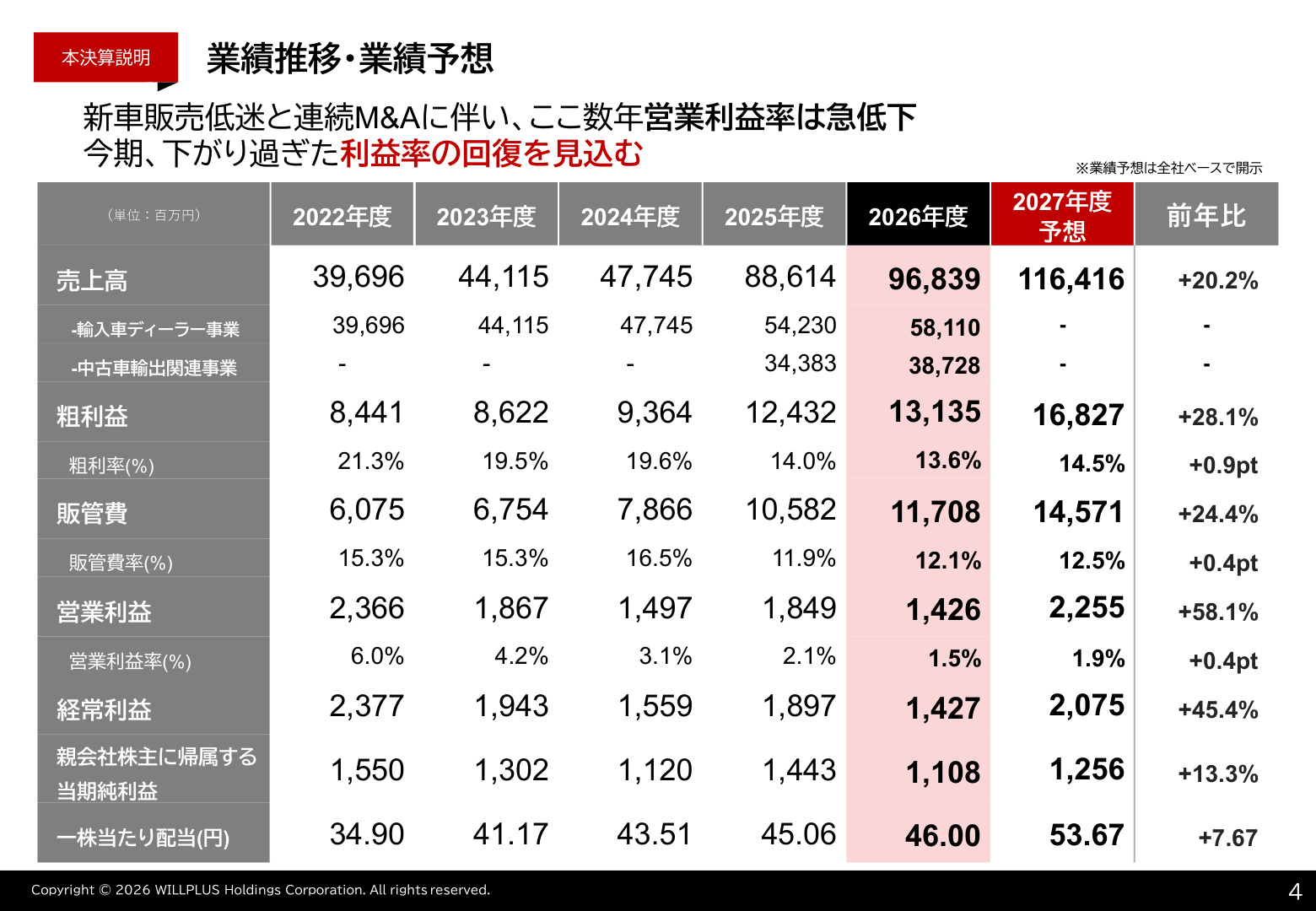
Willplus Holdings (Securities Code: 3538) reported its full-year financial results for the fiscal year ending June 2026, with net sales of 96.839 billion yen (+9.3% YoY) , operating profit of 1.426 billion yen (-22.9% YoY) , ordinary profit of 1.427 billion yen (-24.8% YoY) , and net profit attributable to owners of the parent of 1.108 billion yen (-23.2% YoY) .
While the company exceeded its revised full-year guidance (net sales of 92.16 billion yen and operating profit of 1.4 billion yen) by 105.1% and 101.9% respectively, the results reflect a year of increased revenue but decreased profit. This was primarily due to the prolonged slump in the new car market and the impact of upfront costs associated with a series of M&A activities.
The historical performance trends and future plans are as follows:
Background and Structural Factors of Performance Trends
As shown in the slide above, the company's net sales have expanded rapidly over the past few years due to an aggressive M&A strategy (growing approximately 2.4 times from roughly 39.7 billion yen in FY2022). Conversely, the operating profit margin declined from 6.0% in FY2022 to 1.5% in FY2026 . This is primarily attributed to the following three factors:
- Historic Slump in the New Car Market : Rising vehicle prices due to the rapid depreciation of the yen have led to a "wait-and-see" approach among consumers, keeping domestic new import car registrations at low levels.
- Upfront M&A Costs and Losses from Newly Acquired Branches : Initial SG&A expenses (personnel costs, facility expenses, and depreciation) for stores acquired and integrated into the group from the previous period through the current period have weighed on earnings.
- Declining Gross Margins in Used Car Export-Related Businesses : In response to stagnant exports of core models, the company increased "wholesale" sales to prioritize inventory turnover. While this boosted top-line revenue, it negatively impacted the product mix and compressed gross margins.
2. Segment-Specific Trends and Changes in Revenue Structure
① Import Car Dealer Business: Multi-Brand Strategy and Quarterly Bottoming Out
Domestic new import car registrations remain in a challenging environment, down more than 20% from their peak (308,000 units in 2018). While the Jeep brand, once a core driver, has seen a significant decline in volume, the company is leveraging its "Multi-Brand Strategy" to provide support through a diverse portfolio including MINI, JAGUAR / LAND ROVER, VOLVO, BYD, and Hyundai .
On a quarterly basis, after hitting a bottom in Q3 (operating profit margin of 0.9%), the company reported net sales of 17.229 billion yen and an operating profit of 664 million yen (operating profit margin of 1.3%) in Q4 . This marks the first improvement in profitability in five quarters, signaling a clear bottoming out. In addition to new car sales at existing stores recovering to year-ago levels, the revenue contribution from M&A-acquired stores has begun to materialize in earnest.
② Growth of Recurring Revenue Business: Strengths in Vehicle Maintenance and Insurance Agency Services
In contrast to the flow-based business, which is susceptible to fluctuations in vehicle sales volume, the "Recurring Revenue Business (Vehicle Maintenance and Insurance Agency Services)" continues to demonstrate robust growth.
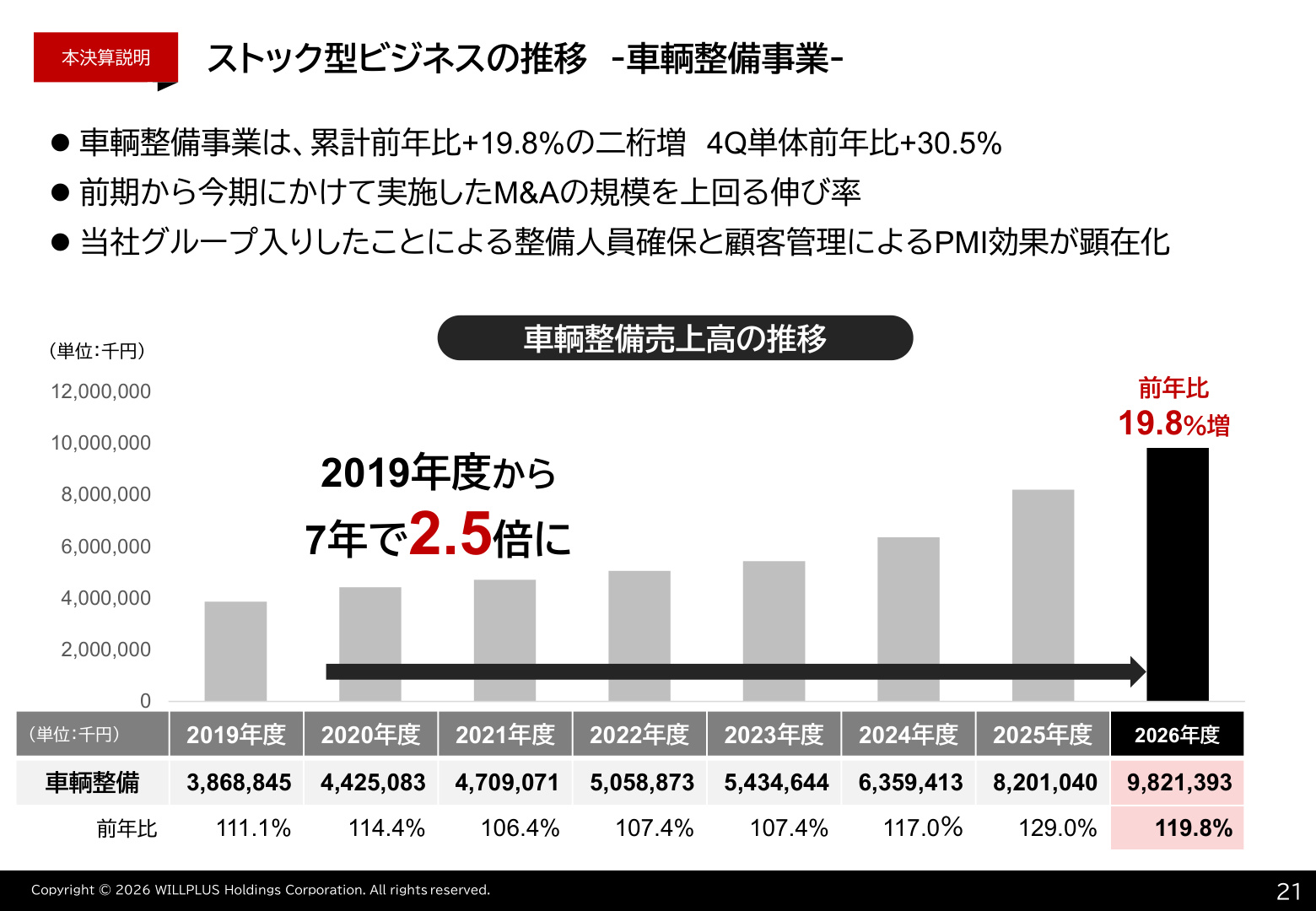
Revenue from the vehicle maintenance business has expanded 2.5 times over seven years, from approximately 3.87 billion yen in FY2019 to approximately 9.82 billion yen in FY2026 (+19.8% YoY) . This growth rate exceeds the pace of scale expansion through acquisitions, proving the success of securing maintenance personnel and thorough customer management (PMI) at newly integrated stores. Furthermore, in the non-life insurance agency business, the company successfully adapted to revisions in the agency commission system, with insurance commission income reaching 477.96 million yen (+8.7% YoY, and +25.4% YoY in Q4 alone) and the total number of insurance policies hitting a record high of 16,899 (+15.9% YoY) .
③ Used Car Export-Related Business: Shift to Turnover Focus and Pricing Challenges
In the used car export business (e.g., ENG), despite a favorable exchange rate environment such as the strength of the Malaysian Ringgit, the business faced declining demand for core export models and rising maritime transport costs. To prevent inventory stagnation, the company significantly increased the volume of domestic wholesale sales (+35.3% YoY) , aiming to secure gross profit while maintaining product turnover and inventory health.
3. FY2027 Earnings Outlook and Mid-to-Long-Term Growth Story
For the fiscal year ending June 2027, the company anticipates significant growth in both revenue and profit, supported by the expansion of its business base through M&A over the past few years and the progress of PMI (Post-Merger Integration).
FY2027 Earnings Forecasts
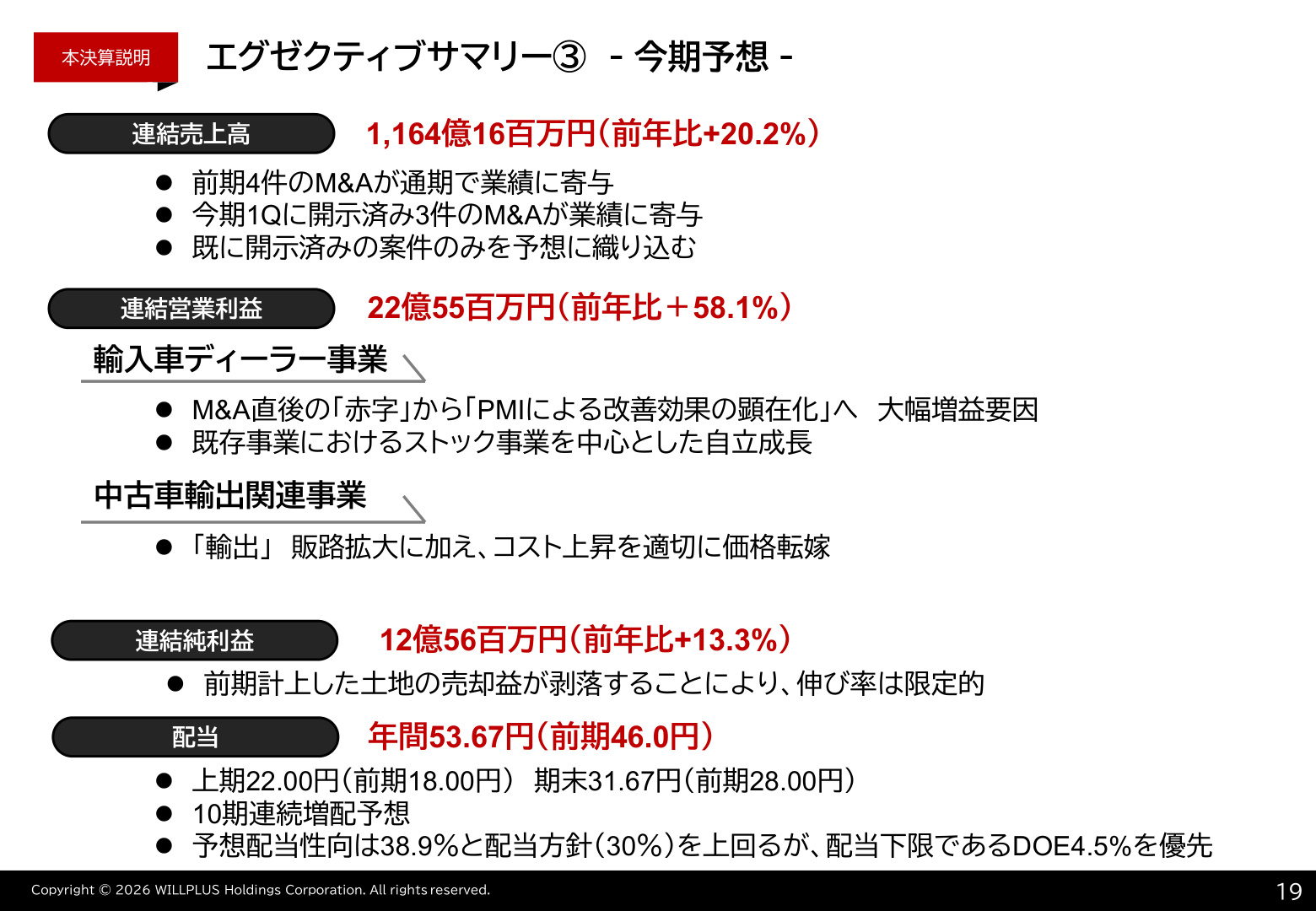
- Net Sales : 116.416 billion yen (+20.2% YoY)
- Gross Profit : 16.827 billion yen (+28.1% YoY, +0.9pt improvement in gross margin to 14.5%)
- Operating Profit : 2.255 billion yen (+58.1% YoY, +0.4pt improvement in operating margin to 1.9%)
- Ordinary Profit : 2.075 billion yen (+45.4% YoY)
- Net Profit Attributable to Owners of the Parent : 1.256 billion yen (+13.3% YoY)
- Annual Dividend Forecast : 53.67 yen (7.67 yen increase, marking the 10th consecutive year of dividend hikes)
Three Pillars Supporting the V-Shaped Recovery
- Full Contribution of M&A and Profitability Turnaround via PMI : In addition to the full-year contribution of the four M&As conducted last fiscal year, three additional M&As disclosed in Q1 of this fiscal year will be added. By introducing the company's standard operations to acquired stores that were previously incurring upfront costs or losses, the company expects improved gross margins and optimized SG&A expenses , serving as a major driver for profit growth.
- Further Accumulation of Recurring Revenue Base : With the increase in the cumulative number of vehicles in operation, high-margin vehicle maintenance and insurance commission income will continue to drive stable growth.
- Appropriate Price Pass-Through in Used Car Exports : The company will promote a review of sales pricing to reflect rising costs and expand sales channels to restore the profitability of the export business.
Shareholder Return Policy (Focus on DOE of 4.5%)
Regarding dividend policy, the company has set a Dividend on Equity (DOE) ratio of 4.5% as a lower-limit benchmark to ensure stable dividends. The annual dividend for FY2027 is planned at 53.67 yen (22.00 yen interim, 31.67 yen year-end). If achieved, this will mark the 10th consecutive year of dividend increases (forecasted dividend payout ratio of 38.9%).
This content is not intended as investment advice or a recommendation. Any opinions expressed are solely the personal views of each article.