


Leopalace21 Q1 FY2027 Earnings Analysis: Record-High Contract Rent Rates and Growth Driven by Foreign Demand and Development Business

StockClub
Published: Aug 27, 2026, 09:55 AM
Sentiment Analysis
Executive Summary
Leopalace21 (8848) reported solid Q1 FY2027 results in line with initial projections, with revenue of ¥115.902 billion (+3.7% YoY) , operating profit of ¥12.123 billion (-1.1% YoY) , ordinary profit of ¥12.279 billion (+6.2% YoY) , and quarterly net profit of ¥7.034 billion (+1,166.2% YoY) .
In the core leasing business, the contract rent rate index hit a record high of 123 in June , supported by robust corporate demand, particularly in the Tokyo metropolitan area. The average occupancy rate for Q1 stood at 87.23% (+0.98 percentage points YoY) , exceeding the plan. Furthermore, the growth-oriented development business saw a strong start, with the progress rate of full-year order targets reaching 34.1% , driven by the expansion of sales bases into the Kansai and Kyushu regions and the acquisition of medium-to-large-scale projects.
1. Earnings Highlights and Financial/Cost Structure Trends
Overview of the Profit and Loss Statement (PL)
Key features of the Q1 profit structure include steady revenue growth alongside planned investments in human capital and digital transformation (DX) for future growth.
- Revenue : ¥115.902 billion (+3.7% YoY / -0.2% vs. plan)
- Gross Profit : ¥26.511 billion (+5.6% YoY / +1.2% vs. plan)
- SG&A Expenses : ¥14.388 billion (+12.0% YoY / +3.5% vs. plan)
- Operating Profit : ¥12.123 billion (-1.1% YoY / -1.4% vs. plan)
- Quarterly Net Profit : ¥7.034 billion (+1,166.2% YoY / -0.9% vs. plan)
Cost of sales rose by ¥2.7 billion YoY to ¥89.3 billion due to enhanced property maintenance, though it was ¥500 million lower than planned as utility cost increases for monthly contracts remained below expectations. The increase in SG&A expenses reflects investments in human capital, including improved compensation and a headcount increase (+242 employees, +¥800 million), as well as DX initiatives such as system license fees (+¥500 million). These are considered upfront investments for long-term operational efficiency. The significant surge in net profit is primarily due to the absence of the loss on cancellation of treasury stock options (approx. ¥10 billion) recorded in the same period last year.
Strengthening the Financial Base (BS)
Driven by steady operating cash flow, cash and deposits increased by ¥7.8 billion from the previous quarter-end to ¥65.719 billion . With the accumulation of retained earnings (+¥5.399 billion), the equity ratio improved to 26.3% (+2.5 percentage points from the previous quarter-end) , indicating steady progress in financial health.
2. Leasing Business: Success in Pricing Strategy and High Occupancy
In the leasing business, the strategy of raising rent rates while maintaining high occupancy levels is yielding clear results.
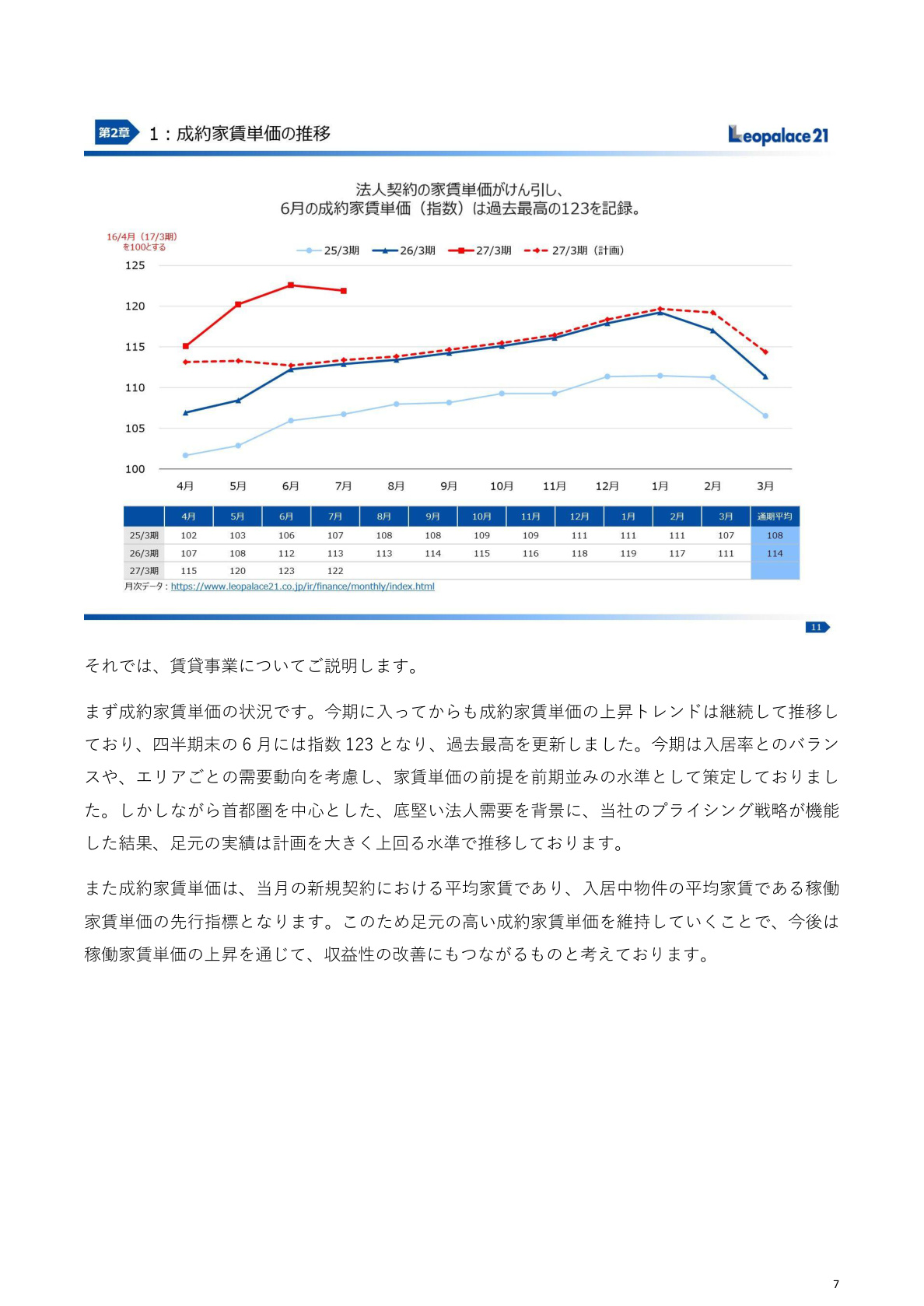
Upward Trend and Leading Nature of Contract Rent Rates
As shown in the slide above, the contract rent rate index (April 2016 = 100) has continued to rise, reaching a record high of 123 in June 2026 . While the company set conservative pricing in its initial plan to balance occupancy, the effective execution of pricing strategies against strong corporate demand in the metropolitan area has led to results significantly exceeding the plan.
Since contract rent rates reflect new contracts, they serve as a leading indicator for "operating rent rates," which include existing tenants. As mentioned in the Q&A, while the reduction in monthly contracts has temporarily slowed tenant turnover (down by approx. 1,200 units YoY), the ongoing replacement with higher-rate contracts is expected to boost profitability in the medium to long term.
Regional Occupancy Trends
The average Q1 occupancy rate remained high at 87.23% (+0.98 points YoY, +0.19 points vs. plan) . By region, the Tokyo metropolitan area led the performance with Tokyo at 96%, Saitama/Chiba at 94%, and Kanagawa at 93% . Significant improvements were also seen in regional cities, such as Aomori (84%, +7p YoY) and Akita (95%, +7p YoY), where demand was bolstered by infrastructure projects like power plants and dams.
3. Deep Dive into Demand Structure: Stability of Corporate Demand and Surge in Foreign Talent
Regarding tenant composition, the corporate usage ratio remained at a record high of 66.5% (+1.8 points YoY) .
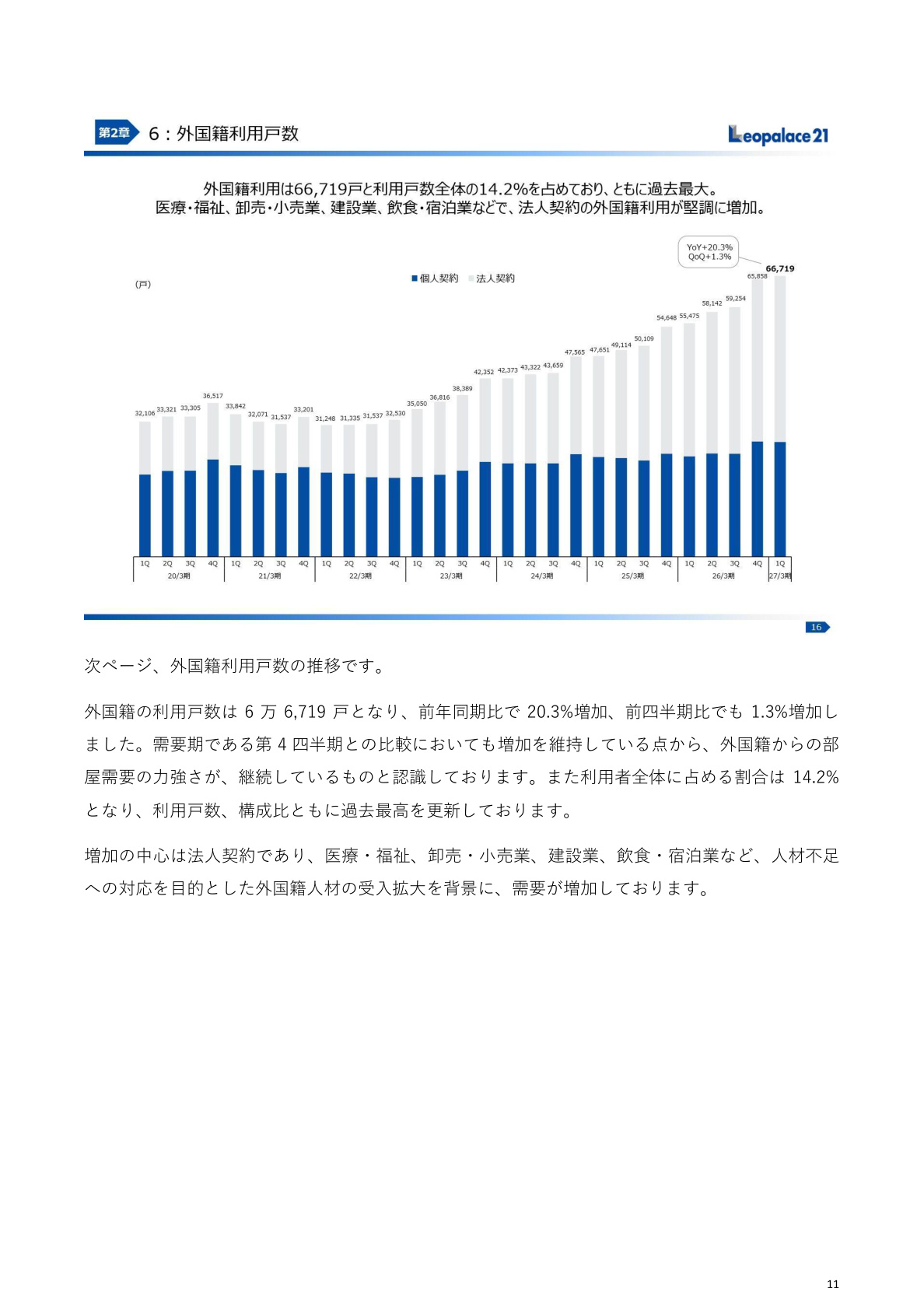
Continuous Expansion of Foreign Tenant Units
Strongly supporting the company's leasing demand is the expansion of foreign talent usage shown in the slide above. In Q1, the number of units occupied by foreign nationals reached 66,719 (+20.3% YoY, +1.3% QoQ) , accounting for a record 14.2% of total occupied units .
Amid severe labor shortages, companies in sectors such as medical/welfare (+20.2% YoY), food/accommodation (+13.3% YoY), wholesale/retail, and construction are increasingly securing Leopalace properties as corporate housing. The fact that unit counts continued to rise even after the peak Q4 (January–March) season demonstrates the structural strength of demand that is resilient to seasonal fluctuations.
4. Resurgence of the Development Business and Partnership Strategy
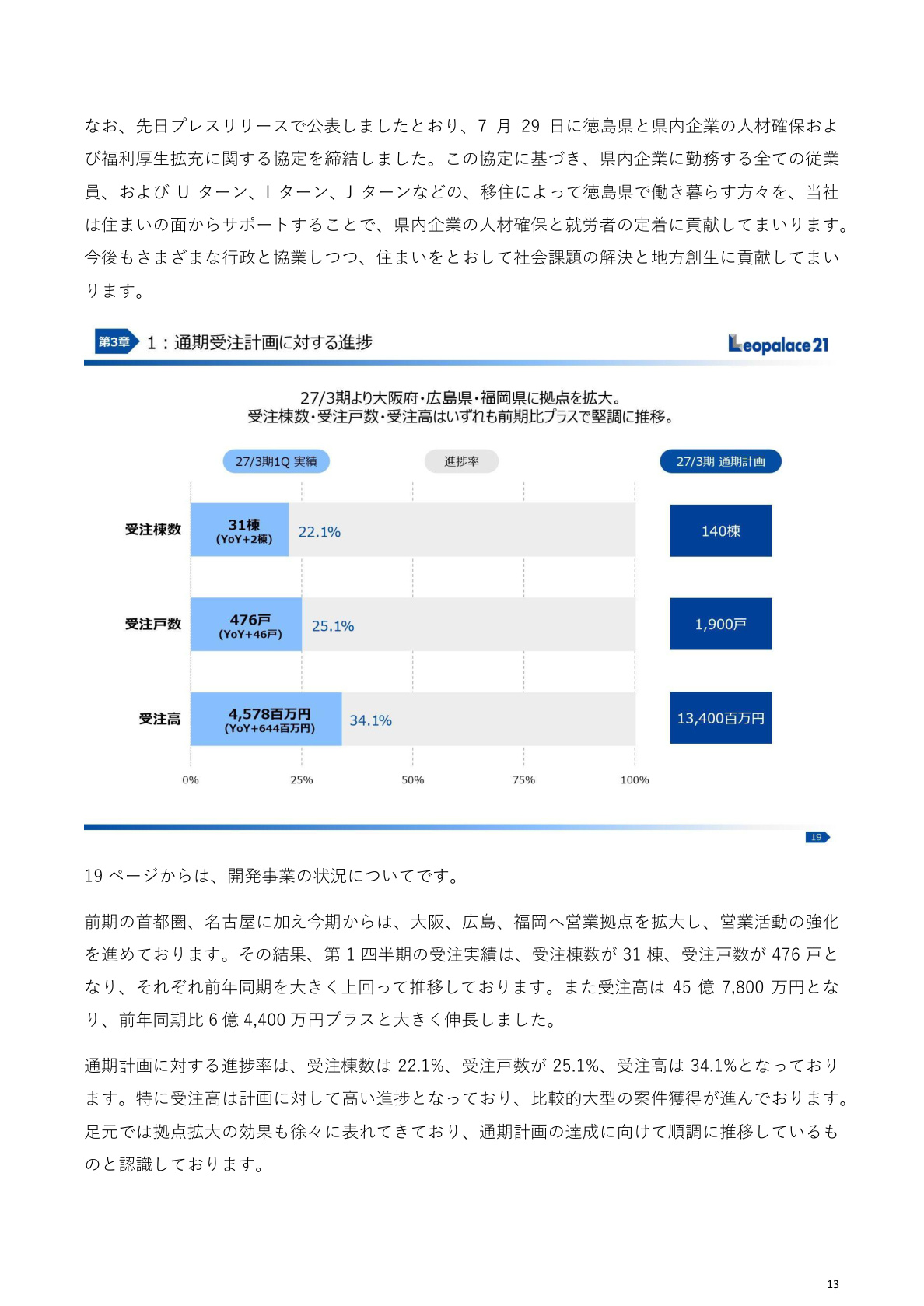
Progress in the Development Business
In the development business, which rebuilds the supply base for managed properties, the company has expanded its sales bases to Osaka, Hiroshima, and Fukuoka , in addition to the existing Tokyo and Nagoya regions. This expansion has yielded early results, with Q1 performance showing strong progress:
- Number of Buildings Ordered : 31 (+2 buildings YoY / 22.1% progress)
- Number of Units Ordered : 476 (+46 units YoY / 25.1% progress)
- Order Value : ¥4.578 billion (+¥644 million YoY / 34.1% progress )
Compared to the historical average of approximately 16 units per building, the acquisition of larger-scale projects this term has pushed the progress of order value significantly ahead of the full-year plan (¥13.4 billion).
Business Alliance with Relo Estate
In late July 2026, the company announced a partnership with Relo Estate, a subsidiary of Relo Group, the leader in corporate housing management. To address the challenge of limited supply for furnished properties, the company plans to leverage its nationwide network of approximately 540,000 managed units and its stock of furnished apartments to capture further corporate housing demand.
5. Capital Policy and DX Strategy Direction
During the earnings briefing and Q&A, key policies for strengthening the management foundation were outlined:
- Capital Policy and Shareholder Returns : With cash on hand reaching the ¥65 billion level and retained earnings recovering to approximately ¥33 billion, the company indicated it would flexibly consider share buybacks and shareholder returns at appropriate times, while monitoring major shareholders' intentions and distributable profit constraints.
- Operational Efficiency via DX/AI Investment : In addition to promoting electronic contracts for individual tenants and introducing smart locks, the company continues to invest in technology for AI analysis of sales activities and the automation of management tasks for its 540,000 units. While this involves some upfront SG&A costs, it is driving long-term operational cost reductions and profitability improvements.
Conclusion
In Q1 FY2027, Leopalace21 achieved a very solid start toward its full-year targets, driven by the synergy of "rising contract rent rates," "maintenance of high occupancy," "capture of corporate demand led by foreign talent," and "large-scale project orders from development base expansion." Key points to watch moving forward include the timeline for the high-rate new contracts to permeate into the overall operating rent rates, as well as the realization of synergies from the partnership with Relo Estate.
This content is not intended as investment advice or a recommendation. Any opinions expressed are solely the personal views of each article.