


Nomura System Corporation FY2026 Q2 Earnings Deep Dive: 'H1 Investment, H2 Recovery' via Human Capital and Deepening the Prime Shift

StockClub
Published: Aug 27, 2026, 09:53 AM
Sentiment Analysis

1. Earnings Overview and Executive Summary
Nomura System Corporation (Securities Code: 3940) reported its FY2026 Q2 (interim) financial results , with net sales of 1.689 billion yen (down 0.6% YoY) and an operating profit of 231 million yen (down 22.1% YoY). While the immediate performance may appear stagnant, this is primarily due to planned upfront investments—specifically in human capital, such as recruitment and training—concentrated in the first half, in line with the company's 'H1 Investment, H2 Recovery' model .
Progress against the full-year plan stands at 44.4% for net sales and 43.6% for operating profit, aligning with the expectation that projects will reach full-scale operation in the second half. Furthermore, the company’s long-term strategic initiatives, namely the 'Prime (direct transaction) Shift' and the 'promotion of in-house development,' are yielding steady results, laying the groundwork for a higher value-added and more profitable business model.
2. FY2026 Q2 Performance Summary and Factor Analysis
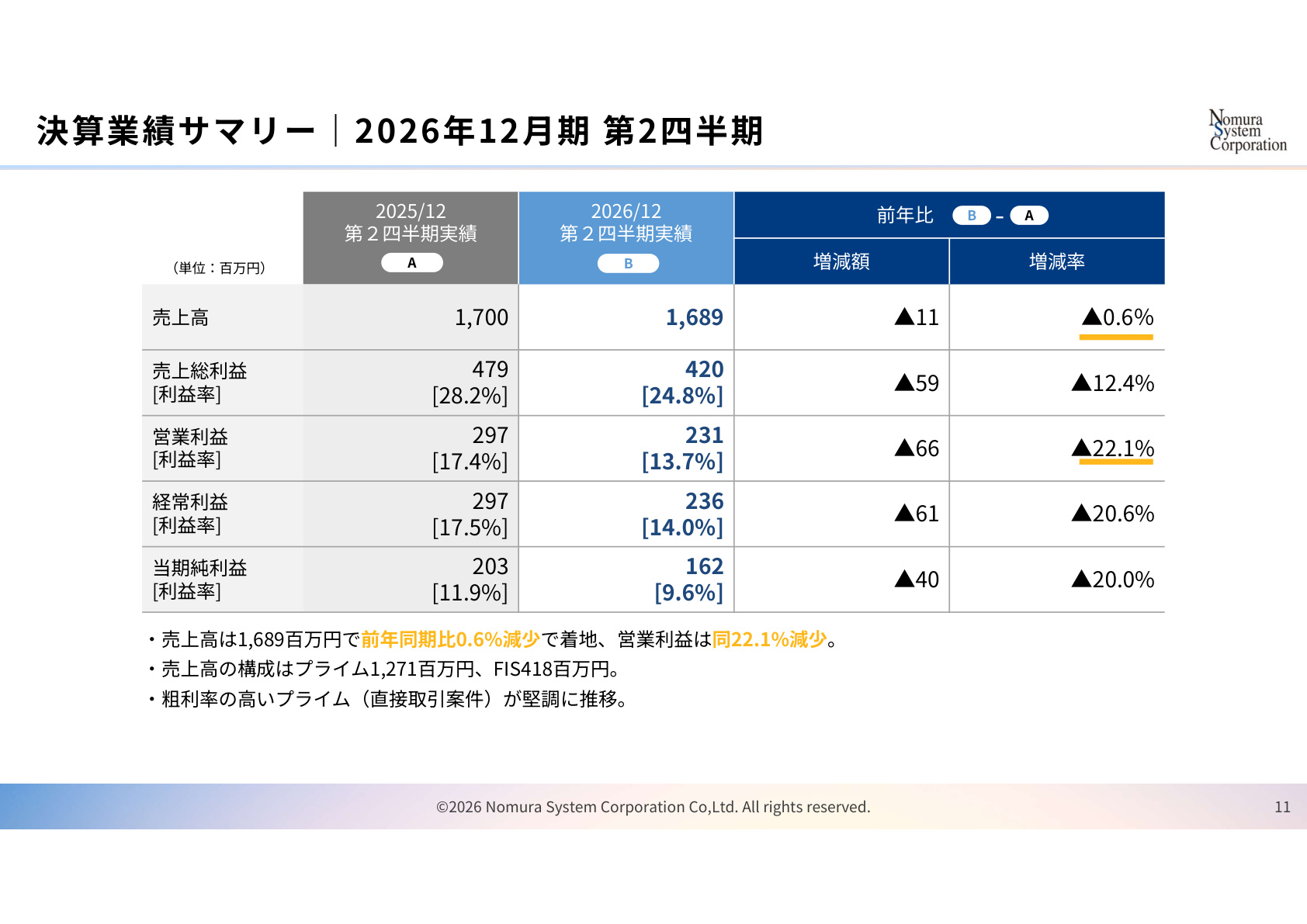
The key figures from the P/L for the first half of the fiscal year are as follows:
Background and Details of Financial Performance
As shown in the earnings summary above, net sales remained nearly flat year-on-year (-0.6%) at 1.689 billion yen , while operating profit declined by 22.1% to 231 million yen .
-
Breakdown of Net Sales and Gross Margin Trends Net sales consisted of 1.271 billion yen from prime projects (contracted directly with clients) and 418 million yen from FIS (subcontracting projects) , with high-margin prime projects remaining the core of the business. Meanwhile, gross profit was 420 million yen (down 12.4% YoY), and the gross profit margin fell to 24.8% (compared to 28.2% in the same period last year).
-
Factors Behind the Profit Decline The decline in profit is not due to a deterioration in the business environment, but rather to upfront costs associated with the aggressive hiring of consultants (10–20 personnel), the expansion of internal training, and the development of PM/PL (Project Manager/Leader) candidates . The concentration of resource expansion and training in the first half led to a temporary increase in SG&A expenses and cost of sales.
-
Planned Extraordinary Income As announced on August 18, 2026, the company expects to record 190 million yen in gain on sales of investment securities as extraordinary income in the third quarter, which is expected to contribute to the final bottom line.
3. Financial Position and Proactive Shareholder Returns
The company maintains an exceptionally healthy balance sheet with a high level of financial stability.
-
Robust Equity Ratio At the end of the second quarter, total assets were 3.799 billion yen , net assets were 3.452 billion yen , and the equity ratio reached 90.9% (up 2.3 percentage points from the end of the previous fiscal year). This strong financial foundation, bordering on debt-free management, supports the continuation of growth investments.
-
Shareholder Returns and Incentive Design The company maintains a basic policy of 'continuing stable dividends with a payout ratio of 40% or higher.' Additionally, as part of its flexible capital policy, the company has executed share buybacks for four consecutive terms , completing the acquisition of 1 million shares (approx. 142.41 million yen) by March 2026, and announced an additional buyback of up to 150 million yen (1 million shares) on August 7, 2026. Furthermore, the company introduced a Restricted Stock (RS) compensation plan to align the interests of officers and employees with management, disposing of 961,100 treasury shares to commit to enhancing shareholder and corporate value.
4. Evolution of Business Structure: Prime Shift and In-house Development
The driving force behind the company's competitive advantage and margin improvement is the shift away from reliance on subcontracting toward the expansion of direct (prime) transactions.
Dramatic Changes in Project Composition
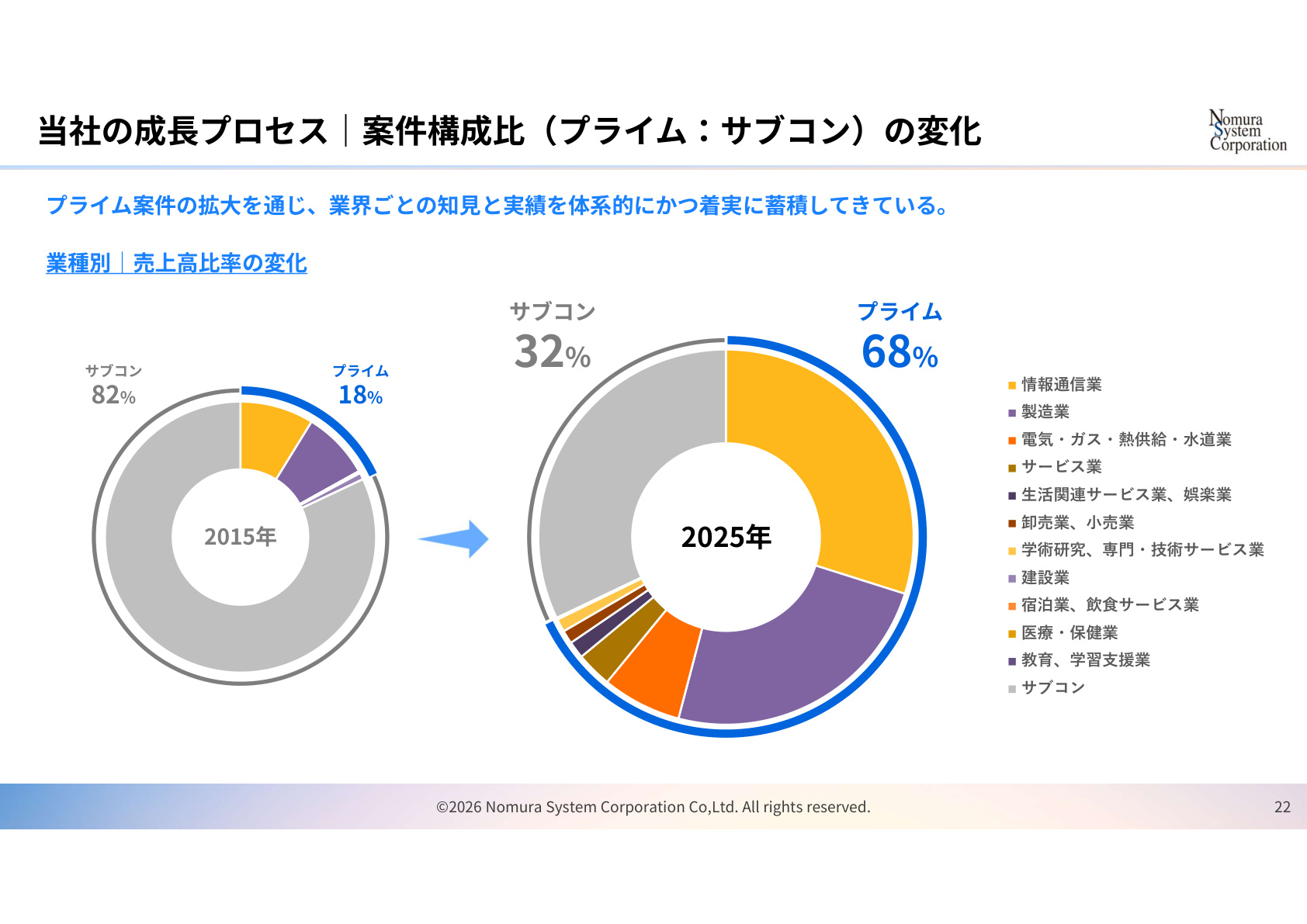
As the slide above illustrates, the company's sales structure has undergone a dramatic transformation over the past decade.
- Expansion of Prime Ratio (18% → 68%) In 2015, subcontracting projects accounted for 82% of sales, while prime projects were only 18%. However, through continuous strengthening of consulting capabilities and a track record of SAP implementations, the ratio has completely reversed, with prime projects reaching 68% and subcontracting projects at 32% in 2025.
- Diversification of Industry Portfolio With the expansion of prime projects, the client base has diversified beyond the core information/communications and manufacturing sectors to include electricity, gas, water, services, wholesale/retail, and construction. This accumulation of industry-specific know-how has strengthened the company's proposal capabilities.
- Improvement in In-house Development Ratio The company has promoted initiatives to reduce reliance on outsourcing and increase the ratio of in-house consultants (permanent staff). The in-house ratio has improved from approximately 37% in 2015 to over 50% in 2025 , achieving both margin improvement and rigorous quality control.
5. Growth Story for the Current Fiscal Year: 'H1 Investment, H2 Recovery' and the Nature of Upfront Investment
To achieve its full-year plan (3.8 billion yen in net sales, 530 million yen in operating profit), the company has presented a clear performance cycle.
The Mechanism of 'H1 Investment, H2 Recovery'
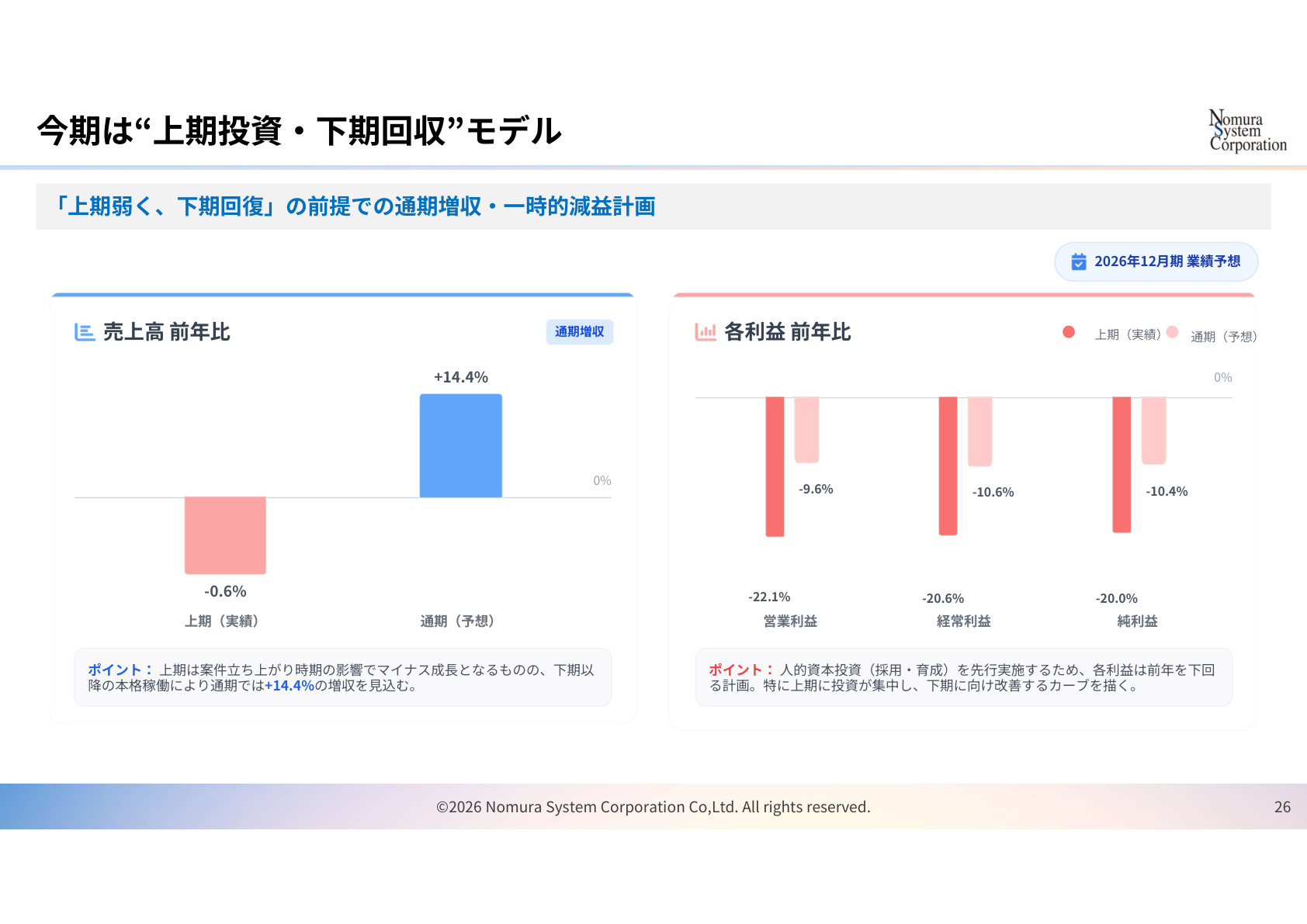
The slide above logically explains why the first half saw a temporary profit decline despite the projected full-year revenue growth (+14.4% YoY) for FY2026.
- Strong Demand, 'Supply Capacity' as the Bottleneck Demand for ERP (SAP) modernization—driven by the '2027 Problem' and cloud migrations like 'RISE with SAP' and 'GROW with SAP'—as well as system investments for human capital management, is extremely robust. With abundant inquiries, the primary challenge to capturing growth opportunities is 'consultant supply capacity.'
- The Nature of the Profit Decline = Human Capital Investment for the Future In the first half, the company prioritized: (1) strengthening internal training systems led by experienced consultants, (2) recruitment activities for 10–20 personnel, primarily at the PM/PL level, and (3) expanding skills into S/4HANA-related solutions. This investment allocation is the reason for the lower first-half profit.
- Recovery Phase from the Second Half As the newly hired and trained personnel begin full-scale project work from the second half onward, the company expects to see an increase in utilization rates and a sharp rise in net sales (+14.4% for the full year), with a recovery curve in profitability expected toward the end of the year.
6. Key Business Topics and Proprietary Solutions
Specific business developments and topics for the second quarter include:
- Acquisition and Continuation of Projects from Major Blue-Chip Clients The company has successfully secured high-difficulty, large-scale prime projects, including core system implementation consulting for a major domestic electronics manufacturer, PMO consulting support for a major domestic comprehensive electrical manufacturer, and continued PM support for core system modernization at a major domestic airline group.
- Efficiency Support for Municipal New Power Companies The company has launched projects to support operational efficiency, including automation, for municipal new power companies, expanding its DX support footprint in the public and energy sectors.
- SAP Store Registration and Deployment of Proprietary Products The company registered its proprietary solutions, 'Jet-One Timesheet' and 'Jet-One EngagementSurvey,' which integrate with SAP SuccessFactors, on the official SAP Store. By providing these templates, the company is shortening implementation periods and generating license revenue.
- Strengthening Marketing Activities The company sponsored and exhibited at 'HR Connect Tokyo 2026,' the flagship event hosted by SAP Japan, to strengthen its approach to major corporations focused on human capital management.
7. Mid-to-Long-Term Growth Strategy: Roadmap to Over 20% Operating Margin
The company has set a mid-term goal of achieving an 'operating profit margin of 20% or higher' and is pursuing two major growth drivers to realize this:
- Growth Driver ①: Developing the Middle/Small Market via Jointly Developed Templates Targeting middle and small-sized manufacturers with annual sales under 50 billion yen (a potential market of thousands of companies), the company is deploying business templates developed with partners. By scaling these through model case demonstrations and implementations, the company aims to increase proposal efficiency and order win rates in a 'snowball' effect .
- Growth Driver ②: Maximizing Supply Capacity and Unit Prices through PM/PL Development Based on a 'talent ladder,' the company is executing a roadmap to systematically step up consultants to PL and PM roles (targeting +10 PM-level personnel over 5 years). By increasing the ratio of senior-level staff, the company aims to simultaneously raise the average unit price per person and enhance its capability to execute large-scale projects, thereby significantly improving profit margins.
Armed with a solid track record and brand reputation of '100% project success rate (zero past implementation failures),' the company aims to steadily expand its supply capacity in the over-demanded SAP market and establish a trajectory of sustainable, high-profit growth.
This content is not intended as investment advice or a recommendation. Any opinions expressed are solely the personal views of each article.