


Miratap Q3 FY2026 Earnings Analysis: Record Revenue, Significant Turnaround to Profit, and Strategic Evolution for the 'Leap Phase'

StockClub
Published: Aug 27, 2026, 09:52 AM
Sentiment Analysis
Miratap Co., Ltd. (formerly Sanwacompany Ltd.) has demonstrated strong progress in its Q3 FY2026 financial results. Following a phase of upfront investment associated with its corporate rebranding, the company achieved record-high cumulative Q3 revenue and a significant turnaround to operating profit , moving out of the red recorded in the same period last year. This report provides an in-depth analysis of the earnings highlights, drivers of profitability improvement, category-specific performance, AI-driven productivity reforms, and mid-to-long-term growth strategies.
1. Q3 FY2026 Earnings Highlights: Record Revenue and Operating Profitability
For the cumulative third quarter, revenue rose 3.4% year-on-year to 11.888 billion yen , while gross profit increased 2.0% to 4.439 billion yen (gross margin of 37.3%). In terms of profitability, the company posted an operating profit of 267 million yen (compared to an operating loss of 139 million yen in the same period last year), an ordinary profit of 232 million yen (compared to an ordinary loss of 139 million yen), and a quarterly net profit of 233 million yen (compared to a net loss of 172 million yen). This marks a significant increase in revenue and profit, and a successful return to profitability compared to the previous year.
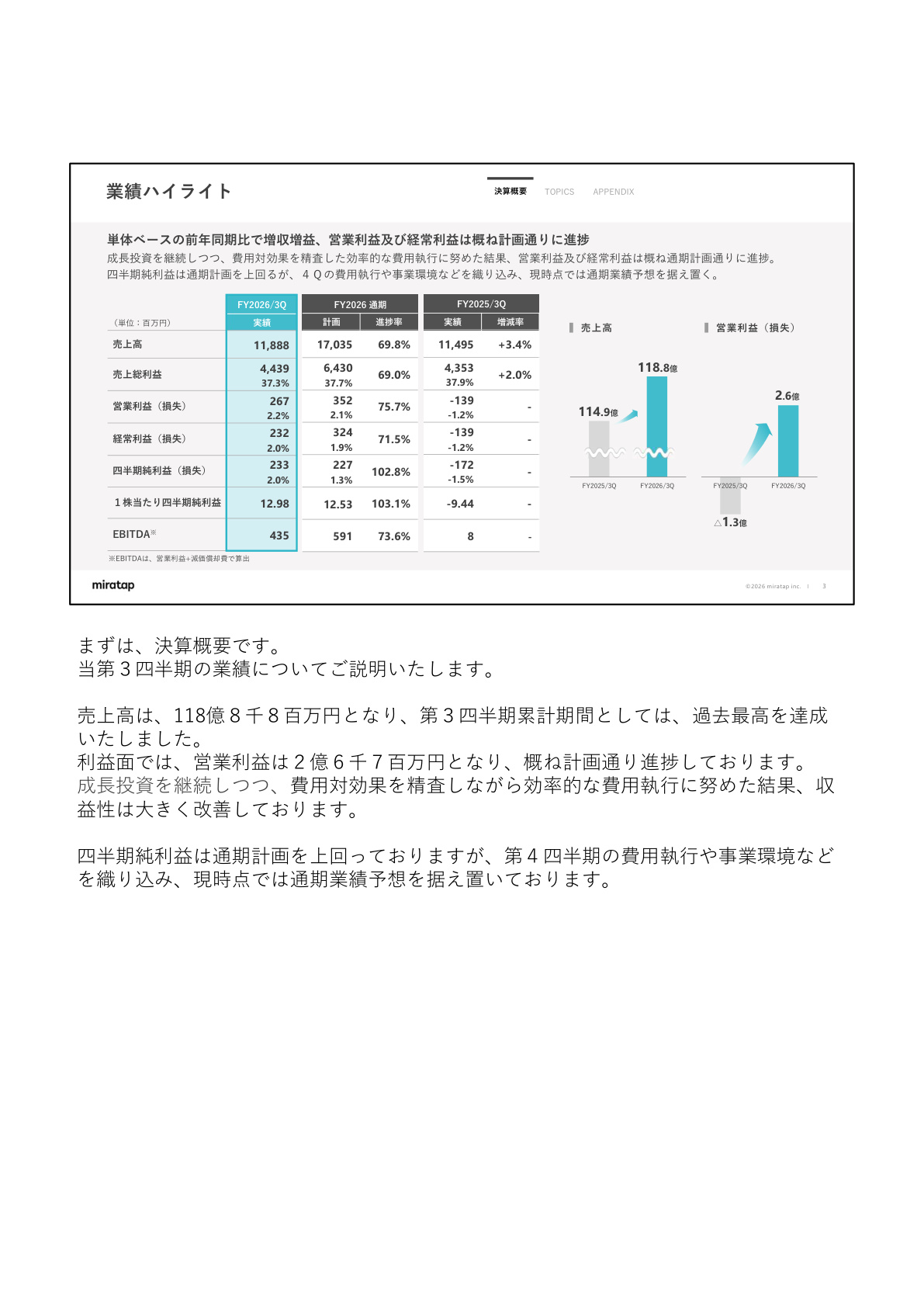
As shown in the slide above, the progress rate against the full-year plan stands at 69.8% for revenue , 75.7% for operating profit , and 71.5% for ordinary profit , indicating that performance is largely on track. Notably, quarterly net profit has reached 102.8% of the full-year target (227 million yen), effectively achieving the initial goal ahead of schedule. While the full-year forecast remains unchanged to account for potential additional expenses in Q4 and fluctuations in the business environment, it is clear that profitability is improving steadily.
2. Quarterly Revenue Trends and Demand
Revenue for the third quarter alone reached 4.001 billion yen , a 6.4% increase year-on-year , marking a record high for a third quarter. While challenges remain in expanding the total customer base, the company’s core foundation— increased order value and frequency among loyal customers —is strongly driving performance.
Furthermore, high-value-added new products, such as the "InViera" built-in refrigerator launched in May 2026 and the top-tier full-ceramic kitchen "Giora," have had a strong start, facilitating lead generation and conversion into business negotiations. The conversion of prospective customers acquired through enhanced social media presence and digital content is expected to support revenue from Q4 onwards.
3. Analysis of Operating Profit Fluctuations: Normalization of Advertising Investment and Structural Reform
Behind the 406 million yen improvement in operating profit—from a 139 million yen loss in the previous year to a 267 million yen profit this term—lies a clear shift in the cost structure.
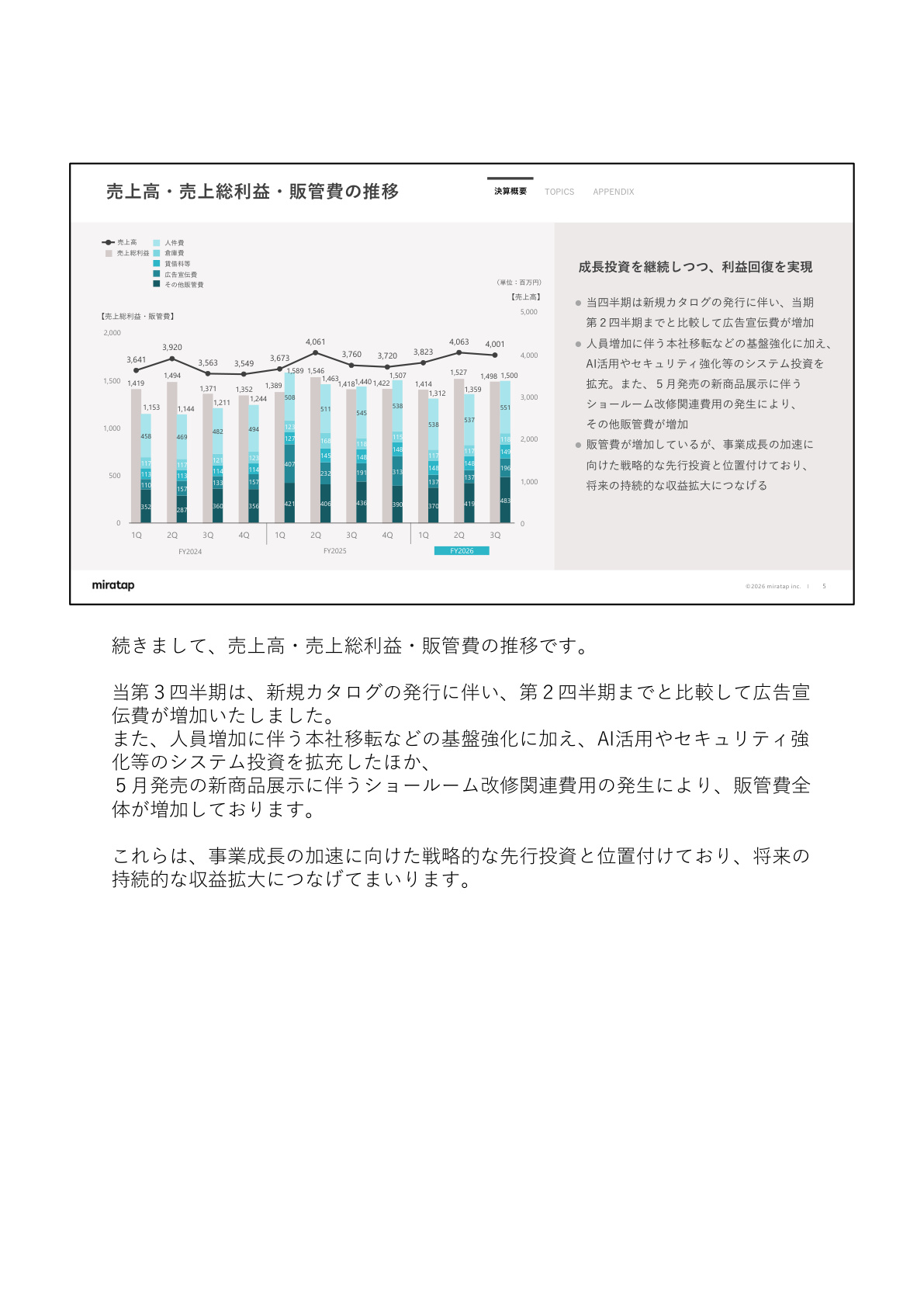
Looking at the breakdown of factors in the slide, the primary driver of profit growth is the optimization of advertising expenses (+360 million yen) . The large-scale, temporary promotional activities associated with the corporate rebranding (from Sanwacompany to Miratap) have concluded, and the company has shifted to efficient advertising operations based on rigorous ROI analysis. The elimination of one-time costs incurred in the previous year, such as double rent and relocation expenses for warehouses (+56 million yen) and equipment acquisition costs for the head office relocation (+40 million yen), also bolstered the recovery.
On the other hand, the company has incurred upfront investment costs, including increased personnel expenses (△62 million yen) to prepare for future expansion, higher rent (△31 million yen) due to the head office relocation and the opening of a new Tokyo office, and increased depreciation (△21 million yen) from the acquisition of core and CRM systems. However, a structure has been established to fully absorb these costs through revenue growth and the normalization of fixed expenses.
4. Improvement in Financial Position and Cash Flow
Total assets as of the end of June 2026 stood at 8.835 billion yen (an increase of 45 million yen from the end of the previous fiscal year). In current assets, accounts receivable increased to 1.147 billion yen (up 202 million yen) due to sales growth, while cash and deposits increased to 1.452 billion yen (up 144 million yen) through cash generated from operating activities.
Regarding liabilities, the company reduced short-term borrowings by 888 million yen, shifting a portion to long-term debt (133 million yen), resulting in a net reduction of 755 million yen in total interest-bearing debt . Net assets reached 3.034 billion yen due to the accumulation of quarterly net profit, demonstrating steady progress in strengthening the financial structure through increased equity and reduced debt.
5. Sales Trends by Product Category
In the product sales mix, the core plumbing and water-related category maintains a strong presence.
- Washroom & Plumbing : Revenue of 5.435 billion yen ( +6.0% YoY ), accounting for 45.7% of total sales. Driven by products like the minimalist "Smith" mirror box and the "Pitta Mirror," which can be ordered in 1mm increments, this category remains the pillar of the company's revenue.
- Kitchen : Revenue of 2.163 billion yen ( +3.5% YoY ), accounting for 18.2% . Products balancing design and functionality continue to perform steadily.
- Bath : Recorded a high double-digit growth rate of 16.2% , with revenue of 482 million yen .
- Doors, Exterior, & Tiles : While some segments like doors (846 million yen, △6.7%) and exteriors (554 million yen, △6.6%) have seen sluggish growth, the company is aiming for an early recovery through the introduction of new products and lineup expansion.
6. Brand Awareness and Social Media Marketing Results
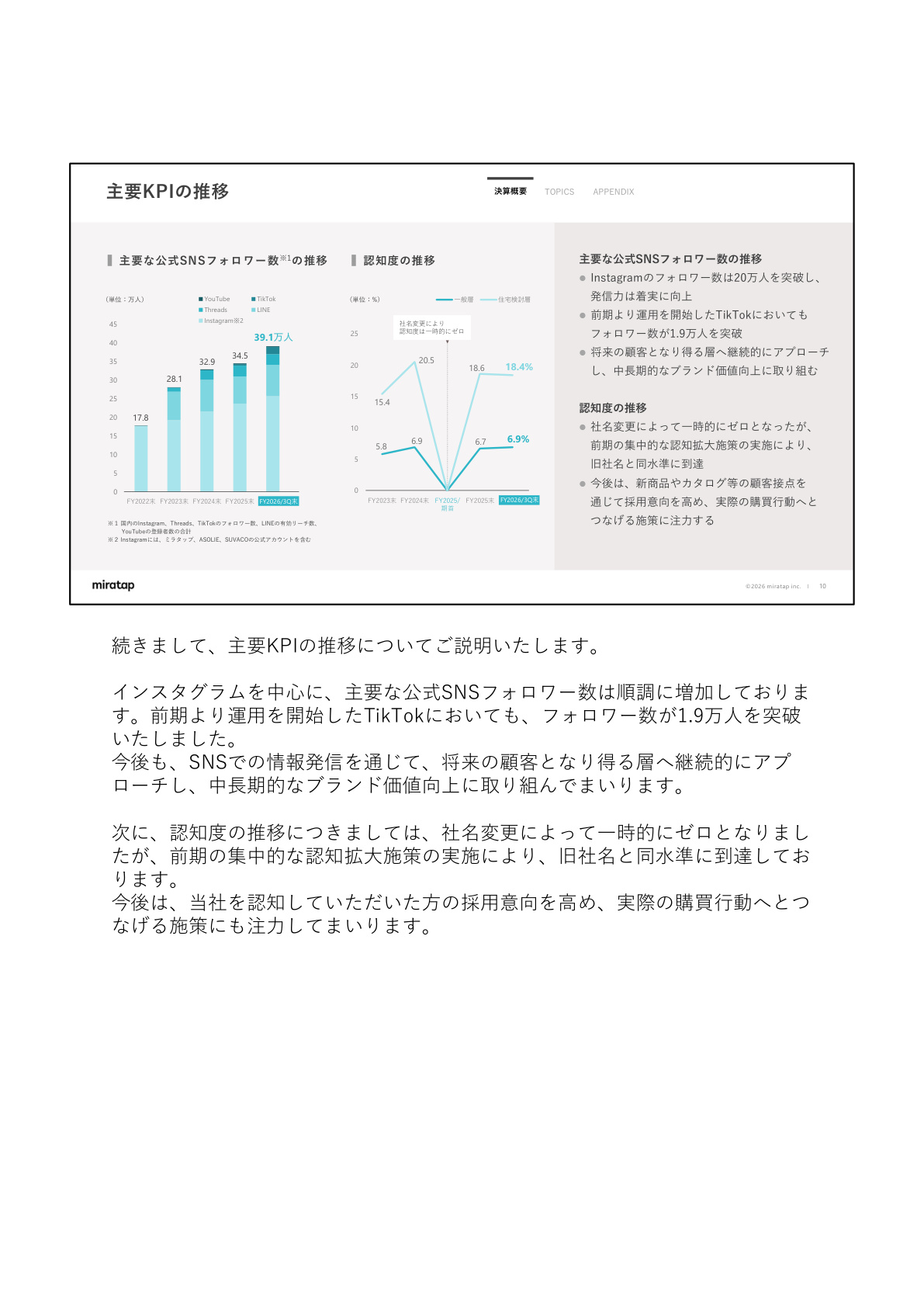
Brand awareness, which dipped temporarily immediately after the name change, has recovered to 6.9% among the general public and 18.4% among those considering home purchases, returning to levels comparable to the former company name era.
Total followers on official social media have reached 391,000 , with Instagram surpassing 200,000 and TikTok exceeding 19,000. This has significantly strengthened the company's ability to reach digital-native generations and first-time homebuyers directly. Anticipating changes in the web search environment, the company is shifting its KPIs from EC site traffic to social media follower bases, focusing on improving conversion rates to actual purchases.
7. Mid-to-Long-Term Growth Strategy: Business Expansion and High Value-Added Offerings
In its medium-term management plan, the company defines the current period as a "Leap Phase," aiming for high growth that significantly outpaces the market.
As shown in the roadmap above, the pillars of the strategy are "Strengthening Product Competitiveness" and "Advancing Sales Strategy."
- Full-Scale Entry into Home Appliances : Following the original "Toar" lighting launched in May 2025, the company released its first original home appliance, the "InViera Built-in Refrigerator," in May 2026. By pursuing a flat design that harmonizes with the space, the company is realizing total space proposals that integrate housing equipment and appliances.
- Expansion of Flagship Products : The company is introducing new products targeting the high-end market, such as the full-ceramic kitchen "Giora" and the large-format tile "Basalti," to increase average unit prices.
- Diversification of Sales Channels and Promotion : Initiatives include the acquisition of the architectural professional platform "SUVACO," the start of sales for select products on Amazon, the optimization of TV advertising from traditional spots to catch-up TV streaming (TVer), and continued participation in nationwide exhibitions, creating a multi-channel path from awareness to purchase.
8. Company-wide Business Transformation (DX) through AI
To overcome labor shortages and improve productivity, the company is promoting advanced AI utilization across the organization. In April 2026, the company's proprietary AI employee "Mira Nina" joined the team, beginning customer service duties in showrooms and appearing in AI-avatar form for earnings presentation videos.
Internally, in addition to providing generative AI tools to all employees, the company introduced a unique skill visualization index called "mirAIs." The goal for this term is for the entire company to move beyond "Level 0 (Not yet started)" and transition to an "AI-Ready" state. The strategy is to shift human resources freed up by the automation of customer service and routine tasks into the more profitable B2B corporate sales sector.
9. Progress of Structural Reform and Conclusion
Starting from the fiscal year ending September 2026, Miratap has transitioned to non-consolidated financial reporting following the sale of all shares in its former consolidated subsidiary (Best Bright Co., Ltd.). By shedding unprofitable factors, the profit structure has become leaner, creating an environment where the company's standalone profitability is directly reflected in its performance.
Based on its strong differentiator—the industry-first "Web Direct-to-Consumer, One-Price Model" —the company is simultaneously pushing forward with the expansion of product categories including home appliances, operational efficiency through AI, and the strengthening of its financial foundation. These efforts toward the "Leap Phase" are beginning to show steady results in the numbers.
This content is not intended as investment advice or a recommendation. Any opinions expressed are solely the personal views of each article.