


Japan Hotel REIT Investment Corporation H1 FY2026 Earnings Deep Dive: A Sustainable Growth Model Driven by Large-Scale Capital Recycling and Proactive Value-Add Strategies

StockClub
Published: Aug 26, 2026, 09:56 AM
Sentiment Analysis
1. Executive Summary
Japan Hotel REIT Investment Corporation (JHR, Ticker: 8985) delivered strong results for the first half of the 27th fiscal period (ending December 2026), characterized by a robust recovery in inbound demand and the successful execution of proactive asset management . These factors culminated in significant growth in both revenue and profit, alongside an upward revision to the distribution per unit (DPU) forecast.
A key highlight of the period was the execution of a large-scale capital recycling strategy, involving the acquisition of the "Hyatt Regency Tokyo" (¥126 billion) via a public offering, coupled with the divestment of "The Beach Tower Okinawa" at approximately five times its book value (sale price: ¥30.9 billion; gain on sale: ¥24 billion) and the acquisition of "Candeo Hotels Osaka Namba" (¥14.3 billion) .
As a result, the full-year DPU forecast for the fiscal period ending December 2026 has been revised upward to ¥5,811 (+14.8% YoY, +4.1% vs. previous forecast) . The portfolio size has expanded rapidly to ¥907.6 billion on an appraisal value basis (with unrealized gains of ¥255.6 billion) , while simultaneously achieving a reduction in market-value LTV and an expansion of liquidity.
2. H1 Earnings Highlights and Upward Revision of Full-Year Forecast
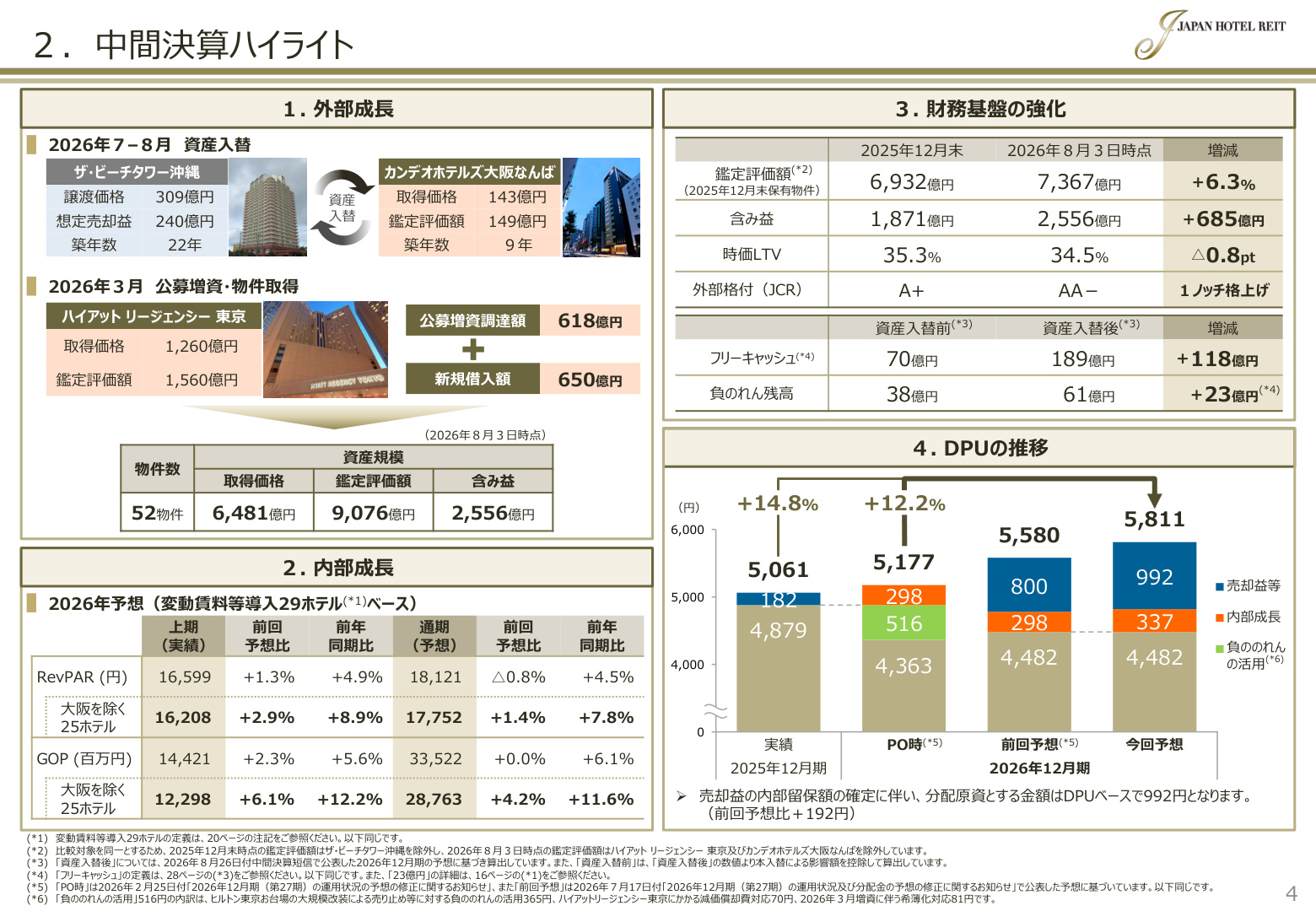
The slide above summarizes the key achievements of the interim results across four pillars: "External Growth," "Internal Growth," "Strengthening Financial Base," and "DPU Trends."
Key Performance Metrics (Full-Year Forecasts)
- Operating Revenue : ¥75.124 billion (+64.9% YoY)
- Operating Income : ¥58.372 billion (+88.0% YoY)
- Net Income : ¥52.099 billion (+91.9% YoY)
- Distribution Per Unit (DPU) : ¥5,811 (an increase of ¥750 or +14.8% from the previous period's ¥5,061)
The primary drivers for the significant increase in full-year revenue and profit are the booking of ¥24.071 billion in gains on the sale of real estate , the full-year contribution of newly acquired properties, and the rise in RevPAR (Revenue Per Available Room) across existing hotels. The REIT plans to retain approximately ¥18.1 billion of the gain on sale as a reserve for special tax treatment on replacement of assets to fund future growth and stable dividends, while returning ¥992 per unit in DPU to unitholders.
3. The Full Scope of Large-Scale Capital Recycling and Maximizing Capital Efficiency
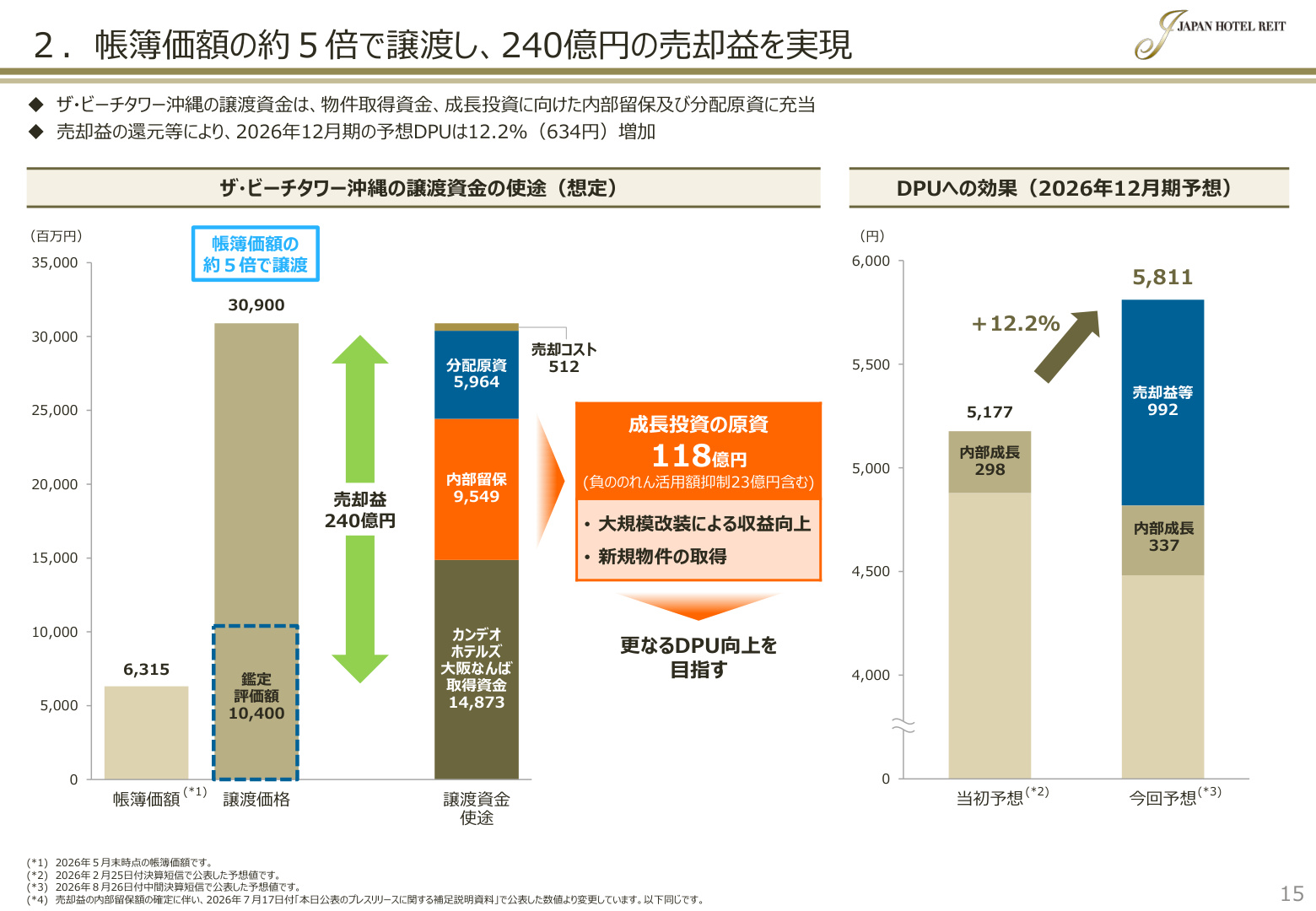
This slide clearly illustrates the use of proceeds from the sale of "The Beach Tower Okinawa" and its structural impact on DPU and financial health.
Strategic Points of Capital Recycling
- Divestment at ~5x Book Value : Sold for ¥30.9 billion against a book value of ¥6.315 billion (appraisal value of ¥10.4 billion), realizing a gain on sale of ¥24 billion .
- Generation of ¥11.8 Billion for Growth Investment : Of the ¥30.9 billion proceeds, ¥14.873 billion was allocated to the acquisition of "Candeo Hotels Osaka Namba." Furthermore, by securing ¥95.49 billion in internal reserves and optimizing negative goodwill utilization, the REIT generated ¥11.8 billion in free cash for future growth investments.
- Portfolio Rejuvenation and Quality Enhancement : Replaced the 22.3-year-old "The Beach Tower Okinawa" with the 9.2-year-old "Candeo Hotels Osaka Namba" (completed in 2017). This reduces future large-scale capital expenditure burdens while securing a high-quality asset in the Osaka Minami area, which benefits from strong inbound demand.
4. Hotel Operational Trends and Strength of Internal Growth
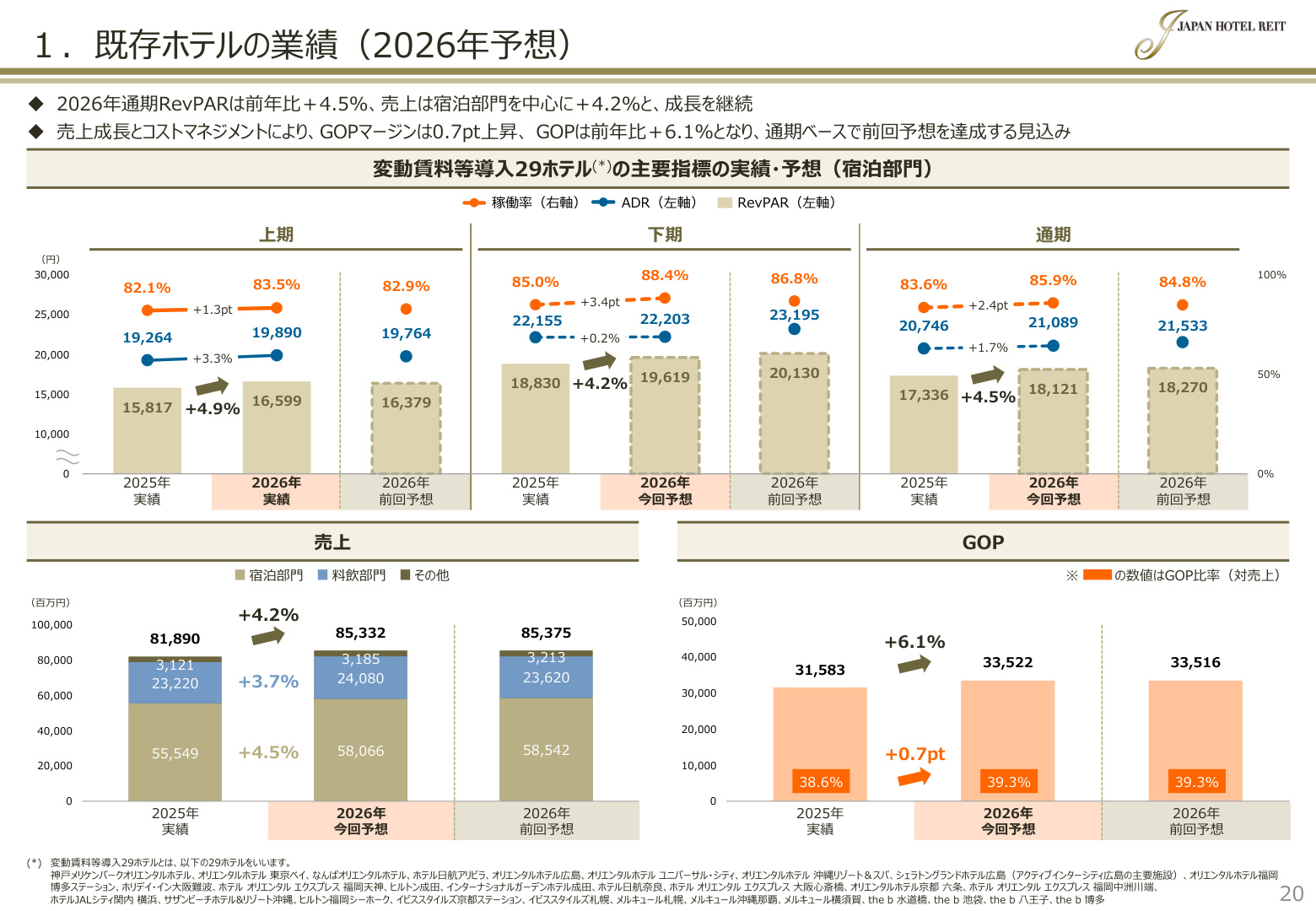
As shown in the slide above, hotel operational performance for the 29 hotels with variable rent structures remains exceptionally strong.
Key KPI Trends (29 Hotels with Variable Rent, Full-Year Forecast)
- Occupancy : 85.9% (+2.4 pts YoY)
- Average Daily Rate (ADR) : ¥21,089 (+1.7% YoY)
- RevPAR : ¥18,121 (+4.5% YoY)
- Total Revenue : ¥85.332 billion (+4.2% YoY)
- GOP (Gross Operating Profit) : ¥33.522 billion (+6.1% YoY)
- GOP Margin : 39.3% (+0.7 pts improvement YoY)
Regional Polarization and Recovery Scenarios
Regionally, RevPAR significantly outperformed the previous year in all areas except Osaka, including Okinawa (+9.6%), China (+9.2%), Kyushu (+8.9%), and Kanto (excluding Tokyo, +8.3%). Meanwhile, the Osaka area (4 hotels) is experiencing a temporary adjustment phase with RevPAR down 12.5% YoY due to a slowdown in travel demand from China. However, driven by the capture of non-Chinese inbound demand and limited new hotel supply (projected at only 0.6% of stock for 2027–2028), a gradual recovery is expected starting in 2027, with 2026 marking the bottom .
5. Value-Add Through Strategic CAPEX, Rebranding, and Rent Revisions
JHR is aggressively pursuing profitability improvements (realizing upside) through proactive asset management beyond mere property ownership.
- Acceleration of Strategic CAPEX :
- Okinawa Harborview Hotel (Full renovation: ¥3.85 billion, completed May 2026)
- Hilton Tokyo Odaiba (Full renovation: ¥10.85 billion, scheduled Feb 2026–Dec 2027) Focusing on repositioning investments to attract high-spending customers while keeping expenditures within the scope of depreciation.
- Operator Changes and Rebranding : Promoting tenant changes and rebranding to HMJ (Hotel Management Japan Co., Ltd.), a group company of the asset manager. At "Oriental Hotel Okinawa Resort & Spa," rebranding and renovations led to a 96.5% increase in RevPAR and a surge in NOI yield from 5.6% to 12.3% .
- Rent Revisions Upon Expiration of Fixed-Term Lease Agreements : At "Hakone Gora Onsen Setsugetsuka," the lease was converted from fixed rent to GOP-linked variable rent, increasing NOI yield from 6.6% to 15.6% . Similarly, "Dormy Inn Kumamoto" saw its yield rise from 11.3% to 15.5% , establishing a scheme that directly reflects strong hotel performance in distributions.
6. Strengthening Financial Base and Resilience to Rising Interest Rates
As the world shifts toward a "higher interest rate" environment, the soundness of financial management has been further reinforced.
- LTV Control : Total asset LTV is 46.9% , and market-value LTV has decreased to 34.5% (-0.8 pts vs. pre-asset replacement), maintaining disciplined financial operations (targeting market-value LTV below 40%).
- Expansion of Unrealized Gains and NAV : Total unrealized gains for the portfolio have grown to ¥255.6 billion (unrealized gain ratio of 39.2%). NAV per unit has reached ¥95,334 .
- Credit Rating Upgrades : JCR rating upgraded from "A+" to "AA-" , and R&I rating upgraded from "A" to "A+" (May 2026).
- Fixed Interest Ratio and Sensitivity : Maintained a fixed interest ratio of 78.5% and an average remaining duration of 3.4 years. The structure is designed to fully absorb a +0.5% to +1.0% rise in Bank of Japan policy rates if RevPAR grows by +2.6% to +3.4%.
7. Conclusion
Japan Hotel REIT's H1 FY2026 results successfully combined the acquisition of prime international flagship hotels with capital recycling that significantly realized unrealized gains. By balancing the proceeds and cash across three pillars— "Unitholder Returns (significant DPU increase)," "Future Growth Investment (¥11.8 billion in internal reserves)," and "Financial Strengthening (34.5% market-value LTV, AA- rating)" —the REIT has established a robust growth platform capable of withstanding future interest rate hikes and market volatility.
This content is not intended as investment advice or a recommendation. Any opinions expressed are solely the personal views of each article.