


Fujisan Magazine Service (3138) Q2 FY2026 Earnings Deep Dive: The 'Three Arrows' of Structural Transformation and Future Outlook

StockClub
Published: Aug 26, 2026, 09:51 AM
Sentiment Analysis

Executive Summary
Fujisan Magazine Service Co., Ltd. (Tokyo Stock Exchange Growth: 3138) operates one of Japan's largest e-commerce platforms for magazine subscriptions, "Fujisan.co.jp," while actively expanding into digital agency services and new business domains such as EdTech.
For the second quarter of the fiscal year ending December 2026 (cumulative), the company reported net sales of 2,930 million yen (up 2.4% YoY) . However, operating profit stood at 30 million yen (down 39.5% YoY) , and the net loss attributable to owners of the parent was 12 million yen (compared to a profit of 20 million yen in the same period last year) . While growth in new business areas partially offset negative factors—such as the impact of stricter credit card payment authentication, amortization of goodwill from its subsidiary Seeds Factory, and a decline in advertising revenue—the results fell short of initial projections, leading to a downward revision of the full-year earnings forecast.
Nevertheless, the company has clearly articulated its transition from a traditional "online bookstore for print magazines" to a "company supporting hobbies, subscriptions, and Ikigai." It is simultaneously executing capital policies, including approval for a market transition to the TSE Standard Market (February 25, 2026) and the implementation of a 16-yen per share dividend policy alongside an expanded shareholder benefit program.
1. Business Structure and Model: The "Three Arrows" Strategy
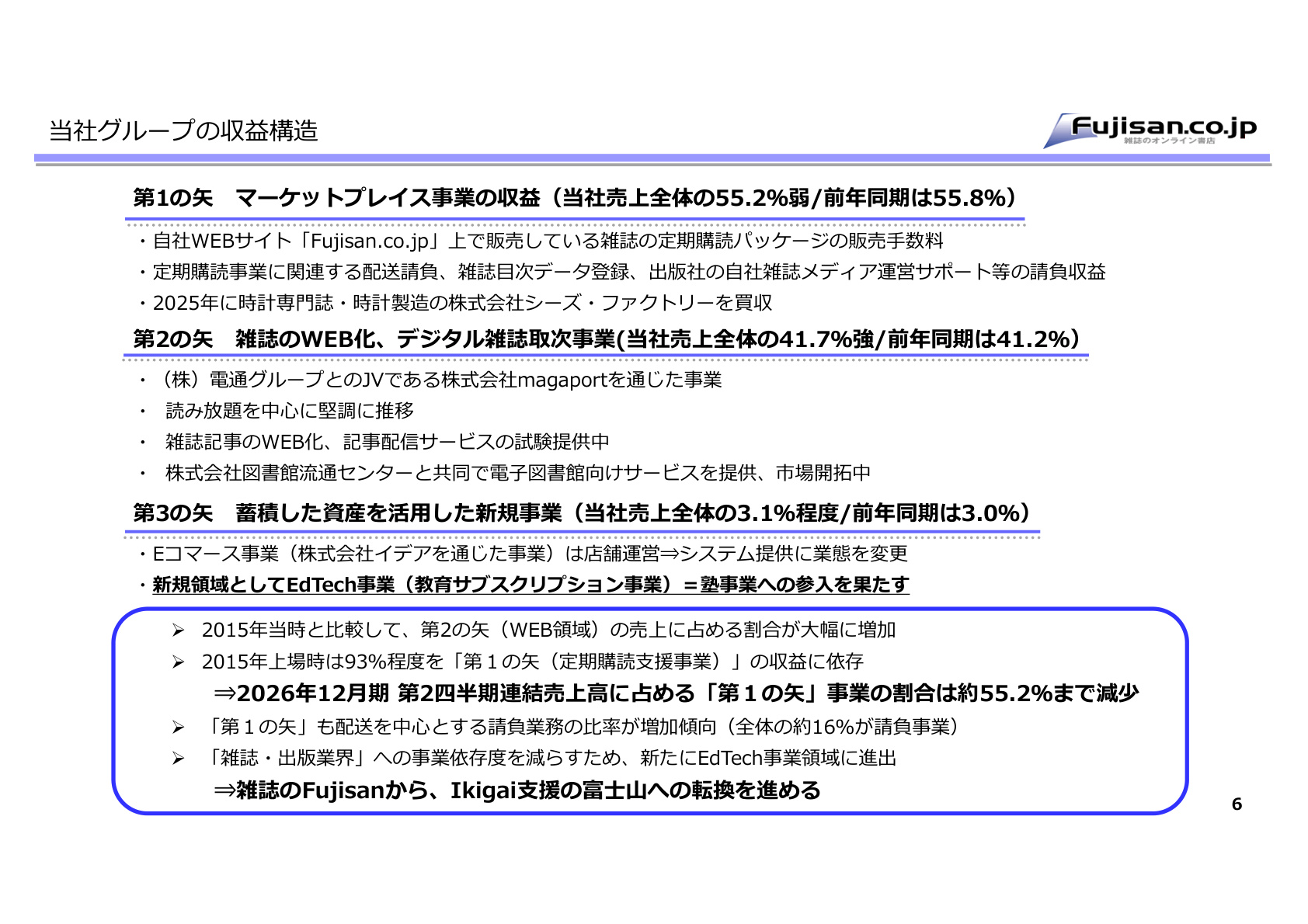
Fujisan Magazine Service's revenue base is built on three pillars: the "First Arrow (Marketplace Business)," the "Second Arrow (Digital Agency Business)," and the "Third Arrow (New Business/EdTech)."
Significance of the Slide and Background
The slide above is the most critical for understanding how the company has diversified and transformed its structure since its IPO in 2015, when it relied on a single business model.
- Dependence on the First Arrow has dropped from approximately 93% at the time of the IPO to about 55.2% as of Q2 FY2026.
- In its place, the Second Arrow (digital agency/web conversion) , centered on the joint venture with the Dentsu Group, magaport Inc., has grown into a second pillar, accounting for approximately 41.7% of total sales .
- Furthermore, the Third Arrow (EdTech, etc.) , which includes education and cram school businesses, has shifted to comprise 3.1% of the total structure.
Business Characteristics of Each Segment
- First Arrow: Magazine Subscription Marketplace
- A long-tail model featuring approximately 10,000 magazines. The company does not hold inventory and receives service fees from publishers.
- The average retention rate for subscription contracts remains at the 70% level , forming a stable recurring revenue base.
- Second Arrow: Web Conversion and Digital Agency for Magazines
- Promotes agency services for "all-you-can-read" platforms and develops markets for digital library services in collaboration with TRC (Library Marketing Co., Ltd.).
- Commenced full-scale feasibility studies for AI-driven article distribution services in partnership with ABEJA, Inc.
- **Third Arrow: New Businesses Utilizing Accumulated Assets (EdTech/Cram Schools)
- Operates the "Fujisan Academia Group," which integrates the expertise of Showa Publishing, the Mirica Group (Create Kenkyukai), and Veritas Academy.
2. Q2 FY2026 Earnings Highlights
Key Financial Metrics
- ** Net Sales **: 2,930 million yen (93.4% of initial forecast, +2.4% YoY)
- ** Operating Profit **: 30 million yen (39.5% of initial forecast, -39.5% YoY)
- ** Ordinary Profit **: 28 million yen (38.4% of initial forecast, -44.4% YoY)
- ** Net Profit Attributable to Owners of Parent **: -12 million yen (Initial forecast: 41 million yen, Previous year: 20 million yen)
- ** Total Registered Users **: 4,504,720 (+2.8% YoY)
- ** Paying Users **: 481,257 (-9.0% YoY)
While net sales increased due to contributions from the Second Arrow (+43 million yen) and the First Arrow (+22 million yen), profitability was significantly lower than planned due to a decline in high-margin products and an increase in one-time expenses.
3. Analysis of Operating Profit Variance
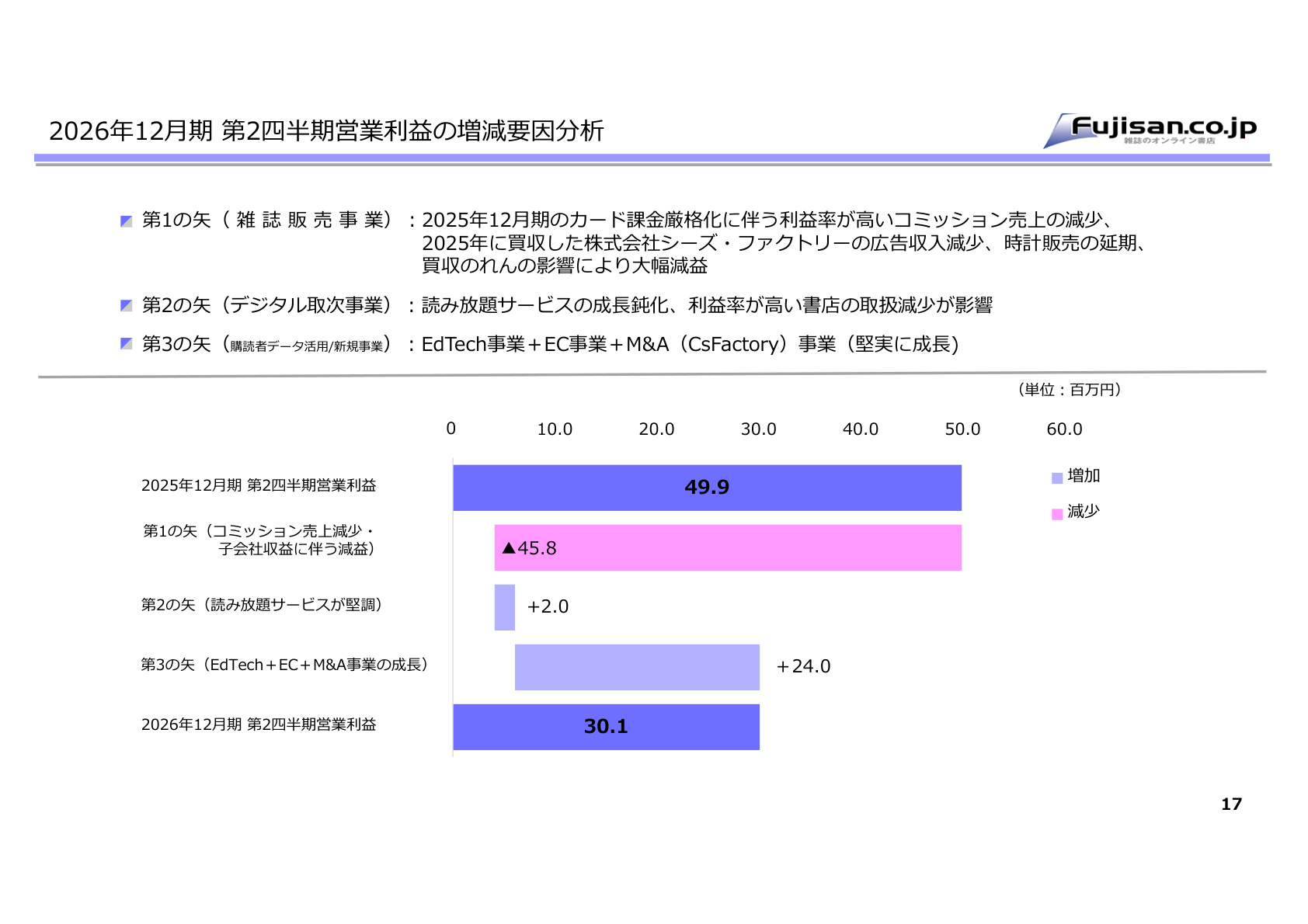
Details of the operating profit variance in Q2 (from 49.9 million yen in the previous year to 30.1 million yen this period, a decrease of 19.8 million yen) are as follows:
Significance of the Slide and Background
The slide above visualizes the profit and loss impact by segment. It clearly shows that the primary cause of the profit decline is the ** "decrease in high-margin commissions in the First Arrow." **
- ** First Arrow (Negative impact of 45.8 million yen): **
- Due to the ** stricter credit card billing and identity verification ** implemented in Q1 FY2025, the re-acquisition of customers who canceled subscriptions did not proceed as planned, leading to a decline in high-margin commission revenue.
- The burden of decreased advertising revenue at Seeds Factory (acquired in 2025), the postponement of watch sales, and the ** incurrence of goodwill amortization ** following the acquisition.
- ** Second Arrow (Positive impact of 2.0 million yen): **
- Although the growth rate of "all-you-can-read" services slowed, it maintained a steady trend.
- ** Third Arrow (Positive impact of 24.0 million yen): **
- EdTech, e-commerce, and M&A-related businesses grew steadily and began contributing to profits.
Structural Factors in Cost of Sales and SG&A
- ** Cost of Sales **: 2,125 million yen (2,064 million yen in the same period last year). While ** depreciation expenses (159 million yen) ** related to software development through 2024 remain high, the company plans to curb development investment from 2026 onwards.
- ** SG&A Expenses **: 774 million yen (746 million yen in the same period last year). In addition to increased personnel costs (157 million yen), ** shareholder benefit expenses significantly increased ** due to the expansion of the shareholder incentive program.
4. Financial Soundness and Cash Position
On the balance sheet, the ** cash and deposits balance as of the end of Q2 2026 is 3,308 million yen **. However, this includes deposits from subscribers and funds earmarked for payments to publishers; the company explains that the ** actual cash and deposits balance is approximately 1,500 million yen **.
Net assets are maintained at ** 2,454 million yen (equity ratio of approximately 42%) **, ensuring financial stability.
5. Revision of Full-Year Earnings Forecast and Business Policy
Based on progress through Q2, the company revised its full-year consolidated earnings forecast on July 31, 2026.
| Item | Previous Forecast (A) | Revised Forecast (B) | Change (B-A) | Change (%) | FY2025 Actual |
|---|---|---|---|---|---|
| ** Transaction Volume ** | - | 12,000 million yen | - | - | 11,146 million yen |
| ** Net Sales ** | 6,276 million yen | ** 6,187 million yen ** | -89 million yen | -1.4% | 5,814 million yen |
| ** Operating Profit ** | 174 million yen | ** 81 million yen ** | -93 million yen | -53.4% | 162 million yen |
| ** Ordinary Profit ** | 172 million yen | ** 89 million yen ** | -83 million yen | -48.3% | - |
| ** Net Profit ** | 96 million yen | ** 12 million yen ** | -84 million yen | -87.5% | - |
| ** EPS ** | 29.07 yen | ** 3.63 yen ** | - | - | - |
Key Initiatives for the Second Half
- ** First Arrow **: Thorough cost reduction, expansion of mook books and manga products, and support for publishers' web conversion.
- ** Second Arrow **: Promotion of AI-related businesses utilizing magazine article data and expansion into corporate CMS operation services.
- ** Third Arrow **: Building the foundation for existing cram school businesses, entering the junior high school entrance exam tutoring market, and franchising online individual medical school tutoring for regional students.
6. Market Transition and Shareholder Return Policy
While the company is in a transitional phase of structural reform, it is actively promoting market transition and shareholder returns.
Significance of the Slide and Background
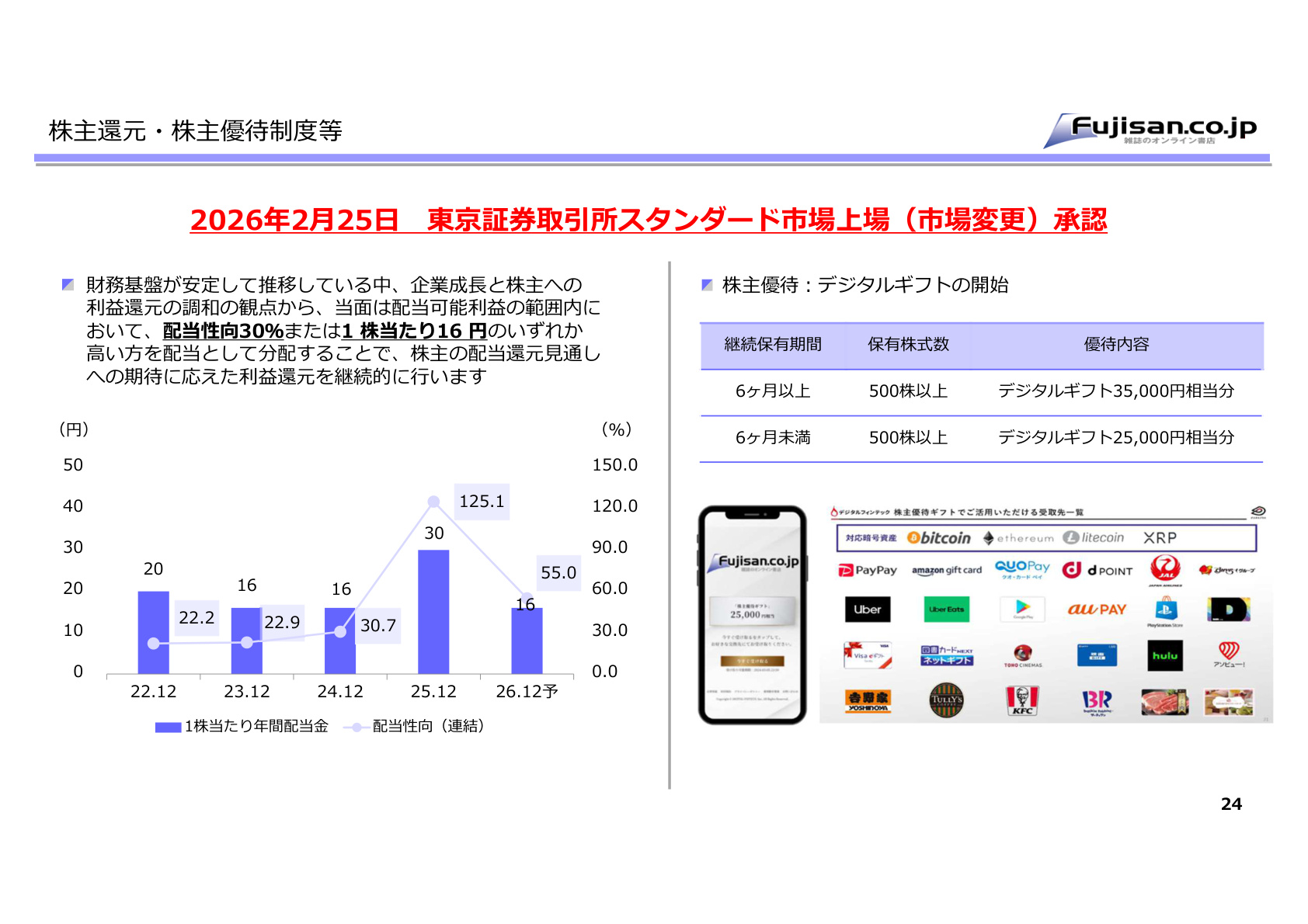
The slide above is a key page summarizing the company's capital policy and investor incentive design.
- ** Approval for Market Transition to TSE Standard Market (February 25, 2026): **
- Implemented to improve liquidity and social credibility.
- ** Dividend Policy: **
- Adheres to a policy of paying the higher of a ** "30% dividend payout ratio" or "16 yen per share annually." ** Even in FY2026, where net profit was revised downward, the company plans to pay a ** 16-yen dividend per share (expected payout ratio of 55.0%) **.
- ** Shareholder Benefit Program (Digital Gift): **
- Shareholders holding 500 shares or more receive ** 35,000 yen worth of digital gifts annually ** for holding periods of 6 months or more, and ** 25,000 yen worth annually ** for less than 6 months (exchangeable for various crypto assets, code payments, e-commerce points, etc.).
7. Mid-to-Long-Term Growth Scenario and Challenges
Fujisan Magazine Service is shifting from a single business entity centered on "print magazine sales" to the following directions:
- ** Redefinition from "Magazine Bookstore" to "Hobbies, Subscriptions, and Ikigai Support" **
- Utilizing approximately 4.5 million registered users and purchasing data to operate fan clubs and expand into "Maga-Commerce" (merchandise sales).
- ** Monetization of EdTech and Exit Strategy **
- Expanding the business by combining medical preparatory schools and online learning content, with an eye toward future investment recovery (equity transfer or exit).
- ** Management Challenges**
- Re-growing the number of active paying users, which declined following stricter card payment authentication.
- Early recovery of depreciation expenses related to past system investments and goodwill from M&A.
- Ensuring the growth speed of new businesses (AI, EdTech, digital agency) exceeds the long-term downward trend of the magazine market.
This content is not intended as investment advice or a recommendation. Any opinions expressed are solely the personal views of each article.