


Invincible Investment Corporation: Fiscal Period Ended June 2026 Earnings Analysis – Portfolio Resilience Amidst Post-Expo Headwinds and Growth Strategy Toward DPU of Over ¥4,500 by 2029

StockClub
Published: Aug 25, 2026, 09:56 AM
Sentiment Analysis
Executive Summary
Invincible Investment Corporation (Ticker: 8963) is a diversified J-REIT primarily focused on hotels and residential properties. In the fiscal period ended June 2026, the REIT achieved growth in both revenue and profit , despite facing significant headwinds including the post-Expo (Osaka-Kansai Expo 2025) decline in lodging demand and a decrease in Chinese inbound travelers due to deteriorating Japan-China relations. Driven by contributions from properties acquired in August 2025, strong performance in overseas hotels (Cayman Islands), and the expansion of non-Kansai domestic demand and non-Chinese inbound tourism, Distribution Per Unit (DPU) reached ¥1,930 , marking the highest level for a June fiscal period since the REIT's rebranding in February 2010.
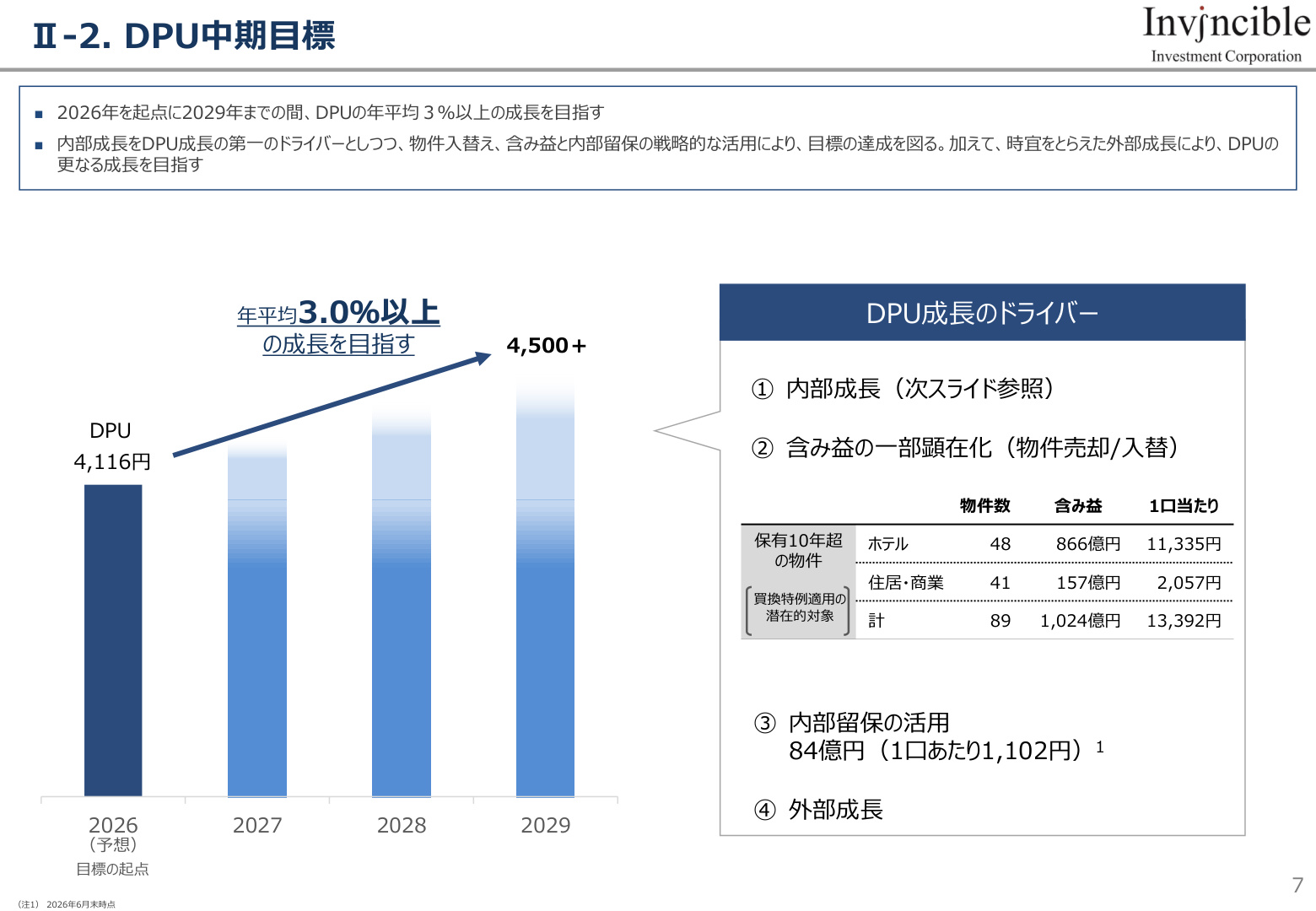
Regarding its medium-to-long-term strategy, the REIT has established a new mid-term goal of achieving an average annual DPU growth of 3.0% or more (surpassing ¥4,500 annually) by 2029 . The strategy centers on internal growth through aggressive strategic CAPEX, combined with the realization of over ¥100 billion in unrealized gains (via property sales and replacements) and the strategic utilization of internal reserves to steadily enhance unitholder value.
1. Fiscal Period Ended June 2026: Earnings Highlights
The financial results and year-on-year comparisons for the current period are shown in the table and slide below.
Key Financial Metrics and Factor Analysis
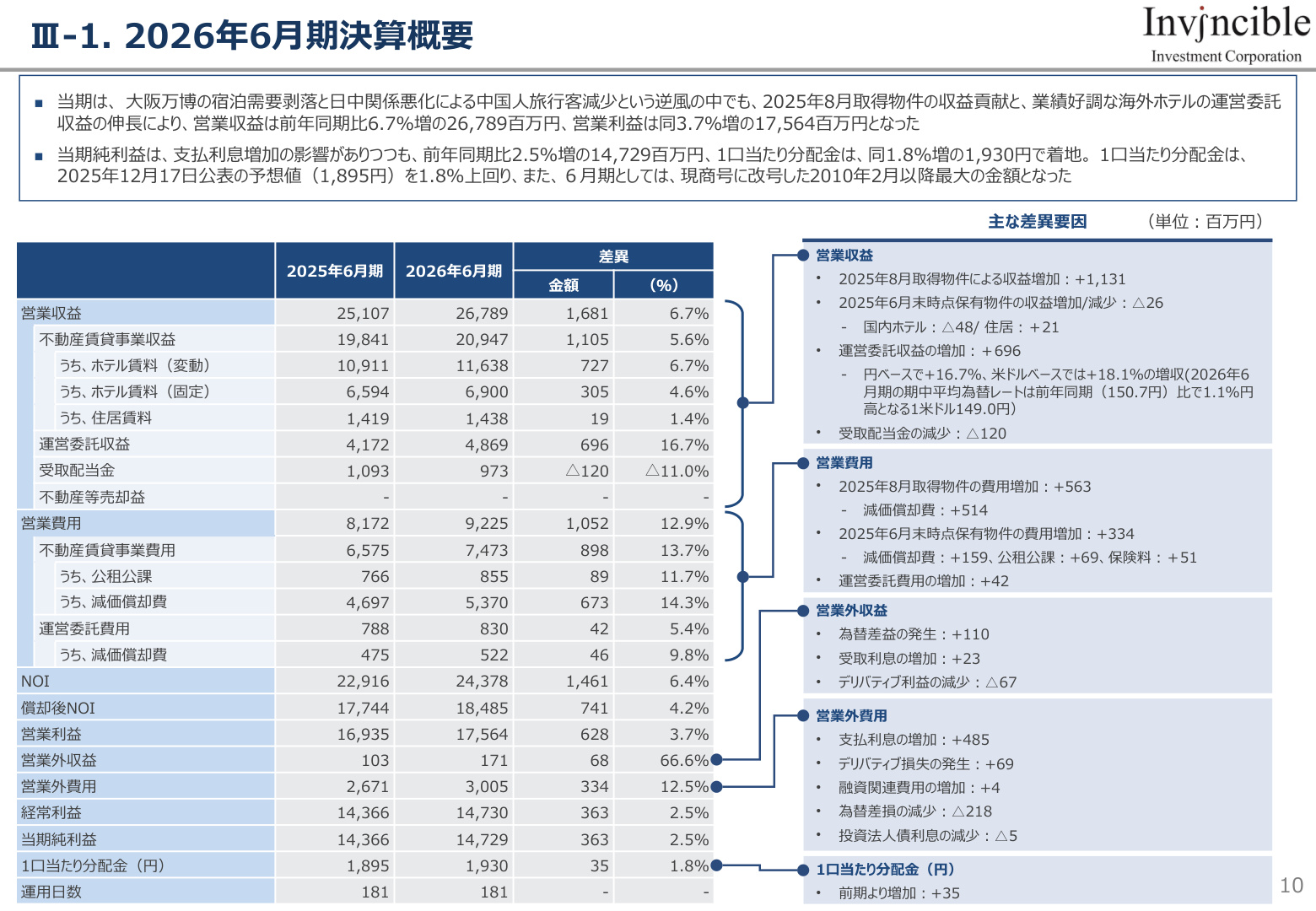
- Operating Revenue: ¥26,789 million (+6.7% YoY)
- Real estate leasing revenue rose 5.6% YoY to ¥20,947 million. Specifically, hotel variable rent grew steadily to ¥11,638 million (+6.7%), and fixed rent reached ¥6,900 million (+4.6%).
- Operating management revenue from the two Cayman hotels and others recorded double-digit growth of ¥4,869 million (+16.7%). In USD terms, this represented a robust increase of +18.1%.
- Operating Profit: ¥17,564 million (+3.7% YoY)
- Net Income: ¥14,729 million (+2.5% YoY)
- Distribution Per Unit (DPU): ¥1,930 (+1.8% YoY, +1.8% vs. initial forecast)
- This exceeded the forecast of ¥1,895 announced in December 2025 by ¥35.
- Period-End Appraisal Value: ¥848,295 million (+2.1% vs. previous period, +¥17,233 million)
- The asset value of the entire portfolio continues to grow steadily.
Profit growth was driven by property acquisition effects (+¥1,131 million) and increased earnings from overseas hotels (+¥696 million), which offset rising costs such as interest expenses due to higher interest rates, as well as increased taxes and depreciation.
2. Earnings Forecasts and Outlook (Periods Ending December 2026 and June 2027)
Forecast for the Period Ending December 2026
- Operating Revenue: ¥28,045 million (-1.9% YoY)
- Operating Profit: ¥18,382 million (-4.8% YoY)
- Net Income: ¥14,988 million (-10.2% YoY)
- Distribution Per Unit (DPU): ¥2,186 (Maintaining the same level as the previous year)
- Outlook Background: The forecast incorporates the full-scale impact of the post-Expo demand decline and deteriorating Japan-China relations, including lower dividend income from the TMK backed by the Sheraton Grande Tokyo Bay Hotel due to increased borrowing costs, and sluggish group travel at Cayman hotels. However, the REIT plans to maintain a DPU of ¥2,186, equal to the previous year, by utilizing retained earnings .
Forecast for the Period Ending June 2027
- Operating Revenue: ¥27,935 million (+4.3% YoY)
- Operating Profit: ¥18,417 million (+4.9% YoY)
- Net Income: ¥14,873 million (+1.0% YoY)
- Distribution Per Unit (DPU): ¥1,949 (+1.0% YoY)
- Outlook Background: With the fading impact of the post-Expo decline, recovery in domestic hotel variable rent (+7.8%), and the completion of renovations at Cayman hotels, the REIT expects to further update its record-high DPU for a June fiscal period .
3. Domestic Hotel Portfolio Operations and Demand Structure
The performance of the 101 domestic hotels operated by the primary operator, Mystays Hotel Management (Iconia Hospitality: ICN), is as follows:
Regional and Nationality-Based Trends
- Overall Metrics: For the 101 ICN properties, room revenue increased by +1.7% YoY, RevPAR was ¥11,722 (+1.6%), ADR was ¥13,849 (+0.7%), and occupancy rate was 84.6% (+0.8pt).
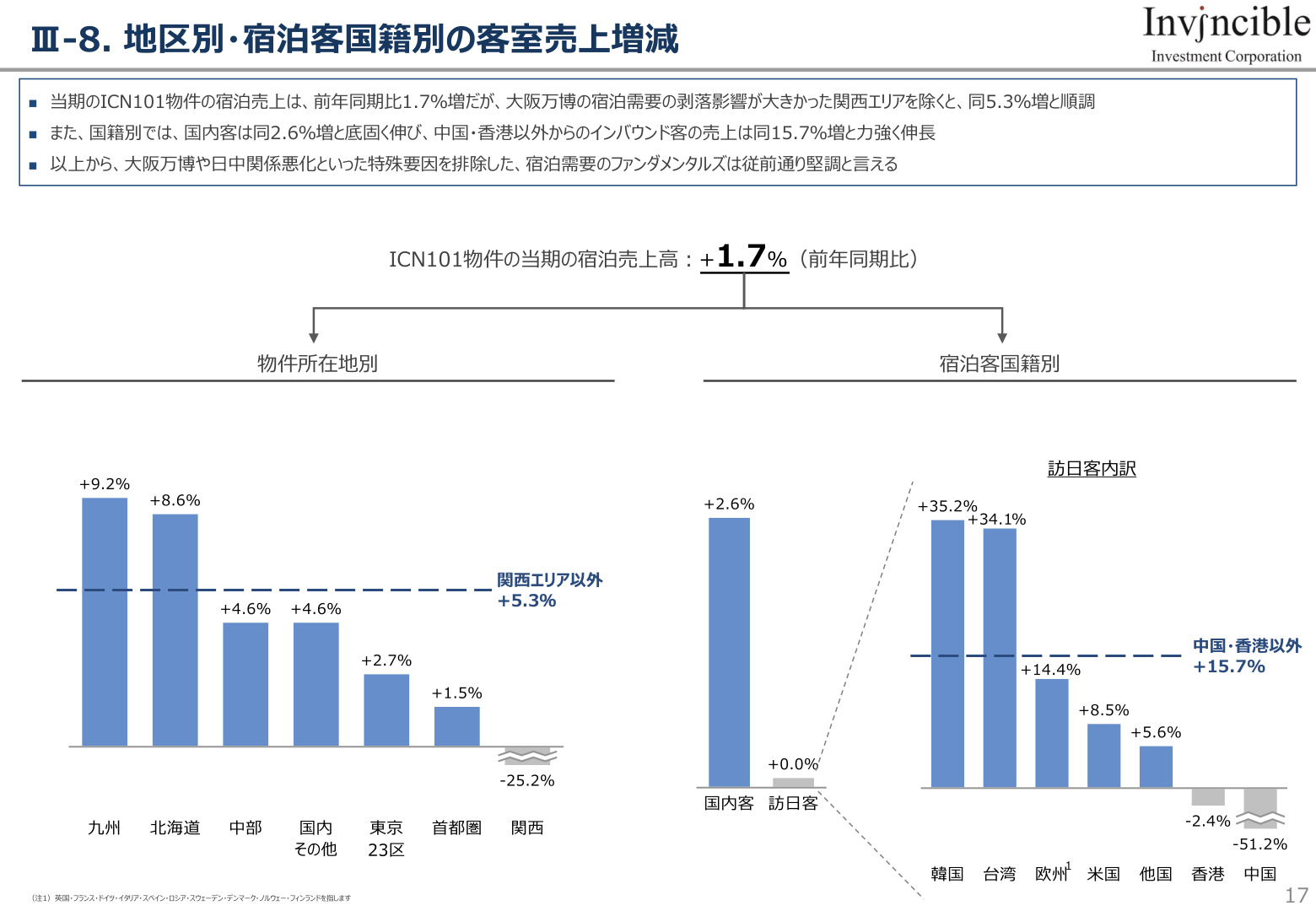
- Kansai Impact vs. Other Regions: While the Kansai area saw a significant decline in room revenue of -25.2% YoY due to the post-Expo slump, areas outside of Kansai grew strongly by +5.3% YoY (Kyushu +9.2%, Hokkaido +8.6%, Chubu +4.6%, Tokyo 23 Wards +2.7%). The geographically diversified portfolio structure functioned as an effective risk hedge.
- Inbound Nationality Shifts: Revenue from Chinese guests fell by -51.2% YoY , and Hong Kong guests fell by -2.4%. However, inbound revenue from outside China and Hong Kong surged by +15.7% (South Korea +35.2%, Taiwan +34.1%, Europe +14.4%, USA +8.5%). Domestic demand also remained solid at +2.6%, indicating a reduction in dependency on China and a diversification of demand sources.
- Growth in Non-Room Departments: Revenue from food and beverage departments, including banquets, conferences, and restaurants, remained steady at +5.6% YoY (+7.2% excluding Kansai) , contributing to overall earnings stability.
4. Overseas Hotel and Residential Portfolio Operations
- Cayman Islands Hotels (2 properties):
- Driven by an increase in flights to the Cayman Islands (+20.1% YoY) and strong visitor numbers (+11.3%), RevPAR achieved a +15.5% increase to 481 USD . GOP rose 18.8% to 32.68 million USD.
- The room renovation effect at "The Sunshine Hotel & Suites" has materialized (ADR +29.4% vs. pre-renovation). Restaurant renovations were completed in June 2026, promising further profitability improvements.
- Residential Portfolio (41 properties):
- NOI increased by +1.8% YoY to ¥1,166 million . Efforts to improve occupancy and increase rents have progressed smoothly, serving as a stable, defensive revenue source.
5. DPU Mid-Term Goals and Growth Strategy (2026–2029)
In light of changing market conditions, the REIT has presented a new growth roadmap toward 2029.
Four Growth Drivers
- Internal Growth via Strategic CAPEX:
- A total of ¥22 billion in strategic CAPEX is planned over the three years from 2027 to 2029. The expected post-depreciation NOI yield is 7.0% , with an estimated annual DPU uplift of approximately ¥200 upon completion of all projects.
- (Examples) Rebranding renovation of "JR Clement Inn Takamatsu Hyogomachi" (investment ¥498 million, expected ROI 44.2%) and full-scale renovation of "Hotel Mystays Nagoya Sakae" (investment ¥779 million, expected ROI 11.8%).
- Realization of Unrealized Gains (Property Sales/Replacements):
- The REIT holds approximately ¥102.4 billion (approx. ¥13,392 per unit) in unrealized gains , primarily in properties held for over 10 years eligible for tax-deferred replacement. Strategic sales and replacements will generate gains to support DPU growth.
- Strategic Utilization of Internal Reserves:
- The REIT holds substantial internal reserves totaling ¥8.4 billion (¥1,102 per unit) . These will be flexibly utilized during short-term market fluctuations or temporary profit dips to stabilize distributions and support upward growth.
- Disciplined External Growth:
- The REIT maintains a rich sponsor pipeline, including approximately 60 hotels (approx. 7,000 rooms) operated by ICN. It will pursue acquisitions at optimal timing while carefully scrutinizing the cost of capital and market conditions (P/NAV trends).
6. Financial Management and Macro Environment Response
- Credit Rating Upgrade and Improved Procurement: Achieved an upgrade to "AA- (Stable)" from the Japan Credit Rating Agency (JCR), leading to improved borrowing spreads in refinancing.
- Hedging Interest Rate Risk: Utilizing interest rate swaps to maintain a fixed-interest rate ratio of approximately 60% . The REIT is strictly managing the diversification of repayment dates and lengthening average borrowing durations to respond to monetary tightening.
- Competitive Advantage in Hotel Supply: Due to soaring construction material and labor costs, new hotel supply plans in Japan remain constrained. The number of rooms per planned hotel is also decreasing (shifting toward smaller, luxury properties), suggesting that the supply-demand balance for existing mid-to-large-scale business hotels will remain tight over the medium-to-long term.
Conclusion
For the fiscal period ended June 2026, Invincible Investment Corporation achieved revenue and profit growth by absorbing the complex headwinds of the post-Osaka Expo decline and the slump in Chinese inbound tourism through its geographically diversified portfolio and the rapid expansion of non-Chinese inbound demand.
Looking ahead, the REIT plans to navigate the transition period in the fiscal period ending December 2026 using internal reserves, and expects to update its record-high DPU again in the fiscal period ending June 2027. Furthermore, with the dual engines of ¥22 billion in strategic CAPEX and the realization of over ¥100 billion in unrealized gains , the REIT has a clear growth story to achieve a DPU of over ¥4,500 by 2029 (average annual growth of +3.0%) .
This content is not intended as investment advice or a recommendation. Any opinions expressed are solely the personal views of each article.