


J.E.T. Co., Ltd. H1 FY2026 Earnings Analysis and Business Restructuring: Recap of Restatements, Performance Progress, and Growth Strategy Toward 2033

StockClub
Published: Aug 25, 2026, 09:53 AM
Sentiment Analysis
Introduction
J.E.T. Co., Ltd. (Securities Code: 6228), a manufacturer of semiconductor cleaning equipment, released its H1 FY2026 Earnings Presentation Materials on August 25, 2026.
This report provides an overview of the accounting irregularities from previous fiscal years, their causes, and preventive measures based on the findings of a Special Investigation Committee. It also details the performance trends and full-year forecasts for the first half of FY2026, as well as the direction of business restructuring and long-term numerical targets (targeting 50 billion yen in sales and 10 billion yen in operating profit by 2033) aimed at achieving stable profitability and a new phase of growth. This report summarizes the disclosed information into 10 key topics.
1. Overview of Accounting Irregularities and Impact on Past Financial Statements
In its development, manufacturing, and sales of semiconductor equipment, the company had adopted the "Installation Report Standard," which recognized revenue upon the completion of services associated with equipment setup. However, due to inadequate standards and operational oversight, the timing of revenue recognition was susceptible to manipulation. Investigations revealed that the company improperly manipulated the revenue recognition timing for 11 units between FY2022 and FY2024 .
The following table shows the restated key financial figures for each fiscal year based on the Special Investigation Committee's findings.
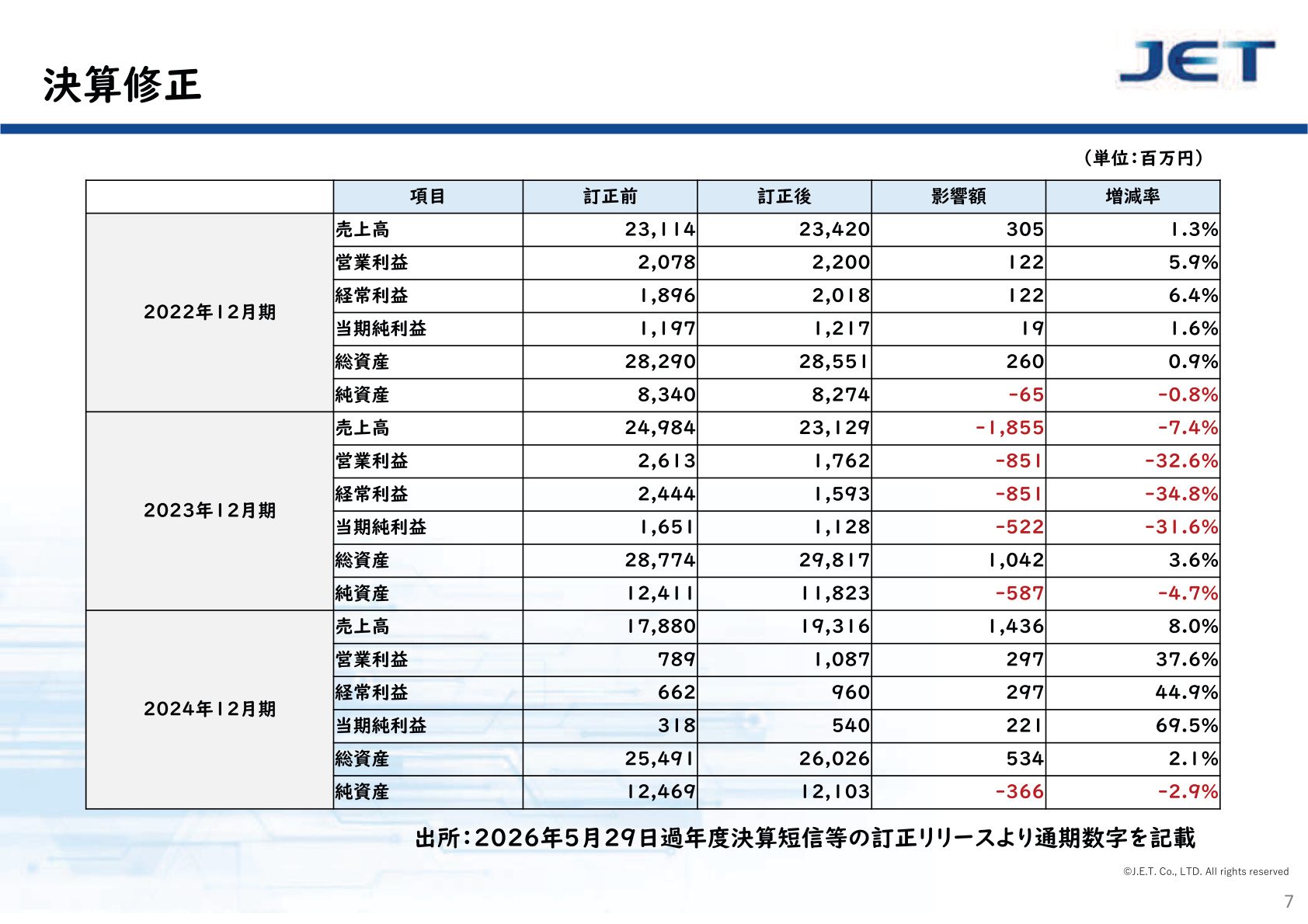
These restatements significantly adjusted the company's historical performance:
- FY2022 : Sales were revised upward to 23,420 million yen (+305 million yen vs. pre-restatement), and operating profit to 2,200 million yen (+122 million yen).
- FY2023 : Sales were significantly revised downward to 23,129 million yen (-1,855 million yen, -7.4%), and operating profit to 1,762 million yen (-851 million yen, -32.6%).
- FY2024 : Sales were revised upward to 19,316 million yen (+1,436 million yen, +8.0%), and operating profit to 1,087 million yen (+297 million yen, +37.6%).
In terms of net assets, the impact resulted in a decrease of 65 million yen at the end of FY2022, 587 million yen at the end of FY2023, and 366 million yen at the end of FY2024, finalizing the impact on the consolidated financial position.
2. Root Causes of Irregularities and Governance Challenges
The investigation identified five primary factors contributing to the irregularities:
- Management Competency : A lack of accounting literacy required for executives of a listed company among several members of management, including top leadership.
- Inadequate Revenue Recognition Standards : Internal regulations and manuals for the "Installation Report Standard" were incomplete, and there was a lack of thorough training and implementation.
- Lack of Oversight by the Finance Department : The approval flow for revenue recognition was completed entirely within the sales department, and there was effectively no director in charge of administrative departments, as the CFO also served as the CSO.
- Formalistic Internal Audits : Audits were limited to verifying signatures on installation reports, failing to validate the appropriateness of the period attribution or actual work progress.
- Weak Governance Structure : Insufficient sensitivity to accounting fraud risks among full-time corporate auditors and outside directors.
3. Preventive Measures and Transition to New Management
To prevent recurrence, the company is undergoing a fundamental overhaul of its organization and structure:
- Renewal of Executive Structure : Three directors involved in the incident resigned on July 15, 2026. Senior Managing Director Hiroyuki Hirai has been appointed as Representative Director, with plans to appoint a dedicated director for administrative departments at an extraordinary shareholders' meeting in September 2026.
- Stricter Revenue Recognition Processes : The definition of "installation completion" has been revised with the advice of certified public accountants, and new sales management regulations and manuals have been established. A system has been introduced where the Finance Department acts as a second line of defense to approve high-value transactions.
- Strengthening Internal Controls and Governance : The Internal Audit Office has been expanded, and audits now specifically target the risk of improper period attribution. Supervisory functions have been strengthened by including outside corporate auditors in the Outside Directors' Council.
4. Analysis of H1 FY2026 Performance
Consolidated results for the first half of FY2026 showed a decline in revenue and losses at all profit levels.
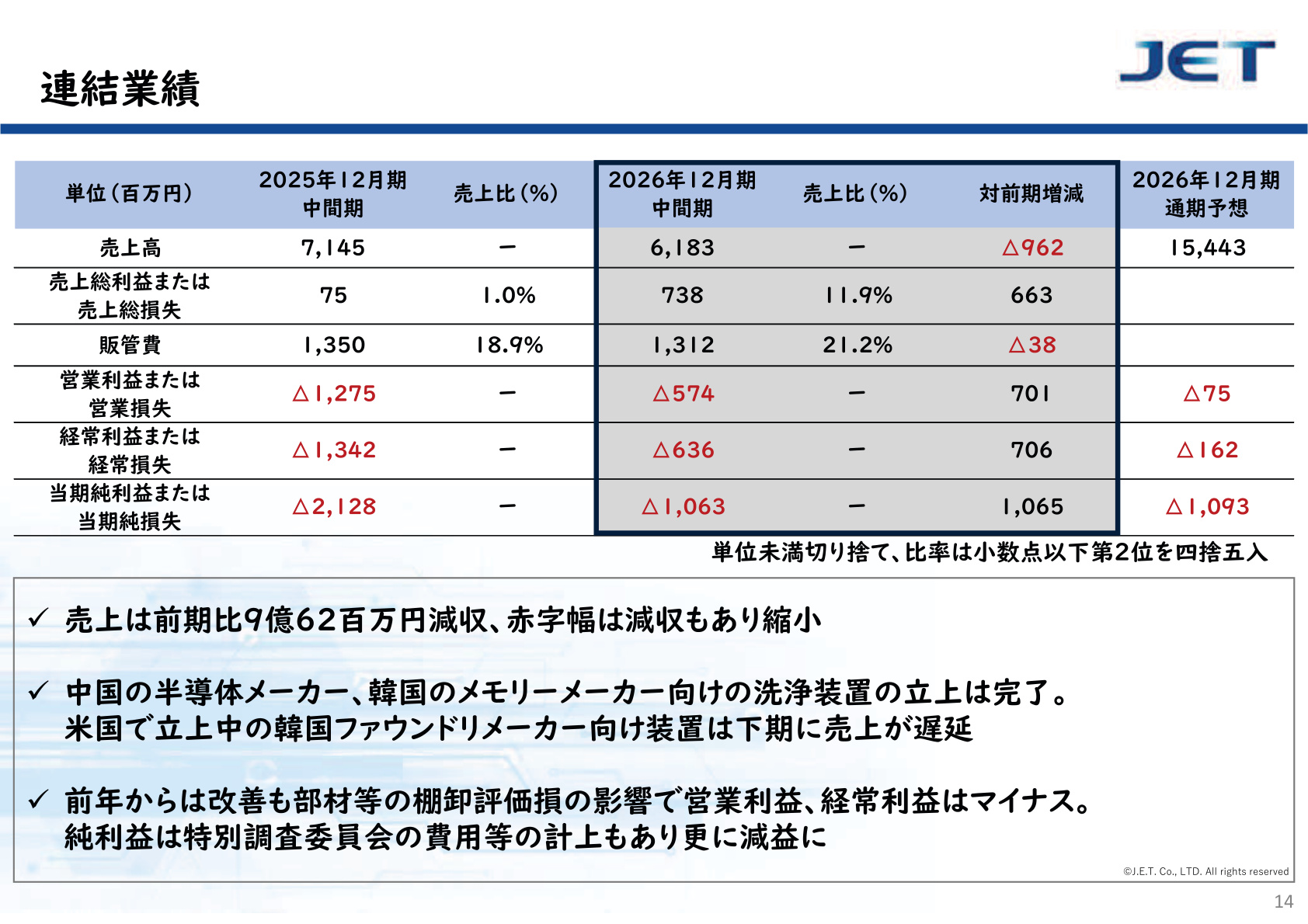
The H1 results and full-year forecasts are as follows:
- Net Sales : 6,183 million yen (down 13.5% YoY, a decrease of 962 million yen from 7,145 million yen in the same period last year)
- Gross Profit : 738 million yen (Gross profit margin of 11.9%, up 663 million yen YoY)
- Operating Loss : -574 million yen (compared to -1,275 million yen in the same period last year, narrowing the deficit by 701 million yen)
- Ordinary Loss : -636 million yen (compared to -1,342 million yen in the same period last year, narrowing the deficit by 706 million yen)
- Net Loss Attributable to Owners of Parent : -1,063 million yen (compared to -2,128 million yen in the same period last year, narrowing the deficit by 1,065 million yen)
While the setup of cleaning equipment for Chinese semiconductor manufacturers and Korean memory makers was completed, the revenue recognition for equipment being set up in the U.S. for a Korean foundry was delayed to the second half , contributing to the H1 revenue decline. On the profit side, although the deficit narrowed, losses remained due to inventory valuation losses on components and expenses related to the Special Investigation Committee.
5. Sales Composition by Product and Destination
The breakdown of semiconductor business sales (6,177 million yen) for H1 FY2026 is as follows:
- Batch Cleaning Equipment : 3,533 million yen (57.2% of total)
- Construction/Parts, etc. : 1,808 million yen (29.3% of total)
- Single-Wafer Cleaning Equipment : 836 million yen (13.5% of total)
By destination, while foundries accounted for 65.6% in 2023, the share for memory manufacturers surged to 67.2% in 2024. As of H1 2026, the composition is balanced, with 53.9% for foundries (2,353 million yen) and 46.1% for memory manufacturers (2,015 million yen) .
6. Regional Sales Trends and Deliveries to "Rapidus"
Regarding regional composition, sales to China decreased from 47.7% in H1 2025 to 40.4% in H1 2026 . Meanwhile, sales to South Korea accounted for 39.7% , the U.S. for 16.2% , Japan for 2.1% , and Taiwan for 1.4% .
Notably, the company recorded over 1 billion yen in sales (1,002 million yen) within Japan, driven by deliveries to the next-generation semiconductor project "Rapidus." This indicates a shift from a portfolio centered on China and South Korea toward capturing domestic advanced investment.
7. Financial Position (Balance Sheet)
As of the end of H1 FY2026, total assets stood at 19,452 million yen (down 60 million yen from the end of the previous fiscal year).
- Assets : Current assets were 17,249 million yen (down 854 million yen, primarily due to a decrease in raw materials and supplies), and property, plant, and equipment were 1,938 million yen (up 786 million yen).
- Liabilities : Current liabilities were 6,697 million yen (up 1,123 million yen, due to an increase in short-term borrowings), and non-current liabilities were 4,019 million yen (down 199 million yen, due to a decrease in long-term borrowings), bringing total liabilities to 10,717 million yen (up 924 million yen).
- Net Assets : Due to the net loss recorded in the first half, retained earnings decreased, resulting in total net assets of 8,735 million yen (down 985 million yen).
8. Semiconductor Market Environment and Full-Year FY2026 Outlook
The Wafer Fab Equipment (WFE) market is expected to grow from $104.3 billion in 2024 to $143.9 billion in 2026, and surpass $200 billion by 2028 , driven by demand for advanced logic for generative AI and HBM (High Bandwidth Memory). Investment momentum remains strong, with Samsung Electronics and SK Hynix announcing plans to invest a total of 800 trillion won (approx. 83 trillion yen) in four domestic plants in South Korea.
Under these conditions, the company's full-year FY2026 earnings forecast is as follows:
- Net Sales : 15,443 million yen (+5.3% YoY)
- Operating Loss : -75 million yen
- Ordinary Loss : -162 million yen
- Net Loss : -1,093 million yen
Although the full-year forecast anticipates a loss, the company is committed to achieving an ordinary profit for the full year by completing the setup of equipment for U.S. and Korean foundries, strictly selecting orders, and promoting in-house production and cost reductions through optimized equipment design and specifications.
9. Business Restructuring Direction and Area/Product Strategy
The company has formulated a business restructuring strategy aimed at early profitability and establishing a long-term earnings base.
- Area Strategy :
- South Korea : Regain market share in phosphoric acid equipment for Samsung Electronics' NAND and re-approach SK Hynix for single-wafer equipment.
- China : Strengthen relationships with major DRAM manufacturer CXMT and NAND manufacturer YMTC through localization initiatives.
- Japan : Concentrate resources on the flagship single-wafer machine "Eco3" for Rapidus.
- North America/Taiwan : Focus resources on TI (Texas Instruments) in North America and expand sales to UMC in Taiwan through HTS-free demonstrations.
- Focus on High-Value-Added Products :
- BW3500 (Batch type) : Successor to the BW3000, targeting processes of 28nm and above, featuring a reduced footprint and improved operability. Promoting replacement from RCA cleaning.
- Eco3 (Single-wafer type) : Environmentally friendly equipment using ozone gas (O3 GAS). It avoids the generation of acid/alkali reaction products and enables SC1 processing in a single module.
10. Long-Term Growth Roadmap (2033 Target)
With the transition to a new management structure, the company plans to review its medium-term management plan and has clarified its long-term numerical targets.
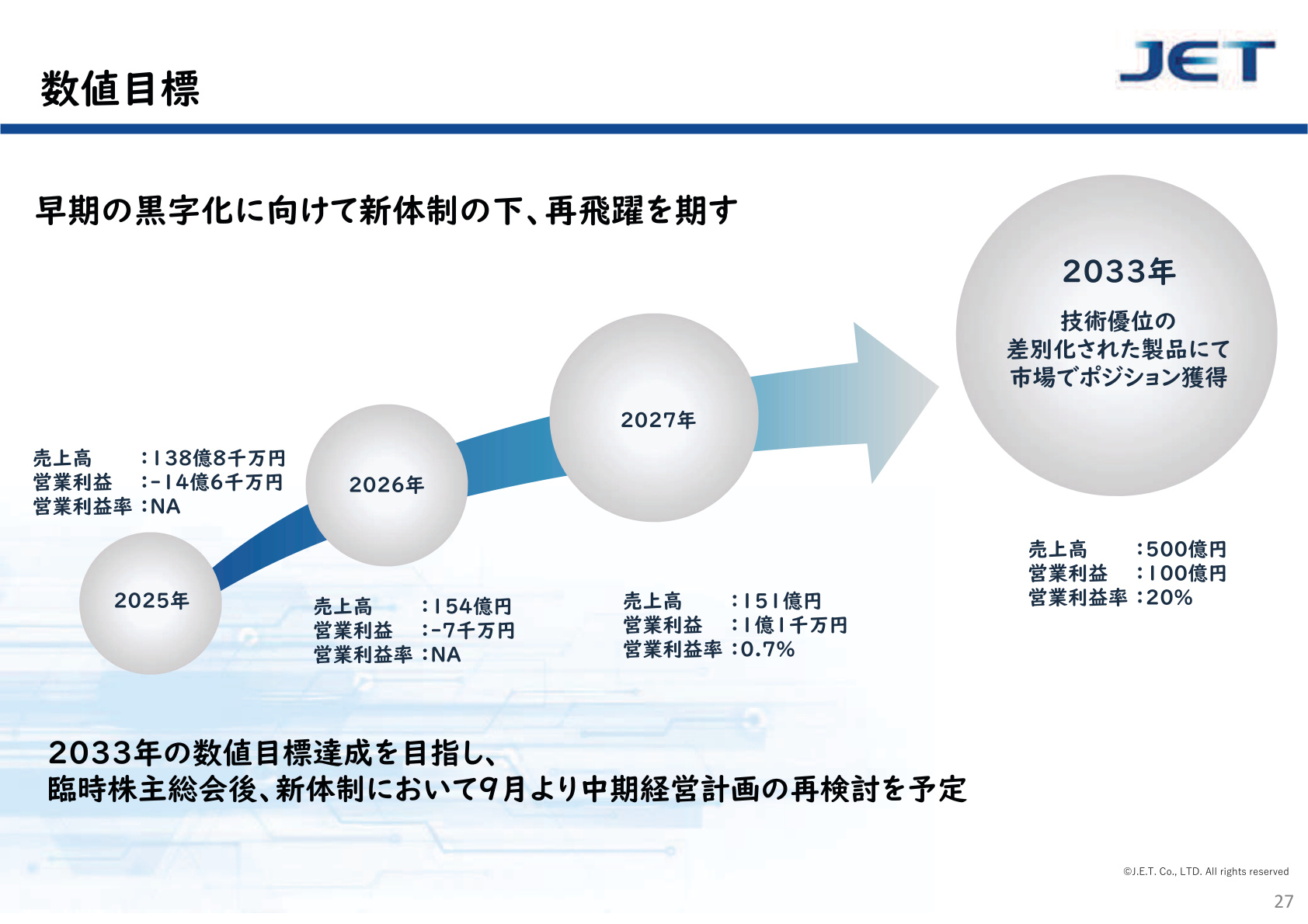
The numerical targets in the roadmap are as follows:
- 2025 (Actual) : Sales 13.88 billion yen, Operating Loss -1.46 billion yen
- 2026 (Forecast) : Sales 15.4 billion yen, Operating Loss -0.07 billion yen (Turning point toward early profitability)
- 2027 (Target) : Sales 15.1 billion yen , Operating Profit 0.11 billion yen (Operating margin 0.7%, return to profitability)
- 2033 (Long-term Target) : Sales 50 billion yen , Operating Profit 10 billion yen ( Operating margin 20% )
The company aims to solidify its profitable structure from 2027 onwards and transform into a high-profit enterprise by 2033, leveraging its differentiated batch and single-wafer product lines.
Conclusion
J.E.T.'s latest earnings presentation is built on three pillars: rectifying past accounting irregularities and renewing governance , restoring current performance , and growth strategies toward 2033 . Having completed the restatements, the company is now fully engaged in recovering performance and achieving its long-term goals under new management by focusing on selective order-taking and expanding sales of high-value-added products (BW3500, Eco3).
This content is not intended as investment advice or a recommendation. Any opinions expressed are solely the personal views of each article.