


Zero Co., Ltd. FY2026 Earnings Report: Record-High Revenue and Operating Profit, Evolution into an Automotive Logistics Infrastructure Provider, and Outlook for Continued Growth

StockClub
Published: Aug 24, 2026, 10:02 AM
Sentiment Analysis
Zero Co., Ltd. (Securities Code: 9028) has announced its financial results for the fiscal year ended June 2026. Despite headwinds such as a sluggish domestic new car market and rising costs associated with the '2024 Problem' in the logistics industry, the company achieved record-high revenue and operating profit . This success was driven by the expansion of used car transport contracts, improvements in unit pricing, and contributions from M&A and new business acquisitions . Furthermore, the company has achieved the key targets set in its medium-term management plan (revenue of 150 billion yen or more, operating profit of 10 billion yen or more, and ROE of 14.0% or more) ahead of schedule.
1. FY2026 Earnings Highlights
Consolidated financial results for the fiscal year ended June 2026 are as follows:
- Revenue : 150.556 billion yen ( +1.8% YoY / Previous: 147.843 billion yen)
- Operating Profit : 10.311 billion yen ( +0.8% YoY / Previous: 10.228 billion yen)
- Operating Profit Margin : 6.8% (Previous: 6.9%)
- Profit Before Tax : 10.308 billion yen ( +0.9% YoY / Previous: 10.213 billion yen)
- Profit Attributable to Owners of Parent : 7.212 billion yen ( +0.5% YoY / Previous: 7.179 billion yen)
- ROE (Return on Equity) : 15.9%
- Annual Dividend : 140.30 yen (Dividend Payout Ratio: 33.0% )
While the first half saw a temporary decline in profit as the growth in used car transport could not fully offset the slump in new car transport, the company recovered in the second half through strengthened used car transport contracts, improved equipment utilization rates, and optimized transport routes, resulting in a full-year performance that exceeded initial forecasts.
2. External Environment and Segment Trends
Regarding the external environment, domestic new car sales remained weak, and sales volume for Nissan Motor, Zero's primary client, declined year-on-year. However, this was offset by an increase in business with Mitsubishi Motors and the expansion of used car auction listings (reaching a scale of 3.55 million units across the USS group) .
Segment Overview
- Domestic Automotive-Related Business (Revenue: 71.2 billion yen / 47% of total) Although new car transport decreased, the company achieved growth through margin-focused sales activities in used car transport, expanded contracts, and improved unit prices. Additionally, the acquisition of 'Zero Plus Maintenance (ZPM)' and the contracting of on-site operations at two locations, including the largest auction site, USS Tokyo , contributed significantly.
- Human Resources Business (Revenue: 23.7 billion yen / 16% of total) The company successfully implemented price revisions for unprofitable sites in private vehicle operation management (shuttle services) and secured new contracts. Centralizing driver recruitment functions within the HR business improved hiring efficiency and allowed the company to steadily capture demand for temporary staffing.
- General Cargo Business (Revenue: 6.8 billion yen / 5% of total) Performance remained solid due to the launch of new warehouse projects utilizing idle assets from the discontinued CKD business and increased port cargo handling volumes for biomass fuel.
- Overseas-Related Business (Revenue: 48.7 billion yen / 32% of total) While used car exports to Malaysia recovered and grew despite port congestion and shipping capacity constraints, segment operating profit declined due to the sluggish performance of Japanese manufacturers in the Chinese market and the absence of one-time gains recorded in the previous year.
3. Analysis of Operating Profit Fluctuations
The factors behind the changes in operating profit clearly reflect the balance between strengthening the profitability of domestic businesses and strategic investments.
As shown in the slide above, the main factors for the change in operating profit are as follows:
- Domestic Automotive-Related Business (+461 million yen) : Increased utilization of transport equipment, route optimization, M&A/new contract effects, and the reversal of impairment losses from the previous year contributed to profit growth. These gains absorbed costs related to improving driver compensation, system investments, and building a division-of-labor system to address the 2024 logistics problem.
- Human Resources Business (+135 million yen) : The effects of price revisions and operational efficiency improvements outweighed the rise in labor costs due to minimum wage increases.
- General Cargo Business (+247 million yen) : Contributed by the launch of new warehouse projects, rent revisions, and gains from the reversal of impairment losses.
- Overseas-Related Business (-455 million yen) : Despite price revisions for exports to Malaysia and the consolidation of ACT in Thailand, the segment was negatively impacted by the absence of one-time profit factors from the previous year and requests for lower unit prices in Chinese new car transport.
4. Growth Strategy: Evolving into an "Automotive Logistics Infrastructure Company"
Zero is accelerating its evolution from a mere 'finished vehicle transport company' into an 'automotive logistics infrastructure company' that covers the entire process of new and used car distribution.
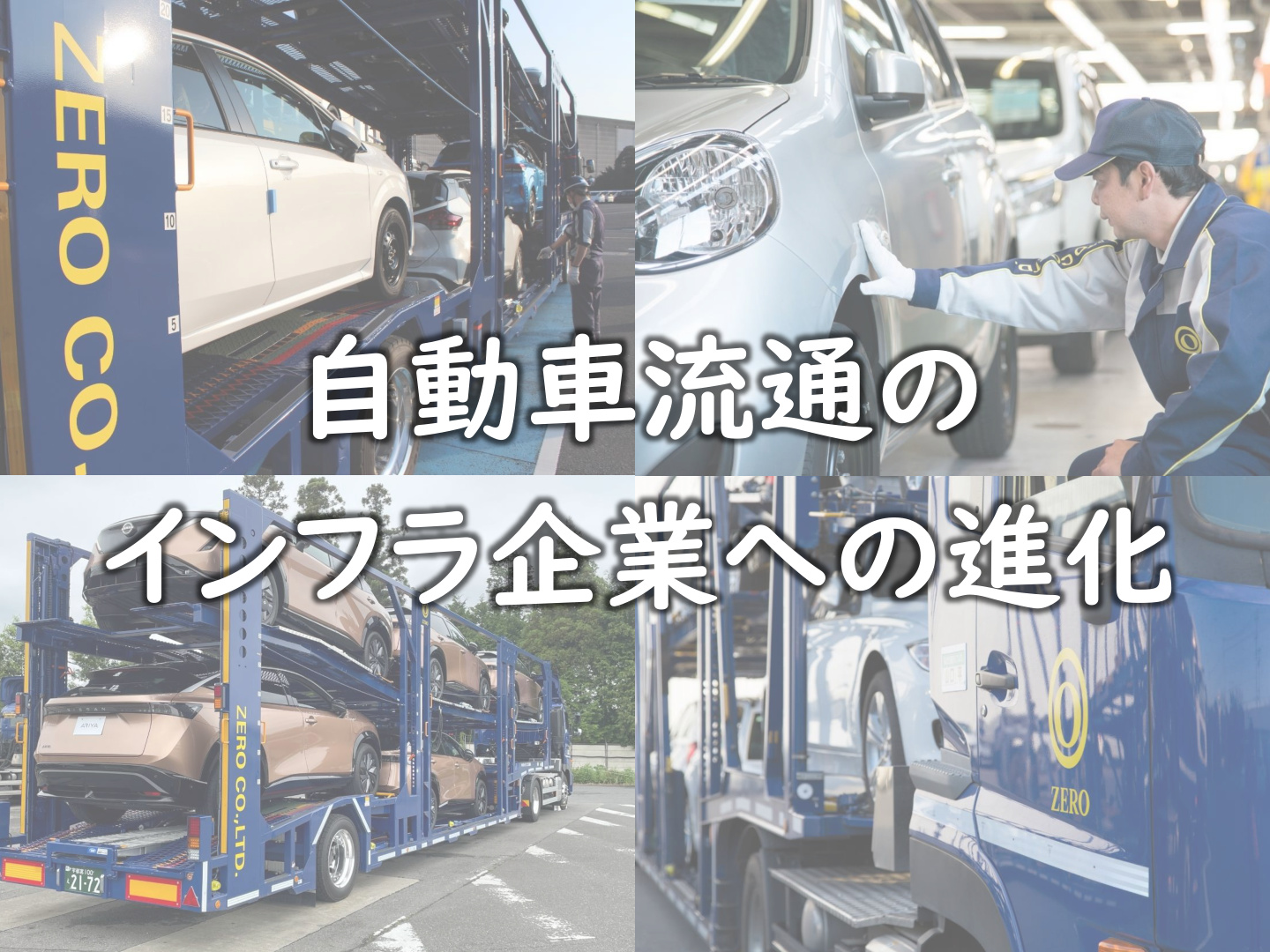
This slide illustrates the expansion of the Zero Group's business domain across the entire value chain, from finished vehicle manufacturers to dealers, users, used car auctions (AA), and dismantling/exporting.
- Pre-Delivery Inspection (PDI) and Maintenance : Enhancing value-added services through collaboration with entities like Zero Plus Maintenance.
- Auction On-site Operations : Diversifying the revenue base by expanding contracts for on-site auction work and management.
- Private Car/Shuttle/Staffing : Self-contained driver supply network through collaboration with Japan Relief, which handles temporary staffing and operation management.
Under the medium-term management plan's core policy of 'Returning to the Fundamentals of Quality' (operational, logistics, human, and financial quality), the company is simultaneously promoting price pass-through (securing appropriate unit prices), strengthening its human resource base, and optimizing dispatch and operations through DX.
5. FY2027 Earnings Outlook and Shareholder Return Policy
{{PAGE_30}}
For the fiscal year ending June 2027, the company forecasts increased revenue, profit, and dividends as follows:
- Revenue : 155.0 billion yen (+3.0% YoY)
- Operating Profit : 11.0 billion yen (+6.7% YoY / Operating Profit Margin: 7.1%)
- Profit Before Tax : 11.0 billion yen (+6.7% YoY)
- Profit Attributable to Owners of Parent : 7.3 billion yen (+1.2% YoY)
- Basic Earnings Per Share (EPS) : 429.18 yen
- Annual Dividend : 141.60 yen (Interim 57.00 yen / Year-end 84.60 yen, Dividend Payout Ratio: 33.0%)
To address the enforcement of new logistics laws and driver shortages, the company plans to achieve sustainable profit growth by establishing a 'Field Human Resources Strategy Department' to integrate recruitment, training, and retention, promoting DX such as web-based ordering and dispatch systems, and continuing a pricing strategy aligned with costs and provided value.
This content is not intended as investment advice or a recommendation. Any opinions expressed are solely the personal views of each article.