


Japan Excellent, Inc. 40th Fiscal Period Earnings Analysis: Accelerating Property Recycling and Rent Hikes to Drive Sustainable DPU Growth

StockClub
Published: Aug 21, 2026, 09:55 AM
Sentiment Analysis
Japan Excellent, Inc. (Ticker: 8987) has announced its financial results for the 40th fiscal period (ended June 2026). The results demonstrate a clear path toward sustainable Distribution Per Unit (DPU) growth, driven by a combination of robust internal growth fueled by rising market rents, strategic property recycling (external growth) from low-yield/low-growth assets to high-quality properties, and agile financial and capital strategies .
---### 1. 40th Fiscal Period (Ended June 2026) Highlights
Performance for the 40th period reached operating revenue of 11,604 million yen (+50 million yen vs. previous forecast), operating profit of 5,265 million yen (+137 million yen), ordinary profit of 4,400 million yen (+128 million yen), and net income of 4,399 million yen (+128 million yen).
In addition to maintaining high occupancy rates and making progress on rent increases across existing properties, the results were bolstered by effective management of utility expenses and SG&A costs. Consequently, DPU landed at 3,070 yen , exceeding the previous forecast of 3,050 yen by 20 yen. The period-end occupancy rate remained exceptionally high at 98.1% , while unrealized gains grew to 83.3 billion yen (unrealized gain ratio of 29.9%) , and NAV per unit expanded to 178,272 yen .
2. Mid-to-Long-Term Story for Sustainable DPU/EPU Growth
The REIT has established a clear policy to achieve sustainable growth in EPU (Earnings Per Unit, excluding gains on sales), targeting an average annual growth rate of 2% or more, with a corresponding continuous expansion of DPU.
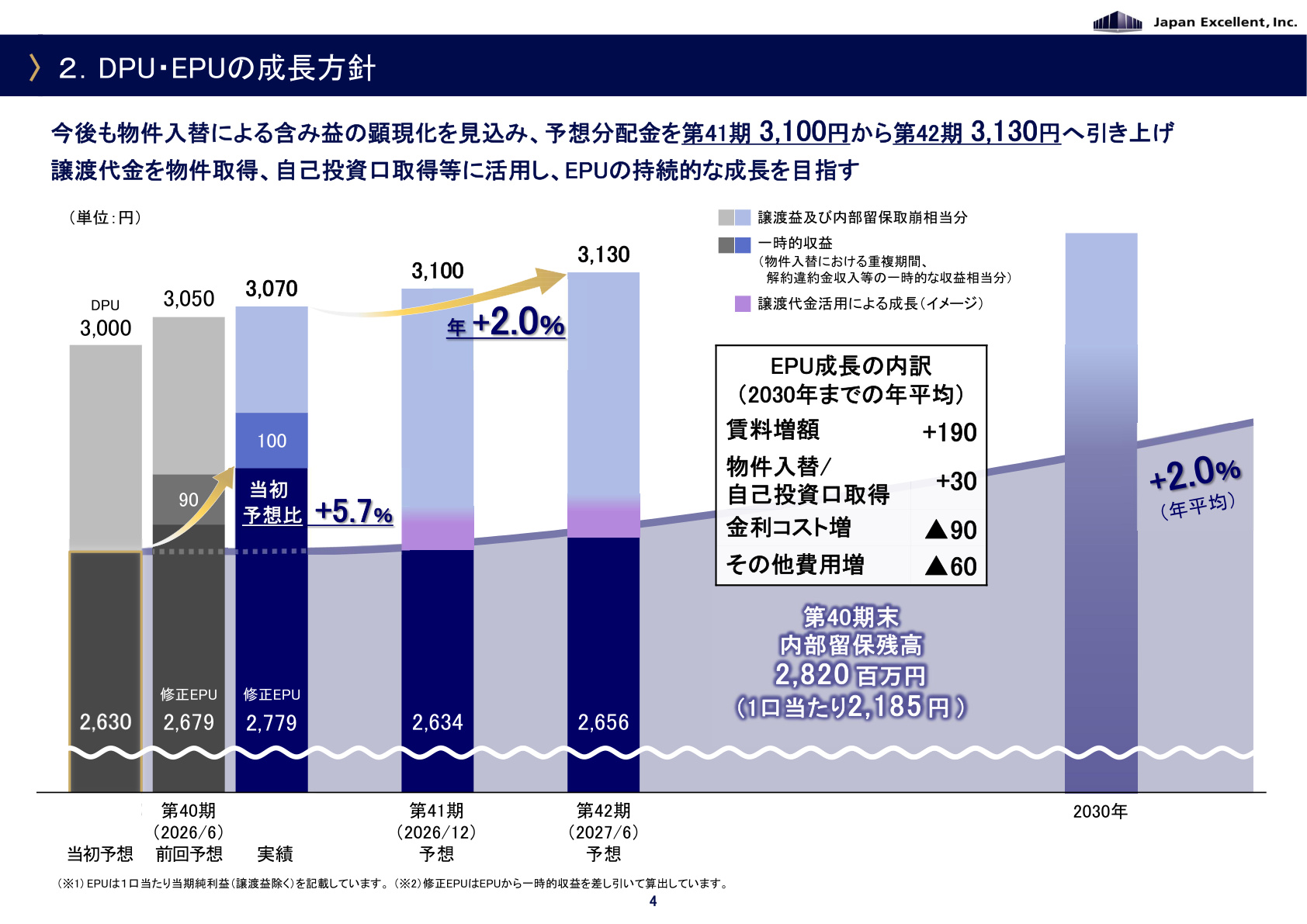
The slide above is a key document illustrating the DPU/EPU growth mechanism the REIT envisions through 2030:
- Rent Increase Effect (+190 yen/period) : Aggressive rent revisions capturing rising market rents serve as the primary driver.
- Property Recycling & Unit Buybacks (+30 yen/period) : Contributions from portfolio quality improvements and agile capital policy.
- Absorption of Cost Increases : Revenue growth is successfully outpacing rising financial costs due to interest rate hikes (-90 yen/period) and other expense increases (-60 yen/period).
Furthermore, as of the end of the 40th period, the REIT holds 2,820 million yen (2,185 yen per unit) in internal reserves , providing a robust buffer to smooth out temporary earnings fluctuations from property recycling while maintaining a stable dividend growth trend.
3. Earnings Forecast: Consecutive Dividend Increases Planned for 41st and 42nd Periods
Regarding the future earnings outlook, the REIT has revised its forecasts upward as follows:
-
41st Period (Ending December 2026) Forecast
- Operating Revenue: 13,123 million yen (+1,519 million yen vs. previous period)
- Net Income: 5,529 million yen (+1,130 million yen)
- Forecast DPU: 3,100 yen (+30 yen increase)
- While recording 2,130 million yen in gains on property sales, 1,529 million yen will be allocated to internal reserves using the tax-deferred replacement special provision.
-
42nd Period (Ending June 2027) Forecast
- Operating Revenue: 11,080 million yen
- Net Income: 3,751 million yen
- Forecast DPU: 3,130 yen (+30 yen increase)
- By combining gains on sales (323 million yen) with the reversal of internal reserves (287 million yen), the REIT plans to grow DPU even during a period of property divestment.
4. External Growth: Strategic Property Recycling and Capital Utilization Strategy
To improve portfolio quality, the REIT is promoting the recycling of approximately 10% of its portfolio (approx. 30 billion yen). Since the 39th period, it has steadily executed cumulative divestments of 20.7 billion yen (approx. 70% progress) and cumulative acquisitions of 13.9 billion yen (approx. 46% progress) .
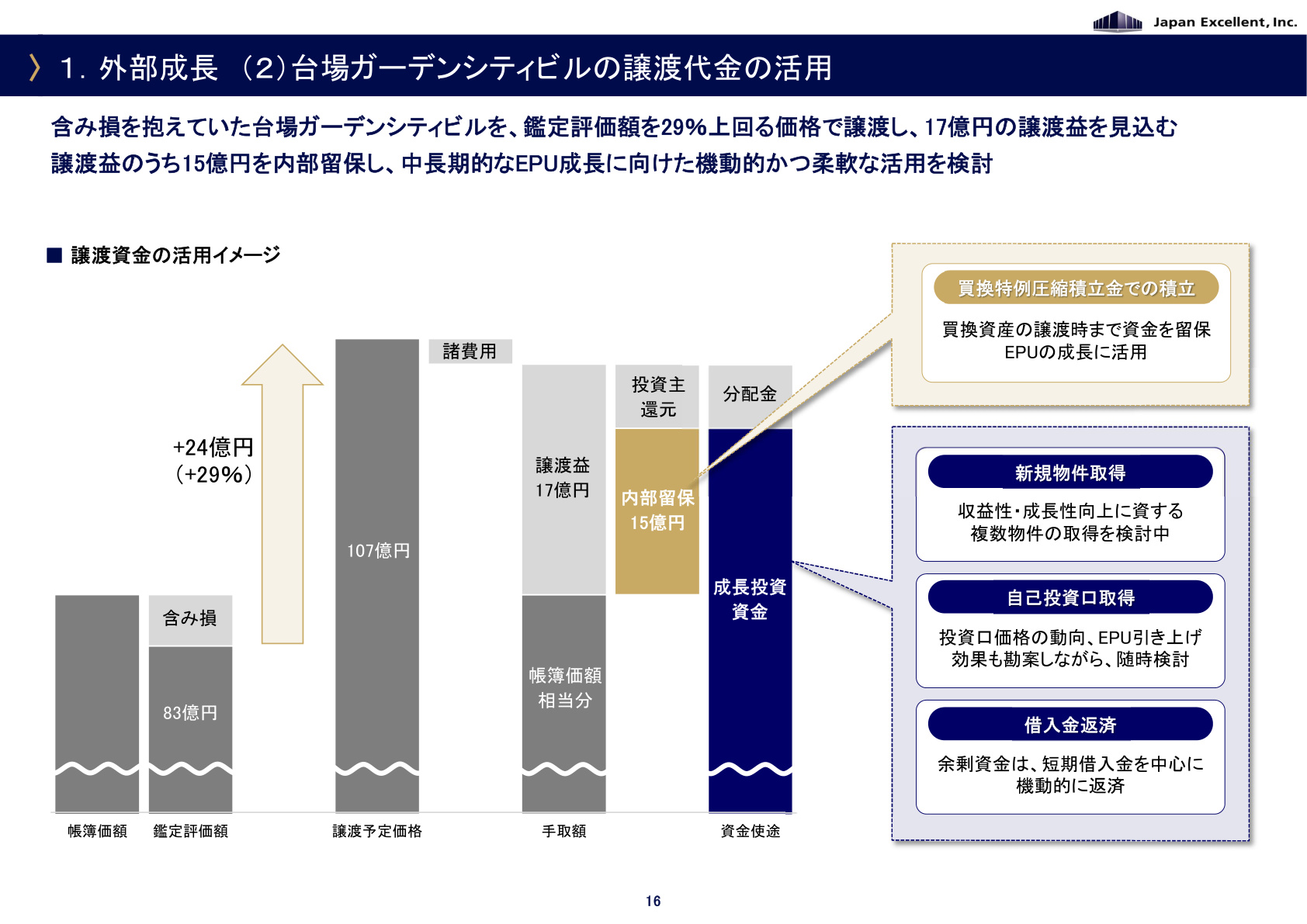
The divestment of "Daiba Garden City Building" shown in the slide above is a symbolic case of portfolio improvement:
- Elimination of Unrealized Losses and High-Price Sale : A property that held an unrealized loss (book value of 8.6 billion yen vs. appraisal value of 8.3 billion yen) was sold for 10.7 billion yen , 29% above its appraisal value.
- Creation of 1.7 Billion Yen in Gains and Internal Reserves : Of the 1.7 billion yen in gains generated, 1.5 billion yen was retained as internal reserves via the replacement special provision.
- Flexibility in Capital Allocation : The secured growth capital is being flexibly allocated to new high-quality property acquisitions, unit buybacks, and repayment of short-term debt, serving as the source for mid-to-long-term EPU growth.
5. Internal Growth: Accelerating Rent Revisions and Utilizing Negative Rent Gaps
In terms of internal growth, aggressive rent increases leveraging the REIT's strengths in office management are yielding results.
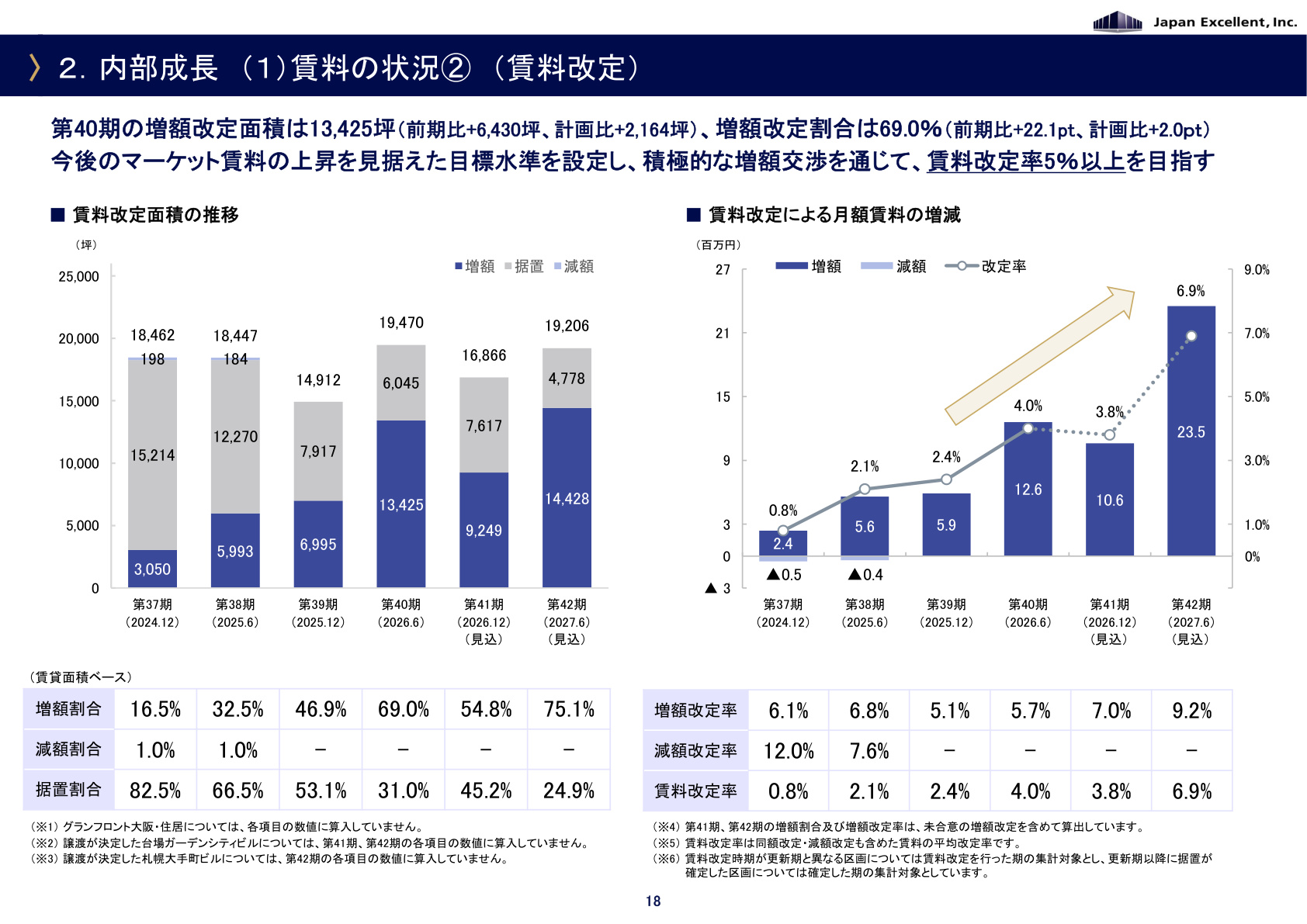
As shown in the slide above, significant improvements are confirmed in rent revisions with existing tenants:
- Rapid Expansion of Rent-Increased Area and Ratio : In the 40th period, the area subject to rent increases reached 13,425 tsubo (+6,430 tsubo vs. previous period), with the rent increase ratio reaching 69.0% (+22.1pt).
- Upward Trend in Revision Rates : The rent revision rate reached 4.0% in the 40th period (+1.6pt), with further acceleration expected to 3.8% in the 41st period and 6.9% in the 42nd period (with a 9.2% rent increase rate).
Additionally, the rent gap for the entire portfolio has widened to -8.4% (72% of the total is below market rent), confirming that there is significant room for rent increases during future contract renewals.
6. Financial Strategy and ESG Promotion
- Financial Soundness : Interest-bearing debt stands at 136.1 billion yen, with a total asset LTV of 45.5% (market value-based LTV of 35.6% ), maintaining a healthy level. By securing an average remaining maturity of 3.9 years and combining a 74.7% fixed-interest rate ratio with short-term/floating-rate debt, the REIT is managing costs amid rising interest rates. It maintains an AA- (Stable) rating from JCR.
- ESG Initiatives : The REIT has achieved the highest "Green Star" rating in the GRESB Real Estate Assessment for 11 consecutive years (4 Star). The ratio of green building certifications for its properties has reached 87.8% (29 properties), and progress on CO2 emission and energy consumption reduction targets remains on track.
Summary
Japan Excellent, Inc. is pursuing a three-pronged strategy: "improving portfolio quality through strategic property recycling and building internal reserves," "accelerating rent increases by capturing robust office demand," and "disciplined financial management." By skillfully controlling earnings fluctuations from temporary property sales through internal reserves, the REIT has established a solid operational framework aimed at dividend increases to 3,100 yen in the 41st period and 3,130 yen in the 42nd period , alongside mid-to-long-term EPU growth of 2% or more annually.
This content is not intended as investment advice or a recommendation. Any opinions expressed are solely the personal views of each article.