


Cyfuse Biomedical FY2026 Q2 Earnings Report: Revenue Surges 3.5x YoY; Clinical Trials Advance for Key 3D Regenerative Medicine Pipelines Including Peripheral Nerve and Osteochondral Regeneration

StockClub
Published: Aug 21, 2026, 09:52 AM
Sentiment Analysis
Executive Summary
Cyfuse Biomedical K.K. (Securities Code: 4892), a developer of 3D regenerative medical products and research tools composed solely of cells—without the use of scaffolds—utilizing its proprietary "Bio 3D Printer" technology, has announced its financial results for the second quarter of the fiscal year ending December 2026.
In the first half of the fiscal year, the company achieved a significant revenue increase, with net sales reaching 143.21 million yen (up 254.6% YoY, approximately 3.5 times higher) , driven by progress in contract services and expanded sales of existing devices and consumables. While continuing to invest in R&D, the company successfully narrowed its operating loss to 417.50 million yen (compared to 471.24 million yen in the same period last year) through efficient development driven by strategic partnerships. The company maintains a robust financial foundation with cash and deposits of approximately 3.39 billion yen , ensuring sufficient capital to advance its core clinical pipelines.
Operationally, the company made strategic progress across all three business segments: "Regenerative Medicine," "Drug Discovery Support," and "Devices." Notably, in the regenerative medicine sector, the investigator-initiated clinical trial for allogeneic peripheral nerve regeneration is progressing smoothly , and the submission of the clinical trial notification for the osteochondral regeneration pipeline has been completed , marking significant strides in clinical development with an eye toward regulatory approval around 2028.
1. FY2026 Q2 Financial Results and Highlights
Financial Overview and Analysis
- Net Sales : 104 million yen (29 million yen in the same period last year, +254.6% YoY )
- Gross Profit : 64 million yen (14 million yen in the same period last year, +341.9% YoY )
- Operating Loss : 417 million yen (471 million yen in the same period last year, loss narrowed )
- Ordinary Loss : 433 million yen (401 million yen in the same period last year)
- Net Loss for the Quarter : 434 million yen (402 million yen in the same period last year)
Top-line growth reached approximately 3.5 times the previous year's level due to the expansion of contract development and increased device-related sales. Selling, General and Administrative (SG&A) expenses were 482.30 million yen (down 0.7% YoY), demonstrating disciplined cost control while actively promoting R&D, which, combined with revenue growth, contributed to the reduction of the operating loss .
Robust Cash Position and Financial Health
- Total Assets : 3.9258 billion yen
- Cash and Deposits : 3.39152 billion yen
- Net Assets (Equity) : 2.62218 billion yen (Equity Ratio: approx. 66.8% )
For a biotech venture, R&D funding is critical; the company maintains over 3.3 billion yen in liquidity. This ensures a solid financial position to continue clinical development and production technology development aimed at commercialization without interruption.
2. Multi-faceted Business Model and Progress Across Three Segments
Cyfuse has built a multi-layered business model that generates cash flow in the short, medium, and long term, centered on its proprietary bio 3D printing technology.
Slide Commentary: Strategic Synergy of the Three Business Segments
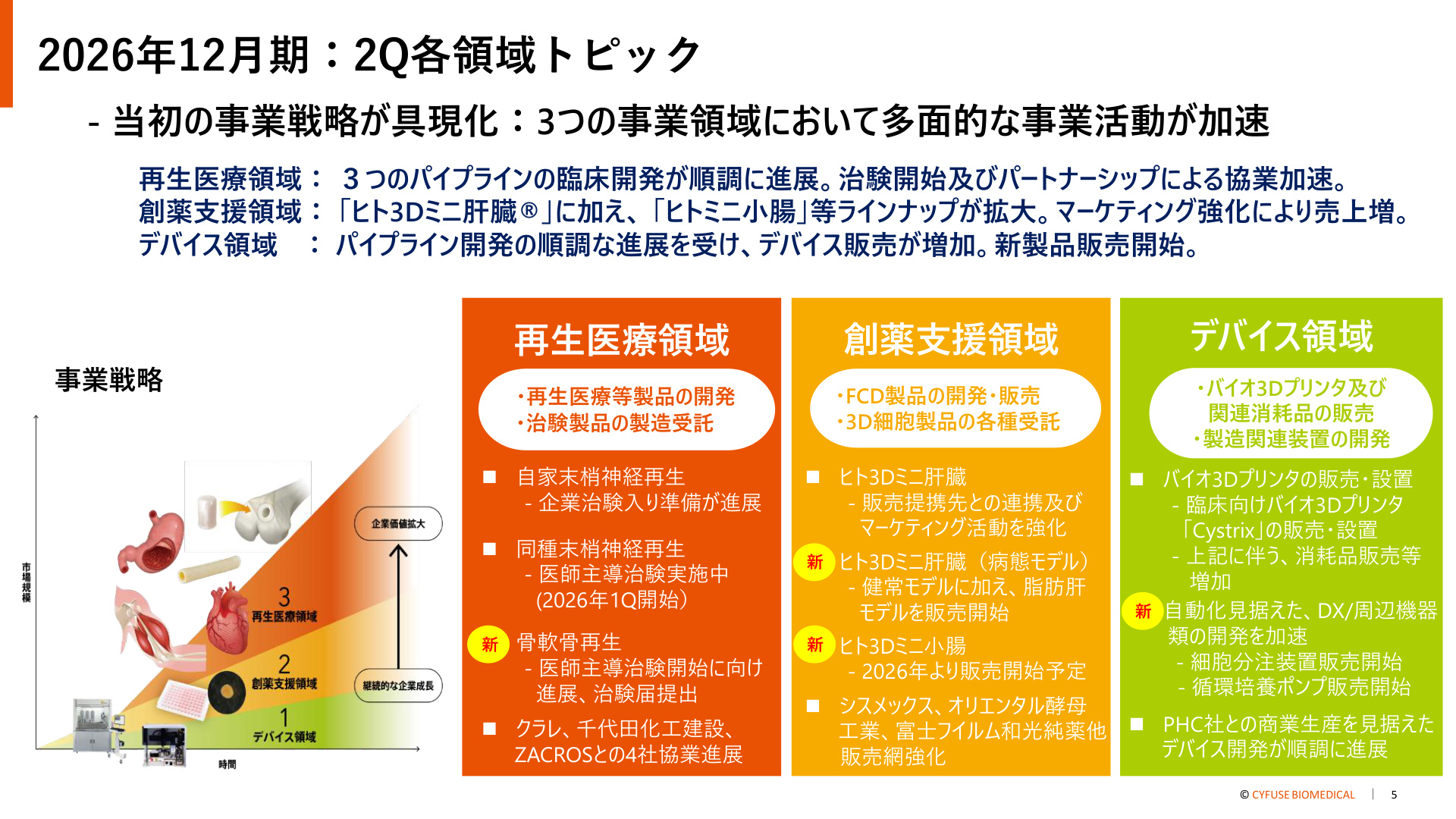
As shown in the structure above, the company is simultaneously developing the "Device Segment" for short-term base revenue, the "Drug Discovery Support Segment" for medium-term growth and revenue diversification, and the "Regenerative Medicine Segment" for long-term, massive corporate value creation. The interaction of these three pillars enables both the stabilization of the revenue base during the R&D phase and the advancement of the technology platform.
- Regenerative Medicine Segment (Future Core Growth Driver)
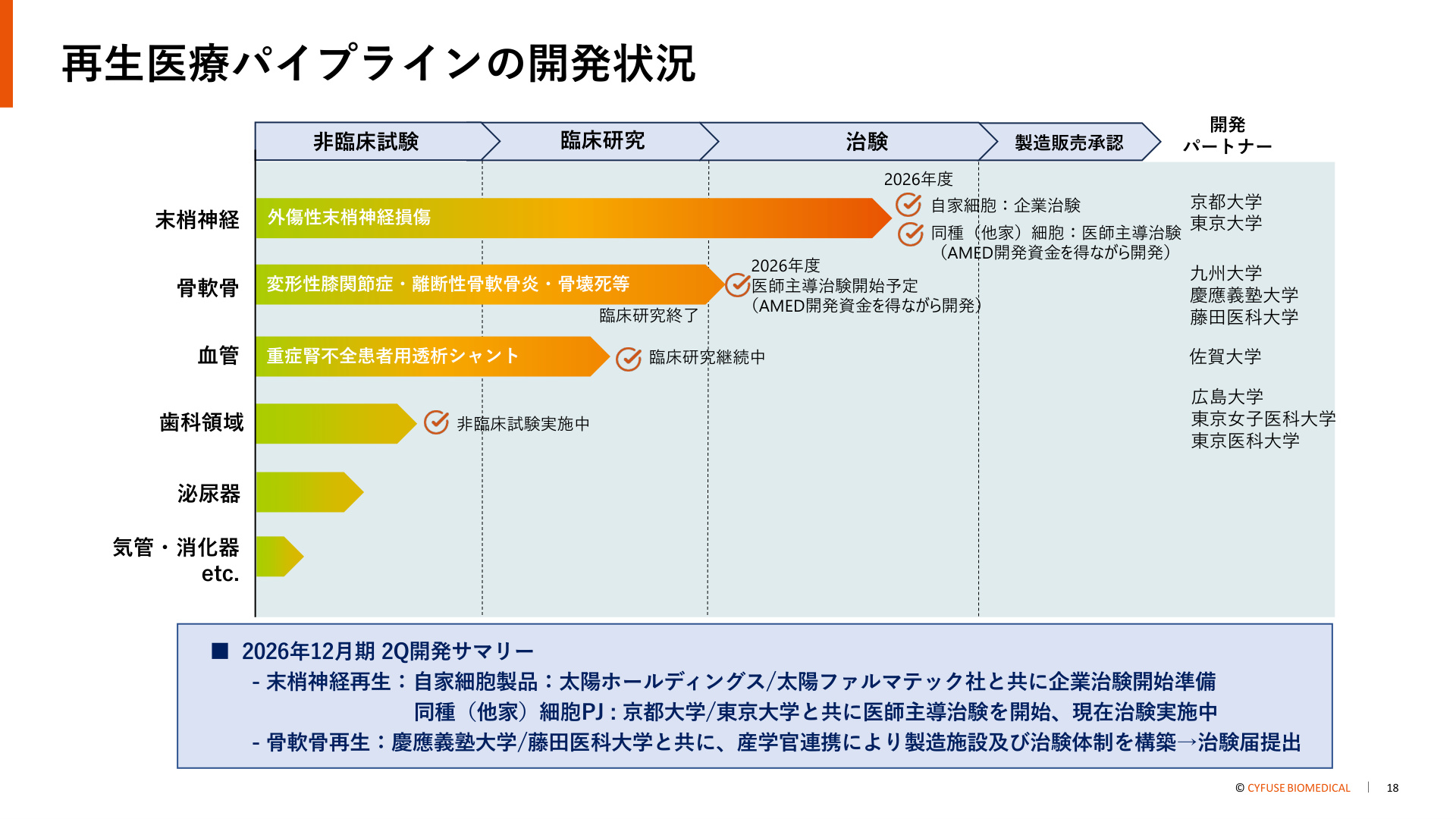
- Focusing on three major pipelines: peripheral nerve regeneration (autologous/allogeneic), osteochondral regeneration, and vascular regeneration.
- Accelerating development through industry-academia-government collaborations with Kuraray, Taiyo Pharma Tech, Keio University, and Kyoto University.
- Drug Discovery Support Segment (Medium-term Base Revenue Expansion)
- Expanding the lineup of Functional Cell Devices (FCD®).
- Launched sales of the new product "Human 3D Mini-Liver® (Pathology Model/Fatty Liver Model)."
- Developing "Human 3D Mini-Intestine," with sales planned for 2026. Strengthening sales networks with partners like Sysmex and Fujifilm Wako Pure Chemical.
- Device Segment (Short-term Revenue and Ecosystem Expansion)
- Increased sales of consumables associated with the installation of the clinical bio 3D printer "Cystrix" and the research-use "S-PIKE®."
- Expanded the peripheral equipment lineup with the launch of the new foldable compact dispenser, "CAP."
3. Regenerative Medicine Pipeline Development and Clinical Stages
Slide Commentary: Pipeline Timeline and Progress
The pipeline list above clearly shows that Cyfuse's clinical development is steadily transitioning from "non-clinical" to "clinical trial stages." In particular, "Peripheral Nerve" and "Osteochondral" have reached the clinical trial phase, passing critical milestones toward domestic approval (expected around 2028).
① Peripheral Nerve Regeneration Pipeline (Dual-track Development: Autologous and Allogeneic)
Slide Commentary: Strategic Positioning of Autologous vs. Allogeneic Products
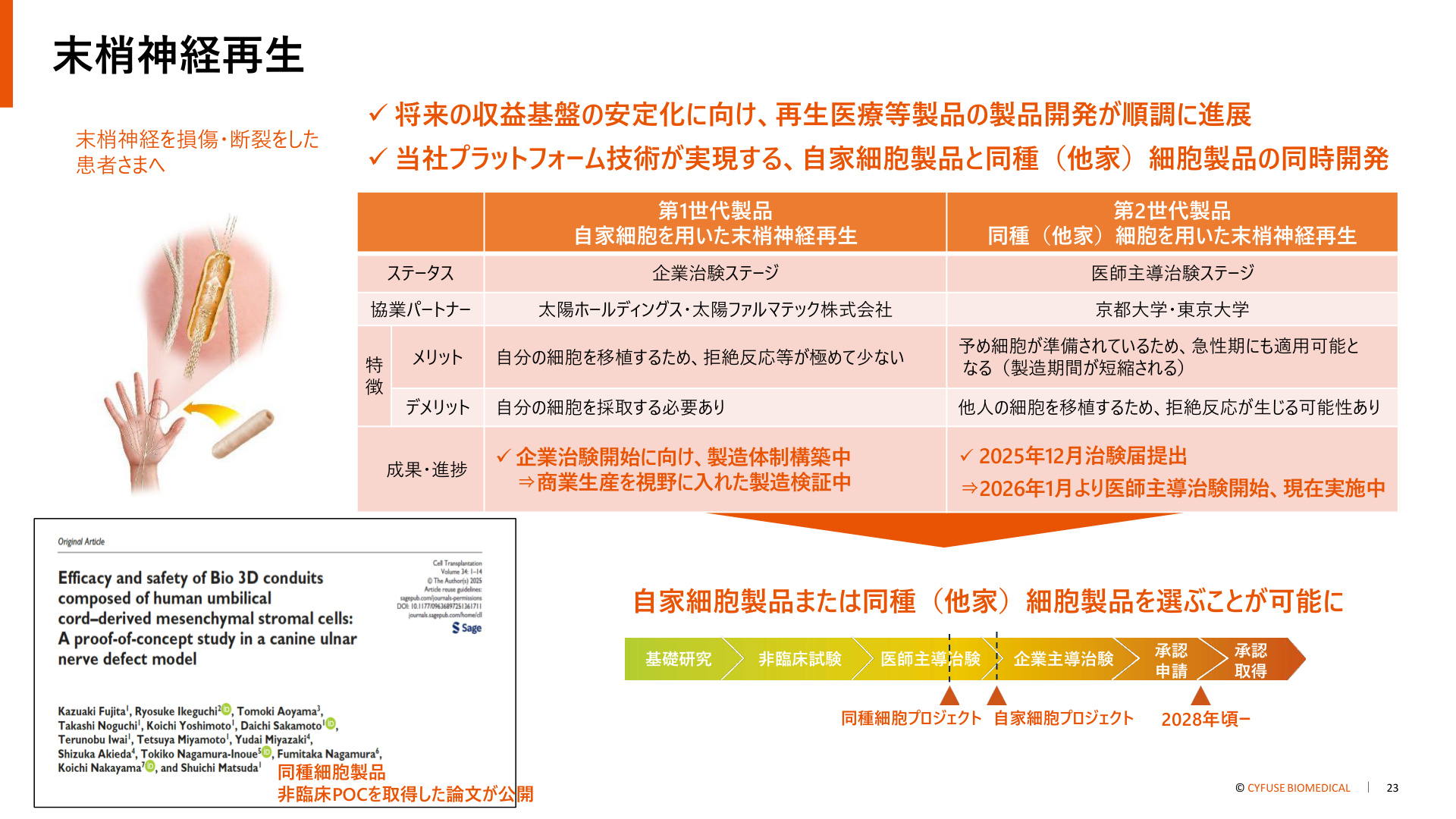
In treating peripheral nerve injuries, the company employs a unique strategy of developing the 1st Generation (autologous) and 2nd Generation (allogeneic) products in parallel.
- 1st Generation: Autologous Cell Product
- Uses the patient's own cells, minimizing immune rejection risk; currently in the preparation stage for corporate clinical trials.
- Collaborating with Taiyo Holdings/Taiyo Pharma Tech and PHC to build a manufacturing verification system for commercial production.
- 2nd Generation: Allogeneic Cell Product (AMED-funded project)
- By pre-stocking umbilical cord-derived mesenchymal cells (using a cell bank), the company achieves significantly shorter manufacturing times and applicability to acute care .
- In collaboration with Kyoto University Hospital and the Institute of Medical Science at the University of Tokyo, the investigator-initiated clinical trial began in January 2026, with patient enrollment and transplantation currently proceeding smoothly .
With 68,000 to 170,000 patients in Japan and approximately 1.4 million in the U.S. suffering from traumatic peripheral nerve injuries, the company aims to achieve long-term, extensive nerve regeneration—which was difficult with existing artificial nerves (collagen tubes)—using 100% cell-based conduits.
② Bone and Cartilage Regeneration Pipeline (World's First: Simultaneous Regeneration)
For cases where damage extends to the subchondral bone due to osteoarthritis or osteonecrosis, the company is developing a 3D cell structure that regenerates bone and cartilage tissue simultaneously as an integrated unit .
- Development Progress : Following a successful manufacturing pre-run in collaboration with Keio University and Fujita Health University, the clinical trial notification has been submitted . The investigator-initiated clinical trial is scheduled to begin in Q4 2026.
- Market Size : The potential patient population in Japan is approximately 30 million (with 10 million symptomatic patients). It is expected to become an innovative treatment option that bridges the gap between existing cartilage-only regenerative therapies and artificial joint replacement.
③ Vascular Regeneration Pipeline (Dialysis Shunt)
Co-developing a "small-diameter cell-based artificial blood vessel" for hemodialysis in patients with severe renal failure in partnership with Saga University. Clinical research is ongoing to reduce infection risks and thrombus formation by avoiding artificial materials.
4. Strategic Alliances for Commercialization and Mass Production
Beyond internal development, Cyfuse has formed powerful alliances with major companies in materials, engineering, and pharmaceuticals to establish "mass production technology" and a "global supply chain" for regenerative medical products.
- NSK Ltd. : Joint development of next-generation bio 3D printers for commercial production of regenerative medicine and 3D cell products.
- Kuraray / ZACROS / Chiyoda Corporation : A four-company collaboration to develop mass cell culture technology and automated production processes for future social implementation.
- PHC : Collaboration on device development aimed at commercial production.
5. Future Outlook and Key Focus Points
- Data Accumulation for Peripheral Nerve Trials and Transition to Corporate Trials for Autologous Products
- Progress in safety and efficacy data from the allogeneic nerve conduit trial and the timing for the start of corporate trials for the autologous product.
- Start of Osteochondral Regeneration Clinical Trials (Scheduled for Q4 2026)
- Commencement of the first patient administration following the clinical trial notification and establishment of operational systems in clinical settings.
- Revenue Growth in Drug Discovery Support and Device Businesses
- Expansion of domestic and international sales of the Human 3D Mini-Liver (fatty liver model) and revenue contribution from the launch of the new "Human 3D Mini-Intestine."
- Laying the Groundwork for Global Expansion
- Progress in overseas market research utilizing Fukuoka Prefecture grant programs and the formulation of regulatory strategies for obtaining approvals in the U.S. and other international markets.
Cyfuse is steadily advancing the development of its commercial production infrastructure while maximizing the value of its pipelines by leveraging the strengths of its platform technology.
This content is not intended as investment advice or a recommendation. Any opinions expressed are solely the personal views of each article.