


Fibergate FY2026 Full-Year Financial Results: Business Structural Transformation and New Strategies for Renewed Growth

StockClub
Published: Aug 20, 2026, 10:00 AM
Sentiment Analysis
1. FY2026 Consolidated Financial Highlights and Variance Analysis
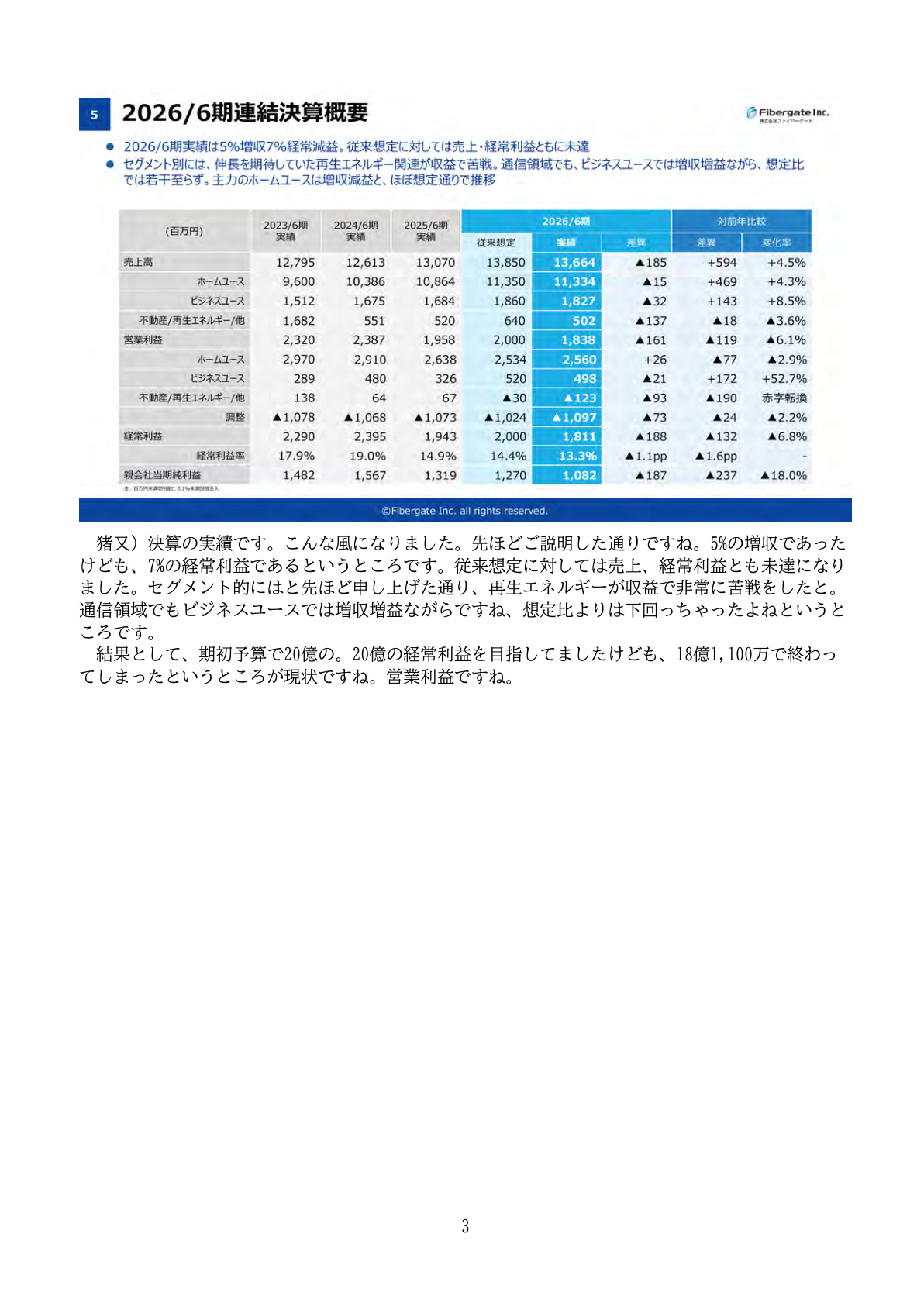
Fibergate Inc. reported its full-year consolidated financial results for the fiscal year ended June 30, 2026, with net sales of 13.664 billion yen (+4.5% YoY) , operating profit of 1.838 billion yen (-6.1% YoY) , ordinary profit of 1.811 billion yen (-6.8% YoY) , and net profit attributable to owners of the parent of 1.082 billion yen (-18.0% YoY) .
While the company achieved record-high net sales and maintained growth driven by the accumulation of recurring revenue in the core Home-Use segment and expansion in the Business-Use segment, the results fell short of the initial ordinary profit target of 2.0 billion yen.
Key Factors Behind the Earnings Shortfall and Profit Decline
The breakdown of the 160 million yen variance in operating profit against the initial forecast is as follows:
- Struggles in the Renewable Energy Business (-90 million yen): Delays in inventory liquidation at a solar construction firm acquired in August 2025 and project completion delays due to extended construction periods for new developments.
- Increase in Head Office and M&A-related Expenses (-70 million yen): Inclusion of 60 million yen in stock acquisition costs (including goodwill amortization) related to three M&A deals conducted during the fiscal year.
- Transition Period in the Business-Use Segment (-20 million yen): A reactionary decline in flow revenue following the completion of large-scale projects.
- Shift to Equipment Sales in the Home-Use Segment (+30 million yen): Higher-than-expected sales from the equipment-outright-sale model (+480 million yen) offset the shortfall in the equipment-leasing model (-450 million yen), resulting in segment profit exceeding initial projections.
2. Segment Trends and KPI Performance
① Home-Use Segment: Sales Model Transformation and Cross-Selling Expansion
The Home-Use segment reported net sales of 11.334 billion yen (+4.3% YoY) and segment profit of 2.560 billion yen (-2.9% YoY) .
- Shift to Equipment-Outright-Sale Model: The transition from the traditional "equipment-leasing model" (high gross margin but involves asset capitalization and fixed asset taxes) to the "equipment-outright-sale model" (lower gross margin due to upfront recognition of equipment costs) has progressed. While this pressured flow profit margins, the structural reform of the business is nearing completion.
- Expansion of Connected Units: The number of residence Wi-Fi connected units reached 740,000 at the end of the fiscal year (a net increase of approximately 60,000 units/year). The ratio of new multi-family housing remains high at 51%.
- Growth in Cross-Selling: Driven by heightened security awareness, sales of cross-sell products such as network cameras, intercoms for multi-family housing (FG Smart Call), and delivery lockers have expanded, with the cross-sell ratio in flow revenue reaching 17.0% .
② Business-Use Segment: Accumulation of Recurring Revenue and Preparation Phase
The Business-Use segment achieved significant profit growth, with net sales of 1.827 billion yen (+8.5% YoY) and segment profit of 498 million yen (+52.7% YoY) .
Although flow revenue declined in Q4 due to the reactionary effect of large-scale projects for medical/nursing facilities and educational institutions concentrated in Q3, the company steadily captured demand for on-premises communication infrastructure services, maintaining a high profit margin for the full year.
③ Renewable Energy Business: Addressing Challenges and Proactive Impairment
The Renewable Energy segment reported net sales of 206 million yen and a segment loss of 142 million yen (compared to near break-even in the previous year). Following delays in inventory disposal and the insolvency of the acquired solar construction firm, the company proactively recorded impairment losses on goodwill in Q4, effectively clearing the path for future profitability.
3. Financial Soundness and Cash Flow Generation
Despite being in a transitional phase of profitability, the company’s financial position and cash-generating capabilities remain robust.
- Equity Ratio: Maintained at 53.3% as of the end of June 2026, the highest level since listing.
- Free Cash Flow (FCF): Recorded a surplus of 980 million yen , marking the fourth consecutive year of positive FCF . The transition from an upfront investment phase to a "cash-accumulation phase" is now firmly established.
- Growth in Recurring Revenue: The quarterly CAGR of recurring revenue based on communication infrastructure reached 19.4% , continuing a trend of revenue growth for 33 consecutive quarters since listing.
4. FY2027 Full-Year Earnings Outlook
For the fiscal year ending June 30, 2027, the company anticipates a significant increase in revenue and a shift toward profit growth .
FY2027 Forecasts
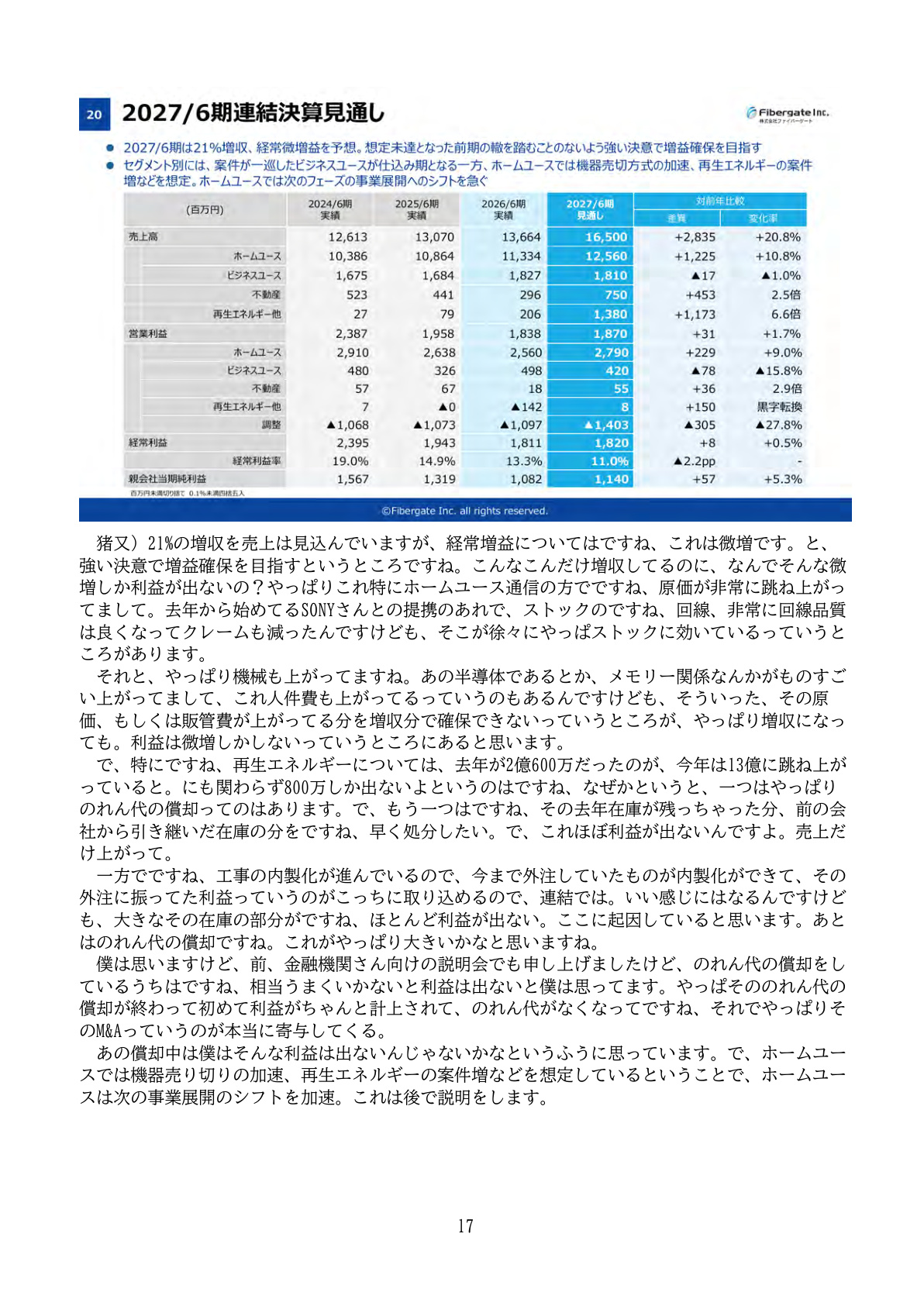
- Net Sales: 16.500 billion yen (+20.8% YoY)
- Operating Profit: 1.870 billion yen (+1.7% YoY)
- Ordinary Profit: 1.820 billion yen (+0.5% YoY)
- Net Profit Attributable to Owners of the Parent: 1.140 billion yen (+5.3% YoY)
Analysis of Factors
- Substantial Revenue Growth: Driven by the acceleration of the equipment-outright-sale model in the Home-Use segment (12.56 billion yen, +10.8%) and the full-scale contribution of the Renewable Energy business (1.38 billion yen, approx. 6.6x YoY).
- Profit Constraints: Despite the projected >20% revenue growth, ordinary profit is expected to see only marginal gains due to: (1) rising line procurement costs to enhance quality, (2) soaring prices for semiconductors, materials, and labor, (3) upfront investment in core system upgrades (e.g., Salesforce implementation) for operational efficiency, and (4) goodwill amortization related to M&A.
5. Mid-to-Long-Term Growth Strategy: Evolving into a "Premises Infrastructure Integrator"
The company is promoting a business model transformation with the goal of establishing a 5.0 billion yen ordinary profit structure in the mid-to-long term.
① Sophistication of Targets and Value Proposition
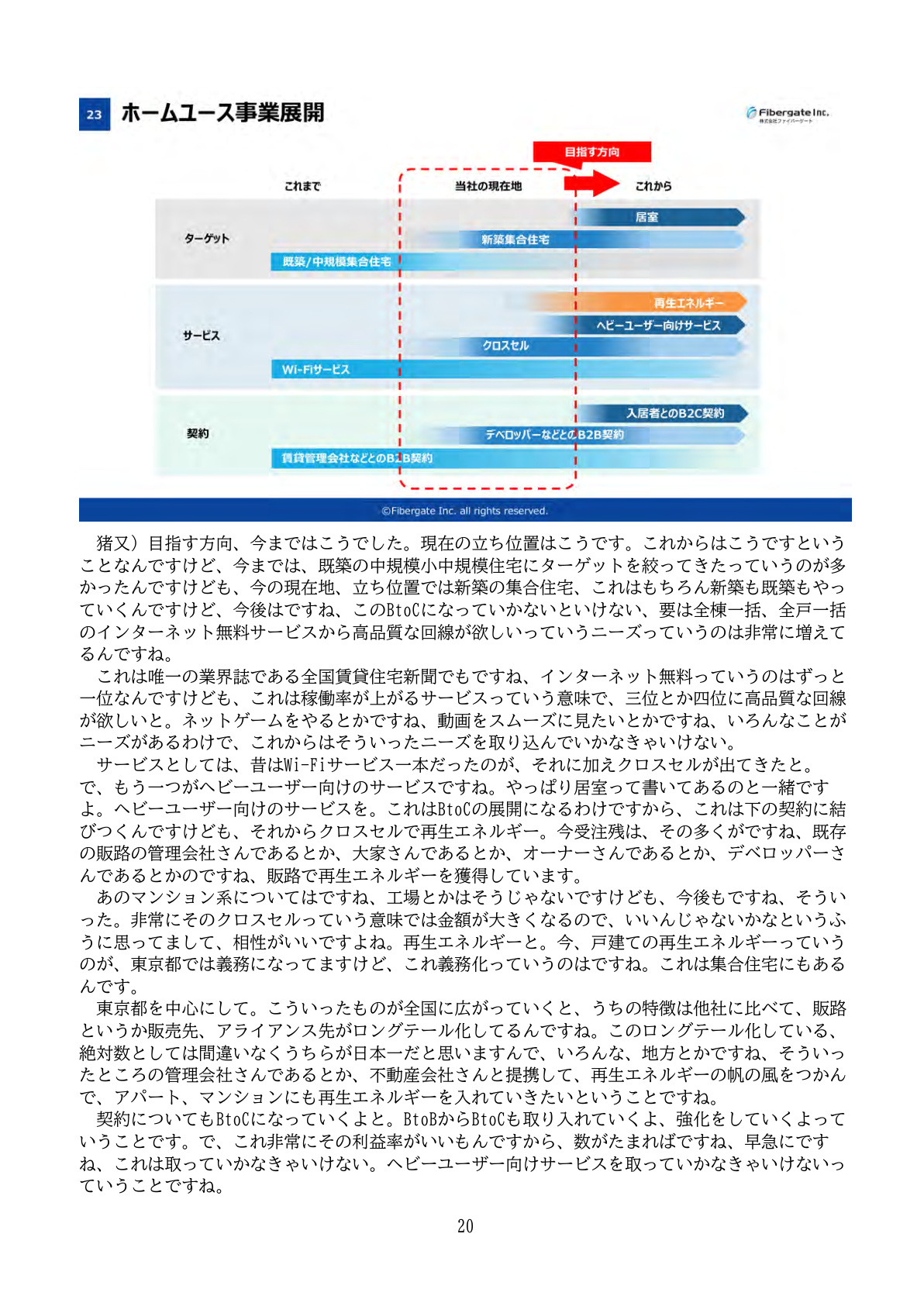
The company is expanding its scope from traditional "bulk Wi-Fi installation for existing mid-sized multi-family housing" to "newly built multi-family housing," "B2B for developers," and "B2C for tenants (high-quality lines/IoT for heavy users)." Through partnerships such as Mitsubishi Estate Group’s "HOMETACT," the company aims to increase Average Revenue Per User (ARPU).
② Convergence of Telecom and Renewable Energy (Telecommenergy)
Leveraging strong relationships with real estate management companies and owners nationwide (long-tail sales channels), the company offers integrated proposals for solar power generation, storage batteries, and perovskite solar cells for multi-family housing.
③ In-house Construction and Value Chain Integration via M&A
By bringing communication construction firms (Aiwa Co., Ltd.) and renewable energy construction firms (Power Denki Innovation Co., Ltd., Smart Green Co., Ltd.) into the group, the company is reducing outsourcing costs and internalizing construction capabilities to enhance cost competitiveness.
6. Capital Allocation and Shareholder Return Policy
- Strategic Investment Framework: The company plans 5.0–6.0 billion yen in strategic investments (M&A, system upgrades, B2C expansion) and 3.0–4.0 billion yen in maintenance/renewal investments over the next two years. Growth capital will be secured by combining operating cash flow (5.0 billion yen over two years) and external financing (approx. 5.0 billion yen).
- Dividend Policy: The company paid an annual dividend of 27.0 yen (50.2% payout ratio) for FY2026. It expects to maintain an annual dividend of 27.0 yen (47.7% payout ratio) for FY2027, clearly prioritizing stable shareholder returns even during this business transition period.
This content is not intended as investment advice or a recommendation. Any opinions expressed are solely the personal views of each article.