

AeroEdge FY2026 Earnings Deep Dive: Record-Breaking Performance Driven by Blade Production Ramp-up and M&A, Growth Accelerating to ¥7.95 Billion in FY2027

StockClub
Published: Aug 20, 2026, 09:59 AM
Sentiment Analysis
1. Earnings Highlights and Executive Summary
AeroEdge (TSE Growth: 7409) delivered a stellar performance for the fiscal year ended June 2026, significantly surpassing all-time highs in both revenue and profit at every level , underpinned by a robust recovery in aircraft demand and expanded market share for its core products.
For the full fiscal year 2026, consolidated revenue reached ¥5,084 million (+41.2% YoY) , operating profit hit ¥1,145 million (+74.8% YoY) , and EBITDA climbed to ¥1,562 million (+50.5% YoY) . The company outperformed both initial and revised forecasts, with the operating margin improving by 4.3 percentage points to 22.5% , up from 18.2% in the previous year.
Key drivers of this strong performance include:
- Expansion of core TiAl (Titanium Aluminide) blade sales : Increased demand for both the Airbus A320neo family and the Boeing 737MAX.
- High-margin contract development revenue : Revenue from new material development (approx. ¥300 million) contributed during the second quarter.
- Full acquisition of Ono Plant : The company integrated Ono Plant, a manufacturer of aircraft structural parts, to diversify its business portfolio (FY2026 reflects B/S consolidation only; P/L consolidation begins in FY2027).
2. Analysis of Performance Trends and Profit Structure
■ Analysis of Operating Profit Variance
Operating profit for FY2026 increased by ¥490 million (+74.8%) from the previous year's ¥655 million. Despite cost increases—including upfront investments for new mass-production projects (personnel expenses: -¥279 million), M&A-related costs for the Ono Plant acquisition (-¥55 million), and higher maintenance and consumable costs due to inflation (-¥95 million)—these were substantially offset by marginal profit contributions from contract development and increased TiAl blade sales (+¥1,057 million) , as well as favorable foreign exchange impacts (+¥96 million).
■ Financial Health and Cash Flow
- Equity Ratio : Following the full acquisition of Ono Plant and increased borrowing for growth investments, total assets expanded to ¥12,261 million (from ¥8,211 million at the end of the previous year), resulting in an equity ratio of 39.1% (down from 47.3%).
- Net D/E Ratio : With cash and deposits maintained at a healthy ¥2,628 million, the Net D/E ratio remains sound at 0.6x .
- Operating Cash Flow : Driven by higher pre-tax profit and the receipt of subsidies for capital investment (+¥1,979 million), operating cash flow saw a significant surplus of +¥2,959 million .
3. Market Environment and Performance of the Core "LEAP Engine Blade Business"
■ Over a Decade of Aircraft Backlog
Key narrow-body aircraft, the Airbus A320neo family (7,469 units in backlog) and the Boeing 737MAX (5,404 units in backlog), hold a massive backlog equivalent to 12.3 years of production . Strong demand for new aircraft from airlines continues to provide a foundation for long-term business stability.
■ Key KPI: Trends in Engine-Equivalent Blade Shipments
Sales volume of low-pressure turbine (LPT) TiAl blades for LEAP engines, processed and sold by AeroEdge, reached 847 engine-equivalents, up 32.6% YoY . This aligns with the steady 43% YoY increase in LEAP engine deliveries by CFM International (2,103 units), maintaining high shipment levels on a quarterly basis.
4. FY2027 Full-Year Forecast and Growth Acceleration Scenario
For the upcoming fiscal year ending June 2027, the company anticipates further acceleration in growth.
Full-year forecasts for FY2027 project revenue of ¥7,950 million (+56.4% YoY) , operating profit of ¥1,550 million (+35.3% YoY) , and net income of ¥960 million (+22.9% YoY) , marking consecutive years of significant revenue and profit growth and new record highs .
The breakdown and drivers of this rapid top-line growth are clearly illustrated in the graph below.
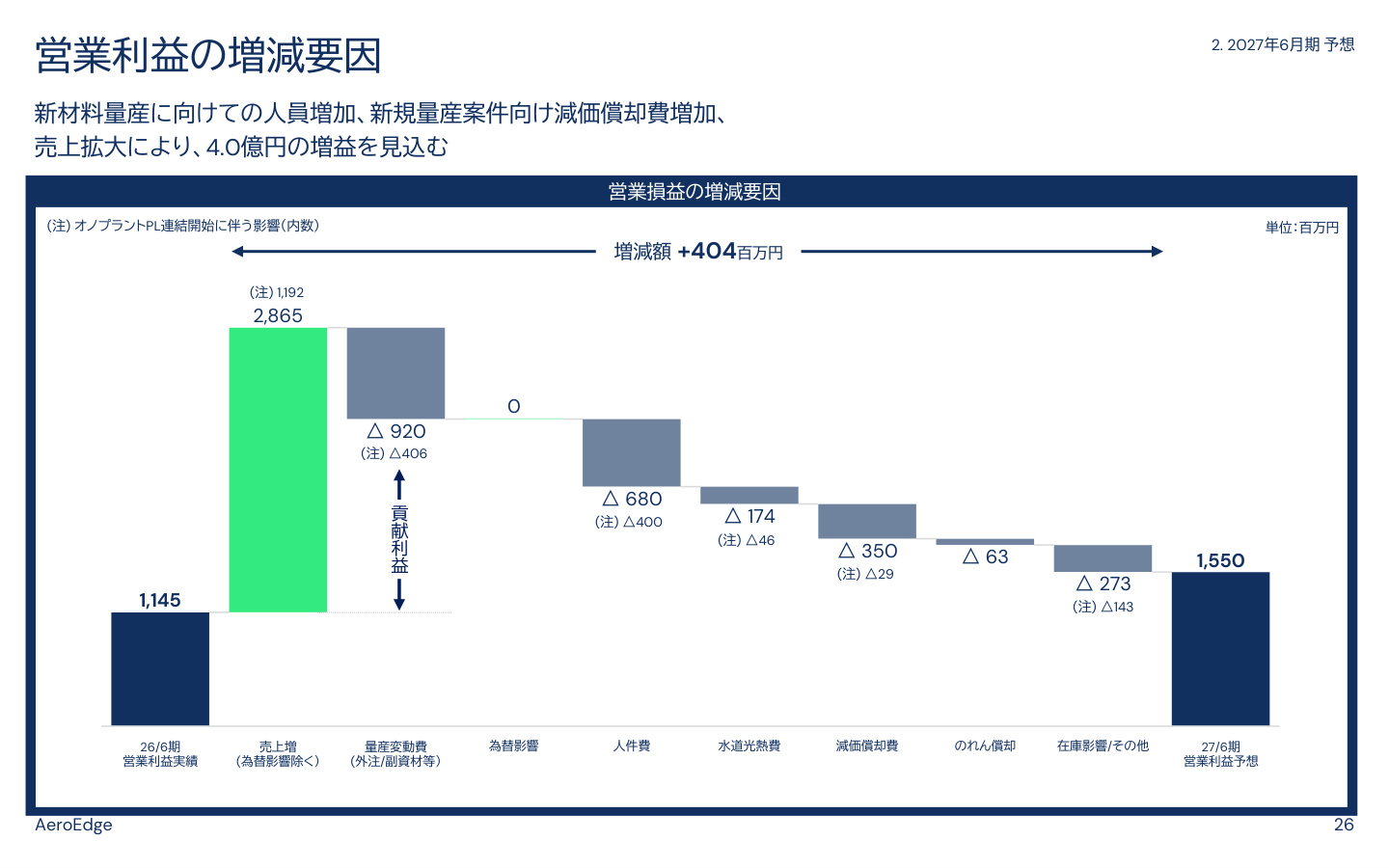
■ Three Major Drivers of Revenue Growth (+¥2,865 million):
- Expansion of TiAl blade processing (¥5,574 million, +20.5%) :
- In addition to production rate hikes for the A320neo and 737MAX, the company expects 1,084 engine-equivalents (+28.0% YoY) , driven by proactive share gains ahead of the planned market share increase (from 40% to the high 40% range) scheduled for 2028.
- Ramp-up of new mass-production projects (Aircraft engine B-parts) (¥796 million) :
- New mass production for global aerospace manufacturers has commenced, transitioning into the monetization phase.
- Full-year P/L consolidation of Ono Plant (¥1,192 million) :
- Full-scale diversification into airframe structural parts and realization of group synergies.
5. Mid-to-Long-Term Growth Strategy and Capital Allocation
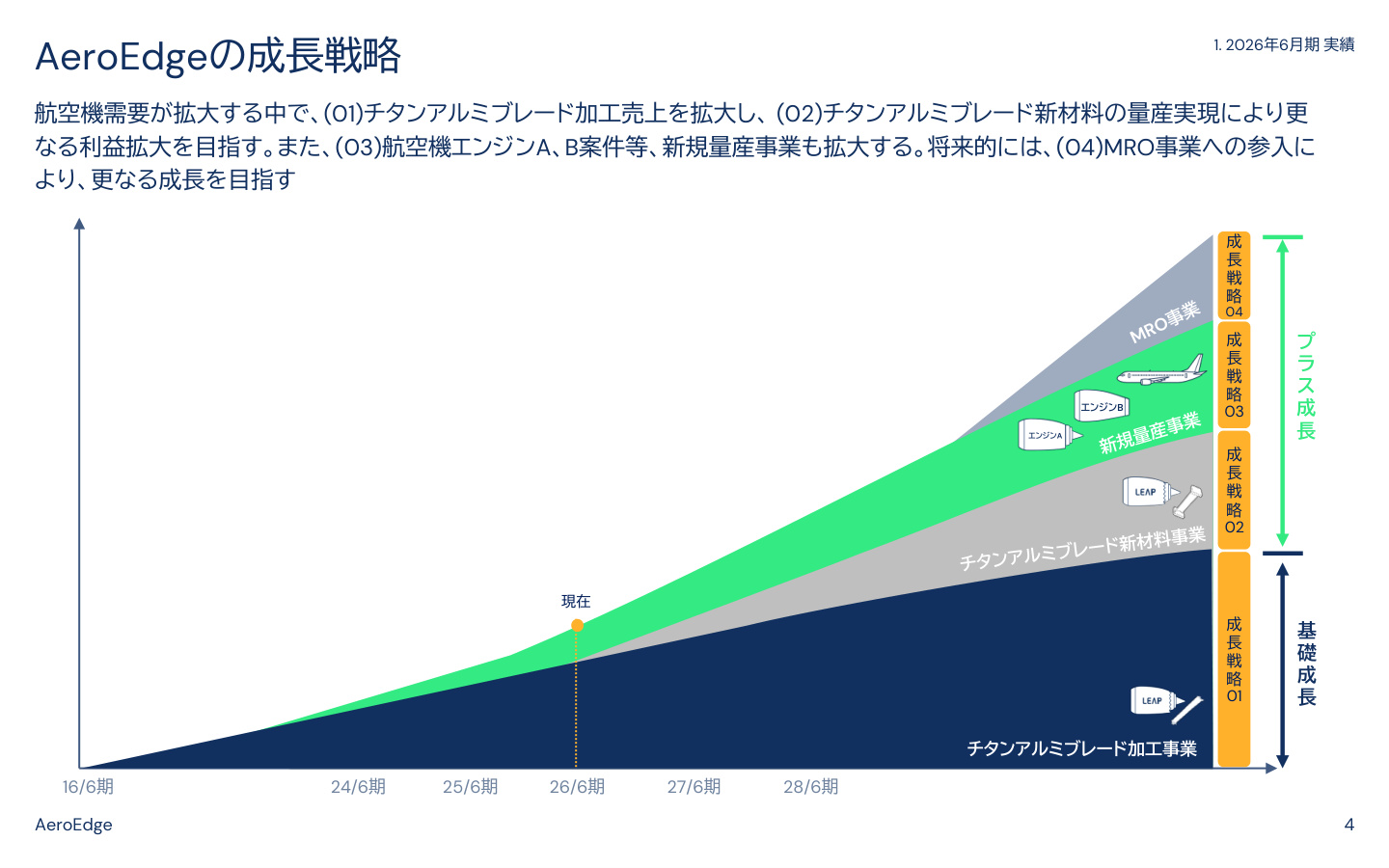
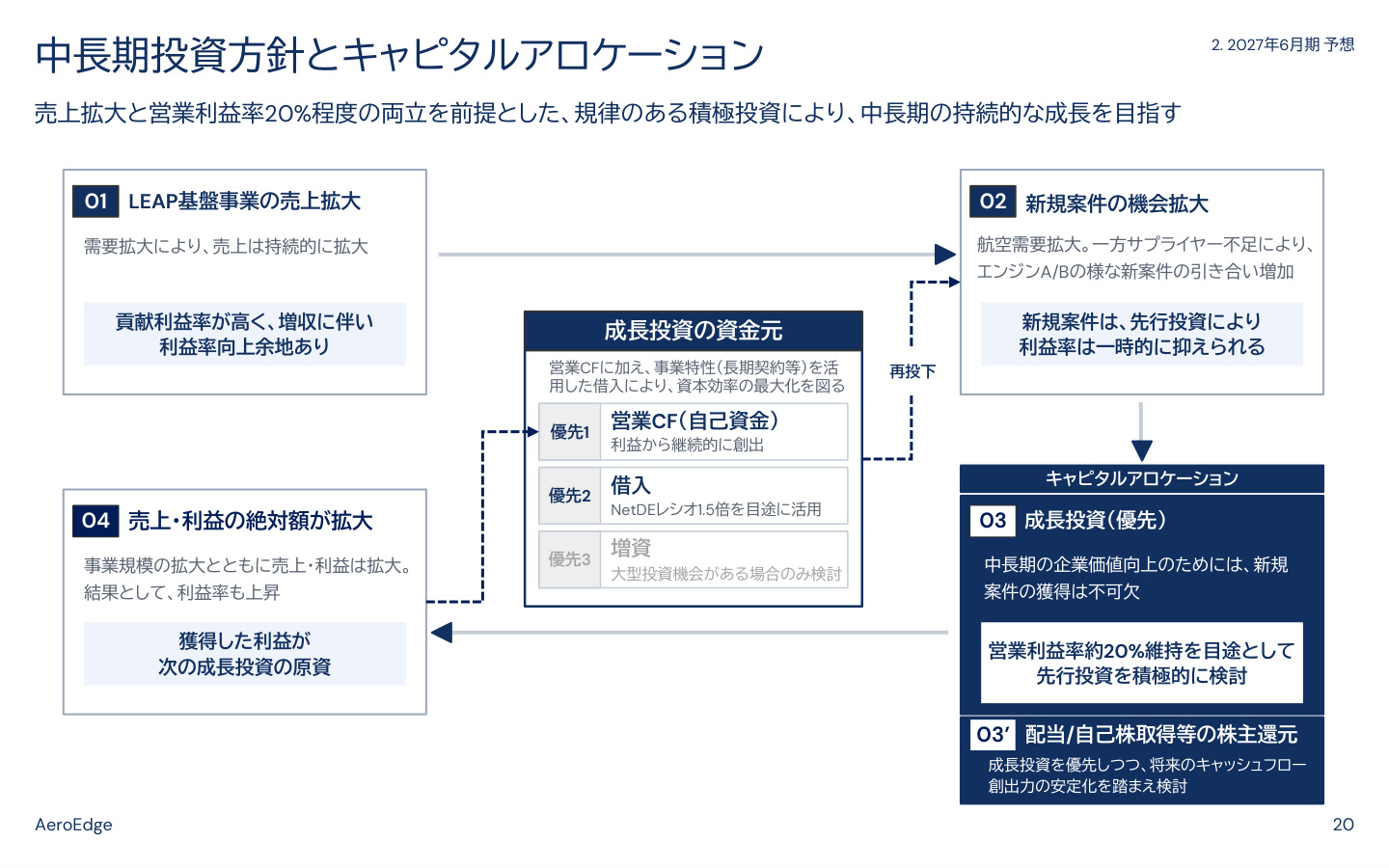
AeroEdge aims to balance "maintaining an operating margin of around 20%" with "disciplined and aggressive investment."
■ Four-Stage Growth Strategy Roadmap
- Growth Strategy 01 (LEAP Blade Processing) : Maximize base earnings through the fulfillment of share-gain contracts and facility expansion.
- Growth Strategy 02 (New Materials/Casting Business) : Small-scale supply to begin in FY2027 (full-scale monetization expected from FY2029 onwards). Aiming to establish the world's only integrated TiAl blade production process.
- Growth Strategy 03 (New Mass-Production Projects) : Following engine B-parts, engine A-projects currently in the customer testing phase are slated for monetization from FY2028 onwards.
- Growth Strategy 04 (MRO Business) : Preparing for entry into the repair and maintenance market utilizing Additive Manufacturing (AM) technology.
■ Capital Allocation Policy
Given the long-term nature of its contracts, the company prioritizes the use of "operating cash flow (internal funds)" and "borrowing (targeting a Net D/E ratio of 1.5x)" as sources for growth investment. The policy is to reinvest while maintaining high profit margins to achieve non-linear improvements in corporate value.
6. Risk Factors and Investment Considerations
The report highlights the following variables alongside its long-term growth potential:
- Supply Chain Constraints : Risks of fluctuations in monthly production due to parts procurement delays at engine manufacturers.
- Customer/Product Concentration : High dependency on Safran (France) and the LEAP engine.
- Vertical Ramp-up Costs for New Projects : Speed of yield improvement during the initial mass-production phase of new materials and engines.
- Foreign Exchange Impact : The majority of revenue is denominated in USD (assumed rate: ¥152/USD). Exchange rate sensitivity is approximately ¥40–50 million in operating profit for every ¥1 fluctuation .
This content is not intended as investment advice or a recommendation. Any opinions expressed are solely the personal views of each article.