


Takemoto Yohki Q2 FY2026 Earnings Deep Dive: Profitability Growth Driven by Sustainable Packaging Expansion and Global Development

StockClub
Published: Aug 20, 2026, 09:54 AM
Sentiment Analysis
1. Q2 FY2026 Consolidated Financial Highlights
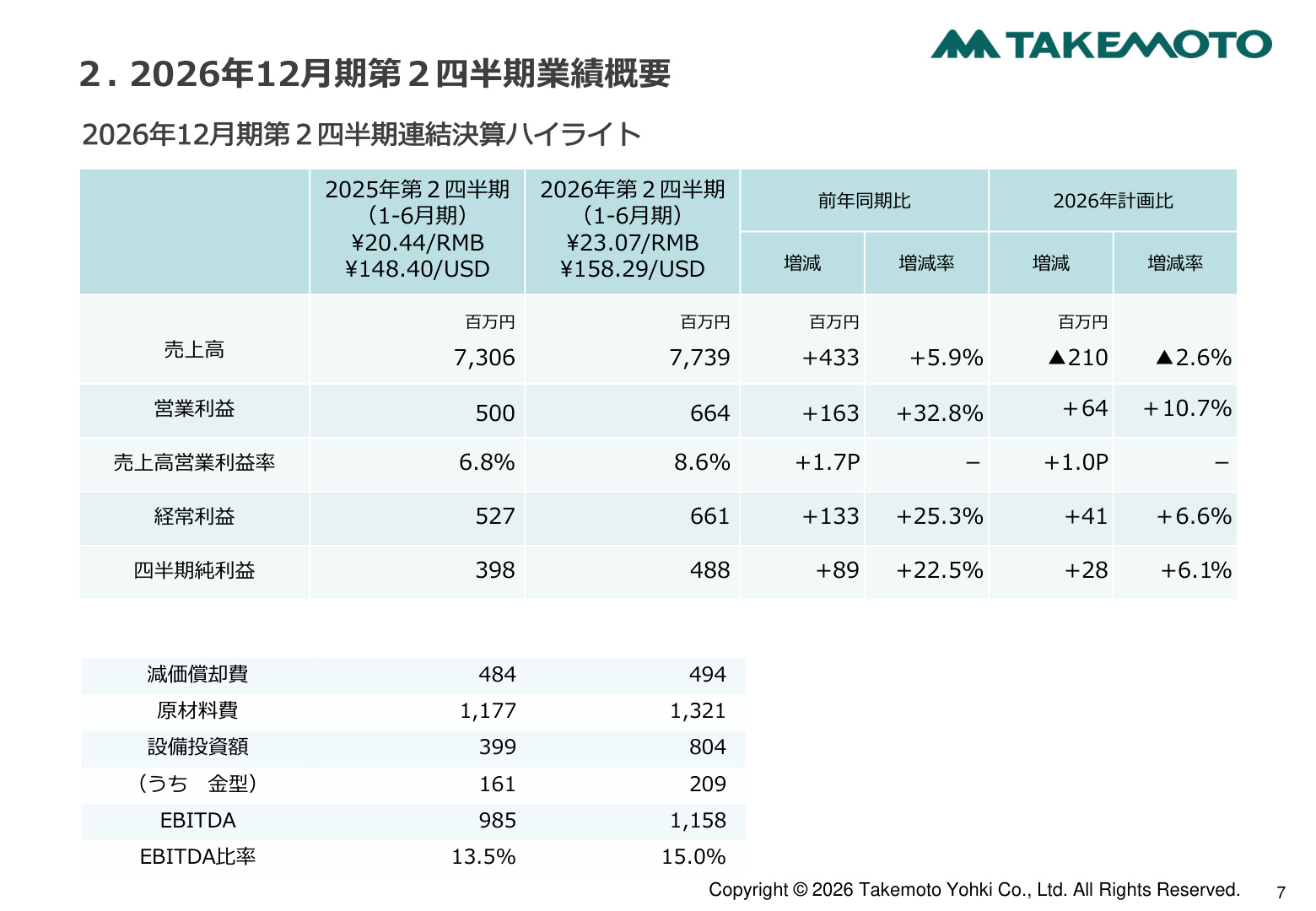
For the first half of the fiscal year ending December 2026, Takemoto Yohki Co., Ltd. achieved revenue of ¥7.739 billion (+5.9% YoY) , operating profit of ¥664 million (+32.8% YoY) , ordinary profit of ¥661 million (+25.3% YoY) , and net profit attributable to owners of the parent of ¥488 million (+22.5% YoY) , marking both top-line growth and a significant increase in profits. EBITDA, a key indicator of earning power, reached ¥1.158 billion (+17.6% YoY) .
The slide below summarizes the key financial figures for the second quarter and progress against the initial plan.
Progress Against Plan and Profitability Improvement
As shown in the highlights, while revenue fell short of the initial plan by ¥210 million (-2.6%) , operating profit exceeded the plan by ¥64 million (+10.7%) , and ordinary profit surpassed it by ¥41 million (+6.6%) .
The operating profit margin improved by 1.7 percentage points to 8.6% from 6.8% in the same period last year (and +1.0 point against the plan), demonstrating that the shift toward high-value-added products, productivity improvement measures, and the progress of price pass-throughs contributed to the margin expansion. Furthermore, capital expenditure increased significantly from ¥399 million in the same period last year to ¥804 million , reflecting active investment in molds and the expansion of production lines for future growth.
2. Analysis of Operating Profit Variance
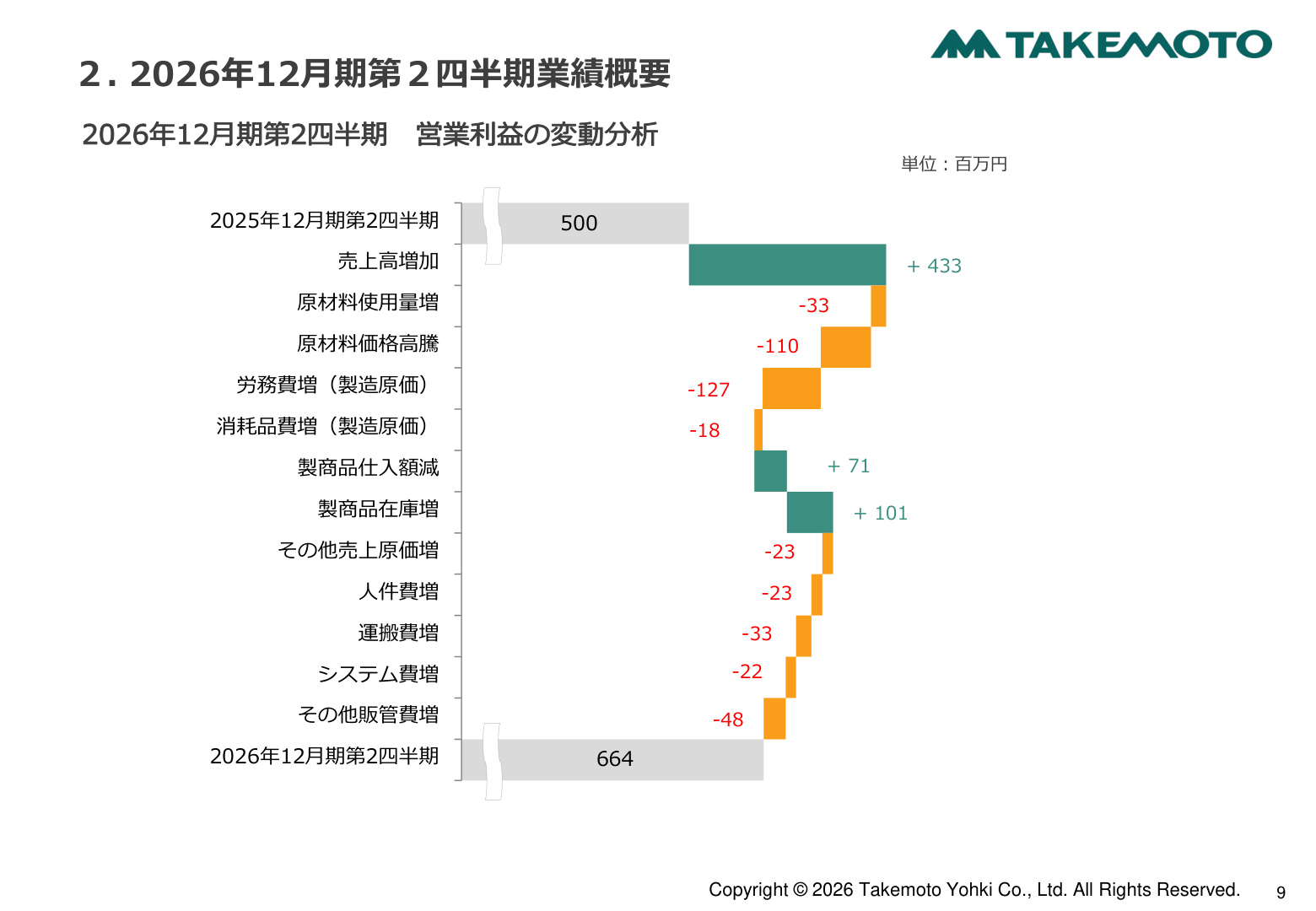
A detailed analysis of cost structure fluctuations was conducted to explain the ¥164 million increase in profit , rising from ¥500 million in the same period last year to ¥664 million.
Key Drivers of Profit Growth and Cost Pressures
As this waterfall chart illustrates, the largest positive factor was the increase in gross profit due to higher sales (+¥433 million) . Additionally, reductions in product purchasing costs ( +¥71 million ) and the impact of inventory valuation due to increased stock levels ( +¥101 million ) also boosted profits.
Conversely, the following cost pressures were observed:
- Surging raw material prices : -¥110 million
- Increase in labor costs (manufacturing costs) : -¥127 million
- Increase in raw material usage : -¥33 million
- Increase in SG&A expenses : Transportation costs (-¥33 million), personnel expenses (-¥23 million), system costs (-¥22 million), etc.
Despite global inflation, rising labor costs, and upfront investments in system upgrades, the company has demonstrated a structure capable of absorbing these cost increases through sales expansion and value-added improvements, thereby achieving significant profit growth.
3. Regional Segment Trends
Japan: Gross Margin Improvement in Core Standard Bottles and New Business Development
- Revenue : ¥5.688 billion (+0.8% YoY), Operating Profit: ¥500 million (+23.0% YoY)
- Trends : Revenue turned to growth in Q2 after a decline in Q1. By increasing contact frequency with major clients and strengthening product introductions via web marketing, revenue from new projects increased . Although repeat business saw a slight decline, the higher composition ratio of standard bottles and improved gross margins led to a substantial increase in operating profit (+23.0%).
India: Capturing Market Vitality and Achieving Record Quarterly Results
- Revenue : ¥584 million (+46.1% YoY)
- Trends : In addition to the overall vibrancy of the cosmetics market, Takemoto Yohki’s design and high quality were highly regarded, leading to a significant expansion in the number of new clients . To meet the surge in demand, the company continues to invest in expanding its own facilities and supply chain.
China: Revenue Growth Offset by High Raw Material Costs Leading to Temporary Loss
- Revenue : ¥1.483 billion (+20.3% YoY, +6.6% in local currency)
- Trends : Amidst continued consumer frugality and intensifying competition, the company secured revenue growth by strengthening sales activities, particularly in the cosmetics sector. Although the company worked to reduce costs by introducing automated and labor-saving lines at production sites, the rise in raw material prices took a toll, resulting in an operating loss of ¥7 million (compared to a profit of ¥21 million in the same period last year).
4. Financial Foundation and Shareholder Returns (Maintaining DOE 4.0% Target)
Cash Flow and Financial Position
- Operating Cash Flow : +¥491 million (an improvement of +¥243 million YoY). Stable funds were generated through profit before income taxes (¥669 million) and depreciation (¥494 million).
- Investing Cash Flow : -¥668 million . Continued investment in fixed assets, including molds and machinery, both domestically and internationally.
- Financing Cash Flow : -¥449 million . Repayment of long-term loans (-¥232 million) and dividend payments (-¥217 million).
- Cash and Deposits : The balance remains at ¥3.73 billion , maintaining a sound financial position.
Dividend Policy
The company continues its policy of targeting a Dividend on Equity (DOE) ratio of 4.0% . For the fiscal year ending December 2026, the company plans an interim dividend of ¥19.00 per share (¥18.00 in the previous year) and a year-end dividend of ¥19.00 , resulting in an annual dividend of ¥38.00 (payout ratio of 50.9%) .
5. Mid-to-Long-Term Growth Strategy: Evolving into a "Resource-Circulating Packaging Company"
The company has set a 2030 vision to become a "Resource-Circulating Packaging Company" and has positioned the expansion of market share for environmentally friendly containers as its most important strategy.
Growth Trajectory of Resource-Circulating Products and KPI Targets
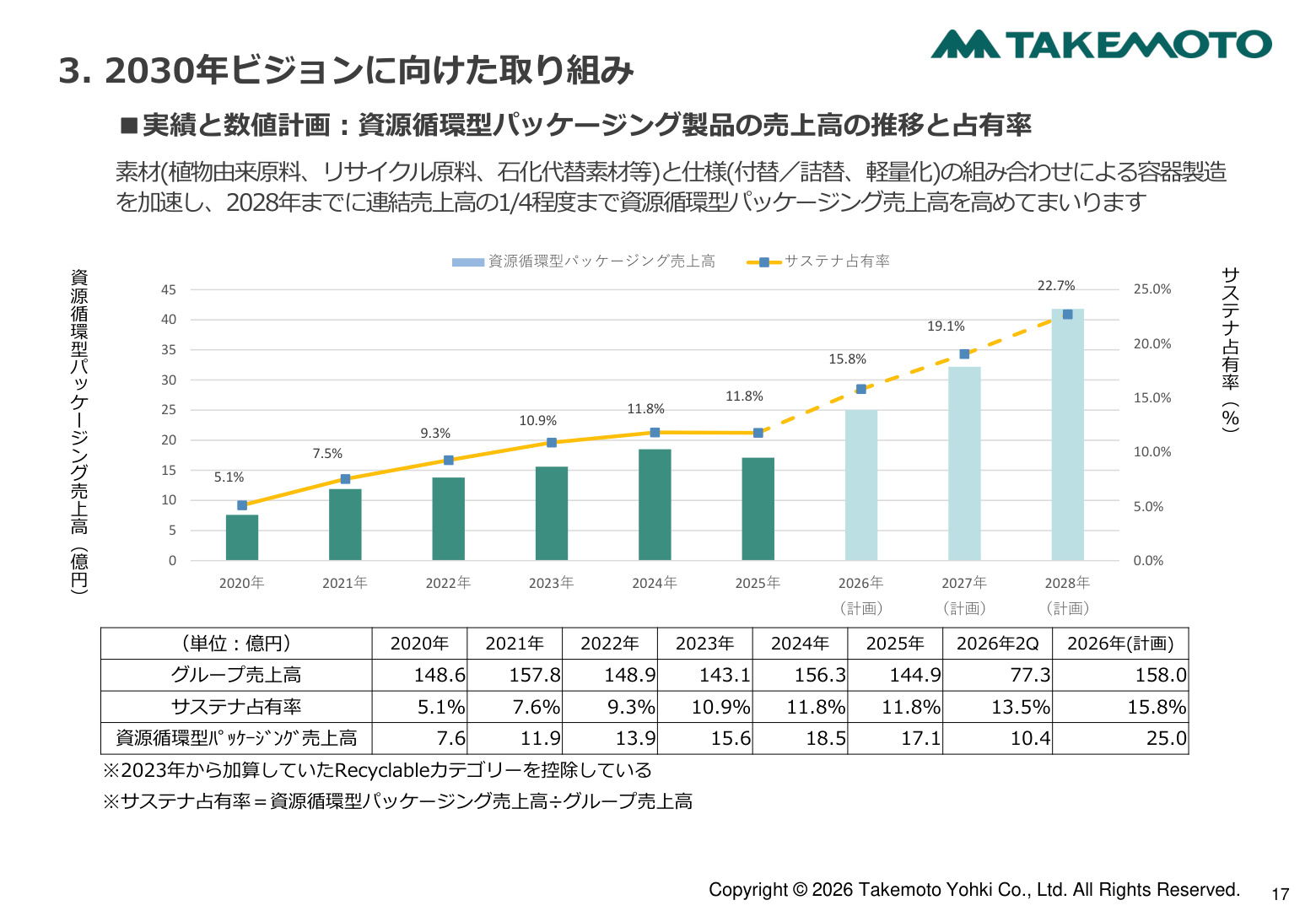
The slide above shows the trends in revenue and sales share of the company’s environmentally friendly products (biomass resin, recycled resin, lightweight/refillable containers, etc.) and mid-term numerical targets through 2028.
- Q2 FY2026 Results : Resource-circulating packaging revenue reached ¥1.041 billion (+21.4% YoY) , with a sustainability share of 13.5% .
- FY2026 Annual Plan : Aiming for revenue of ¥2.5 billion and a share of 15.8% .
- 2028 Long-Term Goal : Planning to increase this to approximately 1/4 of consolidated revenue (22.7% share, over ¥4 billion in revenue) by 2028.
Three Key Themes for Realizing the Vision
- Materials (Innovation in materials and specifications) : Adoption of biomass materials, post-industrial recycled (PIR) materials, and biodegradable plastics, as well as the promotion of lightweight and mono-material designs.
- Recycle (Establishing horizontal recycling) : Utilizing nano-bubble ink removal technology for cleaning and reusing cosmetic containers, and building collection schemes with local governments and the market.
- Innovation (Carbon Neutrality) : Visualization of Product Carbon Footprint (CFP) and CO2 reduction across the entire supply chain.
Organizational Restructuring and Advancement of Sales/Development Processes
To directly link environmental strategy to business growth, the company is promoting the following organizational and functional reforms:
- Building Customer Segment-Based Organizations : Reorganizing into units based on lot size and degree of customization—such as large-lot, medium-lot, and web/showroom sales—to enhance responsiveness.
- Development Outsourcing and Account Management : Establishing a "development outsourcing" model that accompanies clients from upstream processes like planning and design, thereby deepening sales.
- Accumulation of Intellectual Property : The number of registered patents, utility models, designs, and trademarks has increased by more than 2.5 times since 2019, building barriers to entry through unique design and technical capabilities.
This content is not intended as investment advice or a recommendation. Any opinions expressed are solely the personal views of each article.