


Sharing Innovations Q2 FY2026 Earnings Analysis: Profitability Structure Improves During 'Recovery Phase' with 207% YoY Operating Profit Growth; AI-Driven Transformation and H2 Outlook

StockClub
Published: Aug 20, 2026, 09:53 AM
Sentiment Analysis

Sharing Innovations' financial results for the second quarter of the fiscal year ending December 2026 demonstrate a significant recovery and growth in profitability. The company has designated 2026 as a "Recovery Phase," focusing on improving its business model, profitability, and business portfolio. While absorbing the impact of a challenging external environment on revenue, the company has successfully promoted high-value-added core businesses and company-wide productivity reforms.
This report provides a detailed analysis of the financial performance for the first half of the fiscal year, segment-specific trends, progress toward full-year targets, and the company's strategic focus on "AI-Driven Transformation."
1. Q2 FY2026 Earnings Highlights
For the first half of the fiscal year ending December 2026, the company reported revenue of 1,949 million yen (down 16% YoY) . Conversely, operating profit surged to 82 million yen (up 207% YoY) , ordinary profit reached 83 million yen (up 445% YoY) , and net profit attributable to owners of the parent was 41 million yen (compared to a 5 million yen loss in the same period last year) , marking a substantial increase in profitability.
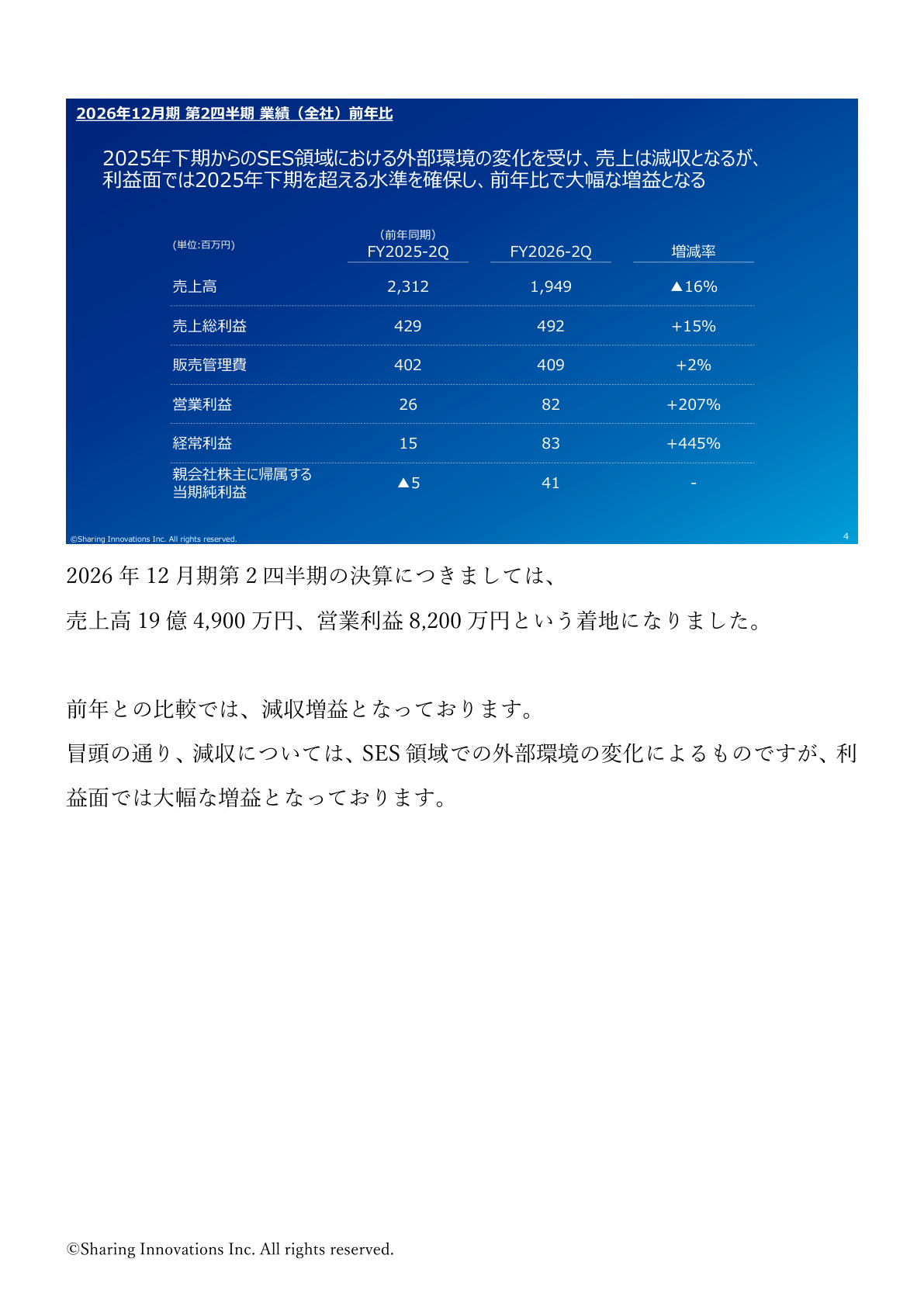
As shown in the slide above, the decline in revenue was driven by the ongoing trend of clients moving toward in-house development in the System Engineering Service (SES) sector—a trend that began in the second half of 2025—as well as reduced demand in legacy areas due to geopolitical risks in regions such as the Middle East.
However, the profit trend tells a different story. Gross profit expanded to 492 million yen (up 15% YoY) . By keeping the increase in selling, general, and administrative (SG&A) expenses to 409 million yen (up 2% YoY) , operating profit jumped more than threefold from 26 million yen in the same period last year to 82 million yen. Despite continued investment in human resources, such as recruitment and the development of personnel systems, the shift toward high-margin projects and improved delivery efficiency have driven this profit growth.
2. Analysis of Operating Profit Variance
The 56 million yen improvement in operating profit (from 26 million yen to 82 million yen) is primarily attributed to increased gross profit across business segments.
- Contribution from DX Business (+52 million yen): The core DX business was driven by strong order activity in the Salesforce domain . Furthermore, maintaining engineer utilization rates near full capacity significantly improved profitability at the delivery stage.
- Contribution from Platform Business (+10 million yen): This was driven by efforts to increase the billable hours of appraisers, expand usage among existing users, and improve the cost-effectiveness of advertising for new user acquisition.
- Other Factors (-6 million yen): This reflects a slight increase in expenses associated with company-wide organizational strengthening and investments.
3. Segment Performance Trends
The performance of the company's two main business pillars, the "DX Business" and the "Platform Business," is as follows:
(1) DX Business
- Revenue: 1,754 million yen (down 18% YoY)
- Segment Profit: 216 million yen (up 33% YoY)
While revenue declined due to the shift toward in-house development by clients and a decrease in legacy and low-skill project volume, the segment profit margin jumped significantly to 12.3% (up from 7.6% in the same period last year) . This was driven by an increased ratio of high-priority cloud integration projects, such as Salesforce, resulting in a 33% increase in segment profit.
(2) Platform (PF) Business
- Revenue: 209 million yen (up 6% YoY)
- Segment Profit: 34 million yen (up 33% YoY)
The Platform business achieved both revenue and profit growth. Success in initiatives to increase activity among existing users, combined with more efficient digital advertising, helped suppress new acquisition costs and boost overall profitability.
4. Quarterly Trends and Financial Soundness
Looking at quarterly operating profit, the company recorded 45 million yen in Q1 and 37 million yen in Q2, totaling 82 million yen for the first half. This exceeds the total operating profit of 73 million yen recorded in the second half of the previous fiscal year (Q3+Q4 2025), confirming that the company is on a solid recovery trajectory.
Furthermore, the consolidated balance sheet at the end of Q2 remains stable:
- Total Assets: 2,349 million yen (+19 million yen from previous year-end)
- Net Assets: 1,651 million yen (+41 million yen from previous year-end)
- Total Liabilities: 697 million yen (-22 million yen from previous year-end)
- Equity Ratio: Approximately 70.3%
With the regular amortization of goodwill from past M&As and the repayment of interest-bearing debt, the company maintains a robust financial foundation.
5. Progress Toward Full-Year FY2026 Targets and H2 Outlook
As of the second quarter, the company is tracking ahead of its full-year consolidated earnings forecast, particularly in profit-related metrics.
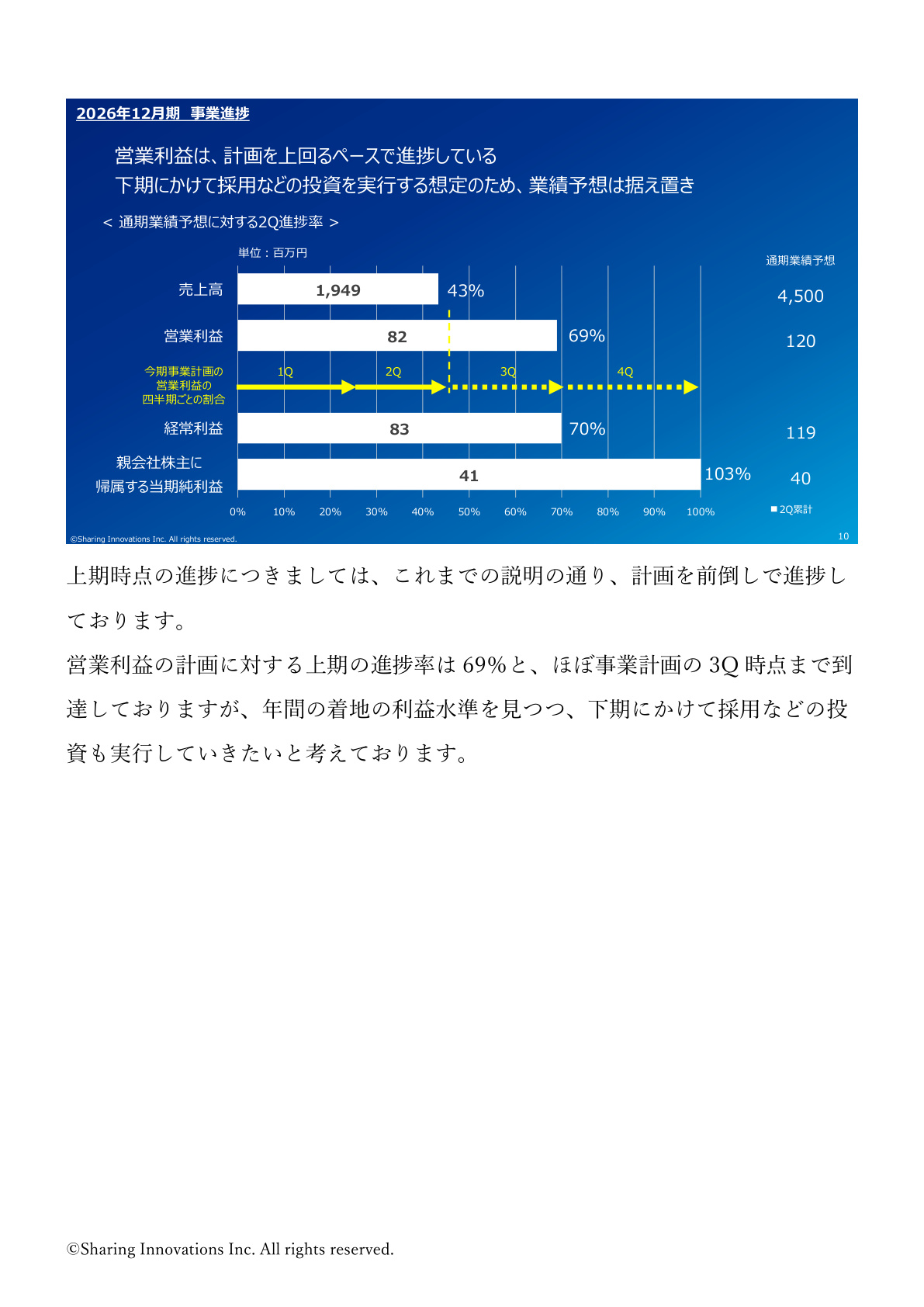
As shown in the progress chart above, the achievement rates are as follows:
- Revenue: 1,949 million yen / Full-year forecast 4,500 million yen ( 43% progress)
- Operating Profit: 82 million yen / Full-year forecast 120 million yen ( 69% progress)
- Ordinary Profit: 83 million yen / Full-year forecast 119 million yen ( 70% progress)
- Net Profit: 41 million yen / Full-year forecast 40 million yen ( 103% progress)
The operating profit achievement rate reached approximately 70% in the first half, and net profit attributable to owners of the parent has already exceeded the full-year plan. While the initial business plan assumed an even distribution of profit across quarters (approx. 25% each), the first-half results have effectively front-loaded performance.
The company has maintained its full-year earnings forecast, citing a policy to actively execute investments for future growth, such as recruitment, throughout the second half while monitoring the final profit level. The plan is to reinvest in human capital—essential for sustainable growth—after solidifying the company's earning power during this recovery phase.
6. Growth Strategy Topics: Company-wide "AI-Driven Transformation"
As announced in May 2026, Sharing Innovations is fully deploying its "AI-Driven Business Transformation." This initiative goes beyond the simple introduction of tools; it involves redesigning business processes across all departments—development, sales, marketing, planning, and corporate—with generative AI as a core premise.
(1) Overwhelming Productivity Gains in Real Projects
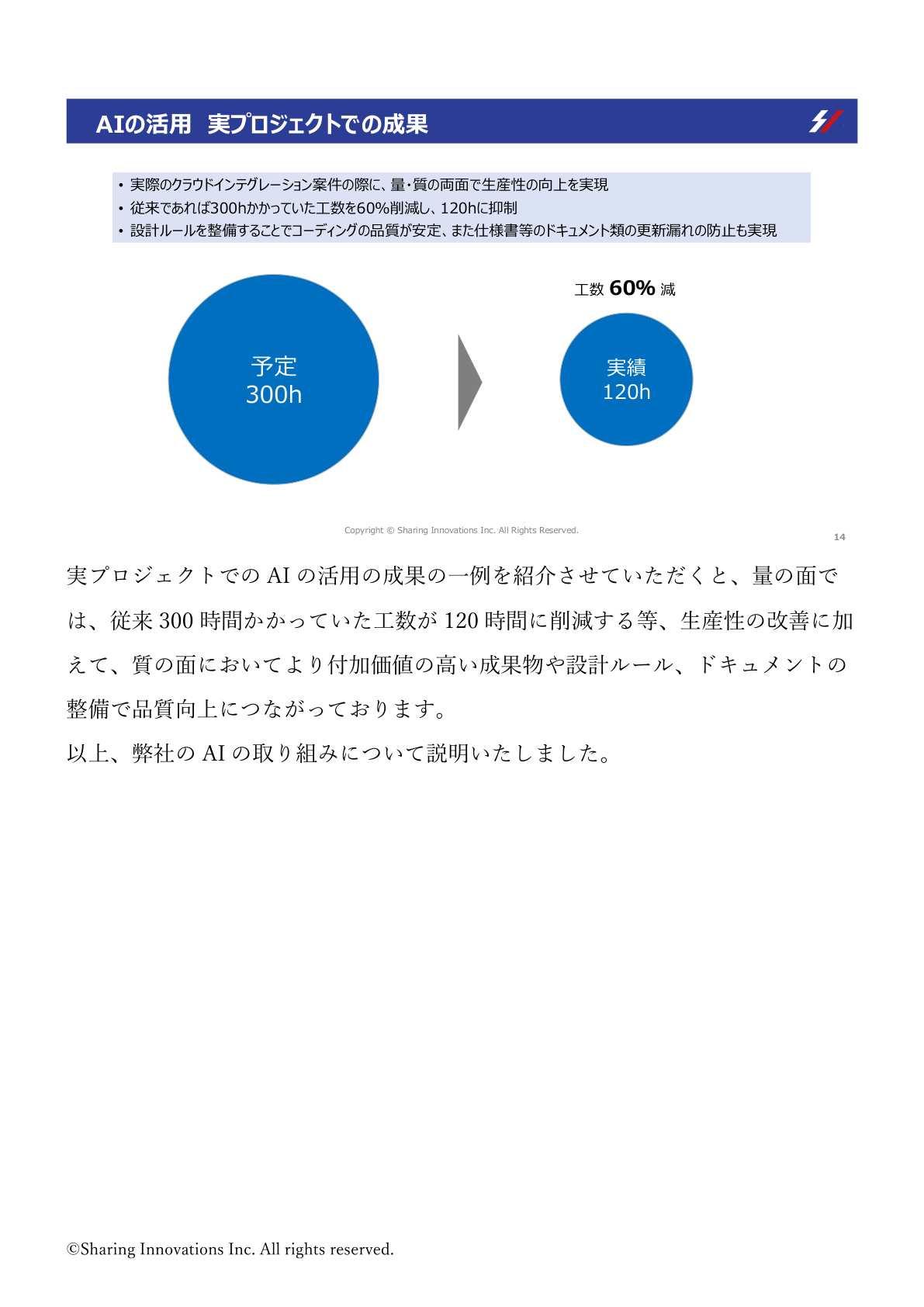
The slide above illustrates the quantitative results of AI utilization in actual cloud integration projects:
- Reduction in Man-hours: Development and design processes that previously required 300 hours were reduced to 120 hours , achieving a 60% reduction in man-hours .
- Improved Quality and Documentation: Establishing design rules has stabilized coding quality and improved documentation management, such as preventing omissions in specification updates.
(2) Future Roadmap and External Solution Provision
- Through 2025 (Validation Phase): Applied AI development tools to practical work and verified the impact and output quality in design, implementation, and testing phases.
- H1 2026 (Results Creation Phase): Conducted training programs for the transition to AI-driven development and expanded the number of engineers involved. Confirmed productivity improvements in actual projects.
- H2 2026 and Beyond (Scaling and Commercialization): Moving toward full-scale implementation in projects and expanding AI-driven transformation to non-engineering roles such as sales and marketing.
Furthermore, leveraging the know-how gained internally, the company has begun providing AI and data utilization solutions (planning, selection, implementation, and operational support) to client companies , expanding this as a high-growth business area.
7. Conclusion
In the second quarter of FY2026, Sharing Innovations achieved significant profit growth by focusing on high-value-added areas like Salesforce and improving utilization rates, effectively countering the environmental shift caused by the contraction of legacy areas.
With operating profit at 69% of the full-year target, the company remains in a strong position. It plans to utilize the generated capital to accelerate recruitment, human resource investment, and company-wide AI-driven transformation in the second half. These results confirm that the transition to a high-profit structure and the implementation of next-generation productivity measures are progressing steadily.
This content is not intended as investment advice or a recommendation. Any opinions expressed are solely the personal views of each article.