


JINUSHI Co., Ltd. (3252) Q2 FY2026 Earnings Deep Dive: Accelerating Acquisitions with Interest Rate and Inflation Resilience, Setting a Solid Foundation for Full-Year Targets

StockClub
Published: Aug 20, 2026, 09:52 AM
Sentiment Analysis
1. Overview of Q2 FY2026 Financial Results and Revenue Structure
JINUSHI Co., Ltd. (Ticker: 3252) reported its cumulative financial results for the second quarter of the fiscal year ending December 2026: net sales of 34,592 million yen (down 13.1% YoY), operating profit of 4,416 million yen (up 8.9% YoY), ordinary profit of 3,258 million yen (up 2.6% YoY), and net profit attributable to owners of the parent of 2,092 million yen (down 24.7% YoY).
Progress against the full-year plan (net sales of 100 billion yen, operating profit of 12 billion yen, ordinary profit of 9 billion yen, and net profit of 8 billion yen) stands at 34.6% for sales, 36.8% for operating profit, and 26.2% for net profit. While this progress may appear modest at first glance, it is due to the company's revenue structure, which is planned to recognize property sale gains primarily in the fourth quarter . Management characterizes this as "progressing smoothly as expected."
Notably, 92% of the properties scheduled for sale this fiscal year have already been secured for sale , and letters of intent have been received for the remaining 8%. This ensures a high degree of certainty in achieving the full-year net profit forecast of 8 billion yen.
2. Certainty of Earnings Forecasts and Adaptability to the External Environment
The company has demonstrated its strategy for ensuring earnings reliability amidst a macroeconomic environment characterized by rising interest rates and inflation concerns.
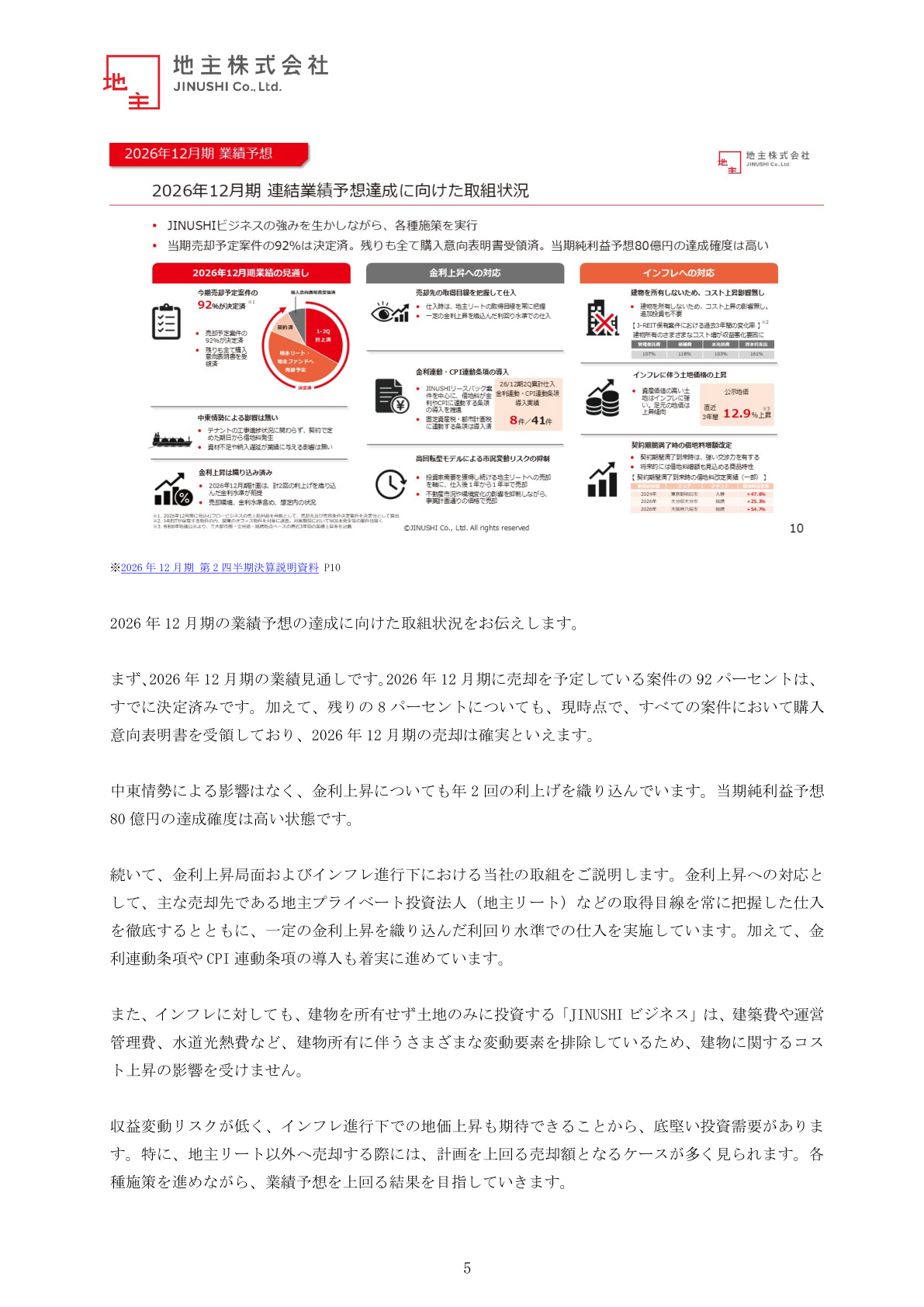
[Slide Commentary: The Importance of PAGE_4]
The slide above clearly illustrates the solid foundation for achieving the full-year net profit target of 8 billion yen and the company's structural strengths against interest rate hikes and inflation. With 92% of planned sales already under contract and the remainder covered by letters of intent, the risk of downward earnings revisions is extremely limited. Furthermore, regarding the market's concern over "rising interest rates," the company has formulated a conservative plan that already incorporates two rate hikes per year . It is also aligning acquisition yields with the investment criteria of its primary buyer, JINUSHI Private REIT, and introducing interest-rate-linked and CPI-linked clauses (implemented in 8 out of 41 acquisitions in Q2). Regarding inflation, the " JINUSHI Business model, which invests only in land and does not own buildings ," structurally eliminates risks associated with rising costs such as construction, maintenance, and utilities. The model is visually and logically explained as highly inflation-resistant, as it benefits from rising land prices and allows for rent revisions upon contract maturity.
3. Rapid Expansion of Acquisitions: Progress Toward the 100 Billion Yen Annual Target
Real estate acquisitions, the source of the company's future earnings, are proceeding at a pace significantly higher than the same period last year.
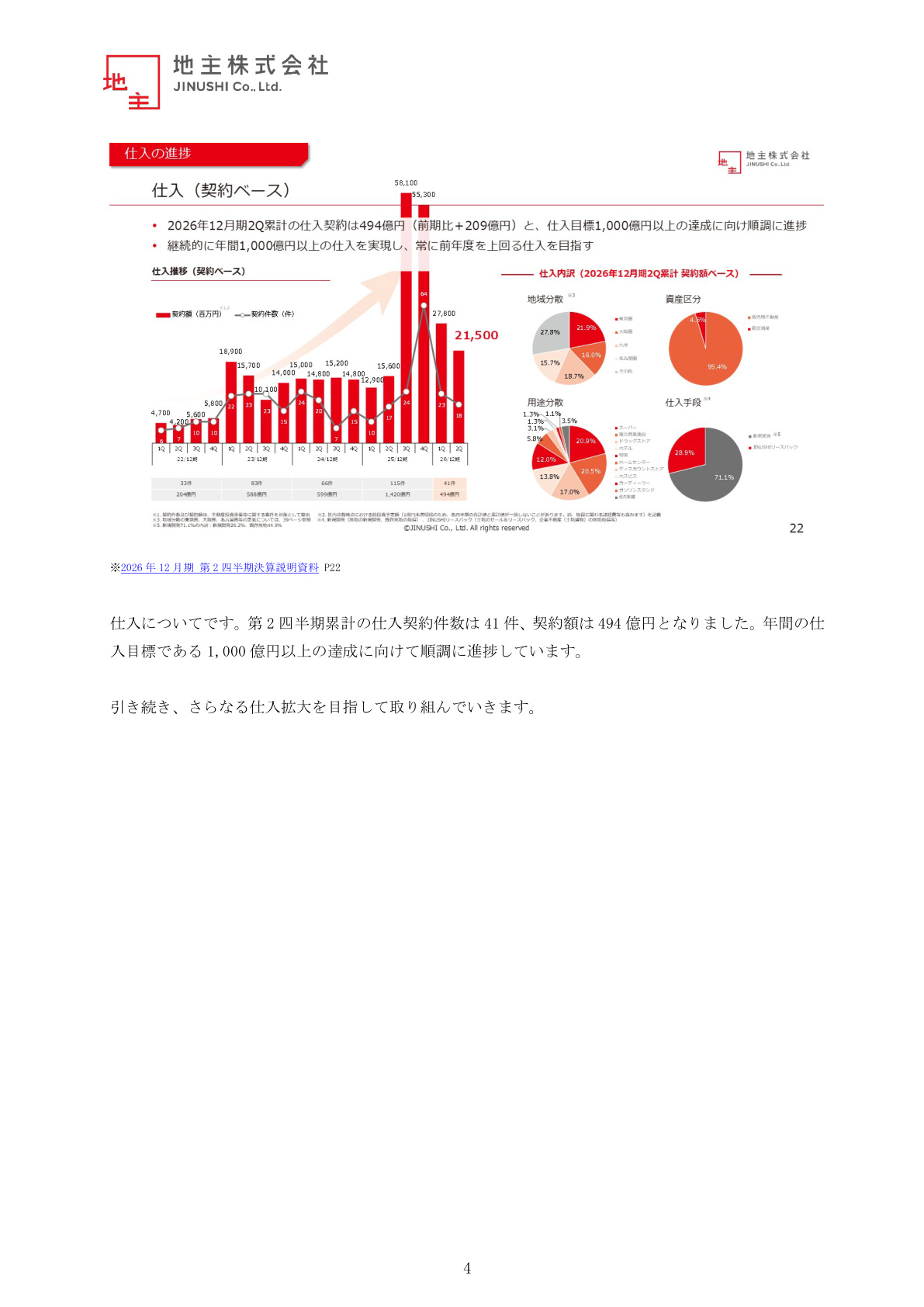
[Slide Commentary: The Importance of PAGE_3]
This slide provides critical data on the trends and breakdown of acquisition contracts , a leading indicator of the company's business growth. In the first half of FY2026, the number of acquisition contracts reached 41, with a contract value of 49.4 billion yen (an increase of 20.9 billion yen YoY) . This indicates that the company is on a very steady path toward its annual target of "100 billion yen or more in acquisitions." In terms of usage, defensive commercial facilities centered on daily necessities—such as supermarkets (20.9%), drugstores (20.5%), and discount stores (17.0%)—account for the majority, building a portfolio that generates stable cash flow. Furthermore, the breakdown of acquisition methods shows 71.1% from new developments and 28.9% from JINUSHI leasebacks , demonstrating the company's success in capturing corporate CRE needs and raw land sales from developers.
4. Changing Social Structures and the Tailwinds of CRE Strategy Driving Acquisitions
The rapid expansion of the company's acquisitions is supported by significant changes in the external environment surrounding corporations.
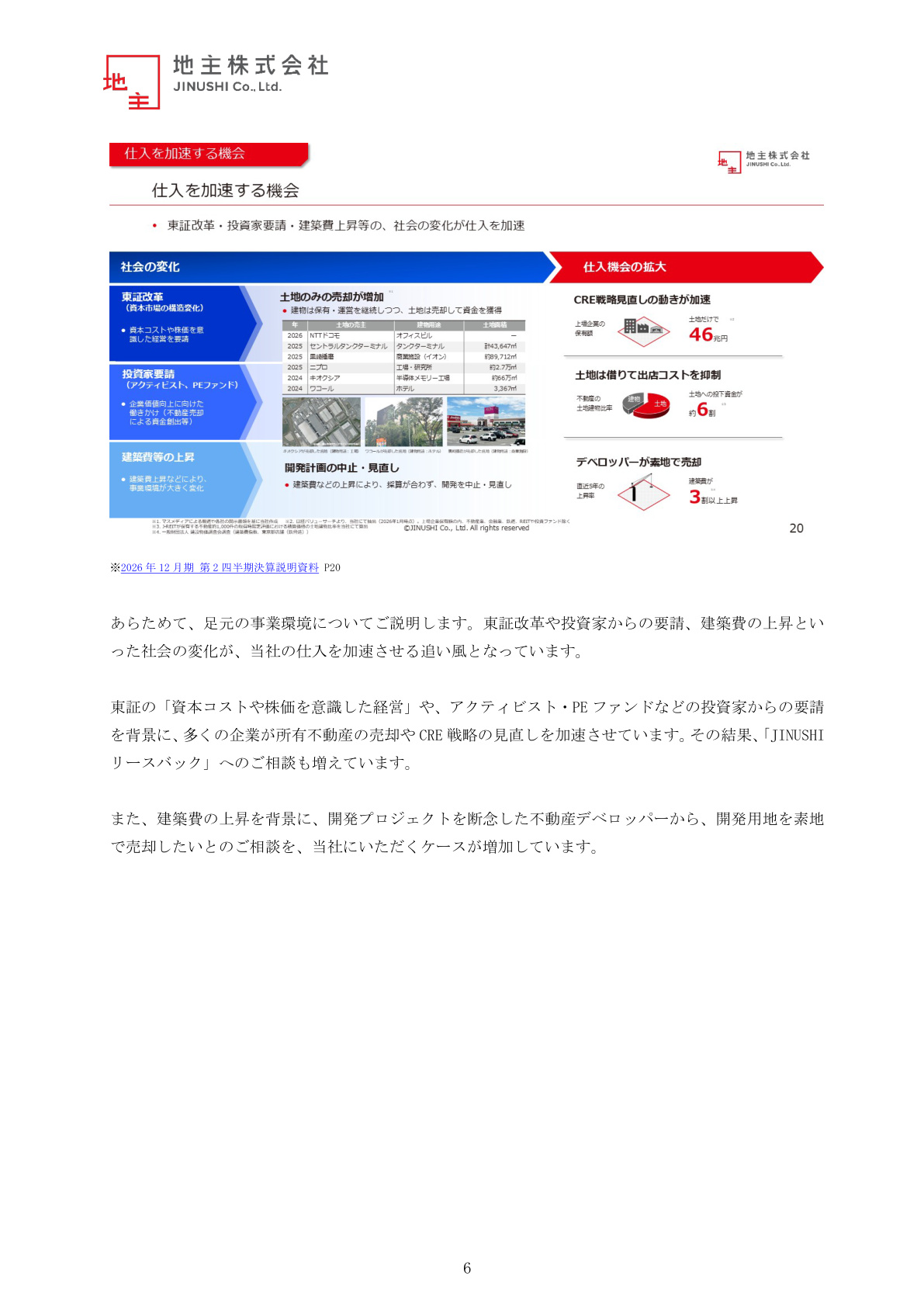
[Slide Commentary: The Importance of PAGE_5]
This slide explains the structural background of why the company is currently experiencing strong tailwinds . Specifically, the following three social changes are expanding the company's acquisition opportunities:
- TSE Reforms (management conscious of capital cost and stock price) and Activist/PE Fund Demands : With listed companies holding approximately 46 trillion yen in land assets, there is an accelerating trend of revisiting CRE strategies —selling land to monetize assets and reinvesting in core businesses to improve capital efficiency (ROIC/ROE).
- Tenant Cost-Cutting Needs : As land accounts for about 60% of real estate investment, tenants can significantly reduce initial store-opening costs by leasing land rather than purchasing it.
- Developer Raw Land Sales Due to Soaring Construction Costs : With construction costs rising by over 30% in the last five years, developers are increasingly abandoning condominium or housing projects due to poor profitability, leading to a surge in consultations to sell development land (raw land) as-is . These factors have created an environment where the company can acquire a large volume of high-quality land assets with a unique positioning that faces little competition.
5. Key Takeaways from Q&A and Deep Insights into the Business
During the earnings Q&A session, management provided clear explanations regarding investor concerns and future growth initiatives.
(1) Resilience to Long-Term Interest Rate Hikes and Investor Demand for JINUSHI REIT
Even with long-term interest rates trending upward, demand from institutional investors and pension funds for JINUSHI REIT remains extremely robust . As the company's products lack building risk and offer long-term stable rent, they are viewed as "corporate bond substitutes," a characteristic that tends to be highly valued during periods of high market volatility. Marketing for the next capital increase starting in July is also progressing smoothly.
(2) Accelerating the Introduction of Interest-Rate-Linked Clauses
In addition to raising target acquisition yields to match the interest rate environment, the company is promoting the inclusion of interest-rate-linked clauses in tenant contracts. These were implemented in 8 cases as of Q2, and the policy is to continue increasing this ratio to thoroughly hedge against future interest rate fluctuation risks.
(3) JINUSHI Fund Concept and Diversification of Exit Strategies
The formation of the " JINUSHI Fund ," in collaboration with Mitsubishi HC Capital Realty and others, is progressing. This fund serves as a bridge to close the gap between the rapid increase in acquisitions and the growth speed of JINUSHI REIT, while also acting as a new buyer, further enhancing the flexibility of exit strategies.
(4) Financial Soundness and Focus for the Second Half
As of the end of Q2, real estate for sale grew to 113.7 billion yen, fixed assets (long-term leasing business/JINUSHI Club) to 56.1 billion yen, and total assets to 206.6 billion yen. While the equity ratio is temporarily at 24.6%, it is expected to recover to the financial discipline target of around 30% upon the completion of property sales in the fourth quarter . With the achievement of earnings forecasts considered certain for the second half, the company plans to concentrate resources on acquisition activities to build a pipeline for further growth in the next fiscal year and beyond.
6. Conclusion: Mid-to-Long-Term Growth Driven by a Unique Business Model
JINUSHI Co., Ltd. is leveraging its thorough low-risk model of "investing only in land and not owning buildings" to turn external environmental changes—specifically CRE reviews driven by TSE reforms and soaring construction costs —into its greatest tailwinds.
This earnings report clearly demonstrates the company's policy of aiming for stable profit growth and continuous dividend increases by establishing an acquisition system of over 100 billion yen annually, while incorporating interest rate and inflation resilience into its product design and maintaining a robust sales pipeline (JINUSHI REIT, JINUSHI Fund, etc.).
This content is not intended as investment advice or a recommendation. Any opinions expressed are solely the personal views of each article.