


K Pharma FY2026 H1 Earnings Deep Dive: Clinical Progress and Commercialization Strategy for iPS Drug Discovery and Regenerative Medicine Pipelines

StockClub
Published: Aug 19, 2026, 09:54 AM
Sentiment Analysis
K Pharma Inc. (4896), a biotech venture originating from Keio University, has released its financial results for the second quarter (H1) of the fiscal year ending December 2026. The company integrates two core approaches—"iPS drug discovery" and "regenerative medicine"—to advance R&D specialized in the central nervous system (CNS) disease field , where there is a high unmet medical need.
This report provides a comprehensive analysis of the key points investors should monitor, including the latest disclosed financial data, clinical development progress of major pipelines, new formulation development, global patent strategies, and the alliance framework for commercialization.
1. FY2026 H1 Financial Highlights and Financial Foundation
K Pharma's profit and loss and financial position for the first half of FY2026 are progressing largely in line with the plans of an R&D-driven biotech venture.
- Net Sales : 0 million JPY (unchanged YoY)
- Selling, General and Administrative (SG&A) Expenses : 471 million JPY (Previous H1: 437 million JPY)
- Of which R&D Expenses : 206 million JPY
- Operating Loss : -471 million JPY (Previous H1: -437 million JPY)
- Net Loss for the Period : -492 million JPY (Previous H1: -444 million JPY)
SG&A expenses have been kept lower than initial projections and are progressing within the range of the previously disclosed full-year earnings forecast. The company plans to carefully consider whether to revise its full-year outlook based on Q3 performance.
Regarding the financial position, total assets stood at 2,567 million JPY (down 371 million JPY from the end of the previous fiscal year), total liabilities at 1,794 million JPY (up 120 million JPY), and total net assets at 773 million JPY (down 491 million JPY). Cash and deposits , which account for the majority of current assets, remain at 2,364 million JPY , serving as the foundation for clinical trial preparations, preclinical research, and working capital.
2. Overview of Development Pipeline and Business Portfolio
K Pharma's business model consists of two pillars: the "iPS Drug Discovery Business," which conducts drug screening using disease-specific iPS cells, and the "Regenerative Medicine Business," which utilizes cells derived from human iPS cells.
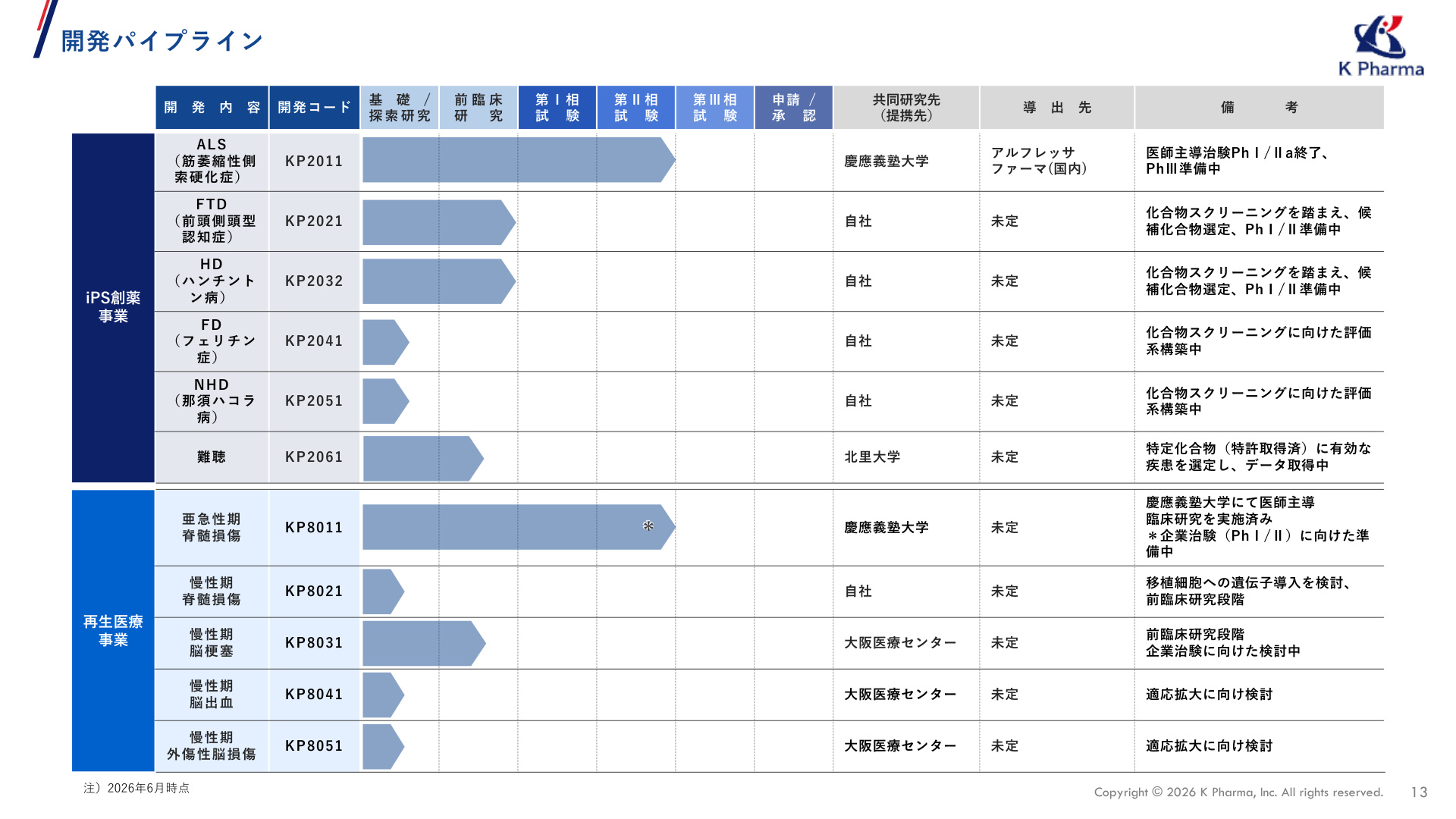
As shown in the figure above, the company has built a multi-layered pipeline that does not rely on a single candidate compound.
iPS Drug Discovery Pipeline
- KP2011 (ALS: Amyotrophic Lateral Sclerosis) : Completed physician-led Ph1/2a trials; preparing for domestic Ph3 (licensed to Alfresa Pharma in Japan).
- KP2021 (FTD: Frontotemporal Dementia) : Completed compound screening and identified candidate compounds; preparing for Ph1/2 .
- KP2032 (HD: Huntington's Disease) : Similarly identified candidate compounds; preparing for Ph1/2 .
- KP2041 (Ferritinopathy) / KP2051 (Nasu-Hakola Disease) : Building evaluation systems for screening.
- KP2061 (Hearing Loss) : Extended joint research agreement with Kitasato University to accelerate data acquisition for specific compounds and prepare for corporate clinical trials.
- Novel CNS Diseases (Code TBD) : Selected for the AMED "Acceleration Program for Regenerative, Cellular, and Gene Therapy" and has begun exploring applications for psychiatric disorders such as schizophrenia .
Regenerative Medicine Pipeline
- KP8011 (Subacute Spinal Cord Injury) : Completed physician-led clinical research at Keio University; preparing for corporate clinical trials (Ph1/2) .
- KP8021 (Chronic Spinal Cord Injury) : Preclinical research stage exploring gene transfer into transplanted cells.
- KP8031 (Chronic Cerebral Infarction) / KP8041 (Chronic Cerebral Hemorrhage) / KP8051 (Chronic Traumatic Brain Injury) : Advancing indication expansion in collaboration with the Osaka National Hospital.
3. Cutting-Edge iPS Drug Discovery: Progress and Commercialization Strategy for KP2011 (ALS)
The company's flagship, KP2011 (Ropinirole Hydrochloride) , has reached a critical milestone in its development for ALS.
Accumulation of Superior Clinical Data
In the physician-led Ph1/2a trial conducted at Keio University (published in the international journal Cell Stem Cell), the following results were confirmed:
- Safety and tolerability confirmed at doses up to 16mg per day.
- Suggested the potential to delay disease progression by approximately 27.9 weeks (about 7 months) over a one-year administration period compared to placebo.
- Significantly suppressed muscle weakness and decline in physical activity across multiple muscle groups during the first 6 months of administration.
Enhancing Product Value through New Formulation Development
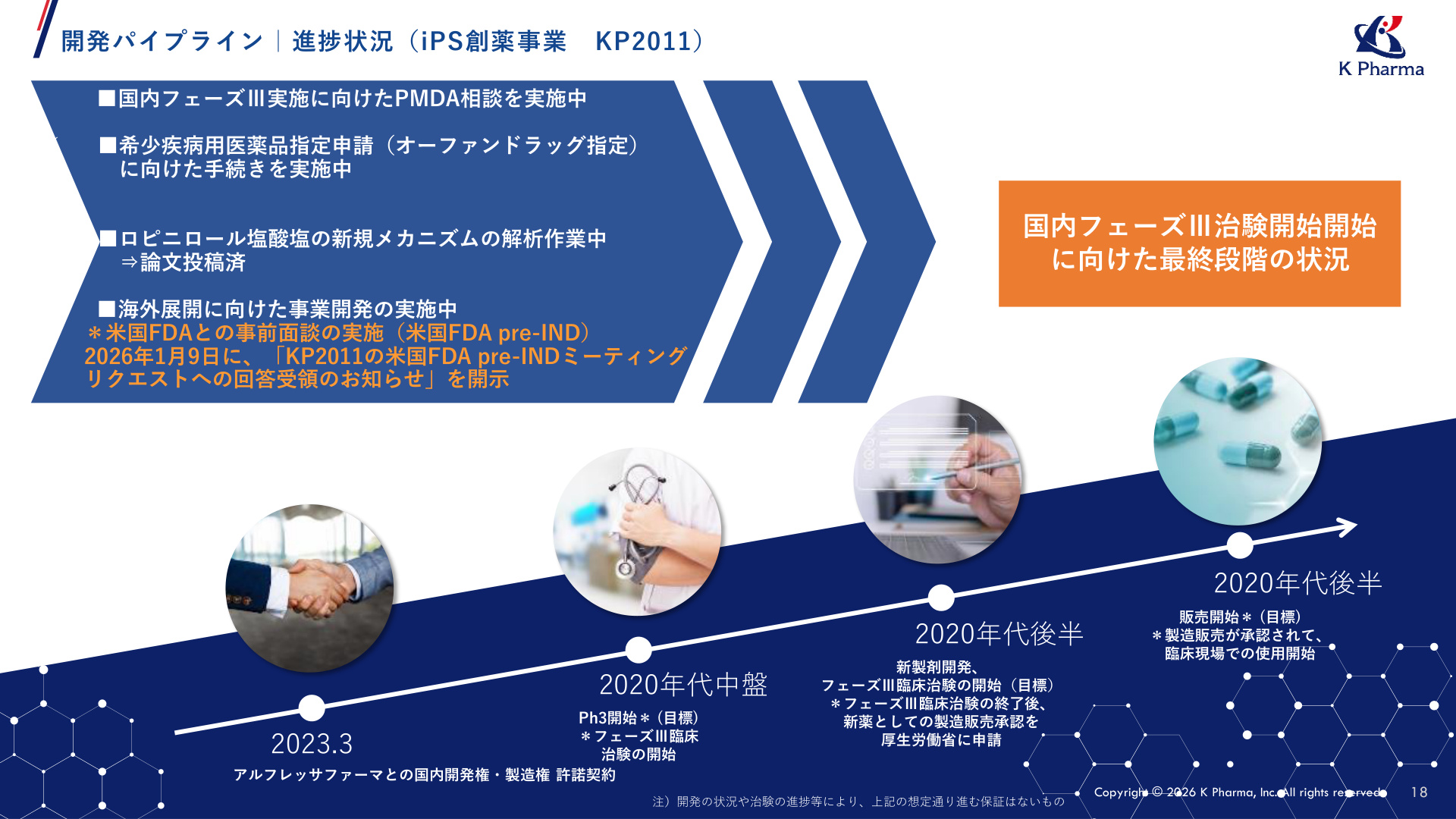
Led by domestic licensee Alfresa Pharma , development is underway for a "sustained-release granule formulation" to improve medication adherence and QOL for ALS patients, who often suffer from dysphagia, replacing the conventional sustained-release tablets (Requip CR). Subject recruitment for pharmacokinetic and safety studies in healthy volunteers is complete, and the start of domestic Phase 3 trials is expected within FY2026 using this new formulation. Beyond improving patient convenience, the new formulation provides barriers to entry through formulation patents and advantages in drug price listing as a new drug .
Global Intellectual Property and Overseas Expansion
KP2011 has already secured use patents in the US, Europe, Canada, India, and Japan , with applications pending in China. Notably, in March 2026, the company received a Notice of Allowance from the USPTO. For the US market, the company has received responses from the US FDA regarding a pre-IND meeting , and alliance and licensing negotiations with global pharmaceutical companies are intensifying based on discussions with local regulatory authorities.
4. Progress on KP2021 (FTD) and KP2032 (HD)
The company's iPS drug discovery platform extends beyond ALS. For KP2021 targeting Frontotemporal Dementia (FTD) and KP2032 targeting Huntington's Disease (HD) , candidate compound selection and use patent filings are complete.
Following presentations at US international conferences in October 2024 and discussions with Key Opinion Leaders (KOLs), the company is currently formulating clinical trial plans, selecting CROs, and conducting pre-consultations with the PMDA for domestic Phase 1/2 trials . Parallel to trial preparations, early-stage business development and partnership negotiations are also underway.
5. Regenerative Medicine Business: Clinical Breakthrough for KP8011 (Subacute Spinal Cord Injury)
The frontrunner in the regenerative medicine field is KP8011 (treatment for subacute spinal cord injury) , which uses human iPS cell-derived neural progenitor cells.
Dramatic Efficacy and High Safety Demonstrated in Clinical Research
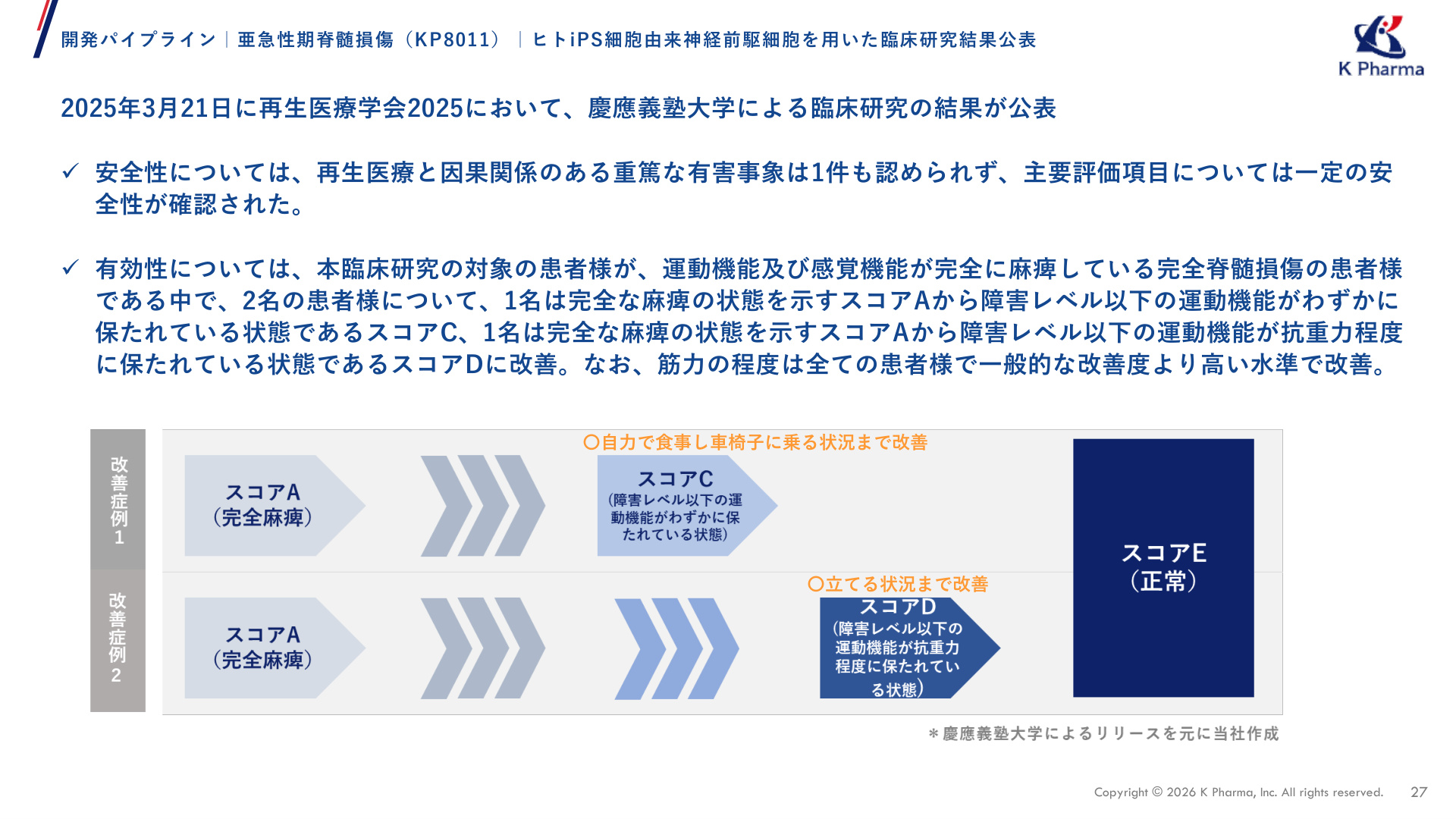
Clinical research results presented by Keio University at the Japanese Society for Regenerative Medicine in March 2025 showed highly noteworthy outcomes:
- Safety : No serious adverse events attributable to the transplanted cells were observed, confirming high safety .
- Efficacy : In patients with "severe complete spinal cord injury (Score A)" who had complete paralysis of motor and sensory functions, one patient improved to Score C (partial recovery of motor function, capable of eating and transferring to a wheelchair independently) , and another improved to Score D (recovery of motor function to anti-gravity level, capable of standing independently) . The degree of muscle strength improvement significantly exceeded standard natural recovery levels.
Unique Therapeutic Technology and Mechanism of Action
KP8011 promotes the recovery of neural function through three mechanisms:
- Synaptic Relay : Transplanted cells differentiate into neurons to form new neural circuits.
- Trophic Actions : Secreted neurotrophic factors protect host tissue.
- Myelination : Axonal remyelination through differentiation into oligodendrocytes.
Furthermore, by using a Notch signaling inhibitor (patented), the company has established a unique differentiation induction protocol that thoroughly avoids the risk of tumorigenesis while achieving high therapeutic effects with a relatively small number of cells.
Supply Chain Construction for Corporate Trials and Commercial Production
K Pharma is optimizing the foundational results established at Keio University and promoting technology transfer to Nikon CeLL Innovation (NCLi) . The company is building a contract manufacturing (CDMO) system that meets GMP/GCTP standards, along with an ultra-low-temperature distribution and storage network for hospitals in partnership with Alfresa and others, steadily preparing for PMDA face-to-face consultations with the goal of submitting a corporate clinical trial notification in 2027 .
6. Summary and Future Milestones
K Pharma's H1 FY2026 earnings indicate that the R&D pipeline is steadily advancing from the "research phase" to the "final clinical and commercialization phase."
Key catalysts to watch include:
- KP2011 (ALS) : Start of domestic Phase 3 trials and progress in overseas partnerships.
- KP2021 (FTD) / KP2032 (HD) : Submission of Phase 1/2 clinical trial notifications and completion of PMDA consultations.
- KP8011 (Spinal Cord Injury) : Completion of technology transfer to NCLi, securing of clinical trial drug supply, and regulatory engagement for the 2027 trial notification.
Attention will continue to focus on the company's development roadmap as it builds a robust intellectual property network and a division-of-labor system with pharmaceutical and manufacturing partners, all based on advanced science originating from academia.
This content is not intended as investment advice or a recommendation. Any opinions expressed are solely the personal views of each article.