

Canss Inc. FY2026 Financial Results Deep Dive: Progress on Lead Candidate 'CBP501' European Phase 3 Preparations, Pipeline Expansion, and Financial Overview

StockClub
Published: Aug 19, 2026, 09:53 AM
Sentiment Analysis
1. Executive Summary
For the fiscal year ended June 2026, Canss Inc. (TSE: 4575) reported no operating revenue as the company continues to prioritize R&D investment in its proprietary anti-cancer pipeline. The company recorded an operating loss of 1,358 million yen (an increase of 249 million yen year-on-year) and a net loss of 1,308 million yen (an increase of 151 million yen year-on-year).
Canss is a biopharmaceutical venture focused on immuno-oncology. Its lead compound, 'CBP501,' successfully met its primary endpoint in a Phase 2 clinical trial for third-line pancreatic cancer , and the company is currently in the process of applying for and preparing for a Phase 3 clinical trial in Europe. Furthermore, the company is expanding its robust pipeline, including preparations for preclinical trials of the next-generation immune-switch agonist 'CBT005,' the re-evaluation of the reversible XPO1 inhibitor 'CBS9106' (following the return of all rights from Stemline Therapeutics), and collaborative AI-driven drug discovery research. With cash and deposits maintained at 1,445 million yen at the end of the fiscal year, the focus remains on clinical development progress and disciplined financial management.
2. FY2026 Financial Highlights and Overview
Income Statement Summary
- Operating Revenue : — million yen (no revenue recorded in the previous period)
- Operating Profit : △1,358 million yen (loss increased by 249 million yen YoY)
- Ordinary Profit : △1,307 million yen (loss increased by 151 million yen YoY)
- Net Profit : △1,308 million yen (loss increased by 151 million yen YoY)
- Non-operating Income/Loss : 50 million yen recorded, primarily due to foreign exchange gains
Total operating expenses amounted to 1,358 million yen , consisting of 226 million yen in basic research expenses, 830 million yen in clinical development expenses, and 301 million yen in selling, general, and administrative (SG&A) expenses. While basic research and SG&A expenses remained largely flat year-on-year, clinical development expenses increased. This entire increase was attributed to CBP501, specifically due to upfront regulatory compliance costs related to manufacturing and formulation for the European Phase 3 trial.
Balance Sheet Trends
As of the end of June 2026, current assets stood at 1,679 million yen (a decrease of 1,277 million yen from the previous fiscal year-end). Within this, cash and deposits were 1,445 million yen (down 1,382 million yen from 2,827 million yen), and advance payments were 184 million yen (up 122 million yen from 62 million yen). The 292 million yen in advance payments recorded at the end of the third quarter were reclassified as expenses in the fourth quarter as progress was made in drug manufacturing and regulatory compliance. Net assets are 1,642 million yen (equity ratio of 92.5%), maintaining a debt-free and solid financial position while prioritizing the allocation of capital toward clinical development.
3. Development Progress and Clinical Data for Lead Pipeline 'CBP501'
Mechanism of Action: Turning 'Cold' Tumors 'Hot'
While immune checkpoint inhibitors show dramatic life-prolonging effects in some patients, they are often ineffective against 'cold tumors' (such as pancreatic cancer), where T-cells are absent or unable to infiltrate the tumor tissue. CBP501 acts as an 'immune igniter'; when combined with agents like cisplatin, it induces immunogenic cell death in cancer cells, effectively converting 'cold' tumors into 'hot' tumors.
Phase 2 Clinical Trial Data and Evaluation
In the Phase 2 trial for third-line pancreatic cancer using a triple-combination therapy (CBP501 + cisplatin + nivolumab), the company achieved its primary endpoint: the 3-month progression-free survival (PFS) rate .
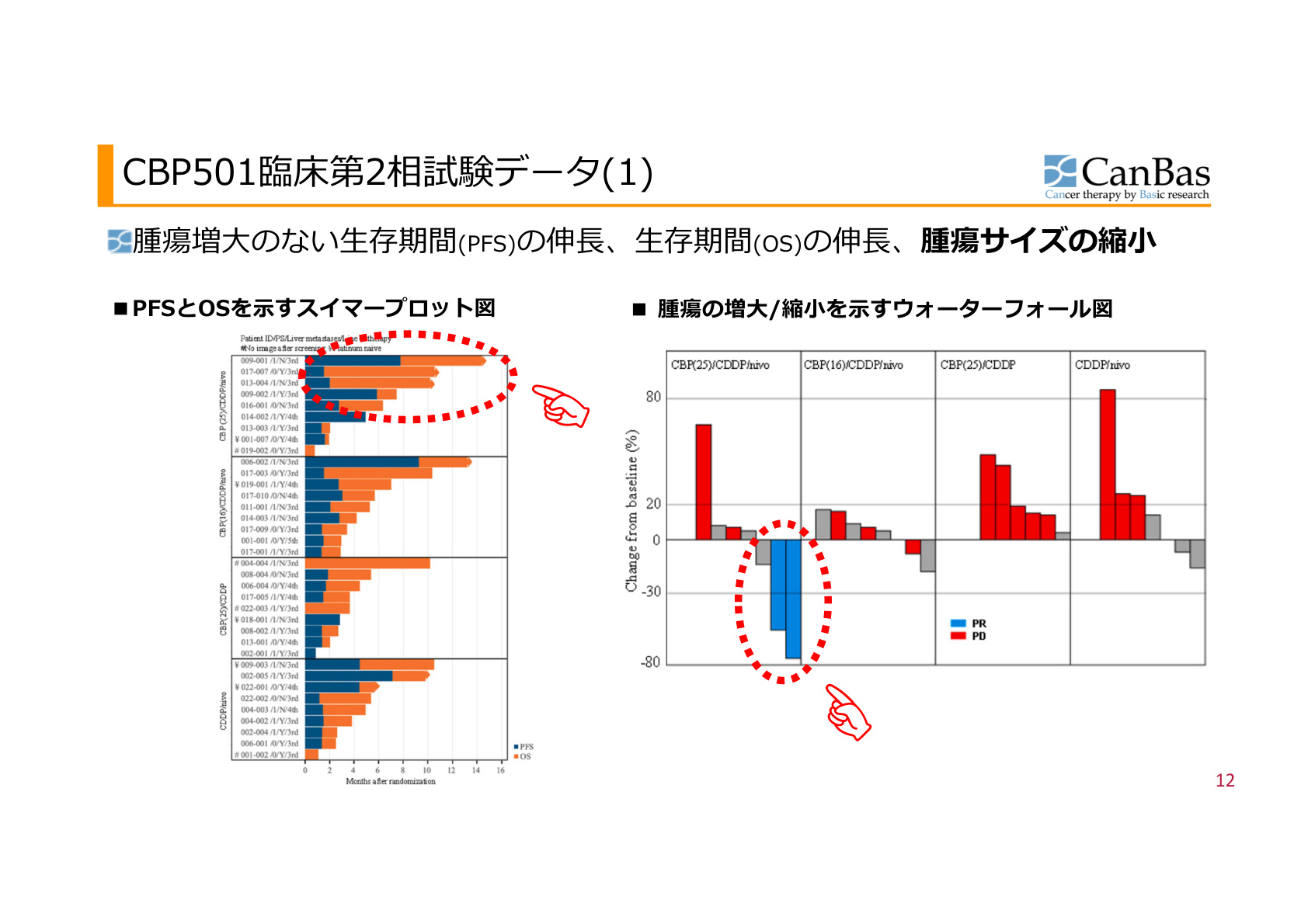
The slide above shows the swimmer plot (left) illustrating the treatment course for each patient in the CBP501 Phase 2 trial, and the waterfall plot (right) showing the degree of tumor shrinkage.
- Swimmer Plot : Multiple cases of long-term survival with significantly extended PFS and overall survival (OS) were confirmed in the patient group receiving the triple-combination therapy (25mg and 16mg cohorts).
- Waterfall Plot : Under the extremely challenging conditions of third-line pancreatic cancer, where no standard treatment is established, clear tumor shrinkage (partial response: PR) was observed in the CBP501-treated group, visually demonstrating disease control efficacy.
The median overall survival (OS) was 6.3 months (95% CI: 3.3-9.3) , yielding a Kaplan-Meier survival curve that exhibits the 'tail-on' phenomenon characteristic of immune checkpoint inhibitor combinations.
Status and Outlook for the European Phase 3 Trial
Currently, protocol adjustments and clinical trial application procedures are underway with regulatory authorities to initiate the Phase 3 trial in Europe.
- Certainty of Approval : With progress in manufacturing-related compliance, the risk of application rejection has steadily decreased, and there are no signs of deterioration.
- Timing Uncertainty : Fluidity remains regarding the approval start date due to external factors beyond the company's control, such as the regulatory authority's drug manufacturing and quality control review process.
- Total Phase 3 Cost Forecast : The estimate of 4.5 to 5.0 billion yen remains unchanged, with some preparatory costs already incurred.
4. Progress on Follow-on Pipelines: CBT005 and CBS9106
Canss is developing multiple proprietary pipelines as engines for medium- to long-term value creation following CBP501.
Immune-Switch Agonist 'CBT005'
'CBT005' is a novel PDC (Peptide-Drug Conjugate) consisting of four peptides that bind to phosphatidylserine exposed on the surface of dying cancer cells, linked to a TLR agonist.
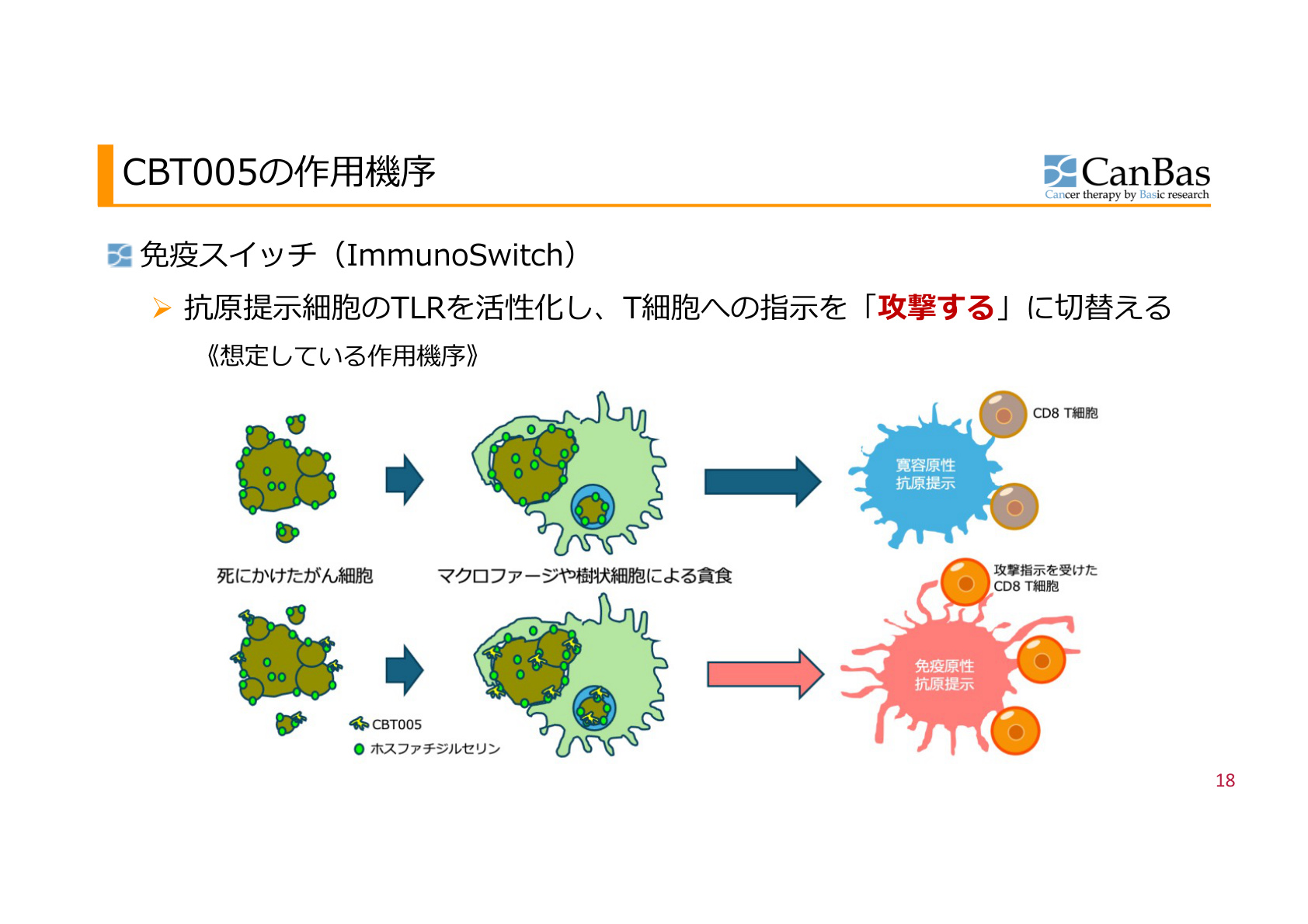
As shown in the slide above, when macrophages or dendritic cells phagocytose dying cancer cells, it typically leads to 'tolerogenic antigen presentation' (suppressing immunity). However, the presence of CBT005 activates the TLR of antigen-presenting cells, causing the instructions to T-cells to switch dramatically to 'attack' (immunogenic antigen presentation). This is a groundbreaking concept that utilizes neoantigens from dying cancer cells to induce anti-tumor immunity, and preclinical trial preparations are currently underway.
Return of Rights for Reversible XPO1 Inhibitor 'CBS9106' (Felezonexor)
The license agreement for 'CBS9106,' a small molecule that reversibly inhibits the nuclear export protein XPO1, was terminated with Stemline Therapeutics in June 2025, and all rights for development and commercialization worldwide were returned to Canss .
- Past Revenue Received : 15 million yen in upfront payments and a cumulative 702 million yen in technical advisory fees.
- Advantage over Competitors (Selinexor) : Compared to existing irreversible inhibitors, CBS9106 has 'best-in-class' potential, including reduced side effects due to XPO1 degradation, a higher maximum tolerated dose, signs of efficacy in solid tumors, and ease of use as an oral agent.
- Future Strategy : The company will acquire additional data within the scope of its basic research budget and formulate a strategy for in-house clinical development or re-licensing, taking the financial situation into account.
5. Early-Stage Discovery Platform and R&D Expense Structure
Expansion of Discovery and Preclinical Pipelines
- IDO/TDO Dual Inhibitor : Optimization is underway through joint research with the University of Shizuoka. Patents have been granted in Japan and the U.S., and alliance activities are being conducted through the Pharma Valley Center.
- CBP-A08 : A peptide-based immuno-oncology agent in the CBP501 lineage. Optimization is complete, and the company is exploring the initiation of preclinical trials.
- NEXT Project / AI Drug Discovery : Collaborative AI-driven drug discovery research is being conducted with Inage Healthcare to accelerate the search for compounds with novel mechanisms.
Quarterly Operating Expense Structure
The company's quarterly operating expenses reflect the progress of development milestones.
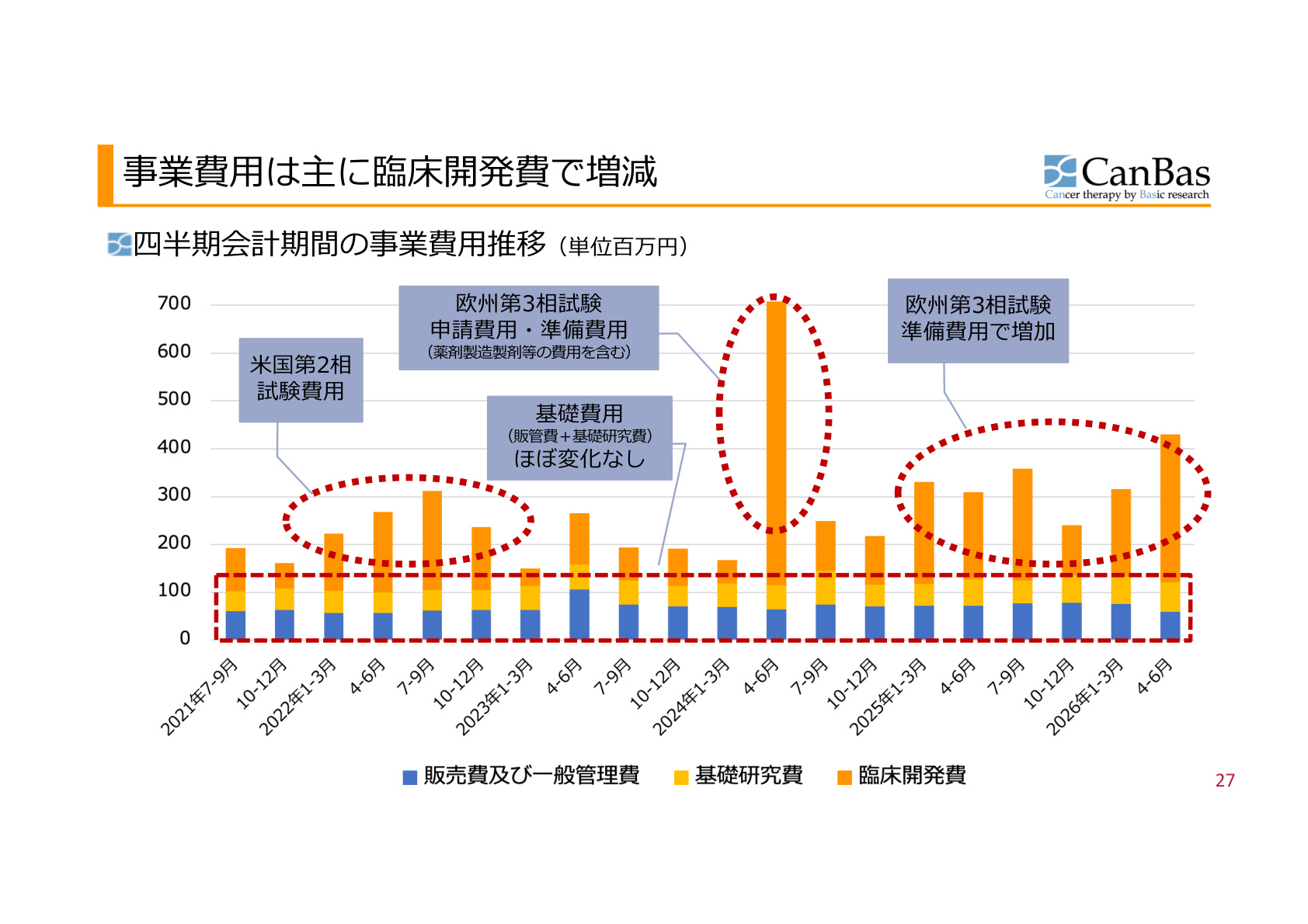
As evident from the graph above, basic research and general administrative expenses (the fixed band at the bottom of the chart) have remained extremely stable at approximately 100 million yen per quarter . The primary driver of cost fluctuations is 'clinical development expenses.' The structure shows that funds are deployed flexibly in line with the clinical trial phase, such as the spike in expenses in the April-June 2024 period (European P3 application/manufacturing preparation) and the recent increase in preparation costs in the April-June 2026 period.
6. Summary and Key Points to Watch
For Canss, the fiscal year ended June 2026 was a pivotal year in which the company steadily advanced regulatory compliance and manufacturing preparations for the European Phase 3 trial of its lead product, CBP501, while also organizing business scenarios for its next-generation pipeline, CBT005, and the returned CBS9106 .
Key checkpoints for future progress include:
- CBP501 : Timing of approval from European regulatory authorities to initiate the Phase 3 trial and the start of patient enrollment at clinical sites.
- P3 Funding and Financial Management : Progress on partnerships, licensing, or financing strategies to cover the estimated 4.5 to 5.0 billion yen in costs.
- CBT005 / CBS9106 : Transition of CBT005 to preclinical trials and the disclosure of a new development roadmap for CBS9106 based on additional in-house data.
Armed with scientific strengths in immuno-oncology and clinical data, the company is reaching a major milestone in its clinical development.
This content is not intended as investment advice or a recommendation. Any opinions expressed are solely the personal views of each article.