


Infometis (281A) FY2026 Q2 Earnings Deep Dive: Accelerating Collaboration with Major Utilities and Growth Strategy Targeting Next-Generation Smart Meters

StockClub
Published: Aug 19, 2026, 09:52 AM
Sentiment Analysis
Executive Summary
Infometis (Ticker: 281A) , a company specializing in proprietary power data analysis technology (NILM: Non-Intrusive Load Monitoring), achieved significant revenue growth and a substantial improvement in profitability for the first half of the fiscal year ending December 2026. Driven by contract development for power supply-demand adjustment and the introduction of next-generation smart meters, the company has outperformed its initial projections across both top-line and profit metrics.
On the business front, Infometis has established collaborative relationships with 5 out of the 10 major legacy Japanese electric power companies . The company is effectively capturing Demand Response (DR)-related demand fueled by rapid market shifts, such as increased power consumption from AI and new data centers, and output control issues stemming from the proliferation of renewable energy. Furthermore, to establish a platform for the future era of universal "next-generation (second-generation) smart meter" adoption, the company is accelerating upfront investment and customer acquisition during the current meter phase.
In its international expansion, Infometis is steadily advancing its heat pump automatic control service through a partnership with Daikin UK and has initiated feasibility studies for entry into mainland Europe. This report provides a comprehensive analysis of the company's FY2026 Q2 financial results, details on ongoing collaborations with power utilities, the strategic intent behind growth investments including capital procurement, and the mid-to-long-term growth scenario leading up to 2030.
1. FY2026 Q2 Financial Overview and Profit Structure Analysis
Earnings Highlights: Dramatic Improvement in Gross Margin and Outperformance of Plans
Performance for the first half of the fiscal year resulted in net sales of 342 million JPY (+36.3% YoY, +11.6% vs. plan) , exceeding the initial forecast by 35 million JPY. In terms of profitability, gross profit reached 234 million JPY (+75.9% YoY, +24.0% vs. plan) , and the ordinary loss was 120 million JPY (an improvement of 97 million JPY YoY and 108 million JPY vs. plan) , marking a significant reduction in losses.
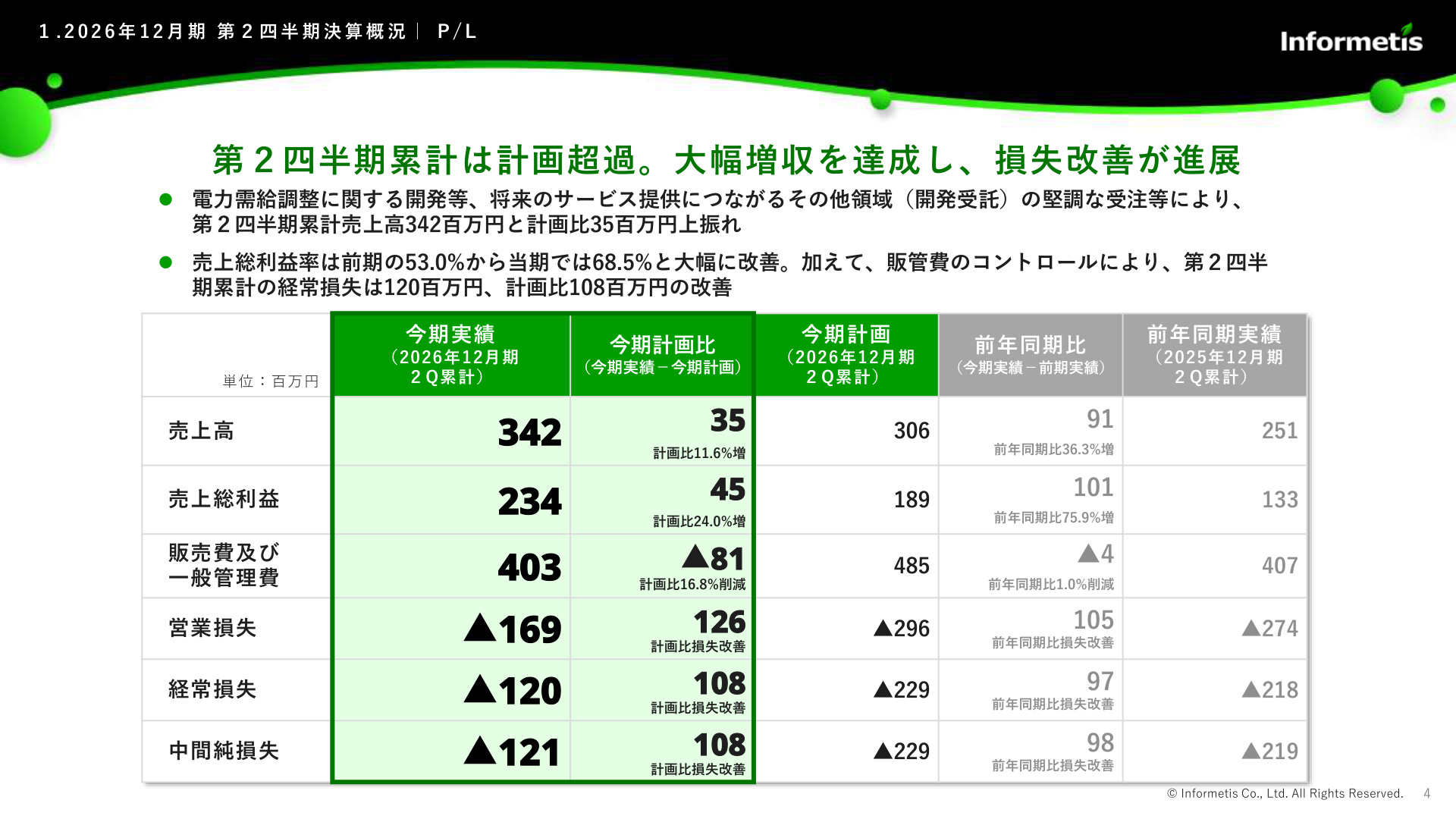
This slide illustrates not only the growth in net sales but also a sharp 15.5-point improvement in the gross profit margin, rising from 53.0% to 68.5% compared to the same period last year. It also highlights how effective control of SG&A expenses (16.8% lower than planned) led to operating and ordinary profits significantly exceeding projections. This indicates that the company is successfully balancing revenue expansion with the contribution of high-margin projects and disciplined cost management.
Analysis by Revenue Segment
- Others (Contract Development): 188 million JPY (a roughly 2.2x increase from 86 million JPY in the same period last year)
- Growth was driven by system development contracts related to next-generation (second-generation) smart meters and service development projects that contribute to balancing power supply and demand, such as storage battery and EcoCute control. These are upfront developments that serve as a foothold for future stock-based service offerings.
- Platform & App Provision: 153 million JPY (164 million JPY in the same period last year)
- While impacted by the termination of a service for large-scale rental housing at the end of March 2026, the decline was minimized by the growth of services like "ienowa" for residential equipment, keeping performance in line with the business plan.
- Full-scale revenue and profit contributions from "BridgeLAB DR," which is being introduced on a performance-based model, are expected from the second half of FY2026 onwards.
- Upfront (Equipment Sales, etc.): 1 million JPY (0.8 million JPY in the same period last year)
- Sales remain limited to power sensor accessories, as demand is being met through inventory held by partner companies.
ARR (Annual Recurring Revenue) Bottoming Out and Recovery Outlook
Although ARR remained flat quarter-on-quarter (202 million JPY), the impact of the rental contract termination is being absorbed as a one-time event. With an increase in orders for DR support services and steady demand for residential equipment, the company is projected to enter a re-expansion phase starting in the second half of FY2026 .
2. Structural Changes in the Business Environment and Strategic Intent of "Upfront Investment"
Tightening Power Supply-Demand and the Explosion of "Upward DR" Needs
With thermal power accounting for approximately 70% of Japan's electricity generation, rising fuel prices due to geopolitical risks are squeezing the margins of retail electricity providers. Furthermore, with the 10-year power demand forecast significantly revised upward (a ~6% increase to 852.4 billion kWh by FY2034 compared to FY2024) due to AI adoption and new semiconductor plants , supply-demand adjustment methods beyond building new power plants have become essential.
In particular, with the coexistence of "output control" issues due to daytime solar power surpluses and supply-demand tightness during other hours, the importance of "Upward DR" (charging storage batteries or heating water during the day) has increased dramatically, alongside traditional "Downward DR" (curtailing usage).
Progress in Collaboration with 5 Major Utilities and Strategy
In addition to the Tokyo Electric Power Group, Chugoku Electric Power, and Shikoku Electric Power, Infometis has begun collaborations with Kansai Electric Power and Kyushu Electric Power . This brings the total to 5 out of the 10 legacy general electric utilities .
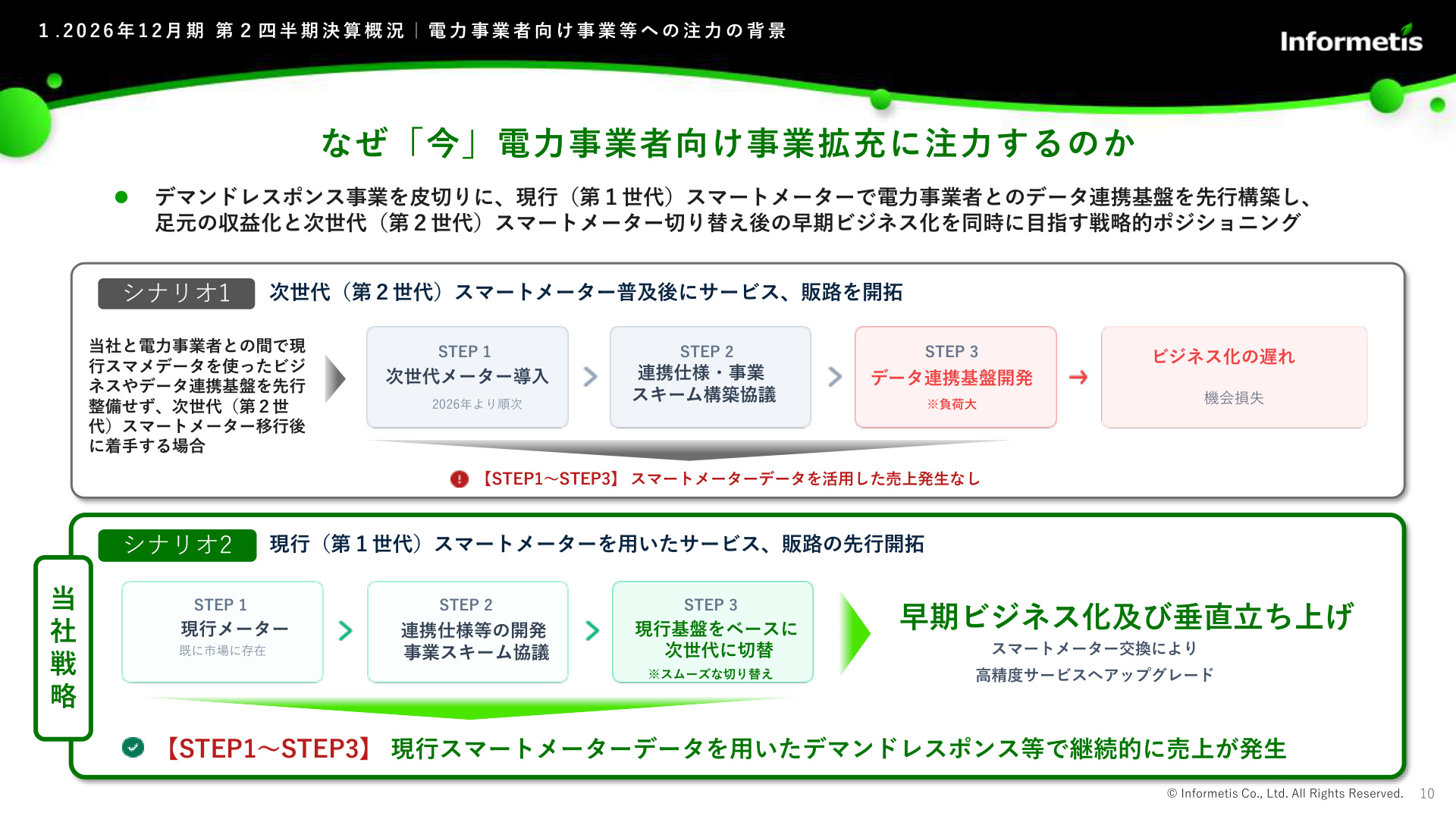
This slide demonstrates the core growth logic of why the company is front-loading investment "now" rather than waiting for the full-scale adoption of next-generation smart meters (starting 2026 onwards) :
- Scenario 1 (Post-adoption approach) : Starting business schemes or infrastructure development after the introduction of next-generation meters would lead to a vertical launch failure and significant opportunity loss.
- Scenario 2 (Company strategy) : Pre-installing "BridgeLAB DR" and data linkage infrastructure during the current (first-generation) smart meter phase to generate revenue while establishing a customer base and pipelines with power companies. The moment physical replacement with next-generation meters begins, the company can smoothly and explosively upgrade to high-precision services (vertical launch) .
To accelerate this strategy, following the completion of the 9th series of stock acquisition rights (raising 370 million JPY), the company issued the 10th series of stock acquisition rights in July 2026 (with a price revision clause, estimated to raise 867 million JPY) , enabling agile capital deployment into system development, talent acquisition, and alliance building centered on DR-related services.
3. International Expansion and Global Competitiveness
Collaboration Model with Daikin in the UK and Expansion into Mainland Europe
In the UK, the transition to heat pump water heaters is accelerating (projected at 600,000 units per year by 2028) as part of decarbonization policies, such as the ban on gas boiler installations in new homes from 2025. Infometis provides automatic control technology based on AI occupancy detection for the "UP Series" heat pump water heaters from its partner, Daikin UK .
Leveraging over a decade of business experience in the UK and its NILM international standardization (international certification) , the company has begun research and verification for expansion into mainland European markets—primarily Germany, Italy, France, and Spain—as well as Asian regions (Taiwan, Thailand, Malaysia, etc.). The foundation for significantly increasing the overseas revenue ratio is progressing steadily.
4. Mid-to-Long-Term Growth Roadmap: The Vision for 2030
FY2026 Full-Year Outlook
The full-year earnings forecast for FY2026 remains unchanged at 845 million JPY in net sales and an ordinary loss of 350 million JPY . While the progress rate at Q2 is 40.4%, the power industry is characterized by seasonal concentration of acceptance inspections in the fourth quarter, and the company plans to achieve its targets while monitoring progress in the second half.
Mid-Term Management Plan towards 2030
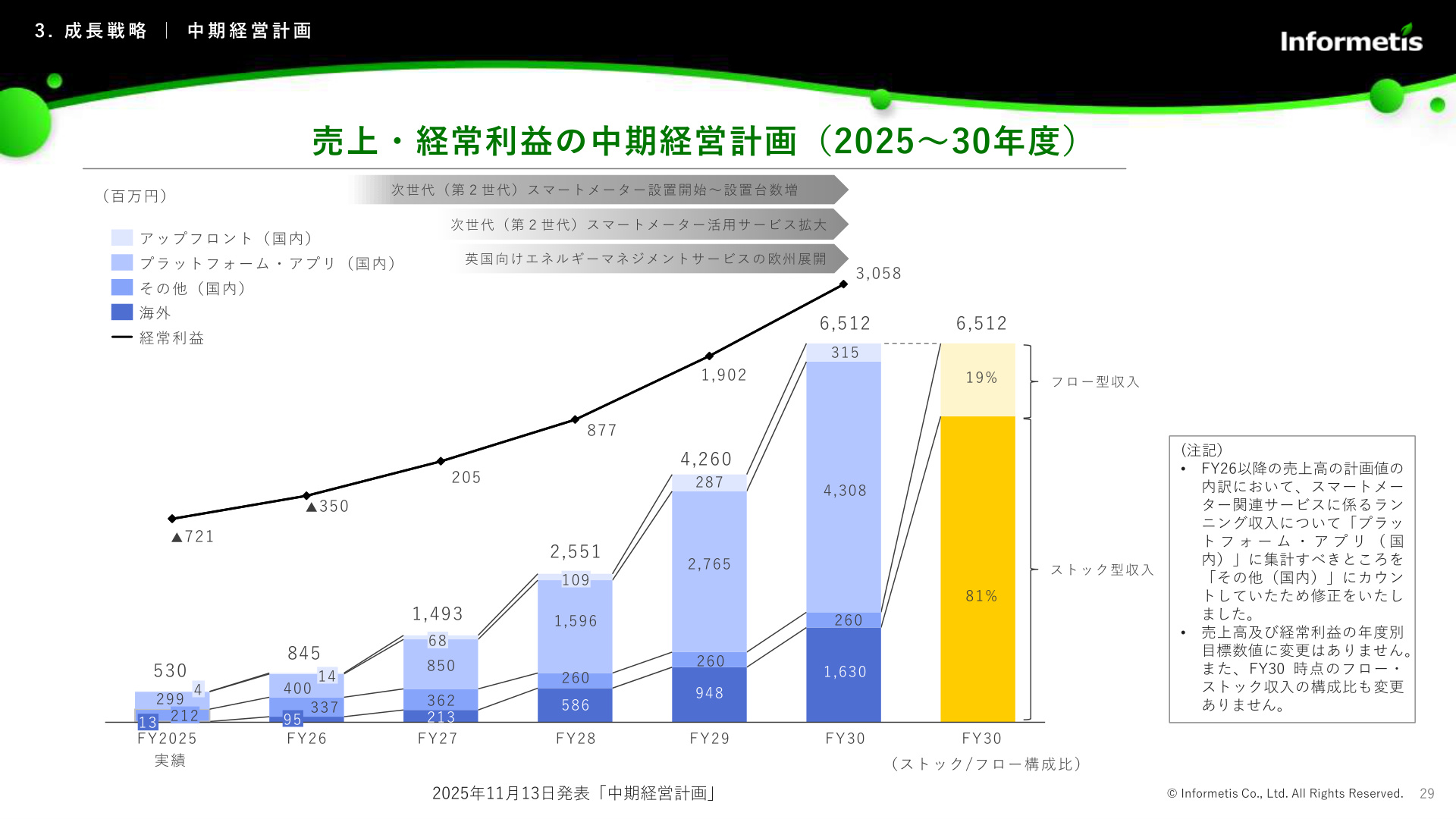
This slide shows the roadmap for the company's mid-term leap. From FY2027 onwards, when the installation of next-generation smart meters enters full swing, both sales and profits are projected to grow non-linearly.
- FY2025 (Actual) : Sales 530 million JPY, Ordinary Loss 721 million JPY
- FY2026 (Forecast) : Sales 845 million JPY, Ordinary Loss 350 million JPY
- FY2027 (Plan) : Sales 1,493 million JPY, Ordinary Profit 205 million JPY (Return to Profitability)
- FY2028 (Plan) : Sales 2,551 million JPY, Ordinary Profit 877 million JPY
- FY2029 (Plan) : Sales 4,260 million JPY, Ordinary Profit 1,902 million JPY
- FY2030 (Plan) : Sales 6,512 million JPY, Ordinary Profit 3,058 million JPY (Ordinary Profit Margin 47.0%)
Notably, the plan targets a stock-based revenue ratio of 81% (5,256 million JPY) by FY2030 . By transforming from a model of installing dedicated sensors in each home to a SaaS model utilizing data from next-generation smart meters installed by power companies in all households (approx. 60.78 million households nationwide), the company is designed to evolve into a stock business with extremely high marginal profit ratios.
5. Summary and Key Points to Watch
Infometis's FY2026 Q2 results demonstrate that the company is steadily improving its current profitability while laying strategic groundwork at the perfect timing for a major long-term market shift (the proliferation of next-generation smart meters).
Key points for future monitoring include:
- Progress of "BridgeLAB DR" performance-based revenue and contract development in the second half, and achievement of full-year plans.
- The pace of transition from pilot projects to full-scale commercial services with major power companies (currently 5).
- Progress in raising growth capital through stock acquisition rights and the efficiency of development investment in the DR and NILM sectors.
- Trends in unit installations via Daikin UK and the progress of alliances in major European countries.
Against the backdrop of a deepening energy crisis and the wave of power DX, the role played by the company's high-precision NILM technology and power data platform is expected to expand further.
This content is not intended as investment advice or a recommendation. Any opinions expressed are solely the personal views of each article.