


Nippon Building Fund Inc. 50th Fiscal Period (June 2026) Earnings Deep Dive: A Scenario for Sustainable EPU/DPU Growth Driven by Accelerated Rent Hikes and Strategic Asset Recycling

StockClub
Published: Aug 18, 2026, 09:56 AM
Sentiment Analysis
Nippon Building Fund Inc. (NBF) delivered strong results for the 50th fiscal period (ended June 2026), underpinned by a robust recovery in office demand and strategic asset recycling, signaling solid earnings foundations and future growth momentum. This report provides a detailed analysis of the earnings highlights, progress in internal and external growth, financial strategy, and the mid-to-long-term growth strategy for EPU (Earnings Per Unit, excluding gains on sales) and DPU (Distribution Per Unit).
1. 50th Fiscal Period Earnings Results and Highlights
In the 50th fiscal period (ended June 2026), operating revenue reached ¥53.858 billion (+10.9% period-on-period), operating profit was ¥26.694 billion (+25.8%), and net income was ¥24.354 billion (+26.2%). Earnings were significantly bolstered by ¥5.192 billion in gains on the sale of real estate , primarily from the divestment of the Sumitomo Densetsu Building, alongside increased rental income from existing properties.
Distribution Per Unit (DPU) stood at ¥2,489 (+¥35, +1.4% period-on-period), maintaining a steady distribution level even while allocating a portion of the sales gains to the reserve for reduction entry. Furthermore, EPU, which represents the underlying earning power on a recurring basis excluding gains on sales, reached ¥2,173 .
2. Earnings Outlook and Revenue Momentum
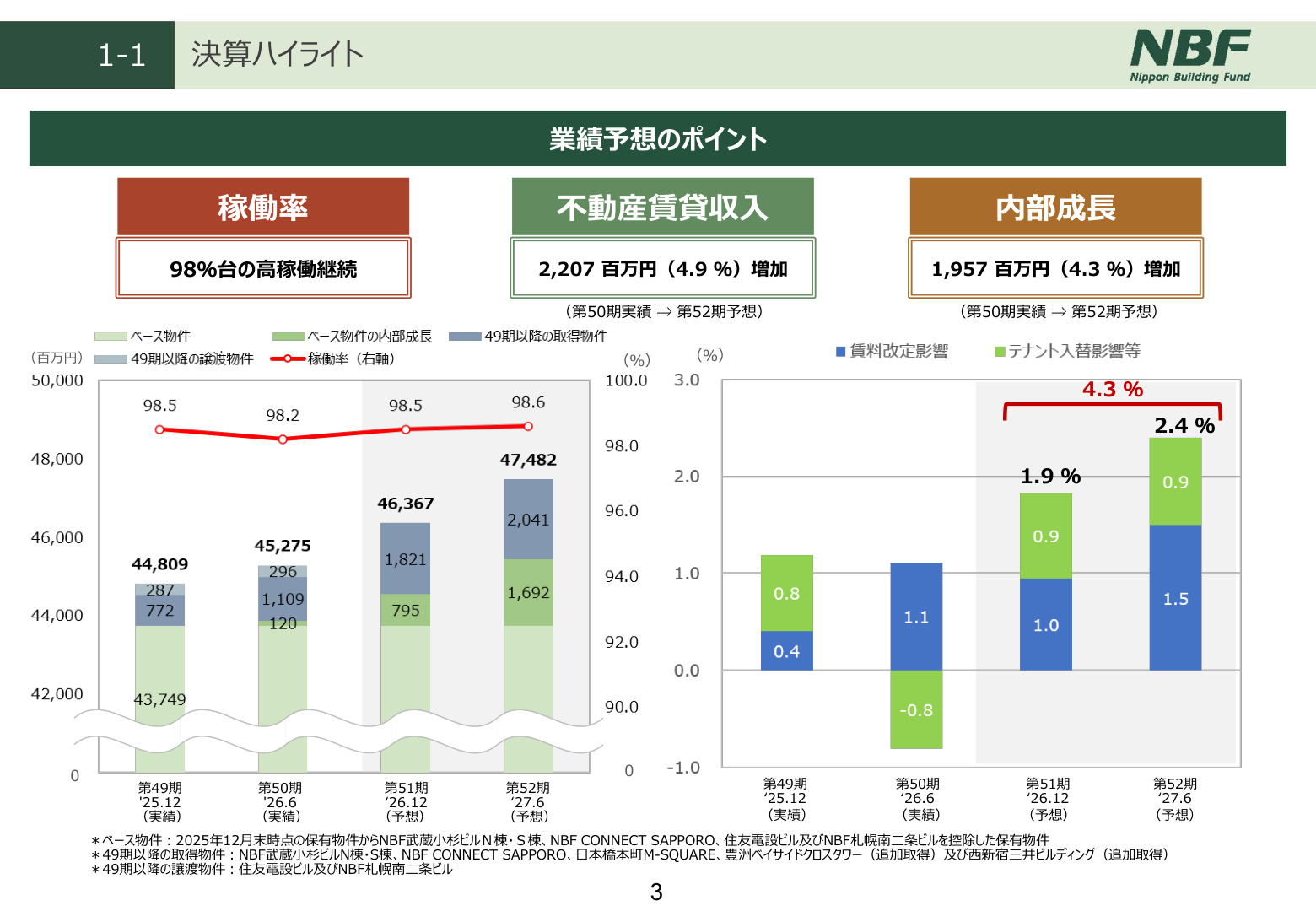
As shown in the slide above, the earnings outlook projects a ¥2.207 billion (+4.9%) increase in real estate rental revenue from the 50th period actuals to the 52nd period (ending June 2027) forecast, while maintaining property occupancy rates at a high level of 98% . The majority of this growth is driven by internal growth, accounting for ¥1.957 billion (+4.3%) through rent revisions and tenant replacements in existing properties.
For the next period (51st period: ending December 2026), the forecast anticipates operating revenue of ¥50.502 billion, net income of ¥19.968 billion, DPU of ¥2,465 , and EPU of ¥2,240 . While net income will temporarily decline due to the absence of one-time sales gains, the recurring-basis EPU is expected to continue its expansion trend, up 3.1% period-on-period. Furthermore, in the 52nd period (ending June 2027), further profit growth is projected, with operating revenue of ¥51.016 billion, net income of ¥20.363 billion, DPU of ¥2,541 , and EPU of ¥2,310 .
3. Office Leasing Market Environment and Accelerated Internal Growth
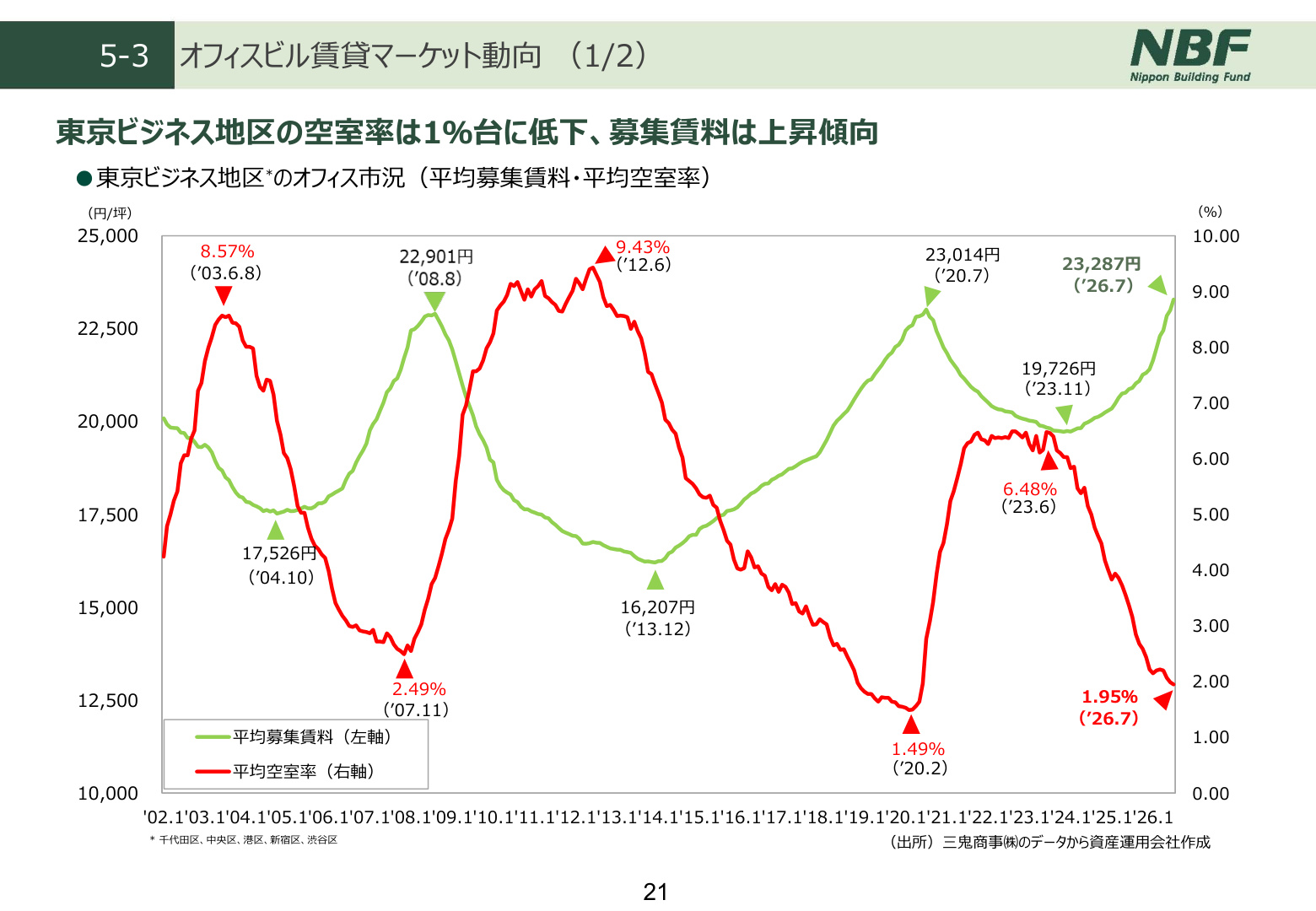
The backdrop for strong internal growth is the rapid improvement in supply-demand dynamics in the office leasing market, particularly in central Tokyo. As indicated by the market data above, the average vacancy rate in Tokyo business districts has dropped significantly from a peak of 6.48% (June 2023) to 1.95% (July 2026) , reflecting an extremely tight supply-demand relationship. Consequently, the average asking rent is following a strong upward trend, reaching ¥23,287 per tsubo .
Capturing this favorable market environment, NBF’s internal growth KPIs have progressed as follows:
- Rent Revision Breakdown (by number of cases) : In rent revisions from January to June 2026, the ratio of agreed rent increases reached 90.6% , and the rent increase rate by floor area recorded 92.1% .
- Expansion of Rent Gap : The rent gap, which indicates the divergence between market rent and existing contract rent, has expanded to 20.4% in the 50th period , up from 8.1% in the 48th period and 12.5% in the 49th period, further increasing the potential for future rent hikes.
- Stability of Contract Structure : The ratio of fixed-term lease contracts remains at 58.2% , with an average lease term of 4.0 years , balancing portfolio stability with opportunities for rent revisions.
4. Update on Growth Strategy: Upward Revision of EPU/DPU Growth Targets
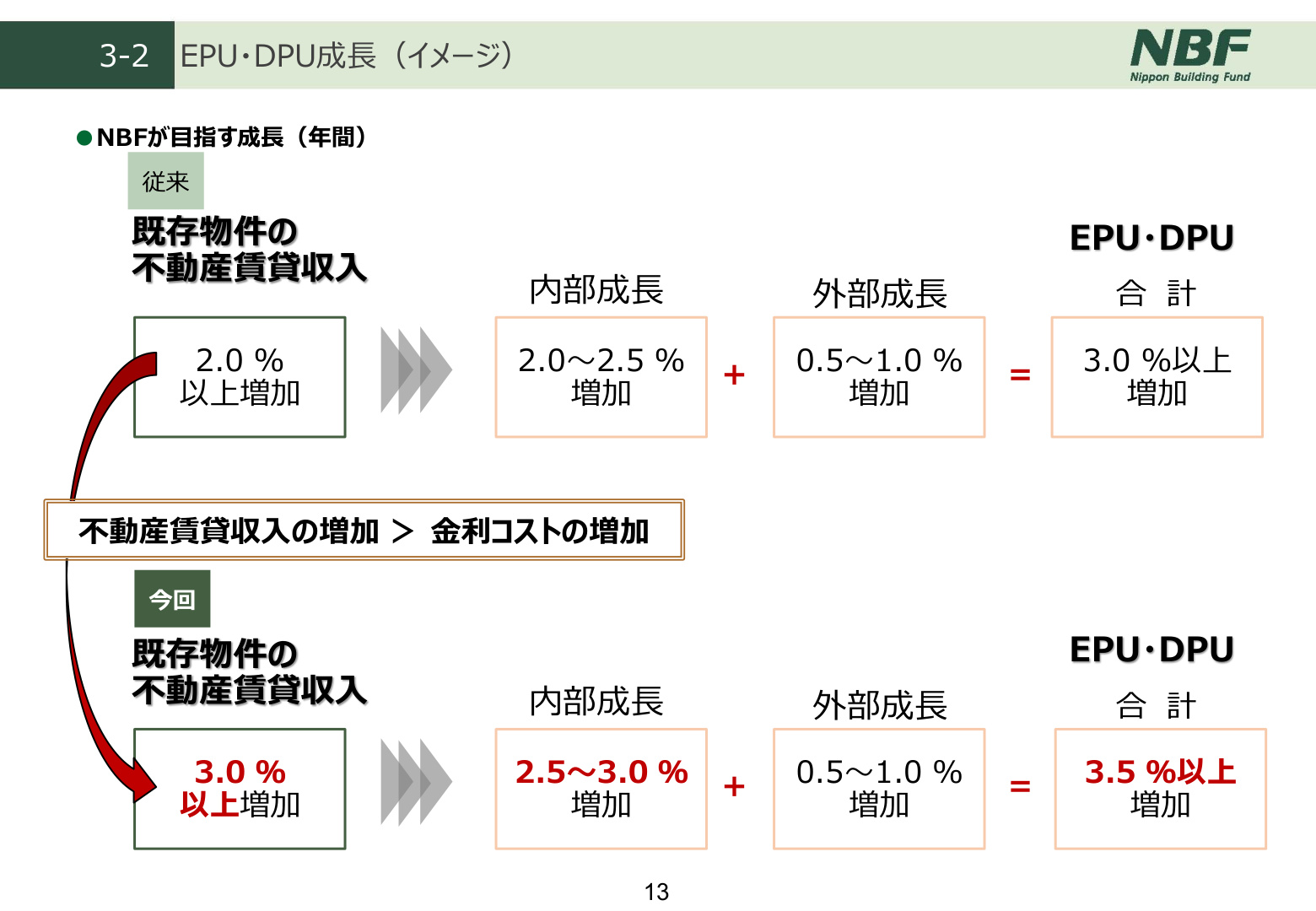
In anticipation of a rising interest rate environment, NBF has revised its mid-to-long-term growth targets upward. Previously, based on the premise of an annual increase of +2.0% or more in rental revenue from existing properties, the target was an annual increase of +3.0% or more in EPU/DPU, combining internal growth of +2.0–2.5% and external growth of +0.5–1.0%.
In this revision, backed by the expanding rent gap and robust leasing capabilities, the pace of increase in rental revenue from existing properties has been raised to +3.0% or more per year . This establishes a clear structure where "increase in rental revenue > increase in interest costs," setting an aggressive policy to aim for annual EPU/DPU growth of +3.5% or more , comprising internal growth of +2.5–3.0% and external growth of +0.5–1.0%.
A scheme is in place to achieve sustainable, step-by-step DPU growth by flexibly drawing down and allocating internal reserves (¥19.2 billion balance at the end of the 50th period) to smooth out the volatility of gains on sales.
5. Qualitative Portfolio Enhancement and Strategic External Growth
NBF is promoting not only the expansion of asset size but also the rejuvenation and profitability improvement of its portfolio through asset recycling.
- Acquisitions : Acquired "Nihonbashi Honcho M-SQUARE" (acquisition price ¥32.1 billion, NOI yield 3.3%), "Toyosu Bayside Cross Tower (additional acquisition)" (¥14.8 billion, NOI yield 3.7%), and "Nishi-Shinjuku Mitsui Building (additional acquisition)" (¥0.2 billion, NOI yield 9.4%).
- Divestments : Sold "Sumitomo Densetsu Building" (sale price ¥10.0 billion, NOI yield 2.3%, gain on sale ¥5.1 billion) and "NBF Sapporo Minami-Nijo Building" (¥1.9 billion, NOI yield 4.8%, gain on sale ¥0.2 billion).
By selling older, lower-yield properties to realize significant gains while acquiring or adding to high-spec, prime-location flagship properties, NBF is enhancing the quality of both its portfolio and cash flows.
As of the end of the 50th period, total assets reached ¥1.5608 trillion (70 properties), with an appraised value of ¥1.824 trillion , maintaining record-high unrealized gains of ¥373.4 billion (unrealized gain ratio of 25.7%).
6. Financial Management and ESG/Sustainability
- Solid Financial Position : LTV (total asset basis) is 42.6% (target range 36–46%), and appraisal LTV is 44.0% , both at extremely healthy levels. Borrowing capacity stands at approximately ¥92 billion (based on 46% LTV).
- Interest Rate Strategy : The long-term fixed interest rate ratio is 76.9% , the average procurement interest rate is 0.82% , and the average remaining duration is 5.12 years . Credit ratings are maintained at the highest domestic levels: JCR "AA+", R&I "AA", and S&P "A+".
- Deepening Sustainability : Achieved a 100% green building certification rate for properties held (based on total floor area). The LED lighting conversion rate has reached 77%, with a plan to increase it to 92% by 2028. GHG emissions (Scope 1+2) have been reduced by 74.4% compared to 2021, clearing the 2030 target (42% reduction) ahead of schedule.
Summary
Nippon Building Fund's 50th fiscal period results clearly demonstrate an acceleration in rent increases by accurately capturing the tightening supply-demand balance of central Tokyo offices, the realization of unrealized gains through strategic asset recycling, and an evolution toward a top-line growth model that outpaces rising interest rates. Leveraging a rock-solid financial foundation and the comprehensive strength of the Mitsui Fudosan Group, the mid-to-long-term expansion trend for EPU and DPU continues.
This content is not intended as investment advice or a recommendation. Any opinions expressed are solely the personal views of each article.