


Nihon Sosei Group (7814) Q2 FY2026 Earnings Deep Dive Report

StockClub
Published: Aug 18, 2026, 09:55 AM
Sentiment Analysis
Nihon Sosei Group (7814) Q2 FY2026 Earnings Deep Dive Report
Nihon Sosei Group’s consolidated results for the second quarter of the fiscal year ending December 2026 clearly reflect top-line expansion driven by aggressive M&A (new group additions) alongside temporary pressure on operating profit due to rising raw material, labor, and depreciation costs . Conversely, the company secured an increase in ordinary profit, bolstered by subsidy income related to capital expenditures, while EBITDA rose 9.0% year-on-year , underscoring the resilience of its cash-generating capabilities.
This report provides a multi-faceted analysis based on disclosed materials, covering earnings highlights, variance analysis, business environment and strategies by segment, and the progress of the company's active M&A and capital investment initiatives.
1. Q2 FY2026 Earnings Highlights
The performance and progress of key management indicators for the second quarter are as follows:
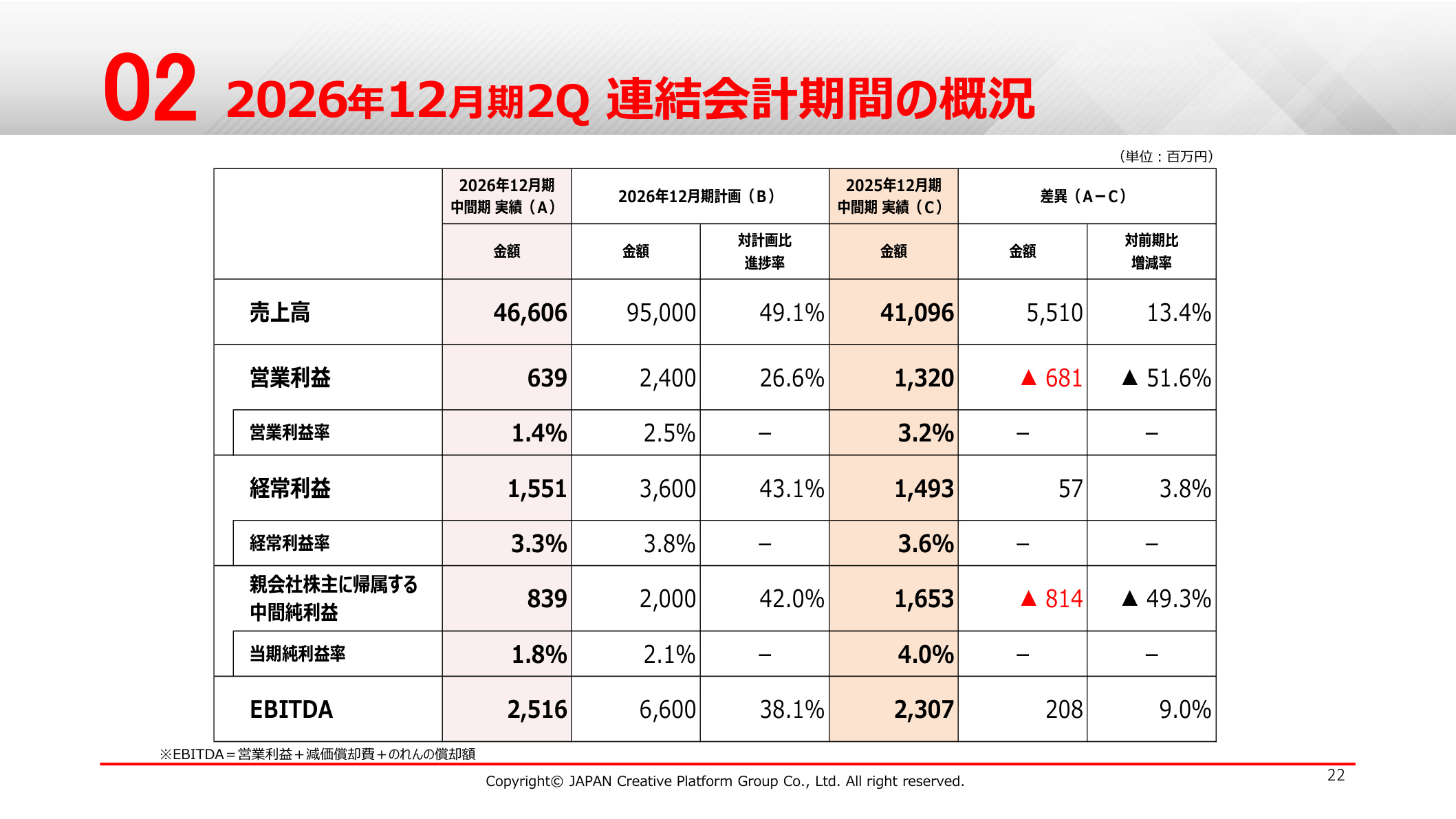
The earnings slide above provides a comprehensive overview of the quarter, from revenue down to various profit levels and EBITDA. While the company achieved significant year-on-year revenue growth, operating profit was halved, making this a critical slide for understanding the shift in the cost structure during this investment phase.
- Revenue : 46,606 million yen (+13.4% YoY, 49.1% progress against plan)
- Operating Profit : 639 million yen (-51.6% YoY, 26.6% progress against plan)
- Operating Margin : 1.4% (compared to 3.2% in the same period last year)
- Ordinary Profit : 1,551 million yen (+3.8% YoY, 43.1% progress against plan)
- Net Income Attributable to Owners of Parent : 839 million yen (-49.3% YoY, 42.0% progress against plan)
- EBITDA : 2,516 million yen (+9.0% YoY, 38.1% progress against plan)
Revenue reached 46,606 million yen, an increase of 5,510 million yen from the same period last year, showing steady progress of 49.1% against the full-year target of 95,000 million yen. Meanwhile, operating profit fell to 639 million yen from 1,320 million yen in the previous year, a 51.6% decline. However, thanks to factors such as the recording of subsidies (miscellaneous income) associated with aggressive capital investment, ordinary profit remained in growth territory at 1,551 million yen (+3.8%) .
Furthermore, EBITDA , which accounts for depreciation and amortization of goodwill, reached 2,516 million yen (+9.0%) , indicating that the fundamental cash flow generated from core operations is steadily expanding.
2. New Consolidation Effects Driving Revenue Growth
The primary driver of double-digit revenue growth is the addition of new subsidiaries through the group’s roll-up M&A strategy.
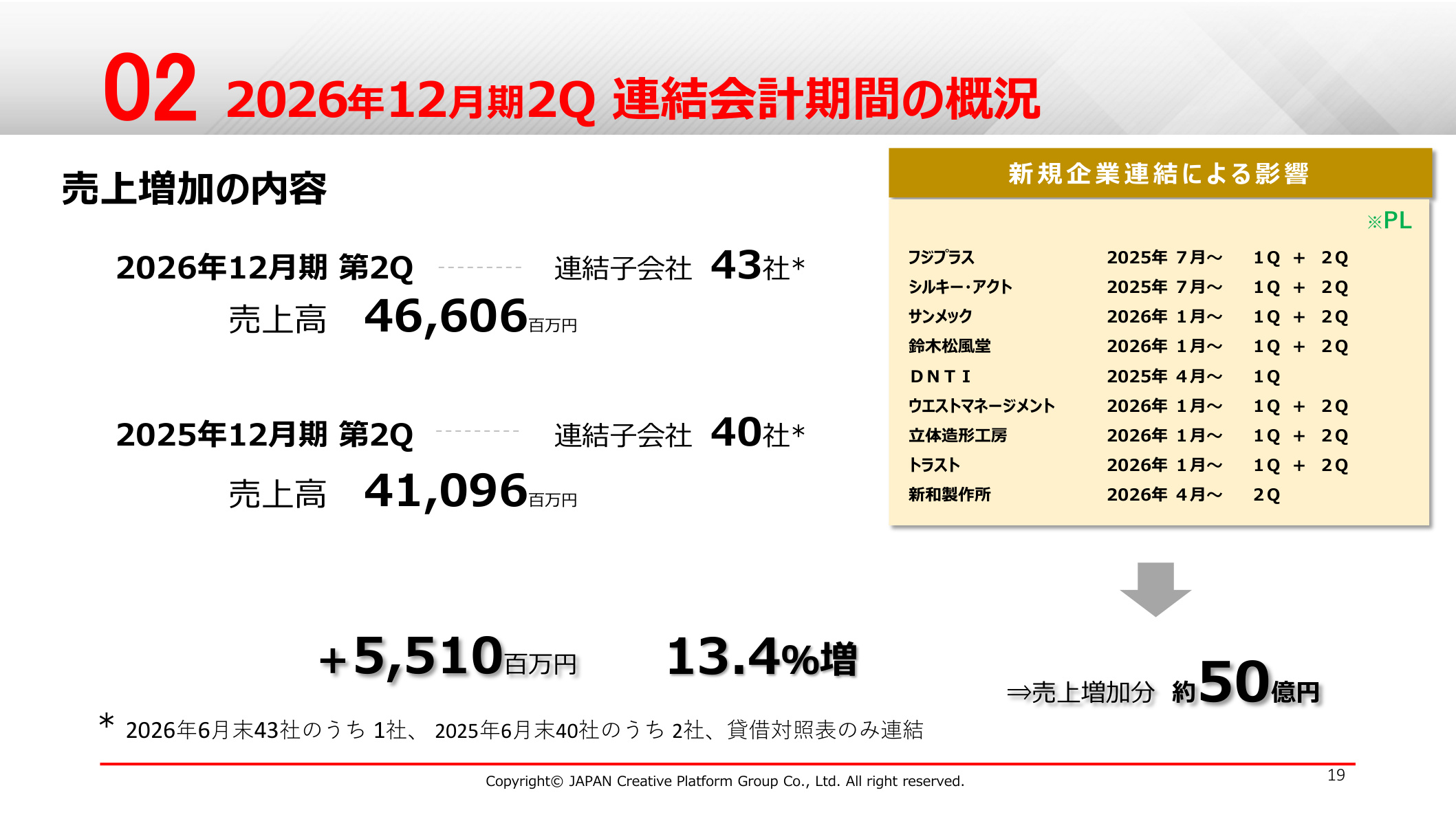
This slide visualizes the impact of newly consolidated companies (approximately 5 billion yen) on the revenue increase (+5,510 million yen) and the timeline of these additions. It is essential for distinguishing between organic growth and M&A-driven effects.
The number of consolidated subsidiaries increased from 40 in the same period last year to 43 . Major new additions consolidated from the second half of the previous fiscal year through the current period include:
- Consolidated since July 2025 : Fuji Plus, Silky Act
- Consolidated since January 2026 : Sanmec, Suzuki Shofudo, West Management, Rittai Zokei Kobo, Trust
- Consolidated since April 2026 : Shinwa Seisakusho
The contribution of these new companies to the P&L reached approximately 5 billion yen , accounting for the majority of the revenue increase (5,510 million yen). By segment, the revenue composition is 68% Printing , 18% IT Media & SP , and 14% Products , forming a portfolio that leverages printing as a foundation while diversifying into peripheral areas.
3. Analysis of Operating Profit Variance
The decline in operating profit despite revenue growth is attributed to increased costs associated with higher sales, as well as upfront investments and external cost pressures.
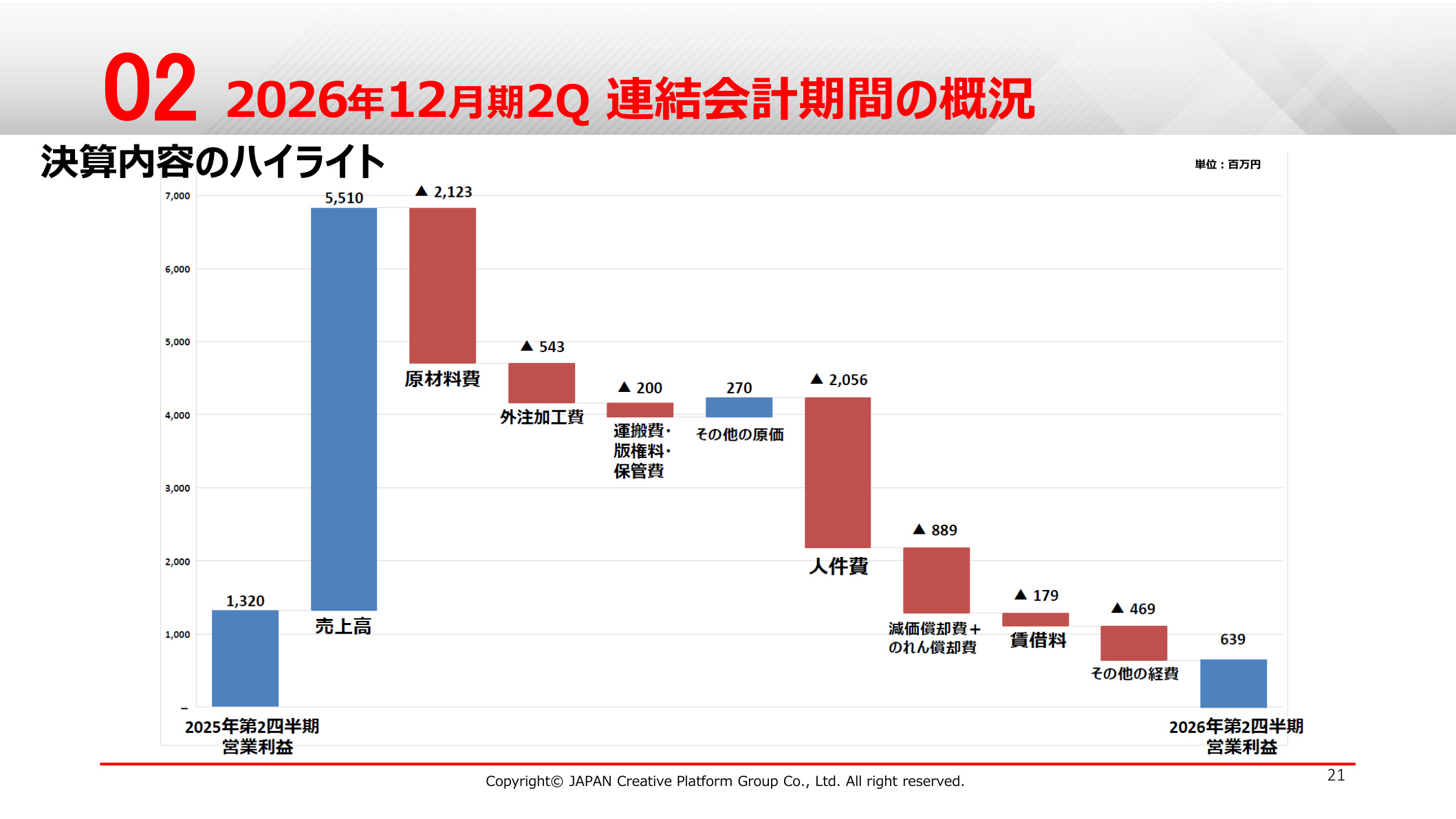
This waterfall chart clearly contrasts the factors driving gross profit growth with the impact of various expense items. It is indispensable for understanding at a glance which cost items are the direct drivers of the profit decline.
The breakdown of the operating profit variance (a decrease of 681 million yen YoY) is as follows:
- Gross profit boost from revenue growth : Top-line expansion equivalent to +5,510 million yen
- Increase in Cost of Sales :
- Raw material costs : -2,123 million yen (due to rising material prices and higher volume)
- Outsourced processing costs : -543 million yen
- Transportation, royalties, storage, etc. : -200 million yen
- Increase in SG&A and investment costs :
- Personnel expenses : -2,056 million yen (due to increased headcount and wage hikes)
- Depreciation and goodwill amortization : -889 million yen (due to expanded capital investment and M&A)
- Rent and other expenses : -648 million yen
In particular, rising personnel expenses (+16.1%) , depreciation (+80.5%, +731 million yen) , and goodwill amortization (+199.3%, +158 million yen) were the primary factors weighing on profits. Additionally, interest expenses increased by 112 million yen (from 243 million yen to 356 million yen) due to rising interest-bearing debt and the current interest rate environment.
4. Market Environment and Competitive Strategy for the Three Core Businesses
The group's perception of the markets it operates in and its corresponding strategies are summarized as follows:
① Printing Business: High Value-Added Shift and Packaging/Specialty Printing
Although the value of domestic printing industry shipments has shrunk by approximately 29% from 7.2 trillion yen in 2004 to 5.09 trillion yen in 2023, it has recently bottomed out in the 5 trillion yen range. While publishing and general commercial printing are declining, demand for the packaging printing market (1.52 trillion yen in 2024, up approx. 10% over 5 years) and specialty printing/post-processing is growing. The company is pursuing a strategy to increase value-added rates by focusing on high-degree processing such as foil stamping and embossing, digital printing, and capturing demand in the packaging and labeling sectors.
② IT Media & Sales Promotion Business: Capturing Digital Twin and Public/Private Demand
The global digital twin market is projected to expand rapidly from $18.9 billion in 2025 to $428.1 billion by 2034 (CAGR +41.4%), with the Japanese market expected to reach approximately 29 trillion yen by 2034. Led by group subsidiary CAD Center, the company is building a foundation for the contract and operation of advanced solutions, including 3D city model production using the Ministry of Land, Infrastructure, Transport and Tourism's "Project PLATEAU" open data, BIM/CIM support, disaster prevention simulations, and metaverse/3DCG space production for exhibitions (such as EXPO 2025).
③ Products Business: "Oshi-katsu" (Fan Activity) Demand and On-Demand Production
The domestic character business market is 2.88 trillion yen , and the Oshi-katsu market is 4.1 trillion yen (as of January 2026), with the fan population reaching 19.4 million. To meet demand for IP merchandise such as acrylic stands (domestic market approx. 100 billion yen), pin badges, textiles, and trading cards, the company has established a "small-lot, short-lead-time, made-to-order system" utilizing UV printers and laser processing machines. Its strength lies in color reproduction and quality control systems capable of meeting strict IP licensing standards.
5. Promotion of Roll-up M&A and Capital Investment
The company continues to pursue M&A to complement and strengthen its printing, packaging, and processing value chain.
- Expansion of Packaging/Paper Container Sector : Acquired Suzuki Shofudo (specializing in paper tubes/cylindrical packaging), Shinwa Seisakusho (Kanto-based packaging printing), and Excel Pack Kabaya (Kansai-based).
- In-house Manufacturing Equipment/Specialty Technology : Acquired shares of Metal Creation , which designs and manufactures packaging equipment.
- Vertical Integration of Peripheral Areas : Integrated highly specialized SMEs into the group, including Wakita Koki Seihon (bookbinding), City Road (store interiors/signage), Nihon Sample and Imura Sample (food samples), and Ringston (polyethylene/paper bags).
Financially, total assets increased by 7,372 million yen from the end of the previous year to 92,430 million yen . While expanding tangible fixed assets (machinery and equipment up 67.0% to 8,276 million yen), the issuance of subsidiary class shares led to a 5,081 million yen increase in non-controlling interests, resulting in net assets of 25,456 million yen (equity ratio of 21.5%) .
6. Summary and Future Outlook
In the second quarter of the fiscal year ending December 2026, aggressive business acquisitions and capital investments steadily grew the revenue base and EBITDA. However, upfront costs, depreciation burdens, and increases in personnel and raw material costs pressured the operating margin. Moving forward, focus will be on the progress of cost-of-sales and outsourcing ratio reductions through group synergies, as well as the monetization of the high-value-added packaging, digital twin, and IP goods sectors.
This content is not intended as investment advice or a recommendation. Any opinions expressed are solely the personal views of each article.